Month: December 2015

  • ‘Built like a tank where it counts’ – LensRentals tears down Canon EF 35mm F1.4 L II

    ‘Built like a tank where it counts’ – LensRentals Canon EF 35mm F1.4 L II teardown

    Roger Cicala at LensRentals has a great job – he gets to take things apart whenever he wants, and get paid to do it. And even better, he gets to pay himself to do it. Roger just got his hands on Canon’s new EF 35mm F1.4 L II, and just like us, he’s been very impressed. But, it must be said, for very different reasons. Click through this slideshow for a quick look at what he found behind the red ring, and if this whets your appetite, read Roger’s full tear-down at lensrentals.com.

    ‘Built like a tank where it counts’ – LensRentals Canon EF 35mm F1.4 L II teardown

    This is the plastic ring which sits at the front of the all of the elements of the 35mm, underneath the cosmetic nameplate.

    According to Roger, ‘In most lenses rings like this hold the front element in place, but in this case, it seems the entire purpose of this ring is to improve weather resistance […] It fits tightly around the glass and into the front barrel of the lens, and it has a rubber gasket for further sealing internally.’

    ‘Built like a tank where it counts’ – LensRentals Canon EF 35mm F1.4 L II teardown

    Where most lenses use only three lightweight screws to attach the filter barrel, the Canon EF 35mm F1.4 L II uses six ‘long, strong and deeply threaded’ ones. 

    Behind the screws, Roger’s team found that ‘each hole contained a brass reinforcing spacer with a spring around it. So basically each of the 6 screws passes through the brass spacer and screws into the front barrel, with a spring maintaining tension. This is an expensive way to do things and obviously serves a purpose.’

    ‘Built like a tank where it counts’ – LensRentals Canon EF 35mm F1.4 L II teardown

    With the rear barrel removed, two more layers of rubber felt sealing gaskets were revealed and a ‘a very, very robust eccentric collar set […] used to optically adjust the rear group.’ (that’s the notched, circular thing towards the top of the rear group in this image, surrounded by red gunk to lock it in place).

    In Roger’s words. ‘we consider thick nylon collars robust, brass collars very robust, but these massive heavy collars with a center locking screw are beyond anything we’ve seen outside of super telephoto lenses and the 70-200 f/2.8 IS II’.

    ‘Built like a tank where it counts’ – LensRentals Canon EF 35mm F1.4 L II teardown

    Unusually, even for weather-resistant lenses, the EF 35mm F1.4 L II features tough, moisture-resistant tape underneath the rubber focusing ring, to prevent water getting underneath and into the main body of the lens (the tape has been removed in this image).

    ‘Built like a tank where it counts’ – LensRentals Canon EF 35mm F1.4 L II teardown

    ‘With the focus ring off, we can see another set of robust optical adjustment collars that adjust group 2. (Later experimentation hinted that these were primarily centering collars, with the rear collars primarily adjusting tilt.)’

    ‘Built like a tank where it counts’ – LensRentals Canon EF 35mm F1.4 L II teardown

    As the disassembly progresses, the EF 35mm F1.4 L II seems to get more and more robust – ‘With the USM motor and barrel off we can see the focusing helicoids and the heavy metal rollers that move the focusing elements within the helicoid. In almost every lens, these would be small nylon washers over a screw, not the relatively huge metal rollers we see in this lens.’

    ‘Built like a tank where it counts’ – LensRentals Canon EF 35mm F1.4 L II teardown

    Roger’s team took a closer look at those helicoid rollers.

    ‘When you look close up you see these aren’t just sliding posts, there are actually tiny ball bearings inside them. There’s also a spring tensioning system around one of the rollers. […] By this point I was really rather awestruck by the amount of careful over-engineering that went into making this lens. Nobody, and I do mean nobody, else is engineering lens mechanics like the newer Canon lenses.’

    Roger’s final analysis: 

    ‘[The EF 35mm F1.4 L II is] designed thoughtfully and logically. Things that will inevitably get damaged on any lens, like the front element and filter ring, are designed to be replaced easily. There are some things inside, particularly with the tensioning screws and springs, that I’m not certain I understand the purpose of, but I am certain there is a purpose. If I had to summarize the mechanical design of this lens, I would say simply that no expense was spared, no corner was cut.’

    Articles: Digital Photography Review (dpreview.com)

  • Fotografieren in der DDR

    Ein paar Junge Leute auf Mofas und Motorrädern.

    Ein Beitrag von: Felix M. Steiner

    Als ich im Juli einen Vortrag von Dieter Demme höre, ist dies eher Zufall. Ein wenig Zeit und völlige Ahnungslosigkeit vom Thema „Fotografieren in der DDR“ bewegen mich schlussendlich doch, mir den Vortrag anzusehen. Reden und Vorträge seien nicht sein Metier, sagt Demme schon im Juli während des Vortrags und wird dies später im Interview wiederholen.

    kwerfeldein – Fotografie Magazin | Fotocommunity

  • Flickr launches 360 degree image viewing app for Samsung Gear VR

    Image sharing platform Flickr has announced today its app for the Samsung Gear VR virtual reality headset. It allows you to view the tens of thousands of 360-degree panorama images that have been uploaded by Flickr users in an immersive way that allows for panning by moving your head. Read more

    Articles: Digital Photography Review (dpreview.com)

  • Painstaking Paper Plane: Model Made from 100 Manila Folders

    [ By Steph in Art & Sculpture & Craft. ]

    paper plane 1

    It only took 100 manila folders, 50 X-Acto blades, a bottle of glue and 1,000 hours of time to create one 1:60 scale model of a Singapore Airlines A380 airplane featuring fully operational sliding doors and properly folding landing gear. This isn’t Luca Iaconi-Stewart’s first model airplane – the 23-year-old, New York-based designer is known for a series of paper planes with amazingly complex parts.

    paper plane 9

    paper plane 2

    paper plane 3

    The artist first started building his own miniatures after finding a highly detailed diagram of an Air India 777-300ER online. He replicated the forms in Adobe Illustrator, printed them onto manila and sliced them out with his X-Acto knife. It took Iaconi-Stewart five years to complete a scale model of a Boeing 777, with an entire summer dedicated to perfecting the seats. While economy seats can be finished in a mere 20 minutes, first class seats take eight hours each.

    paper plane 6

    paper plane 7

    paper plane 8

    The new Singapore Airlines model consists of 3,000 pieces of folded and cut paper, the smallest being a 2.5 x 1mm pin used to hold each business class seat together. The artist notes that manila folders are surprisingly strong when engineered correctly.

    paper plane 4

    paper plane 5

    Considering that Iaconi-Stewart spent a month designing the engines and fourth months assembling them, perhaps it’s no surprise that his classes at Vassar soon started getting in the way, and he ultimately dropped out to focus on full time model-making. He’s now known as the world’s best paper airplane maker. You can follow his creations on Flickr.

    Share on Facebook


    [ By Steph in Art & Sculpture & Craft. ]

    [ WebUrbanist | Archives | Galleries | Privacy | TOS ]


    WebUrbanist

  • Sci-Fi Skyscrapers: 14 Futuristic Visions for Vertical Cities

    [ By Steph in Architecture & Cities & Urbanism. ]

    Screen Shot 2015-12-09 at 9.03.30 AM

    As the global population grows and the world’s largest metropolises evolve into mega-cities, skyscrapers stretching higher than ever before could hold our transit hubs, parking garages, parks, museums and even food production systems. Some of these concept designs seem feasible for the near future while others could serve as the settings for science fiction.

    Light Park Floating Skyscraper
    towers light park

    This concept for a floating skyscraper takes a similar tack, reacting to the infrastructure problems caused by rapid, unchecked urbanization by literally having no earthly footprint at all. The Light Park features a helium-filled cap and solar-powered propellers keeping it looming over Beijing like a ghost ship, and it contains parks, sports fields, green houses, restaurants and other public facilities.

    Alternative Car Park Tower
    tower car park 1

    towers car park 2

    With all of its spiraling open levels, this parking garage tower envisioned for Hong Kong seems chaotic and unstructured, but it’s actually a well-thought-out automatic system that automatically sweeps cars from the ground floor to parking spots surrounding a central atrium.

    Flex Towers for NYC
    towers flex 1

    towers flex 2

    An overflowing, overpopulated New York City could be in dire need of new technology to meet energy needs by the year 2040, as designer Paolo Venturella imagines with his ‘Flex Tower.’ This moving skyscraper tilts and rotates itself to follow the sun to perfectly position its envelope of solar panels at all times of the day.

    The Tall Tower by Project Hieroglyph
    towers heiroglyph

    Sci-fi author Neal Stephenson, known for cyberpunk classics like ‘Snow Crash’ and ‘Quicksilver,’ has teamed up with the Center for Science and Imagination to design an incredible 12.4-mile-tall tower capable of launching rockets into space. 24 times the height of the Burj Khalifa, which is currently the world’s tallest building, Tall Tower would scrape the bottom of the stratosphere.

    Twin Taiwan Towers
    towers taiwan 1

    towers taiwan 2

    towers taiwan 3

    Tangled with lush greenery, these tall, narrow twin towers stretch up to an observatory and sky park looking down over Taiwan. The base is inhabited by a set of museums focusing on the nation’s past, present and future, while the stems contain four different kinds of hanging gardens as well as high-end residences.

    Next Page – Click Below to Read More:
    Sci Fi Skyscrapers 15 Futuristic Visions For Vertical Cities

    Share on Facebook


    [ By Steph in Architecture & Cities & Urbanism. ]

    [ WebUrbanist | Archives | Galleries | Privacy | TOS ]


    WebUrbanist

  • Lightroom plug-in for Pentax 645Z tethered shooting now available

    Ricoh has announced a software plug-in for Adobe Lightroom supporting tethered shooting with the Pentax 645Z medium-format camera. Creative Cloud Lightroom subscribers can also take advantage of integration with Lightroom Mobile, making it possible to comment on and adjust photos remotely via the cloud. The Pentax Tethered Capture Plug-In is available now from Ricoh.


    Press release:

    Ricoh Imaging Delivers Tethered Capture to its Acclaimed PENTAX 645Z Camera

    Highly requested software plug-in to enhance the PENTAX 645Z’s in-studio photo-shooting with Adobe® Lightroom® capabilities available today

    DENVER, December 9, 2015 – Ricoh Imaging Americas Corporation today announced the immediate availability of the highly anticipated PENTAX Tethered Capture Plug-In for use with Adobe® Lightroom®. The software plug-in enhances the tethered capture capabilities of the PENTAX 645Z medium-format camera by enabling files to easily be uploaded into Adobe Lightroom during a studio session, where they can readily be viewed, shared and edited.

    Adobe Lightroom is the digital photo processing and editing software favored by many professional and advanced amateur photographers, making the use of the new PENTAX Tethered Capture software both cost effective and efficient as there is no additional software package to purchase and learn. In addition, with the new capabilities of Lightroom Mobile, uploaded images may be viewed and adjusted by a photographer’s colleagues or clients from any remote location, anywhere in the world.

    “Since Lightroom is already the de-facto standard for many photographers to edit and develop their images, this new plug-in is especially welcome. It makes studio use of the PENTAX 645Z camera easier, more efficient and, ultimately, faster than ever,” said Chris Knight, a New York-based portrait photographer. “Using Lightroom, I am able to quickly share photos with my clients, who are even able to view and comment from remote locations.”

    Since its launch in June 2014, the PENTAX 645Z camera has been embraced by a wide range of photographers. The PENTAX Tethered Capture Plug-In is being offered to further enhance the user experience, and is a free option that can be downloaded starting today at: http://www.ricohimaging.co.jp/english/support/download_digital.html

    Main Features

    • The PENTAX 645Z camera supports industry-standard Adobe DNG (Digital Negative) RAW files, which ensures optimal image quality. The in-camera DNG file format effectively eliminates any RAW file incompatibility issues, thus allowing the photographer to confidently import DNG RAW files during a tethered session.
    • Adobe Lightroom Creative Cloud users can use Lightroom Mobile to connect to tethered sessions via cloud services to comment and adjust photographs and return those edits to the photographer from anywhere in the world.
    • Adobe Lightroom offers an exceptional cataloging system that allows photographers to capture and catalog tethered sessions with confidence.
    • The PENTAX Tethered Capture Plug-in for Adobe Lightroom is an easy-to-install, powerful and streamlined tethering solution that allows any photographer to manage their own workflow from capture to output.
    • Adobe Lightroom users can download and apply presets to any tethered capture session thus eliminating the need to process every raw file individually.

    Articles: Digital Photography Review (dpreview.com)

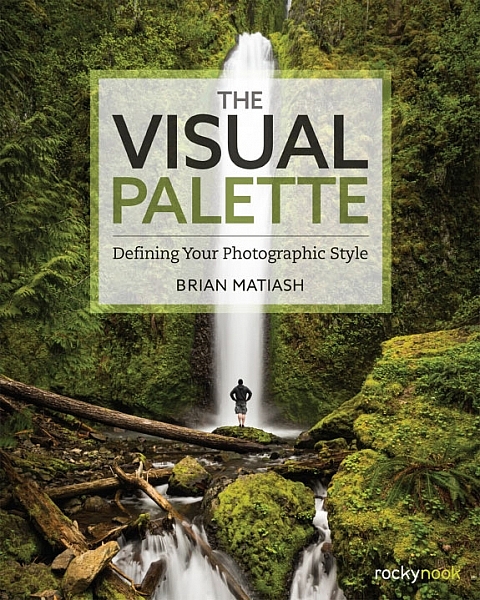
  • Book Review: The Visual Palette by Brian Matiash

    The Visual Palette book review

    Brian Matiash is a photographer based in Portland, Oregon. The Visual Palette is his first book published by Rocky Nook.

    As the title suggests this is not a technical book. It’s aimed at evolving photographers who grasp the basics, but need some guidance in developing the creative side of their photography. The book is divided into three sections – Composition, Post-Processing and Stylization, and Sharing Your Work and Your Brand. Each section builds on the lessons learned in the one before.

    The Visual Palette book review

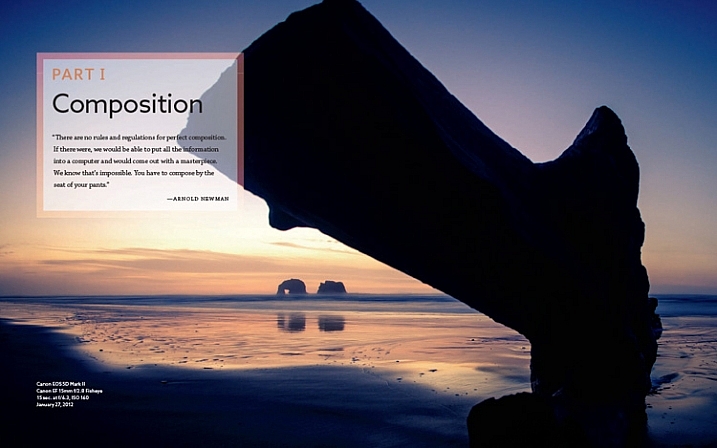
    Screenshot from The Visual Palette

    The book starts with composition. How you see, compose, and tell stories with photos is a major factor that sets your work apart from another. This section covers techniques like the rule-of-thirds, creating depth and using leading lines, as well as giving tips for photographing familiar subjects and learning to see.

    The book continues with post-processing and stylization. This is where you bring further individuality to your work by the style in which you chose to process. It suggests separating photo editing into two distinct skills – post-processing and stylization.

    • Post-processing is the preparation work – preparing a clean image that gives an accurate representation of the scene.
    • Stylization is the process of adding your own artistic interpretation to the image.

    I really like this idea, and think there is a lot to be gained by separating the concepts.

    The book covers the tools you can use to achieve both skills. Be forewarned – there is a lot of grungy HDR in this section, and the processing may look a bit over the top for those of you not into this style of photography.

    On the other hand, Brian does explain how he has moved from a grungy HDR style to a more natural one over the years – a journey that many photographers will probably identify with.

    The Visual Palette book review

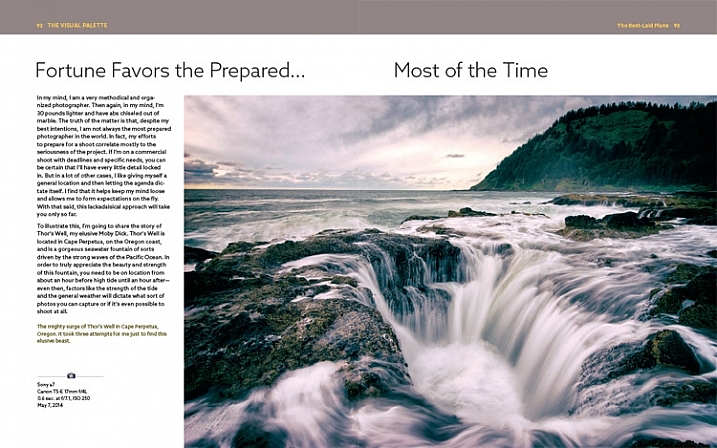
    Screenshot from The Visual Palette

    The final part of the book explores the process of sharing your work and building your personal brand. This will appeal to a wide spectrum of readers, from those who simply want to share their photos on Flickr or 500px, to professional photographers who need to build a brand to promote their work. If you haven’t put much thought much into how you share and promote your work, then you will find this section very useful.

    Personal stories

    As Brian explores the ideas in the book he relates his own experiences, giving you an insight to his thought processes, and his development as a photographer.

    It could be argued that dividing the book into three topics results in a lightweight treatment of each. In a way that’s true – if you want to learn more about composition, for example, you would be better off buying a book dedicated to the topic. However, the aim of this book is to give you a primer in each of the areas it covers. You can then follow up by buying a book that explores the topics that interest you most in more depth.

    For these reasons, The Visual Palette is more likely to appeal to beginners than advanced photographers.

    The Visual Palette book review

    Screenshot from The Visual Palette.

    Annoyances and niggles

    The review copy was provided in PDF form, and there were a couple of problems that stopped me fully enjoying the experience of reading it.

    The first is related to layout. In iBooks or Acrobat Reader (on an iPad) you can only view one page at a time (on a computer you can view page spreads in Reader). Given that the book is designed as a series of double page spreads, and that many photos cross the gutter, this prevented me from seeing the photos properly. You can’t look at, and appreciate the photo, when it is split into two by the formatting. It greatly lessened the enjoyment of the book, and to be honest, put me off buying another ebook from Rocky Nook.

    The Visual Palette book review

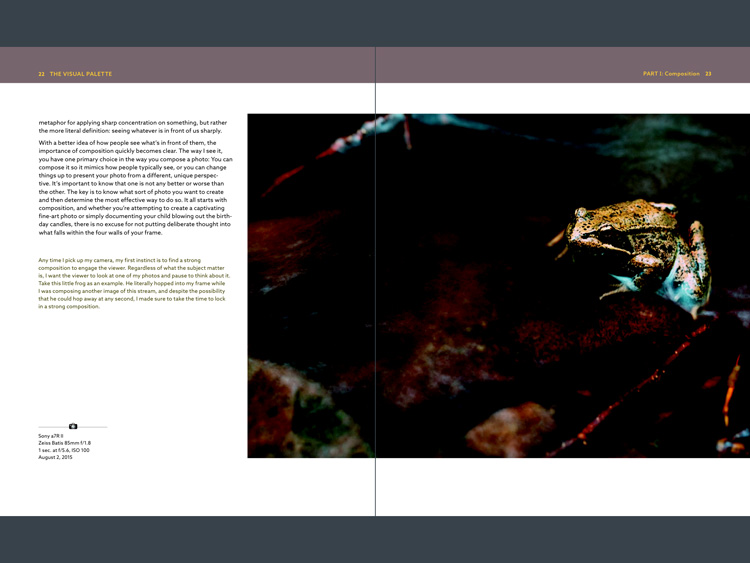
    Here’s an example of what I mean. This is a screenshot from iBooks, which presents the pages one at a time. Not good when you have lot of photos that cross the gutter.

    The solution would be to format the book especially for viewing on the iPad (and other tablets), so that each page in the PDF document contains a double page spread from the book. ILEX do this already with their ebooks (note: ILEX don’t publish PDF ebooks any more, restricting ebook sales to the Amazon Kindle store), and I’d like to see Rocky Nook follow suit.

    It is possible to see spreads in Goodreader, but that brings me to the next point.

    The second annoyance relates to color management. Adobe Acrobat Reader is the only PDF reader that accurately displays the colors and tones of the photos in the book on an iPad. However, Acrobat Reader only lets you view one page at a time, so we are back to the first problem.

    The Visual Palette book review

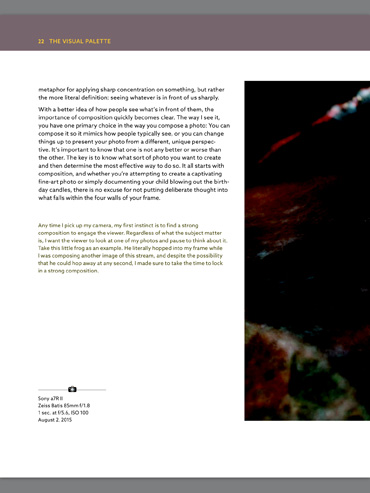
    This screenshot is from Adobe Acrobat Reader. Now we can see the photo with the correct brightness and contrast. But you can’t view two pages together, and the photo is still cut off.

    In Goodreader and iBooks the photos are too dark, have too much contrast, and the colors are inaccurate.

    This is a screenshot from Goodreader, which can display two pages together, as the designer intended them to be seen. Great – now you can see the entire photo. But that's not much use when the photo is too dark to see properly.

    This is a screenshot from Goodreader, which can display two pages together, as the designer intended them to be seen. Great – now you can see the entire photo. But that’s not much use when the photo is too dark to see properly.

    I hope someone from Rocky Nook reads this and takes some action to put it right. Anybody who buys the PDF version of this book and tries to view it in iBooks or Goodreader will be disappointed with the quality.

    Conclusion

    The Visual Palette is well written, well thought out, and full of useful ideas. While little of the content will be new to advanced photographers, most of it will be useful to people starting out.

    There are some good photos in the book (and unfortunately a few weak ones), although the heavy-handed treatment of some of them may put readers off who feel that there is a little more to stylization than using HDR techniques. However, if you ignore that, you’ll find a lot of good ideas in the written content.

    I’m giving this book three and a half stars for the content. I recommend the printed book over the PDF ebook which is virtually unreadable in its current format.

    Given my experience with the PDF version of this book I thought it would be interesting to ask your opinion about ebooks in general. Have you bought any? What did you think of the design? What format do you prefer, PDFs or epub/mobi? What feedback would you give publishers regarding design and content?

    And of course, if you have read The Visual Palette and would like to let us know what you think, or if you have any questions regarding the book, please let us know in the comments below.

    googletag.cmd.push(function() {
    tablet_slots.push( googletag.defineSlot( “/1005424/_dPSv4_tab-all-article-bottom_(300×250)”, [300, 250], “pb-ad-78623” ).addService( googletag.pubads() ) ); } );

    googletag.cmd.push(function() {
    mobile_slots.push( googletag.defineSlot( “/1005424/_dPSv4_mob-all-article-bottom_(300×250)”, [300, 250], “pb-ad-78158” ).addService( googletag.pubads() ) ); } );

    The post Book Review: The Visual Palette by Brian Matiash by Andrew S. Gibson appeared first on Digital Photography School.


    Digital Photography School

  • HandeVision announces five lenses for its Iberit family – full frame lenses for mirrorless cameras

    German/Chinese optics brand HandeVision is set to introduce five new lenses next year that are designed for full-frame mirrorless cameras. Each with a maximum aperture of F2.4, the focal lengths the company is planning to release in its Iberit series will be 24mm, 35mm, 50mm, 75mm and 90mm. 

    The company says it has concentrated on making the lenses small and lightweight to suit small and light cameras, but has used brass, aluminum and stainless steel in the construction of the barrels and mounts. 

    The lenses, which look more than a little like Leica M lenses, are all manual focus and offer aperture rings with markings for F2.4-16. Although they have a 44mm imaging circle that covers a full frame sensor, the lenses will be released with mounts for APS-C cameras, such as the Sony NEX and Fuji X system. These lenses will offer electronic aperture control. The 35mm, 50mm and 75mm lenses have six-blade apertures, while the iris in the 90mm uses 10. There is no specification as yet for the 24mm lens.

    The first set of lenses will be made for Leica M, Sony E and Fuji X cameras, though the company doesn’t specify what other mounts will be available eventually. A Micro Four Thirds mount Ibelux 40mm F0.85 lens already exists, but there is no mention of whether MFT mount versions of these new models will be introduced at any point.

    January 2016 is given as the launch date for the 35mm, 50mm and 75mm lenses, and the 24mm and 90mm lenses will be available ‘later in the year.’ Prices are a bit vague at the moment, but HandeVision says the lenses will cost between $ 480 and $ 660 depending on the model. 

    HandeVision is a brand created through cooperation between German lens manufacturer IB/E Optics and the Chinese company Shanghai Transvision Photographic Equipment Co – the company behind the Kipon brand. 

    For more information visit the HandeVision website. 

    Focal Length   35mm  50mm  75mm  90mm
     Angle of View  63.4  46.8  32.2  27
     Aperture  2.4-16 2.4-16  2.4-16  2.4-16
     Close Focus (M/NEX,FX)  0.7/0.35m  0.7/0.6m  0.7/0.6m 0.7m 
     Iris Blades  6  6  6  10

     Length 
    (M/NEX, FX)

     35/45mm  55/65mm  35/75mm  69/79mm
     Diameter  58mm  58mm  58mm  58mm
     Filter Thread  M49x0.75  M49x0.75  M49x0.75  M49x0.75
     Weight (M/NEX, FX)  NA  250/310g  270/330g  NA
     Elements/Groups  6/6  6/6  5/5  4/4

    Articles: Digital Photography Review (dpreview.com)

  • 9. Dezember 2015

    Das Bild des Tages von: michel nguie

    Ein Mann sitzt vor einem Kaminfeuer, betrachtet durch ein Loch in der Decke, bedeckt von Schnee und herumliegenden Holzbrettern, teilweise in den Raum darunter gefallen.

    Im Ausblick: Surreales, der Ätna und der NSU-Prozess.
    kwerfeldein – Fotografie Magazin | Fotocommunity

  • Master of one: Mitakon Speedmaster 135mm F1.4 pre-production sample gallery

    You might remember us getting our hands on the Mitakon Speedmaster 135mm F1.4 at the Photo Plus Expo back in October. We handled the lens and wrote up some quick impressions at the show, but we were lucky enough to be given one of the prototype lenses to take home to Seattle with us.

    Our sample is an engineering prototype of the E-mount version of this beastly lens, and we’ve spent the past few weeks gathering samples both in our studio and out and about around Seattle, to give you an idea of what it can do. 

    The 135mm F1.4 is a massive piece of glass, and in its E-mount flavor, absolutely dwarfs Sony’s a7 bodies. With a 105mm thread, fully manual operation and a weight of over six pounds (about 2.7kg), it can be rather intimidating, and is near impossible to use hand-held. With the proper support in place though it isn’t difficult to use at all, and can reward patient use with dramatic, unique results.

    When viewing our samples, it’s worth bearing a couple of things in mind. Firstly, this lens is one-of-a-kind. Almost literally. So it has no direct competitors that we can shoot alongside. Also note what we said earlier – we were using an engineering prototype that was not cosmetically final, and may not be completely representative, optically, of the finished shipping lenses when they become available (although it’s likely to at least be extremely close)

    With that in mind, take a look, and enjoy with us this truly unique hunk of metal and glass. Let us know what you think in the comments!

    Articles: Digital Photography Review (dpreview.com)