This post is written by James Maher – author of The Essentials of Street Photography – an eBook currently onsale at SnapnDeals (25% off).
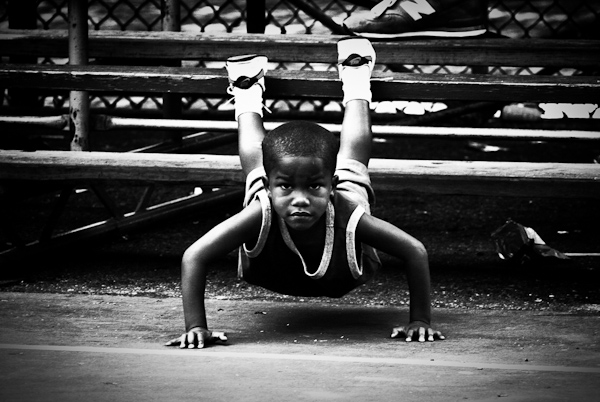
Pushups, Rucker Park, Harlem.
Growing up I obsessed with basketball.
I would skip school; I would play in light rain and sometimes snow; I occasionally failed classes and always fell asleep in them. From age 8 until 22, it’s pretty much all I did and all I wanted to do.
The best players were often reserved, relaxed, and mentally tough and focused. The intense look in the child’s eyes above explains it all and shows how innate this mentality and focus can be.
What Makes A Great Street Photograph?
So how does this story relate to you taking a ‘great street photograph?’
I want to share with you what I have learned, because it has nothing to do with tips, tricks, or techniques. The techniques are necessary to be able to take a technically good photograph but they are not the reason why you take great photographs.
Great street photographs say something about life; they speak to us; they fill us with an emotion; or they give us insight.
They are not about light; they are not about shapes or forms; they are not about faces. Light, shapes, and faces can only aid in the success of a photo; they cannot be the reason for it. When you look at a great street photograph you should not leave it saying, ‘Wow that light was amazing.’ You should leave it saying, ‘Wow the emotion or story in that photograph really hit me – AND the light was amazing.’
A great street photograph is one that makes a person think or one that brings up a specific feeling, story, or idea.
For a quick example, you shouldn’t be trying to capture a face; you should be trying to capture an expression.

If Only For A Moment.
“If Only For A Moment” – A fleeting moment with a story. No faces, subtle blue lighting, and no spectacular forms that stop you in your tracks. What is here is the subtle body language of the pass and that split second ‘what if’ thought going through their minds. This photo leads you on a mental journey through all of those ‘what if’ moments in your life and youth. It makes your heart beat.
How Do We Create Them?
So how do we create these photographs with meaning? Aren’t we at the whims of randomness and our surroundings in street photography?
Not necessarily.
The answer to this comes back to you and it is the reason for the personal stories in this article.
Street photography is a form of self expression. We go out and we search for the type of content that means something to us. When we are out there we are basically photographing ourselves, and searching for people, ideas, stories, and thoughts that we relate to and want to share.
Look at the body of work of any street photographer and you will be able to get some consistent insight into their personalities and how they see the world. They, like us, were at the whims of their surroundings and everyday randomness, yet this meaning still broke through in their work.
That is why you cannot copy another photographer’s style. You can only learn from them and their techniques and apply them to your own way of shooting and your own personality. Style isn’t about a look; it is about meaning.
It is about you.
Street photography is about exploring the world through our eyes and sharing the insights and stories that we see and find. It is showing the viewer how we see and think about the world.
The best photographers are not just interested in photography; they have an interest in people, in life, in social issues or cultural issues. They read and they explore new places and new ideas. They are curious both about others and about themselves. They have a good eye for design, but more importantly they have a good nose for the ideas that are floating around them.

Guess in Red.
“Guess in Red.” – I grew up with a serious case of Attention Deficit Disorder, which luckily subsided as I got older. Even simple stimulations would lead my mind way off track. Because of this and over time, I became very sensitive to advertising and how it intrudes on our attention, because it would break mine constantly. Walking around the streets was like a sensory overload. It’s led me to become fascinated with advertising and their intrusive nature and influence on our lives.
Is the above photo a coincidence or is it the result of influence?
If you want to take better street photographs, figure out why you are shooting and what you want to capture from it. What do you relate to most? Is there a specific type of content or person you are attracted to? Are you attracted to specific emotions or are there cultural issues that you want to show us? There are an infinite amount of ideas that you can go out and capture.
To better understand yourself and your work, study you archives and search for themes. Group similar photographs together. You might notice some ideas that you had previously missed.
It’s not easy.
Think about what your personality is like and how that relates to what you see out there. Maybe you can start by photographing a specific aspect of what life is like in your town or street.
Just because you live in an unpopulated area doesn’t mean you can’t do street photography. Give us insight into what it’s like to live where you are. You don’t even have to leave your home and it doesn’t matter if people are in the photographs or not. If you live in a town without a lot of people, then perhaps out of a series of twenty images, only 5 to 7 of them should actually have people in them. Photograph that sparseness. Let us into your world.
I can’t think of many things that sound more interesting than that.
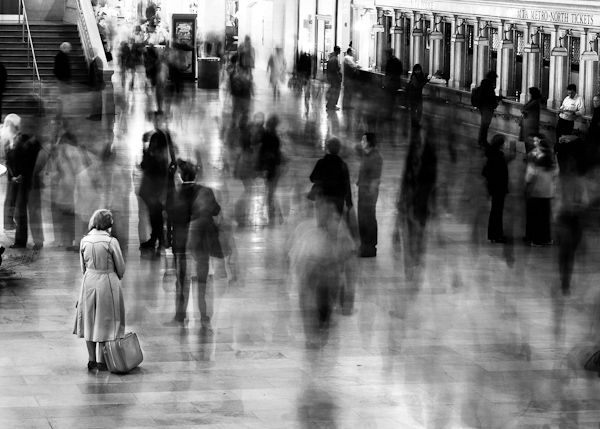
Waiting in Grand Central.
New York is a city where there are a lot of people, a lot of stimulation, and a lot of things happening all at once. However, it is also a very lonely city. Living here, you feel like everyone is competing with you and that everyone is moving so fast that you can barely keep up. This shot was my way of portraying these feelings visually.
A great street photograph is one that comes from your soul and explains how you see the world. Light, faces, composition, and forms are all part of the recipe but they are not the reason why you click that shutter.
And you can create better street photographs by better understanding yourself and your world.
What are your thoughts about what creates a great street photograph?
This post is written by James Maher – author of The Essentials of Street Photography – an eBook currently onsale at SnapnDeals (25% off).
Post originally from: Digital Photography Tips.
Check out our more Photography Tips at Photography Tips for Beginners, Portrait Photography Tips and Wedding Photography Tips.
What Makes A Great Street Photograph and How Do We Create Them


Digital Photography School