Blog

  • ‘That article was more like gossip’ Panasonic’s head of cameras talks downsizing, GH5 and the 8K era

     Yosuke Yamane: Division President, Imagine Network Business Division

    Yosuke Yamane, the Director of Panasonic’s imaging business visited DPReview on a recent trip to the United States. He spoke to us about the GH5, the promise of 8K, reports of downsizing and why we haven’t seen on-sensor phase detection in one of the company’s cameras.

    Initial response to the GH5

    Given it’s the company’s latest product and that Yamane arrived after visiting the video-focused NAB Show in Las Vegas, we started off asking about the GH5.

    Early response has been positive, he says, pointing out that it immediately topped the sales chart at one of the US’s largest dealers. ‘The sales were more than we’d originally planned for,’ he says: ‘It depends on the region: some regions sold three times more than we planned and others it was one-point-five times. We’re very satisfied with the result.’

    ‘Based on our survey, the first customers are mainly videographers,’ he says. But he expects this mix to change: ‘The GH5 provides the best still picture as well as the best moving picture quality ever in any Lumix, so we expect hybrid photographers and videographers to be 50:50.’

    ‘For video users, the specifications of the video are very important whereas the stills photographers tend to want to evaluate the image quality, based on pictures taken with the camera. In that sense, more and more photographers will come to the GH5. That’s what we expect.’

    Who is buying the GH5?

    We pressed Yamane on whether he thought the GH5 was selling beyond existing GH4 owners. ‘We don’t have any specific numbers,’ he says: ‘but my gut feeling is that many GH4 users are upgrading to the GH5, this is a decent portion of our first buyers. But, beside GH4 users, maybe it’ll be Canon EOS 5D III and IV users, or Alpha 7S Mark II users. Especially, my feeling was that EOS 5D Mark III users are very much interested in GH5.’

    ‘The majority of GH5 sales have been body only: that means lots of GH4 users are buying GH5. But also, at the introduction of the Sony a7S, it took share from the Canon EOS 5D Mark II because of the size. I think the same tendency is happening here: Canon EOS 5D Mark III customers are coming to the GH5 because of the compact size and the quality.’

    ‘The professional camcorder users coming to the GH5 because of the 4:2:2 10-bit video. 4:2:2 10-bit capable cameras are usually very expensive. It’s a feature mainly incorporated in cameras costing over $ 10,000 but we realized these functions for the GH5, so it can easily become part of their workflow at a very affordable price.’

    Stumbling over Log?

    On the topic of high-end video users buying the camera, we asked about the popularity of the paid upgrade to add V-Log. ‘We started selling V-Log as an upgrade with the GH4,’ explains Yamane: ‘We don’t know the exact attachment ratio but I know we sold more V-Log packages than we expected. When it comes to the GH5, because the stills side is improved, we don’t know if the attachment rate will be higher or not.’

    Yamane was very open about the reasoning behind selling the V-Log feature as a paid upgrade: ‘If we incorporated it into the camera, we would have to charge a higher price for the GH5. As of now we believe it’s appropriate to offer V-Log as an option.’

    ‘It’s not a cost issue, it’s that Log is recognized as having a certain value in the market. If we want to add that value into this camera, we need to keep the value of Log video to the industry.’

    Improvements to be made

    With the GH5, Panasonic took the unusual decision to launch the camera with the promise of more features that would come after a few months. Yamane confirmed that the delay to introducing 4:2:2 All-Intra recording was simply because it wasn’t ready in time for the planned launch, though it’s noticeable that the V60 cards guaranteed to support its 400mbps write speed aren’t widely available yet. However, he confirms the engineering team is working on more than just delivering the promised features: there will be an update to improve movie autofocus.

    ‘Now we are brushing up the smoothness of DFD for video. We don’t know when we can announce it but there will be firmware.’

    ‘The most important part of video autofocus is not just speed but also the smoothness. We need to find a concession point for the smoothness of autofocus and the speed of autofocus. First we realized fast AF on the stills side using depth-from-defocus (DFD). Now we are brushing up the smoothness of the DFD for the video category. We are working on it right now. We still don’t know when we can announce it but there will be firmware.’

    Why not adopt the phase detection approach used by many of its rivals, we asked. ‘On-sensor phase detection doesn’t work any darker than F8, [which can be a problem in video]. It’s not necessarily true that phase detection is better than DFD plus contrast detection.’

    ‘We think our DFD is going to be better than [the best of our rivals]. That’s our target.’

    ‘We are also aware of other brands’ excellent [phase detection-based] autofocus: we really respect the quality of their sensors and their technology. But if we wanted to do the same; to make our own sensors [using a comparable technology], we’d have to apply those sensors to all of our cameras. The development costs for this kind of sensor would be huge.’

    ‘Our DFD system is not dependent on a specific sensor, so from the viewpoint of expandability, we should probably go with DFD technology.’

    ‘But,’ he says: ‘we think our DFD is going to be better than [the best phase-based AF]. That’s our target and we want to realize that accurate autofocus.’

    Engine of change

    This bold claim is likely to stem from Yamane’s confidence in the GH5’s underlying hardware. This was the most difficult aspect to develop, he says. ‘Really at the core of the camera is its performance, which comes from the LSI’s development: the new processing engine. I truly believe this is the most special engine in the entire industry. This is not only for DSC but also for consumer and professional camcorders.’

    He gave examples of all the things that are asked of the processor: ‘4:2:2 10-bit codec is 64x as much data as before. 4:2:0 8-bit at 60p. Also the DFD system’s speed, Dual IS stabilization, the best image quality for Lumix all need to be calculated in a very short time.’

    The challenge extended beyond simply making a powerful processor, he says: the chip has to be efficient so that it allows good battery life and doesn’t generate excessive heat. ‘The heating issue was very tough to overcome. How to make the most efficient engine and how to dissipate heat was the most difficult part of the product development.’

    Lenses for a hybrid camera

    The Leica DG Vario-Elmarit 12-60mm / F2.8-4.0 ASPH. / POWER O.I.S. is the first in a range of F2.8-4.0 zooms for the Micro Four Thirds system

    Moving on from the GH5, we expressed our surprise that the company would introduce a range of variable aperture zooms alongside such a capable video camera.

    ‘We are not just targeting GH5 customers,’ he explains: ‘we’re targeting all the other Micro Four Thirds cameras users. We’ve also taken other cameras’ sizing into account, and it also fits on the G85 and the GX85 and some other Micro Four Thirds cameras.’

    ‘The benefit of Micro Four Thirds style is that it can be smaller and lighter. If we made constant aperture F2.8 lenses, they’d be more expensive and bigger. Considering the benefit we can provide stills photographers we decided to go with F2.8-4 and give rather smaller lenses at reasonable prices.’

    The lenses include stepless apertures, to minimize any impact on video while zooming, and, he suggests, for anyone concerned about changes in exposure while video shooting, there are workarounds: ‘Videographers can use them as a constant F4: I think we can also give videographers a solution in that way. I agree that in the future we need to offer lenses that best suit videographers but this camera is targeting hybrid users, both videographers and stills shooters, so we decided with this direction for the next three or four lenses.’

    Ambitions and focus

    It’s unusual for camera makers to talk much about the future, but during our discussion, Yamane set out some pretty bullish ambitions. ‘For Lumix, the United States is a very strategic market. Our target is to double the business volume by 2020.’

    We asked him how this would be achieved.The current business in the United States is 30% mirrorless and 70% compact camera,’ he says: ‘though nearer to 50:50 if you count interchangeable lenses as well.’

    ‘For the future, to double the business, we’re going to focus on high end product: mirrorless cameras and high-end compacts. We expect a decent increase of the compact market to be sustainable.’

    In addition to this, he says: ‘We’re also going to strengthen our product for the high-end video market.’

    But, initially at least, this is going to be through cameras like the GH5: ‘firstly we’ll focus on the hybrid form factor. Also help photographers interested in making additional income from providing video. I think this camera will help this kind of photographer.’

    In terms of compacts, we’ll focus on the ZS (TZ) series, such as the ZS100. Then the LX series, we’d like to strengthen. In this category the Sony RX100 series is very important, we have to directly compete with that. Our strength comes from ZS series. We’ll focus on that strength and FZ series long zoom.’

    One camera he didn’t mention was the LX100, which we know to have an avid following. Should we expect a successor, we asked. ‘As I said, RX100 competes directly with LX10 but LX100 is one step higher. So as the customer expects LX200 we will also strengthen the successor of LX100. How will we answer to the passionate customers of the LX100? We will study how we’re going to answer these customers.’

    Trickle-down of technology?

    Yamane (center) was accompanied on his visit by Terry Takabayashi (left), General Manager, Merchandising Department and Kazuki Sugahara (right), Manager, Americas Section, Imaging Marketing Group.

    One method for refreshing models might be through the trickle-down of technology, Yamane suggested: ‘After we introduced the GH4, which was the world’s first 4K mirrorless camera, this 4K technology has been applied in models like G7, G8 and LX100. For the development roadmap, the new technology will first appear in the flagship and then, looking at price and value for money, we will expand the range.’

    ‘we would like to expand the [GH5’s] technology to other models’

    The rationale is pretty straightforward, he says: ‘R&D development of technology requires a lot of investment. So to amortize that investment we have to apply that technology to other models to expand the volume and realize a return on our investment. After we get a return on that investment we have to reinvest that return in new technology: we have to continue that kind of cycle to evolve our product.’

    This means using the GH5 technology more widely, without under-selling it, he says: ‘With GH5 also we would like to expand the technology to other models, looking at striking a balance between offering good value for money and at the price zone at which a customer can expect that technology.’

    All of this comes back to a phrase that recurred throughout our talk: the use of features such as 4K and 6K Photo modes to ‘create a new photo culture.’

    Nikkei, restructuring and gossip

    This all sounds very ambitious for a company reported to be considering scaling back its camera business. Yamane says customers shouldn’t worry too much about what the Nikkei, which published the story, said.

    ‘That article was more like gossip, saying the business may be moving towards the smaller side in the restructuring,’ he says, before explaining what’s happened.

    ‘Panasonic has four companies. The camera division used to be in the AVC Networks business but, as of the first of April, we moved Digital Camera and Camcorders to the Appliances company.’

    ‘I’m really proud of the engineering groups that made this camera available to the market’

    Moving cameras and camcorders away from the pro video division and into the same company as refrigerators may seem odd, but Yamane explains the logic: ‘The Appliances business is much more consumer focused than the AVC group, which has a significant business-to-business component.’

    ‘The move will bring our marketing, manufacturing and R&D departments together in one place, so we gain better integration [by moving]. We’ll still co-ordinate across with the AVC business on advanced technologies but [the restructuring] means our R&D and marketing efforts are together.’

    The coming of the 8K era

    Along with its ambitious targets for US sales, Yamane says the company has ambitious targets for hardware, too. ‘Towards the year 2020, 4K will evolve to 8K. Panasonic has supported the Olympic Games for a long time and in 2020, when the games are in Tokyo, the era of 8K will start, [and] we will develop the hardware to develop the 8K picture.’

    This doesn’t necessarily mean 8K video, though: ‘As far as for the customer category, we don’t know if we will be able to record all of the output from 8K video. So the question is how we utilize 8K information and create a new photographic culture’

    ‘In 2020, when the [Olympics] are in Tokyo, the era of 8K will start: we will develop the hardware to develop the 8K picture’

    ‘8K Photo will completely change the photo shooting style with 33MP resolution. Whether that’s a 4K crop from 8K or 2K cropping from 8K or it’s 33MP images on the stills side.’

    But Yamane makes clear that he’s not just interested in the technology: he’s interested in its photographic benefits to users: ‘Based on the customer voice and the customer opinion, we will make the maximum effort to develop strong products to answer the needs of the customers.’

    A team effort

    Yamane is immediately clear about what’s going to enable the company to achieve these ambitions: when asked what he was most proud of, he was quick to give credit. ‘The engineers who make the product: my team. As the director of the imaging group I’m really proud of the engineering groups that made this camera available to the market. I am proud of every single feature and I respect the engineers who made each function. As long as those talented and reliable engineers are with me, I believe we can make even more innovative products.’

    Articles: Digital Photography Review (dpreview.com)

  • Olympus firmware update brings support for Profoto remote and more to E-M1 II, EM-5 II and PEN-F

    Olympus has announced major firmware updates for its E-M1 Mark II, E-M5 Mark II and PEN-F, as well as a pair of lenses. The camera updates add support for Profoto’s TTL flash system and provide plenty of new features, detailed below.

    The first new feature is support for the Air Remote TTL-O (‘O’ for Olympus) radio trigger from Profoto. Pop it on the hot shoe and you can use a simple interface to control off-camera Profoto Air TTL flashes in both TTL and HSS modes.

    Other major features include AF Target Spot Metering (E-M1 II only), the ability to set a minimum shutter speed in Auto ISO (PEN-F only), improvements to the AF touchpad function on the PEN-F for left-eye shooters, the ability to use High Res Shot and Focus Stacking modes when shooting with non-Olympus flashes, improved color reproduction on the E-M1 II’s EVF, and more.

    Two lenses also receive updates: the 12-100mm F4 IS Pro and 300mm F4 IS Pro. The updates boosts sequential shooting performance when IS is turned on when using the E-M1 II and also improve 5-axis Sync IS with the E-M5 II and the original E-M1.

    The updates are available immediately from the Olympus support website in your region. See the press release below for all of the changes in these updates:


    Press Release:

    PLUG IN AND POWER UP: OLYMPUS® FIRMWARE UPDATE DELIVERS NEW CAPABILITIES FOR OM-D® AND PEN® CAMERAS

    Expansive New Performance Updates for the OM-D E-M1 Mark II, OM-D E-M5 Mark II and PEN-F Include TTL and HSS Compatibility with Profoto AirTTL Flashes

    CENTER VALLEY, Pa., May 8, 2017 — Today, Olympus announces a series of powerful new firmware updates that enhance the performance of the Olympus OM-D E-M1 Mark II, Olympus OM-D E-M5 Mark II, Olympus PEN-F and select M.ZUIKO® PRO and PREMIUM lenses. The updates are available immediately and are designed to bolster Olympus cameras and lenses with the latest functionality, including true compatibility with the new Profoto Air Remote TTL-O, to strengthen the performance for the professional and enthusiast photographer.

    Olympus is dedicated to providing ongoing product functionality and performance improvements to expand the capabilities of their cameras. The E-M1 Mark II, Olympus’s latest flagship camera designed to withstand the rigors of professional use and deliver outstanding images, is upgraded to Version 1.2. The E-M5 Mark II, a high-performance compact system camera that features Olympus’s advanced in-body 5-Axis Image Stabilization, is upgraded to Version 3.0. And the PEN-F, a beautifully crafted camera with creative functions ideal for street shooters and those with an affinity for sophisticated industrial design, is upgraded to Version 2.0.

    The recent updates are comprehensive and go beyond compatibility with the Profoto Air Remote TTL-O. The E-M5 Mark II has been enhanced with features that include “Save Settings and Mysets” for saving camera settings on a computer, and a midtone adjustment function has been added to Highlight & Shadow Control for even greater control over the tonal quality of images. The PEN-F now offers touch-to-select Art Filters while viewing the effect in real time, and users can set the slowest shutter speed allowed before the camera raises the sensitivity in ISO AUTO. For the E-M1 Mark II, High Res Shot and Focus Stacking Modes are now compatible with non-Olympus flashes, and AF HOME settings are saved when the camera is turned off.

    Firmware Version 1.1 for the M.ZUIKO Digital ED 12-100mm f/4.0 IS PRO and Firmware Version 1.2 for the M.ZUIKO Digital ED 300mm f/4.0 IS PRO improves silent sequential shooting performance when image stabilization is active on the E-M1 Mark II. Firmware Version 1.1 for the M.ZUIKO Digital ED 12-100mm f/4.0 IS PRO also improves 5-Axis Sync IS performance when paired with the E-M5 Mark II and the E-M1 Mark II.

    Main Features

    1. Compatibility with Profoto Air Remote TTL-O

    The latest firmware upgrade delivers compatibility between the Profoto Air Remote TTL-O and the E-M1 Mark II, E-M5 Mark II and PEN-F models. The Profoto Air Remote TTL-O wirelessly integrates the Profoto Air TTL Flash with these cameras, providing Olympus users with seamless integration with products from one of the leading manufacturers of lighting and light-shaping tools.

    Simply attach the Profoto Air Remote TTL-O to the hot shoe for quick remote control of all functions. For more information on which functions can be used, please see the Profoto website: http://profoto.com

    1. “Save Settings and Mysets” function saves camera settings on the user’s computer

    The convenient “Save Settings and Mysets” function has been added to the E-M5 Mark II and PEN-F to easily save the user’s customized settings on their computer and restore them on the camera when necessary. This feature is useful for applying the same settings to multiple cameras and saving complex settings when upgrading firmware.

    1. Midtone adjustment function added to Highlight & Shadow Control

    The new midtone adjustment function has been added to the Highlight & Shadow Control on the E-M5 Mark II to provide control over bright and dark sections of a subject and to give users complete control over the tonal properties of the image.

    1. AF Target Spot Metering provides spot metering at the focus point

    AF Target Spot Metering is now available on the E-M5 Mark II to effectively link the AF Target position and spot metering area.

    1. Touch to select Art Filters while viewing sample images on the screen

    Sample images that demonstrate the effects of the Art Filter are now shown at the bottom of the PEN-F’s screen. Users can simply view and touch the sample Art Filter image on the screen to instantly activate that option.

    1. Set the shutter speed to begin raising the ISO sensitivity in ISO AUTO

    It is now possible to control the lowest shutter speed setting on the PEN-F. This allows users to predefine a minimum shutter speed so that the ISO sensitivity increases in low-light situations rather than slowing down the shutter speed. This is convenient for handheld shooting in low-light environments.

    1. Improved AF Targeting Pad on the rear LCD monitor

    The firmware update makes it possible to use touchpad operations on the PEN-F even if your nose touches the rear LCD monitor while looking through the viewfinder. The AF Targeting Pad provides the freedom to move the AF point on the rear LCD monitor using touch operations while keeping your eye on the viewfinder.

    1. High Res Shot and Focus Stacking Mode compatibility on non-Olympus flashes

    The E-M1 Mark II’s powerful 50MP High Res Shot and Focus Stacking Modes are now supported with both Olympus flashes and flashes from other manufacturers.

    1. Automatic switching to rear LCD monitor when shooting with the viewfinder

    When shooting through the E-M1 Mark II’s viewfinder during Rec View, the camera now automatically switches to the rear LCD monitor for image playback when the eye is moved away from the viewfinder.

    1. AF HOME settings saved when camera is turned off

    Previously, AF HOME settings were reset after the E-M1 Mark II was turned off. The firmware upgrade saves the user’s AF HOME settings even if the camera is turned off. 

    Additional Improvements

    • Improved viewfinder color reproduction during shooting for the E-M1 Mark II lets users compose their image while viewing color more accurately.
    • Improved stability for battery level display for the E-M1 Mark II.
    • Lens firmware upgrade improvements:

    (1) M.ZUIKO Digital ED 12-100mm f/4.0 IS PRO Firmware Version 1.1 and M.ZUIKO Digital ED 300mm f/4.0 IS PRO Firmware Version 1.2 improves silent sequential shooting performance when image stabilization is active on the E-M1 Mark II.

    (2) M.ZUIKO Digital ED 12-100mm f/4.0 IS PRO Firmware Version 1.1 improves 5-Axis Sync IS performance when paired with the E-M5 Mark II and E-M1 Mark II.

    Camera Bodies – New Functions and Improvements

      E-M1 Mark II
    Ver 1.2
    E-M5 Mark II
    Ver 3.0
    PEN-F
    Ver 2.0
    Compatibility with Profoto Air Remote TTL-O X X X
    “Save Settings and Mysets” for saving camera settings on a computer Already available X X
    Midtone adjustment function added to Highlight & Shadow Control  Already available  X Already available
    AF Target Spot Metering provides spot metering at the focus point Already available X Already available
    Touch to select Art Filters while viewing sample images X
    Set the shutter speed to begin raising the ISO sensitivity in ISO AUTO  Already available X
    Improved AF Targeting Pad on the rear LCD monitor Already available X
    High Res Shot and Focus Stacking Mode available on non-Olympus flashes X Already available Already available
    Automatic playback on rear LCD when using Rec View in the viewfinder X Already available Already available
    AF HOME settings saved when camera is turned off  X Already available Already available
    Improved viewfinder color reproduction X
    Improved stability for battery level display X

    M.ZUIKO Lenses – New Improvements

      E-M1 Mark II  E-M5 Mark II E-M1
    M.ZUIKO Digital ED 12-100mm f/4.0 IS PRO Firmware Ver 1.1 and M.ZUIKO Digital ED 300mm f/4.0 IS PRO Firmware Ver 1.2 improves silent sequential shooting performance when image stabilization is active  X*
    M.ZUIKO Digital ED 12-100mm f/4.0 IS PRO Firmware Ver 1.1 improves 5-Axis Sync IS performance Already available X X

    * E-M1 Mark II must be upgraded to firmware v1.2

    Articles: Digital Photography Review (dpreview.com)

  • Chain Mail for Space: NASA’s 4D-Printed Metal Fabric Deflects Debris

    [ By WebUrbanist in Conceptual & Futuristic & Technology. ]

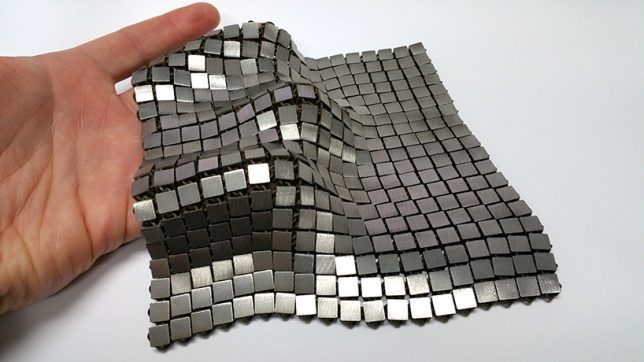
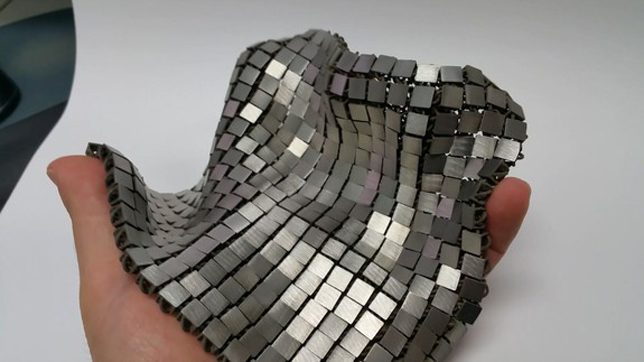
    NASA’s latest futuristic textile is made of metal but can fold and change shape, protecting a wearer (or covered craft) from dangerous collisions that could tear holes in people or ships.

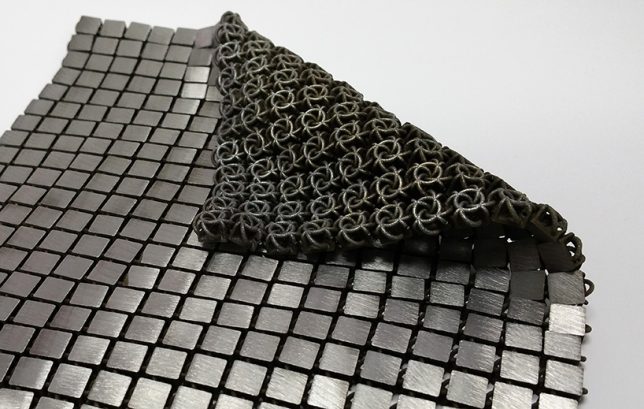
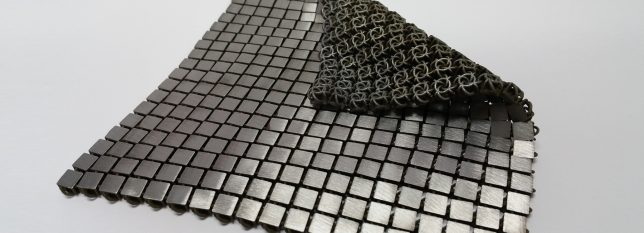
    The woven metal is made up of a squares on the surface that are linked together on the back, but thanks to clever manufacturing the entire system can be created at once (rather than stitched together). With printers sent into space, this means astronauts could recycle and rebuild the material for different applications on demand.

    “We call it 4D printing because we can print both the geometry and the function of these materials,” explains Polit Casillas. “If 20th century manufacturing was driven by mass production, then this is the mass production of functions.”

    Developed by the Jet Propulsion Laboratory, this versatile textile has thermal protective properties as well, able to to keep machinery and people warm. Despite its flexibility, the mail retains a high tensile strength and can reflect or absorb light for heat control depending on which side faces outward.

    Share on Facebook


    [ By WebUrbanist in Conceptual & Futuristic & Technology. ]

    [ WebUrbanist | Archives | Galleries | Privacy | TOS ]


    WebUrbanist

  • From the forums: Starry skies time-lapse

    Longtime DPReview member Tanveer, whose username is tsk1979, created this beautiful time-lapse over the past two years, mostly with a Sony a7 mirrorless camera. The video includes the summer Milky Way, the winter Orion, Andromedia in the North and Sagittarius in the South.

    So throw on a pair of headphones, dim the lights and take a few minutes out of your day to immerse yourself in the night sky. Also be sure to check out Tanveer’s image galleries and Facebook photography page.

    Articles: Digital Photography Review (dpreview.com)

  • Oh Brothel: 12 Abandoned Houses Of Ill Repute

    [ By Steve in Abandoned Places & Architecture. ]

    The world’s oldest profession ain’t what it used to be as these abandoned brothels, bordellos and bawdy houses so sleazily show.

    Oh brothels, where art thou? Brothels can be found just about anywhere regardless of any local legal injunctions prohibiting their existence. Where they ARE permitted – the state of Nevada, for example – savvy owners often locate as close as possible to places that ban them. Flickr user Joel Childers (Vacant West) brings us these artfully (and eerily) lit images of Janie’s Ranch taken in early 2010.

    Janie’s Ranch is situated on Nevada Highway 6 between Tonopah, Nevada and Bishop, California. Janie’s, which closed in the 1990s, used to advertise their sleazy services in California border towns including Bishop and Mammoth Lakes.

    The Caged Bird Swings

    Brothels were commonplace in the oft-lawless Old West. Precious few of these then-essential establishments have been preserved as well as the Bird Cage Theatre in Tombstone, Arizona.

    Operating from 1881 through 1889 (Wyatt Earp met his third wife there), the combination brothel, saloon and casino was shuttered until 1934 when new owners discovered a lost world frozen in time. Over 120 bullet holes (some with embedded slugs) can be found in the building’s walls, floors and ceilings. The place’s motto should’ve been “wham, BLAM, thank you ma’am.”

    Ghosts Of Pleasures Past

    The ghost town of Rhyolite, Nevada exploded into being in 1905 when gold was discovered nearby. The mines quickly played out, however, causing the town’s population to plummet from a high of about 5,000 to just 1 in 1922. The small but solidly-built brothel above, captured in 2008 by Flickr user Jitze Couperus, boasted an innovative roof made from flattened kerosene cans. Now that’s hot!

    It’s Curtains For Ya

    Bobbie’s Buckeye Bar & Brothel had been closed and abandoned for quite some time when Flickr user Bradley Fulton (escapo) chanced upon its remains in 2006. The Tonopah, Nevada brothel appeared to be a rather large and well-organized business with “nicely” furnished quarters for the working girls.

    The warm & fuzzy atmosphere infusing these photos was achieved through the photographer’s use of cross-processing on expired film – appropriate for an expired brothel. Of course, nothing can beat the cheesiness of those painted-on curtains!

    Next Page – Click Below to Read More:
    Oh Brothel 12 Abandoned Houses Of Ill Repute

    Share on Facebook


    [ By Steve in Abandoned Places & Architecture. ]

    [ WebUrbanist | Archives | Galleries | Privacy | TOS ]


    WebUrbanist

  • Updated: Sony a9 samples with Raw support

    Introduction

    Out-of-camera JPEG Processed to taste from Adobe Camera Raw
    We’ve found with some consistency that overall color rendition and auto white balance performance could stand to be improved on the Sony a9 for its out-of-camera files.

    You’ve no doubt heard of the Sony a9 by now – indeed, we’ve been covering as many details as we responsibly can before having a final review unit of our own. But since we’ve just been given full support from Adobe, it’s time for a closer look at the a9’s image quality, but this time we can compare the Raw files to the out-of-camera JPEGs to see how they stack up.

    To start, the Raw files from the Sony a9 are just what we’d expect from a latest-generation Sony sensor. Noise appears to be well-controlled, and they’re very malleable, even at the high ISO values we found ourselves shooting at. However, processing the Raws has also given me a greater perspective on both the strong and weak points of Sony’s JPEG engine.

    The noise (or lack thereof)

    Sony’s context-sensitive noise reduction works very well at keeping noise in check while retaining detail at its default settings. However, I found that the a9’s processing can at times look a little heavy-handed to me at its default settings, which we typically use. In processing out the Raws in Adobe Camera Raw, I ended up with an image that is technically noisier because its processing isn’t as sophisticated, but it comes with a little more ‘bite’ (though this may well be due to the increase in perceived sharpness that a bit of grain can provide).

    At smaller viewing sizes, I found the Raw-processed images which have more visible grain to have just a bit more ‘bite,’ with the out-of-camera JPEG looking a little ‘waxy’ in comparison. That said, Sony’s algorithm does an outstanding job controlling distracting noise in the background and maintaining crisp edges, like along the athlete’s shirt and arm (and this is an ISO 8000 image).

    It comes down to personal taste of course, but I personally don’t mind trading a little noise for a crisper image, and given the time, it’s likely I would be able to find a better balance of in-camera settings. If you’re going to be using the JPEGs from the a9, it’s worth spending some time with the a9’s noise reduction and sharpening settings to find what works best for you.

    The noise reduction isn’t likely to be a deal breaker for a lot of people who need to shoot JPEGs for web viewing. No, the real trouble continues to lie in Sony’s color output.

    The color

    Out-of-camera JPEG Processed to taste from Adobe Camera Raw
    The out-of-camera file shows a purple ping-pong table – it was not purple. It was a deep blue.

    We’ve not been wild about Sony’s color for a while now, which generally skew towards greenish yellows and cool greens – for an example of the latter, simply look at the track in the background in the above image (and there’s many more examples in the gallery). And as we’ve seen from the noise example in the previous section, sophisticated sharpening algorithms are of more limited importance when viewing at small sizes on the web, while quality of color is arguably going to have more of an impact.

    These issues with color are exacerbated with auto white balance that struggled under artificial light (see the skaters at the top of the page). Sure, it’s not difficult to dial in a custom white balance for a sideline photographer shooting under the same light all evening, but it’s something to note nonetheless as auto white balance can be valuable for fast-moving photographers in fast-changing situations.

    Updated samples gallery

    And that brings us to our samples gallery, which has been updated and re-ordered to make it easy to compare the out-of-camera images (which come first) and the JPEGs processed out from Raw files. 

    Please do not reproduce any of these images on a website or any newsletter / magazine without prior permission (see our copyright page). We make the originals available for private users to download to their own machines for personal examination or printing (in conjunction with this review), we do so in good faith, please don’t abuse it.

    $ (document).ready(function() { SampleGalleryGridV2({“galleryId”:”5484254968″,”isMobile”:false}) })

    Sony a9 real world samples gallery

    100 images • Posted on Apr 27, 2017 • View album
    Sample photoSample photoSample photoSample photoSample photoSample photoSample photoSample photoSample photoSample photoSample photoSample photoSample photoSample photoSample photoSample photoSample photoSample photoSample photoSample photoSample photoSample photoSample photoSample photoSample photoSample photoSample photoSample photoSample photoSample photoSample photoSample photoSample photoSample photoSample photoSample photoSample photoSample photoSample photoSample photoSample photoSample photoSample photoSample photoSample photoSample photoSample photoSample photoSample photo

    Articles: Digital Photography Review (dpreview.com)

  • PDN announces 2017 Photo Annual contest winners

    2017 PDN Photo Annual

    Photo District News has announced the winners of its 2017 PDN Photo Annual competition. It selected 165 winners from thousands of entries across 10 categories, with winners ranging from established photographers to up-and-coming artists.

    Of particular note, PDN awarded its first annual Photographer of the Year award to photographer Mark Peterson for creating an outstanding body of work that reflects the year in photography, and for his book Political Theatre

    Head over to the official contest site to see all the winners.

    Above:

    Photographer: Todd Anthony

    Category: Advertising/Corporate Work

    A summer campaign for UK brand Fab Ice Lollies, “A Sprinkle of Summer Fun.” [Client: Nestlé]

    2017 PDN Photo Annual

    Photographer: Julien Grimard

    Category: Sports

    From a series that captures freestyle mountain biker Matt Macduff attempting the Loop Of Doom, his subsequent crash and injuries.

    2017 PDN Photo Annual

    Photographer: Ami Vitale

    Category: Magazine/Editorial

    Pandas, once dangerously close to extinction, are being sent back to the wild. Following China’s massive captive-breeding program, this series shows the next step in the attempt to save the country’s ‘most famous ambassador.’ [Publication: National Geographic]

    2017 PDN Photo Annual

    Photographer: Emile Ducke

    Category: Student Work

    A portrait of Aidara, a West Siberian village accessible only by boat and home to a small community of Russian Orthodox Old Believers. This faction continues liturgical practices prior to church reforms introduced in the mid-17th century. Life in Aidara, Ducke explains, consists of exhausting agricultural work, and beyond the village is a vast forest, prone to fires that the residents must control in the dry summers. [From a series]

    2017 PDN Photo Annual

    Photographer: Jimmy Chin

    Category: Sports

    For this shoot, Chin accompanied Felipe Camargo while he climbed the Getu Arch in China. [From a series]

    2017 PDN Photo Annual

    Photographer: Marcus Palmqvist

    Category: Stock Photography

    ‘Impossible Balance’ tricks the eye with seemingly impossible moves by Swedish dancers caught in camera.

    2017 PDN Photo Annual

    Photographer: Amber Bracken

    Category: Photojournalism/Documentary

    A series about the members of the Standing Rock Sioux tribe and their allies, who camped for nearly a year in opposition to the Dakota Access Pipeline crossing their territory and their water supply. Though on its face the issue is the pipeline, the conflict is steeped in generations of violent history with the American government.

    2017 PDN Photo Annual

    Photographer: Piotr Naskrecki

    Category: Personal Work

    For the last few years Naskrecki has been documenting the lesser-known animals of Africa, which receive little attention due to their small size or elusive lifestyle. Images in this series were taken in Mozambique, ‘one of the least explored countries on the continent, biologically and photographically.’ [Photo of a pangolin, from a series]

    2017 PDN Photo Annual

    Photographer: Mark Peterson

    Category: Photo Books

    Peterson’s caustic black-and-white series about American politicians pulls back the curtain on their performances to show them as they really are. From shortly before the 2013 government shut down to the 2016 presidential election, Peterson cuts through the staging and reveals the cold, naked ambition for power. [Book: Political Theatre, Steidl]

    2017 PDN Photo Annual

    Photographer: Tyler Gray

    Category: Personal Work

    ‘Blue Collar’ is an ongoing series that depicts the harsh beauty and big potential of the North American towns that never quite recovered from the 2009 financial crisis that decimated the manufacturing industry. [From a series]

    2017 PDN Photo Annual

    Photographer: Jack Davison

    Category: Magazine/Editorial

    ‘L.A. Noir’ features the year’s best actors—including Ruth Negga, Emma Stone, Taraji P. Henson and Denzel Washington—channeling classic film-noir looks and scenarios. [From a series]

    2017 PDN Photo Annual

    Photographer: Shawn Corrigan and Steve Boyle

    Category: Video/Multimedia

    A short film about Carol, known as ‘Grubby’ to her teammates, who became a starting middle linebacker after just two weeks of practice in 2001, when women’s tackle football was in its infancy. Nine seasons, hundreds of tackles and one brief retirement later, she’s back for one final season with the Firebirds. [Film: Grubby’s Last Stand]

    Articles: Digital Photography Review (dpreview.com)

  • Lomography plans convertible lens system with three focal lengths

    Alternative photography brand Lomography has set out plans to produce a system that allows users to achieve three different focal lengths by switching the elements in the front half of a lens. The Neptune Convertible Art Lens System comprises a four-element barrel unit that remains attached to the camera, and three interchangeable front sections that can be switched to deliver 35mm, 50mm or 80mm focal lengths.

    A click-less aperture is positioned in the rear section of the Neptune that provides a maximum F-stop setting of F2.8 when used with the 50mm front end. The same iris offers a maximum F number of F3.5 with the 35mm section and F4 with the 80mm section, according to Lomography. Each of the four-element front sections has been given a name – the 35mm F3.5 is called Thalassa, the 50mm F2.8 is called Despina and Proteus is the 80mm F4.

    In addition to interchangeable front element groups the system has a collection of six shaped stops that can be inserted to interrupt the passage of light through the lens. The idea is that the shapes cut into the stops, or Special Aperture Plates, influence the characteristic of out-of-focus highlights in the image.

    Lomography is using a Kickstarter campaign to fund the project, and at the time of writing had already succeeded in raising three times its target figure for production to go ahead. The manual-focus Neptune system will be available in black or silver and in Nikon F, Canon EF and Pentax K mounts. The system will also work with most compact system models via an adapter.

    The company says it intends to begin shipping a limited number of Neptune systems in November this year, with the main production being available from February 2018. The full retail price is expected to be around $ 980, but early bird offers are in place from $ 690. The kit comprises a base lens unit, the three converters and the six aperture plates.

    For more information see the Lomography website and the company’s Neptune Kickstarter page.

    Manufacturer information

    The Neptune Convertible Art Lens System

    The Neptune Convertible Art Lens System is everything you need on any photography venture. A reimagination of the world’s first convertible lens system created by Charles Chevalier in the late 1830s, this unique system opens up a world of possibilities for beginners and professionals alike.

    The Neptune Convertible Art Lens System consists of a lens base that’s mounted to your camera and several convertible lens components. By interchanging the front components, you can shoot photos or videos at three different fixed focal lengths — 35mm, 50mm and 80mm. An Art Lens System unlike any other; it offers you all the freedom of a zoom lens without compromising on prime lens quality, and it’s the only convertible Art Lens out there to work with a range of modern-day analogue and digital cameras. Each component is assembled by using the finest multi-coated glass and crafted to produce exceptionally sharp focus and strong, saturated colors for stunning high-definition images — even when you’re shooting close-ups at 0.25m/9.8” with Thalassa (35mm), 0.4/15.7” with Despina (50mm) or 0.8m/31.5” with Proteus (80mm). This is an Art Lens System that lets you take beautifully intimate shots, allowing you to get near enough to capture every last detail of your subject. And because it’s so small and lightweight design, you can take it with you everywhere.

    And that’s not all — the Neptune Convertible Art Lens System also features two aperture mechanisms to give you all the creative freedom you need. The stopless iris diaphragm aperture mechanism in the lens base features a wide range of optimal Fstops for each focal length, but with the 35mm and 80mm lenses you’ve got the freedom to go beyond that range and experiment. You can also soften your style by inserting the special aperture plates in front of the iris diaphragm to edge your frame with delicate bokeh.

    By reviving and reinventing Chevalier’s convertible lens design for modern-day cameras, we’ve created an Art Lens System that will revolutionize the way you approach photography and videography. There’s no limit to the amount of new front lenses we can produce, and we’re already designing new lens components with unique effects and possible focal lengths ranging from an ultra-wide-angle 15mm to a 400mm monocular.

    Each new front lens will be just like the ones you can see on this page — small, handcrafted and compatible with the same lens base, meaning that you won’t have to break the bank by buying a whole new system every time you want to shoot with a new prime lens.

    Photographers and videographers all over the world have tested the Neptune Convertible Art Lens System to make sure that we’ve created a system that performs exceptionally in any and every shooting situation. Lightweight and compact, it’s everything you need in your bag — no matter where your adventures take you.

    Thalassa: 3.5/35
    When attached to the base, the Thalassa lens shoots at a wide-angle fixed focal length of 35mm, making it perfect for architecture, street photography and reportage. As this is a focal length very close to that of the human eye, you can approach your subjects intimately, fill the frame, and immerse yourself in the shot. And as Thalassa has a closest focusing distance of 0.25m/9.8” and delivers exceptional sharpness, you’ll be able to capture all the gritty details that make this beautiful planet we live on so captivating. Sleek and compact, the Neptune Convertible Art Lens System is discreet enough to capture bustling street scenes off guard. Combine Thalassa with the special aperture plates to turn busy urban backgrounds into colorful bokeh frames for stunning environmental portraits, and try bypassing the optimal maximum aperture of F3.5 to add unique effects to your imagery.

    Despina: 2.8/50
    To shoot at a versatile fixed focal length of 50mm, attach Despina to the base. Nicknamed the Nifty Fifty for good reason, 50mm is one of the pillars of photography — a great focal length for learning, but also for constantly improving your craft. Ideal for everyday, fashion and studio photography, it comfortably captures everything from full-length portraits to editorial spreads in stunning high definition. 50mm also produces delicate bokeh — particularly when fired at the largest aperture of F2.8 and especially when paired with the special aperture plates. With a closest focusing distance of 0.4m/15.7”, Despina captures stand-out features of couture, and allows you to experiment with framing and composition.

    Proteus: 4.0/80
    Proteus is perfect for portraits, sports and action photography. It has a closest focusing distance of 0.8m/31.5”, and when attached to the base it shoots at a fixed focal length of 80mm. This means that the depth of field is very shallow, and as such Proteus produces beautiful, soft bokeh perfect for framing a subject and guiding your viewer to the focus of your shot. Not only is this ideal for placing your subject against a busy background to create a mesmerising headshot, but it’s also great for isolating the background to make subjects in the foreground appear closer, which makes it a popular focal length for capturing sports stars in action. And because the bokeh also turns crisp foliage into textured backdrops for snapshots of fauna, Proteus is a fantastic lens for nature photography. Add delicate effects to your background using the special aperture plates, and bypass the optimal largest aperture of F4.0 to experiment with the blurred areas in your shot even more.

    Articles: Digital Photography Review (dpreview.com)

  • National Geographic kicks off 2017 Travel Photographer of the Year competition

    2017 National Geographic travel photographer of the year

    National Geographic has kicked off its 2017 Travel Photographer of the Year competition, with the grand prize being a 10-day trip to the photogenic Galapagos Islands. The categories are nature, cities and people, and entries are already starting to come in. Take a look at some early Editors’ picks in the nature category.

    Above: ‘A drive to remember’ by Manish Mamtani

    Aerial view of the Scenic drive and the beautiful Fall colors of New Hampshire. I used a drone to capture the fall colors that cannot be seen from the road.

    2017 National Geographic travel photographer of the year

    ‘In Your Face’ by Shane Gross / National Geograhic Travel Photographer of the Year Contest

    Caribbean reef sharks are usually shy so I placed my camera on a rock where I know they frequent and used a remote trigger to click away as they came in and bumped my camera around.

    2017 National Geographic travel photographer of the year

    ‘The Mirror’ by Takahiro Bessho / National Geograhic Travel Photographer of the Year Contest

    Lake Yogo, called “The lake of Mirror”, sometimes reflects everything in front of you.

    2017 National Geographic travel photographer of the year

    ‘Lost in white’ by Adam Cunningham-White / National Geograhic Travel Photographer of the Year Contest

    This photo captures the moment that I, along with 3 other Sami reindeer herders become a little lost while migrating with 350 reindeer. They were rounded up from a section of forest around 30kms south of this point. Our goal was to take them, via rivers, northwards to pastures new using the network of rivers and lakes that flow through Sweden.

    This was taken on Randijaur lake, Jokkmokk, Sweden

    2017 National Geographic travel photographer of the year

    ‘Little Eyewitness’ by Hidetoshi Ogata / National Geograhic Travel Photographer of the Year Contest

    “Little Eyewitness” was taken in Jigokudani Monkey Park, Nagano, Japan on December, 2016. On a cold winter’s day, monkeys have several ways to keep off the cold. For example, in order to keep them warm, they have a soak in a hot spring, take a bedrock bath or huddle together, etc. While monkeys were huddling together, I approached them with the stealthy footsteps. Then I photographed them from directly above at the moment when a little monkey nestled in mother’s arms looked to the camera.

    2017 National Geographic travel photographer of the year

    ‘Blue pond the stellar sky’ by Nao Akimoto / National Geograhic Travel Photographer of the Year Contest

    Voice from the stars

    2017 National Geographic travel photographer of the year

    ‘Powerful cloud’ by Takashi / National Geograhic Travel Photographer of the Year Contest

    Mt Fuji is a treasure trove of mysterious shaped clouds.

    Various forms of clouds appear when a fast air current blows over the Mt Fuji.

    I stayed in the car during the night at the Inokashira forest road about 0.8 miles above sea level about 25 miles west of Mt Fuji. The small clouds that appeared before dawn grew bigger and bigger. Just before sunrise they had become a huge cloud covering Mt. Fuji. The shadows of them in the backlight were the most powerful masterpieces.

    2017 National Geographic travel photographer of the year

    ‘SymmetryrtemmyS’ by Hiroshi Tanita / National Geograhic Travel Photographer of the Year Contest

    Cherry blossoms reflected in perfect condition.

    2017 National Geographic travel photographer of the year

    ‘The Salt Miners’ by Tugo Cheng / National Geograhic Travel Photographer of the Year Contest

    As the most ancient and grueling trade in Ethiopia, the salt miners in the Afar region are still using the most traditional camel caravan to carry loads of salt bricks extracted from the vast salt flats everyday. However, an under-construction railway from Djibouti and new road traversing the old salt route may soon render the camel caravan obsolete.

    2017 National Geographic travel photographer of the year

    ‘Moss forest’ by Tetsuya Hosokawa / National Geograhic Travel Photographer of the Year Contest

    Yakushima is an island full of abundant moss and beautiful water


    If you have a photo you’d like to submit for consideration, you can do so here.

    Articles: Digital Photography Review (dpreview.com)

  • Guerrilla Apparel: Pirate Printers Press Clothes to Painted Public Surfaces

    [ By WebUrbanist in Art & Sculpture & Craft. ]

    A Berlin street art collective is hitting the streets of Europe again, touring major cities to turn infrastructural patterns into (quite literal) streetwear across the continent. Each of their unique creations is tied to public art and design patterns often overlooked as we walk by (or on top of) them.

    Raubdruckerin (AKA Pirate Printer) press apparel to painted street objects featuring a level of relief, soaking up the top layer to create impressions of manhole covers, vents, grates, bike lane symbols and just about anything else with some depth to it.

    In German, there is some nuance to their name as well: ‘Rauber’ means both pirate and robber, while “drucken” is both press and print. Effectively, they press and steal patterns (though since their source material is quite literally in the public domain, no one so far seems to mind).

    Like graffiti artists or mobile street painters with portable canvasses, their work tends to draw a crowd and has a performative aspect to it by its nature. In turn, they aim to raise awareness of overlooked and everyday design objects.

    So far they have made their way through Amsterdam, Athens, Paris and Lisbon. In each location, they press cotton bags and apparel to street surfaces coated in eco-friendly ink, then wash up behind themselves to leave no trace.

    Share on Facebook


    [ By WebUrbanist in Art & Sculpture & Craft. ]

    [ WebUrbanist | Archives | Galleries | Privacy | TOS ]


    WebUrbanist