Blog

  • Photographing Jennifer Lawrence: A photographer’s dream come true

    Clay Cook is an Advertising and Editorial photographer who has worked with clients ranging from the NFL to Red Bull, and been published in Forbes, Popular Mechanics, Adweek, USA Today, ESPN, and more. To see more of his work, visit his website or follow him on Instagram.

    This article was originally published on Clay’s blog, and is being reprinted in full on DPReview with express permission.


    We all have our dreams, some are simple while others are complex, buried with the overwhelming mountain of hurdles. I began my creative career in the one of the most complex industries: music. The business of music is just like any other business, except it’s competitive and hard to navigate as a poor teenager who lives in their parent’s basement.

    But somehow I survived for a few years, and I have the scars to prove it. We toured and recorded albums, yet never seemed to make it where we always dreamed to be. One minute we had a breakthrough, the next we took ten steps back.

    I often think about what was to blame, or who was to blame. But in the end I chock it up to timing. We happened to choose one of the worst times in the history of music to succeed. Free music was the new thing and the sales of compacts discs were crashing at an alarming rate. I often felt like my band was running on a treadmill, covered in sweat, yet never making any big leaps toward fame, fortune and my dream: to be my own boss.

    It’s not often that people live out their dreams. But, what happens when you do? What happens when you achieve every single goal in your path? How do you plan for the future when you have nothing to chase?

    These are questions I recently had to ask myself, because I accomplished the one dream that had been hanging in my head since I started photography. It may seem simple, but for me it was complex. My dream was to photograph Jennifer Lawrence

    I grew up most of my adolescent life in a nice neighborhood, my family owned and operated a successful distribution business, so we lived a good life. Through the music industry I learned a lot the hard way, but was setup to succeed from an early age. Several houses up from ours lived the Lawrence family: Karen and Gary, two brothers Blaine and Ben and a bright-eyed, spunky-blonde Jennifer. Throughout high-school, my older sister dated Ben for a few years and often babysat young Jennifer. While I didn’t have much of a connection to Jennifer or the Lawrence family, my sister certainly did.

    As we grew older, we went to different schools and Jennifer eventually moved and didn’t think much about it. That is until some years ago, when I received an email from my mom alerting me that Jennifer Lawrence, the girl down the street was to be in a movie with Charlize Theron called “Burning Plain.” I watched the film and smiled. When Jennifer starred in “Winter’s Bone” and took home the Academy Award, I felt proud. In a small town such as Louisville, Kentucky everyone seems to have their connection to Jennifer. While my connection may be more significant than the grocery clerk that helped Jennifer’s cousin find powered sugar one day, it’s not a connection where I claim to be close.

    Today, Jennifer Lawrence is considered one of the most popular A-List celebrities in the world, a title that is well-deserved. I not only wanted to photograph her, but I wanted to do it organically. I wanted to work as much as possible to be the photographer chosen to capture Jennifer for “X” client. I constantly kept it in the back of my mind and didn’t tell many. It was a long term goal, one I expected to require years to achieve.

    I wanted to earn it.

    Shortly after the safe return from our adventure in Iraq, I received a call from my friend Coury Deeb, Founder of Nadus Films—a production company based in Louisville that works heavily the non-profit industry. Coury had been working closely with Meredith and Karen Lawrence, who collaborate with Jennifer for her foundation. The Jennifer Lawrence Foundation supports various other non-profit organizations with a primary focus of children in need.

    The Lawrence family were neck deep in planning the “The Power of One” fundraising event presented by the Jennifer Lawrence Foundation and the Frazier History Museum; which recently just opened the doors to The Hunger Games: The Exhibition. The interactive exhibit features actual costumes and props from the production of The Hunger Games series. It’s a massive exhibit that soaks up the focus of the entire museum. It totally made sense to utilize that atmosphere to host this fundraiser. Lucky for us, the foundation was interested in having the event captured Nadus style.

    While over numerous meetings and countless ideas, we landed on a plan of action. Nadus Films would document the event while I photographed Jennifer in two studio sessions. One being a portrait sitting with various children that the foundation supports and the other being a portrait sitting with her solo and a few friends who are attending the event with her. Leading up to the event we hit a few hurdles. The portrait sitting would have to be quick, it would have to feel more candid and most importantly, we had to keep it fun. No big deal.

    I then made a few calls to some friends in the photography industry. First, Sarah Oliphant of Oliphant Studios. I had envisioned a dramatic black and white candid portrait with the children. A mood that felt very light-hearted, yet natural and intimate. I wanted to use a dark background, but with enough character to float behind the subject. In other words, I didn’t want Jennifer to fall into blackness, I wanted some gray surface texture to lift the contrast. I don’t often work with black as a background but gray, so I was thrilled when Sarah provide an option that could cater to my vision.

    On the flip side, it would be an alternate background with more of a warm tone and a strong vignette. A background that more of a standard style of what you would see in a Leibovitz photograph. I would use both of these canvas backdrops over a period of two days.

    The next call was to Digital Transitions—a New York based retailer for Phase One and various other top professional photography brands. I can depend on Digital Transitions for providing a quick rental program for the Phase One system. In this case: a Phase One IQ3 80MP XF Medium Format Camera with a Schneider Kreuznach 40-80mm LS f/4.0-5.6 Lens.

    The reason I chose to shoot with a medium format over my workhorse a Canon 5D Mark III is actually several reasons.

    Firstly, I wanted the resolution. I didn’t quite know what to expect. I knew the shoot would be very quick and fast-paced so the massive resolution of the digital file would provide a breath of options in post-processing. We could crop in dramatically or alter exposure without sacrificing the image quality—in other words, it was a safety in case I just can’t nail it in camera.

    Secondly, I wanted the beautiful buttery look that a medium format camera offers, which if used right can resemble film. While I prefer a deep depth of field in most of my photography, I wanted this particular series to feel warm and soft with a dramatic aura.

    I felt confident about the tools in play, I just needed a plan of action for the setup including lighting, logistics and safety. With Jennifer Lawrence, I wanted to provide as much breathing room as possible. I knew we wouldn’t have but a few moments, so I needed the set to be versatile. It had to be the right light, open enough to offer multiple posing options without a change. Therefore, we went big and soft.

    For both sessions we opted to use a Profoto D1modified with a 51” Large Profoto Deep White Umbrella with a 1.5 stop Profoto Umbrella Diffuser as a key light. As a fill light, we used a Profoto D1 modified with a 65” Extra Large Profoto Deep White Umbrella with a 1.5 stop Profoto Umbrella Diffuser. We feathered the key light to soften shadows and offer a more natural nature of light. The entire set was draped in black cloth to negate the bouncing of light and increase the density of the shadows on her face.

    I was nervous. Although the bath of anxiety wasn’t caused by the fact that this was the most popular and successful celebrity that has stepped in front of my lens. It was because I wanted the image to honor Jennifer, and for my photography to align with her brand and our client The Jennifer Lawrence Foundation.

    We arrived at the venue early, only to receive some bad news: the shoot with the children was cancelled. I felt disappointed, but was thankful for the opportunity to have the second day. Nevertheless, we loaded in all of our equipment just in case… I’m glad we did. Within an hour of the event taking place we received word that our portrait session with the children was a go, with only an hour window to prepare. Fortunately, this wasn’t our first rodeo with this style of project and we were prepared for anything to be thrown our way.

    We had our location, we had our equipment and my assistants prepare the set while I mingled and covered the opening of the event. I spent a brief time pre-staging, pre-lighting and make sure all the preparations were made which we had planned for. After a quick autograph session, I tagged along with Jennifer through The Hunger Games: The Exhibition and led her to our “mock-studio” where we would photograph her with a few select children. This walk provided the time to briefly catch-up and make a connection.

    As we arrived to the set, I pointed to a stool we had setup and began to hand-select various children. I made sure to keep her attention while we made slight adjustments to the light and brought in our first subject.

    Jennifer had never met most of these children, so it was then my job to make the awkward moment fell just right. I fired the shutter while I did my best to guide Jennifer and the children to have more of a conversation, at the same time punched in awkward jokes to bring out some laughter. Instinctively, Jennifer jumped in and helped the process.

    While I was only able to fire several frames per child, I was confident in what we we captured. After four sets of children, a small technical glitch and nearly 30 frames later, Jennifer bailed and headed out of the venue for the evening.

    After the shoot, I felt fairly confident in the candid portraits, but naturally was hard on myself for my equipment acting up. Apparently, radio signals from the radios used in the building for the event had conflicted with our radio triggers used in the portrait setup and caused the lights to fire in an extreme rapid pace, resembling a theater strobe for about four seconds.

    Luckily, it was during our final set, but it was certainly a learning experience.

    The second day started early as we had a lot of setup and didn’t want a repeat of the hiccup from the previous day. Therefore, we spent meticulous time with the lighting and staging. While the set would primarily be used for a professional “portrait-booth” for guests of the fundraising event for the evening, our priority was the solo portrait of Jennifer. After nearly four hours of staging, we were ready.

    I vividly remember pacing back and forth several minutes before Jennifer arrived on set. We got word that she would be arriving with an entourage, which included Frances Lawrence, Director of The Hunger Games film franchise, which only added to the pressure. This was my opportunity to open doors and it had to be right, it had to be perfect.

    As Jennifer walked towards the set I gave her a gentle hug, asked her take a breath and sit next to a posing table we had pre-staged hours beforehand. After a 10-second spew of small talk, I picked up the Phase One IQ3 Medium Format Camera, focused and snapped the shutter. With one sudden pulse of the flash all the anxiety went away and I felt a push of adrenaline. With a swiftness, we blazed through various positions I had pre-set and thought out.

    While Jennifer needed little direction, the smallest ideas helped her provide the expression I was seeking. After just eight photographs, Francis jumped in a for a couple of frames. I did my best to make a stiff moment more awkward, which resulted in both of them bursting in laughter. We kept it fun, we kept it light-hearted, and it was quick. Just 10 minutes later, after a gracious good-bye, Jennifer and her entire crew were off to the next engagement.

    I set the camera down, stepped back and exhaled a burst of air. After a moment of pause, I promptly walked over to my MacBook and reviewed the imagery; I was proud. The rest of the evening came as a relief and we blew off some steam with a few cocktails.

    $ (document).ready(function() { SampleGalleryV2({“containerId”:”embeddedSampleGallery_6290472831″,”galleryId”:”6290472831″,”isEmbeddedWidget”:true,”standalone”:false,”selectedImageIndex”:0,”startInCommentsView”:false,”isMobile”:false}) });

    As a professional photographer, it’s my job to make the process easy and quick. Despite having been in hundreds of campaigns, dozens of films and on nearly every major magazine cover in the world, Jennifer and her team relied on my professionalism, intuition and eye. She trusted me to produce something special. Those 48 hours were a thrill ride, I’ll never forget.

    If you’re struggling to attain your dream: wander, investigate and inquire. You never know what’s around the corner or what a handshake can do. Your life can change in a instant, mine certainly did. When I first watched Jennifer on the big screen, I had no idea that our paths would one day cross. At that time, I wasn’t a photographer, just someone who desired more and worked relentlessly to accomplish a dream. I can only hope I have another opportunity to photograph J-Law, but in the mean time, I’ll be climbing the mountain towards the next dream.

    A special thanks to Nadus Films, Jennifer Lawrence, Karen Lawrence, Meredith Lawrence, Andy Treinen, Frazier History Museum, Ina & Marcella Events, JP Davis, Fund For The Arts, Jordan Hartley, Hunter Zieske, Louis Tinsley, Stacy Swiderski, Digital Transitions and Oliphant Studios.

    Articles: Digital Photography Review (dpreview.com)

  • iPhone X vs. Samsung Note 8

    iPhone X vs. Samsung Note 8

    Two big flagship devices, two big price tags: with the introduction of iPhone X, Apple now has a horse in the “all screen, all the time” smartphone race. Here’s a breakdown of the specs with particular attention to the things that really matter – at least to people who prioritize photography features.

    Dual cameras

    You’d expect no less in the year 2017: each of these devices has a dual camera module. Both use two 12MP sensors with apertures as listed below.

    iPhone X Note 8
    Wide-angle F1.8 F1.7
    Telephoto F2.4 F2.4

    It’s welcome news that both of these dual cam units are dual-stabilized, meaning the wide and telephoto lenses offer optical image stabilization. The iPhone 7 Plus was only equipped with OIS in its wide-angle lens.

    The Note 8 offers 26mm and 52mm equivalent focal lengths, and if the iPhone X is consistent with the 7 Plus, it will come with a 28/56mm combo. The Note 8’s ever-so-slightly wider view of the world may have some advantages, but that depends on your preferences.

    The 12MP sensors used by the Note 8 measure 1/2.55″ in the wide-angle unit and 1/3.6″ in the tele lens. Apple doesn’t specify what size sensors it uses in the X, just that they’re bigger, faster, and have deeper pixels than what was used in the 7 Plus. Relatively speaking, a slightly larger smartphone image sensor is still pretty small. Even if they are bigger than the Note 8’s sensors, that’s likely to have less of an impact than improvements in image processing and camera software.

    Still shooting features

    Apple and Samsung put their devices’ depth-of-simulation modes front and center among camera features. It’s called Portrait Mode on the iPhone X and Live Focus on the Note 8, but they do the same thing: use information collected from the dual cam to create a depth map of the scene and blur the background.

    Samsung lets users specify the amount of blur, while the Apple sticks with its classic “you get what we give you” approach and decides on your behalf how blurry the background should be. The Note 8 will also let you save a photo taken with the wide-angle camera; not so on the iPhone X. And Apple means it when they call it Portrait Mode: it can only be used when a face is detected. Samsung doesn’t require a face to be in the scene.

    Apple promises better low-light results and more natural looking bokeh with its latest iteration of Portrait Mode. Additionally, iPhone X will include a new beta feature called Portrait Lighting, allowing users to apply different lighting effects, either in live view or after the photo is taken.

    Autofocus

    Apple doesn’t go into specifics about its camera sensors and is pretty short on details at this point about the autofocus used by the iPhone X. The company claims autofocus is faster compared to the iPhone 7 thanks to a new image processor. Both the Note 8 and iPhone X offer some level of phase detection autofocus, which Apple calls Focus Pixels and Samsung calls dual pixel.

    Front-facing cameras

    Those who indulge in the occasional selfie will be glad to know that front-facing camera specs are improving with each smartphone generation. The Note 8 users an 8MP F1.7 unit and the iPhone offers a 7MP sensor with an F2.2 lens. That would seem to lend a slight advantage to the Note 8, though the X’s differentiating factor is that it lets you use Portrait Mode with the front camera, as well as its Portrait Lighting feature.

    Video

    On paper at least, the iPhone X appears to slightly edge out the Note 8 in the video department. The iPhone records 4K at up to 60 fps and is capable of slow-motion capture at 1080p/240 fps. That’s just a step ahead of the Note 8’s 4K 30 fps recording and 720p/240 fps slow-motion capture. The Note 8 does offer slightly larger 9MP still capture during 4K recording, compared to the iPhone’s 8MP stills.

    Display

    Some people just like really huge phones. For them, the Note 8 and its 6.3″ AMOLED screen were created. The iPhone X has Apple’s biggest iPhone screen yet, but at 5.8″ it’s still significantly smaller than the Note 8’s.

    It is smaller, but it’s inarguably better in terms of color management. The iPhone X’s wide gamut OLED is the most color accurate device on the market. That’s a benefit to anyone who takes and looks at photos on their mobile device.

    Storage, durability, and other niceties

    Anyone who takes a lot of photos with their device cares about storage space. There’s no surprises here: Apple offers the X with 64GB or 256GB of storage space and doesn’t provide a microSD card slot. The Note 8 is sold with 64GB (your only option in the US right now), 128GB or 256GB built in and provides a MicroSD card slot for up to an additional 256GB of space. We’ve got to consider that a Note 8 advantage.

    Both devices are also fairly durable, which seems only fair since you’ll pay top dollar for either one. The iPhone X has an IP67 rating – the “6” in that number indicates that it’s dustproof, and the “7” indicates it’s protected against immersion in water up to 1m in depth for 30 minutes.

    Long story short, the Note 8 has a better water resistance rating, but they’re both fairly sturdy.

    Fairly solid, but the Note 8 has a better IP68 rating, meaning it’s dustproof and has the highest rating for water resistance. Samsung specifies that this entails “submersion in up to 1.5M of fresh water for up to 30 minutes.” Long story short, the Note 8 has a better water resistance rating, but they’re both fairly sturdy.

    And then there’s battery life. Assuming that Samsung straightened out its well-publicized battery problems, it’s pretty much a wash in this category. The iPhone X promises 21 hours talk time or 12 hours of internet use, and Samsung claims 22 hours of talk time with 12-14 hours of internet usage, depending on whether you’re on Wi-Fi or data.

    Price

    Finally, the thousand dollar question: how much do these devices cost? The iPhone X with 64GB costs $ 999/£999, and the 256GB version costs $ 1149/£1149. An unlocked 64GB Note 8 is $ 930/£869, and ranges from $ 930-960 if purchased outright through a US carrier. Any way you slice it, these are flagship devices with prices to match.


    Do you think one of these devices comes up stronger than the other in terms of photography features? Let us know in the comments.

    Articles: Digital Photography Review (dpreview.com)

  • Yashica is teasing a comeback to the camera market

    The legendary Yashica brand may be planning a comeback to the camera market, and people are kind of freaking out. Unfortunately, very little detail is available at this point, but a teaser video and website published by Yashica show a woman using a camera that looks like an old film model, and even taking selfies with it.

    There is no way of knowing if this means Yashica will release a film camera or a retro-style digital model, but it would certainly be intriguing to see a digital version of an old Yashica like the Electro 35.

    According to Wikipedia, the Yashica brand name disappeared from the camera market in 2003 when Kyocera, which owned the brand, halted production on all Contax, Yashica, and Kyocera-branded cameras. In 2008 the Yashica trademark rights were sold to the Hong Kong-based MF Jebsen Group and in March 2015, 100 Enterprises International Group Co. Ltd. was appointed as Yashica Global Sole Agent.

    If you want to keep up with future developments and see the information that has been posted so far, you should have a look at the Yashica website where you can also sign up for email updates. As for the teaser… well, it doesn’t give much away:

    Articles: Digital Photography Review (dpreview.com)

  • Leak: Profoto is preparing to release its first ever speedlight, the Profoto A1

    $ (document).ready(function() { SampleGalleryV2({“containerId”:”embeddedSampleGallery_1817966601″,”galleryId”:”1817966601″,”isEmbeddedWidget”:true,”standalone”:false,”selectedImageIndex”:0,”startInCommentsView”:false,”isMobile”:false}) });

    It seems Profoto is preparing to announce a new line of products: an A-series of speedlights. The lighting company is known for its powerful, high-end flashes, monolights, and modifiers, but a product page leak shows Profoto is preparing to target a slightly less high-end user with something called the Profoto A1 Air TTL.

    The unofficial Profoto A1 speedlight popped up briefly on a French distributor’s website complete with a full description and plenty of product shots to prove that this isn’t just some silly rumor. While the page has since been taken down, DIY Photography managed to dig up a cached version (here’s the Google translated version) so you can read about the product in full glory.

    The unique-looking speedlight features a rounded head with a focusable Fresnel lens for a “softer” effect than your typical speedlight. It will boast 76 watts of power, features TTL capability, and supports High Speed Sync at up to 1/2000th of a second. Inside you’ll find a lithium ion battery that’s good for 360 full power flashes on a charge, and your recycle time is just 1.2 seconds.

    The A1 allegedly comes with three magnetic modifiers that attach to the flash head, and an optional light box can be attached in the same way, as well as a few color filters.

    All of this is still unconfirmed, of course, but this is as close to a full announcement leak as we’re going to get. The official release will allegedly happen on September 18th, but if you’re interested in the Profoto A1 Air TTL we suggest you start saving your pennies now… the flash will supposedly cost somewhere in the range of 990 Euro or about $ 1,190 USD.

    Articles: Digital Photography Review (dpreview.com)

  • 21 spectacular photos from Saturn: A photographic ode to Cassini

    $ (document).ready(function() { SampleGalleryV2({“containerId”:”embeddedSampleGallery_1611832194″,”galleryId”:”1611832194″,”isEmbeddedWidget”:true,”standalone”:false,”selectedImageIndex”:0,”startInCommentsView”:false,”isMobile”:false}) });

    Earlier today, NASA’s Cassini spacecraft ended its 20-year long mission by plunging into Saturn’s atmosphere and incinerating itself. The probe, which arrived at Saturn in 2004, has been one of the most prolific and consistent sources of mind-blowing imagery NASA has ever produced—sending back photograph after photograph of the ringed planet and its moons.

    The very thought of humans sending a spacecraft 746 million miles (minimum) away to take pictures of a foreign planet is too incredible to grasp, but the photos Cassini sent back were more incredible still. Over the years, we’ve featured several of Cassini’s highlights on DPReview, but now that the spacecraft has shuffled off this mortal coil in a literal blaze of fire and glory, it’s only right we give it a proper photographic goodbye.

    And so we present to you 21 of our favorite photos from the Cassini mission—incredible photographs, mosaics, and radar images of moons, rings, methane lakes, and more. There are even a couple of portraits of Earth thrown in there as well.

    Farewell Cassini. The photo community is grateful for your 20 years of service.


    All photographs courtesy of NASA/JPL-Caltech/Space Science Institute

    Articles: Digital Photography Review (dpreview.com)

  • These are the winners of the 2017 EyeEm Awards, the world’s largest photo competition

    Photo © Sasha Dudkina, EyeEm 2017 Photographer of the Year

    A month and a half after revealing the finalists of the 2017 EyeEm Awards, the photo sharing community and licensing marketplace has finally revealed the winners.

    The 2017 EyeEm Awards have a few distinguishing factors. First, if you go by number of submissions, they are the world’s largest photo competition—over 590,000 photos were submitted by over 88,000 photographers. Second, for the first time in the awards’ short history, all of the winning images come from a full series. And finally, this year EyeEm added a Community Vote category.

    Scroll down to see all of the winning series, along with a short description of the photographer and what they were trying to capture.

    2017 EyeEm Photographer of the Year

    $ (document).ready(function() { SampleGalleryV2({“containerId”:”embeddedSampleGallery_9468219370″,”galleryId”:”9468219370″,”isEmbeddedWidget”:true,”standalone”:false,”selectedImageIndex”:0,”startInCommentsView”:false,”isMobile”:false}) });

    Sasha Dudkina is a 19-year-old photographer from Moscow, Russia. She shoots with a Canon 650D and occasionally her iPhone.

    Sasha’s photographic style is characterized by glances and holding on to fleeting moments. She considers herself an observer, always taking in the people and events around her, often times snapping candid photos of her friends and strangers. Her photography is inspired by her home country of Russia, its literature, music, diversity of nature and especially the people.

    “Sasha has been a super engaged community member since joining EyeEm in 2014,” said Brada Vivi Barassi, Head of Photography at EyeEm. “She regularly participates in Missions and shares life through her lens in a really consistent, intimate way. Sasha is brimming with potential. We’re so excited to work with her, help unleash her creativity to the full and provide support throughout her photography journey.”

    The Great Outdoors Category Winner

    $ (document).ready(function() { SampleGalleryV2({“containerId”:”embeddedSampleGallery_7272267952″,”galleryId”:”7272267952″,”isEmbeddedWidget”:true,”standalone”:false,”selectedImageIndex”:0,”startInCommentsView”:false,”isMobile”:false}) });

    Guiga Pira was asked to join the crew of an anti-poaching ship as the drone pilot for a campaign to protect the most endangered marine mammal in the world from illegal fisherman. Drones were used to locate, identify and document illegal fishing activities in a protected area.

    Pira said as the drone pilot in this campaign “I saw too much of the dark side of humanity in such a beautiful place. I decided to make the best of my time while flying, so every time the drones were launched I tried to capture the beautiful side of the area I was patrolling.”

    The Street Photographer Category Winner

    $ (document).ready(function() { SampleGalleryV2({“containerId”:”embeddedSampleGallery_8091918277″,”galleryId”:”8091918277″,”isEmbeddedWidget”:true,”standalone”:false,”selectedImageIndex”:0,”startInCommentsView”:false,”isMobile”:false}) });

    The lead photo was taken as part of Julie Hrudova’s series, ‘LEISURE,’ which is an ongoing series Hrudova says is “core to what my work is about.” It’s a play with photography being a trustworthy and truthful medium by creating some confusion about what is actually happening in the image, or why. Hrudova says her subjects are focused on their leisure activities and often isolated.

    The photos from the series are taken in Moscow, Tokyo and Amsterdam.

    The Architect Category Winner

    $ (document).ready(function() { SampleGalleryV2({“containerId”:”embeddedSampleGallery_6795496586″,”galleryId”:”6795496586″,”isEmbeddedWidget”:true,”standalone”:false,”selectedImageIndex”:0,”startInCommentsView”:false,”isMobile”:false}) });

    Denise Kwong went to a popular spot in Hong Kong to shoot the markets below, when she looked to the left and saw this block of units. Kwong said: “With its lighting scheme, it was giving off a cinematic vibe and I also love how how each lit balcony made the building facade look like a sheet of negatives – each telling its own story.”

    The Portraitist Category Winner

    $ (document).ready(function() { SampleGalleryV2({“containerId”:”embeddedSampleGallery_8941769226″,”galleryId”:”8941769226″,”isEmbeddedWidget”:true,”standalone”:false,”selectedImageIndex”:0,”startInCommentsView”:false,”isMobile”:false}) });

    The winning image was taken as part of Adeolu Osibodu’s series, ‘Losing Amos.’ Osibodu says: “My Grandfather Amos died in 2014. It was then that I realized how casual my idea of him was. I constantly asked myself why I couldn’t see beyond his heavy grins, why I couldn’t define him as more than the man who was never unhappy… these were unsettling thoughts that meddled with my conscience.” Osibodu decided to take a series of self-portraits wearing different clothes his grandfather owned at various times in his life.

    “Maybe this is inspired by an urge to find consolation or my intimate affection for a time before, or me just being Adeolu. Regardless, I’m forever glad I happened to find myself in this state.”

    The Photojournalist Category Winner

    $ (document).ready(function() { SampleGalleryV2({“containerId”:”embeddedSampleGallery_4474089389″,”galleryId”:”4474089389″,”isEmbeddedWidget”:true,”standalone”:false,”selectedImageIndex”:0,”startInCommentsView”:false,”isMobile”:false}) });

    The winning image is from Ramin Mazur’s series, “The Process,” documenting a production of Hamlet put on in a prison in Moldova.

    The Republic of Moldova has one of the highest numbers of inmates per capita in Europe, including the highest rate of the long term convicted. To shed a light on the issues of penitentiary system, art centre “Coliseum” directed a play in the most secure prison in Moldova. For several months inmates were studying the craft of acting to perform on the same level as professionals from the National Theatre. Some of the inmates had already been in prison for more than half their lives. Through this play, directors Mihai Fusu and Luminita Ticu aimed to draw attention to conditions of lifers in Moldova, the penitentiary system as whole and most importantly, stereotypes.

    Inmates and their right to be changed is a taboo topic among people and, paired with poor economical conditions and corrupted institutions, leaves little chance for those who want to be changed or forgiven.

    The Community Vote Category Winner

    $ (document).ready(function() { SampleGalleryV2({“containerId”:”embeddedSampleGallery_1205950056″,”galleryId”:”1205950056″,”isEmbeddedWidget”:true,”standalone”:false,”selectedImageIndex”:0,”startInCommentsView”:false,”isMobile”:false}) });

    Robert Torrontegui‘s portrait series captured in Manila, Philippines was selected by the EyeEm community from all of the finalists.

    Articles: Digital Photography Review (dpreview.com)

  • Swiss Army Bed: The Ultimate Modular & Multifunctional Furniture Design

    [ By WebUrbanist in Design & Furniture & Decor. ]

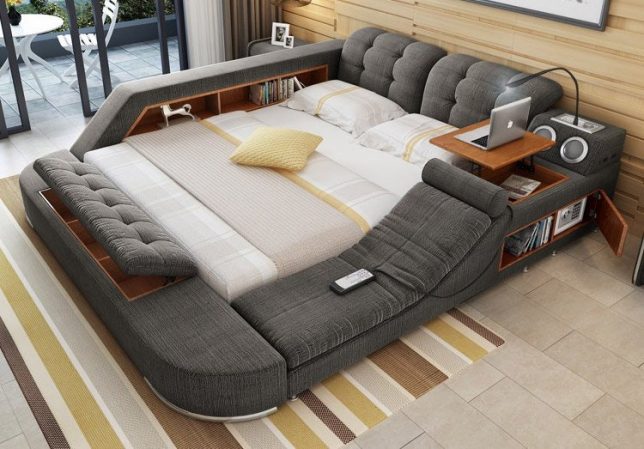
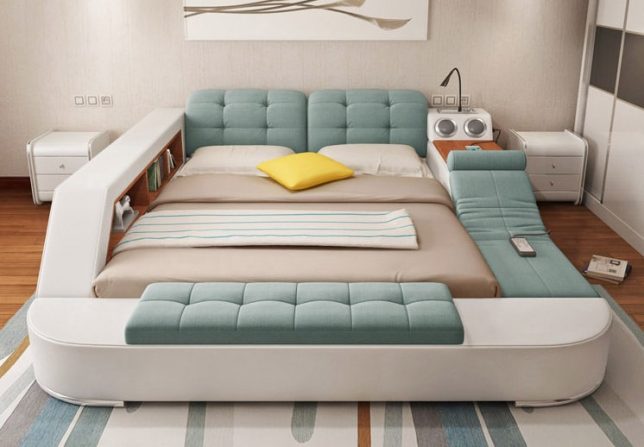
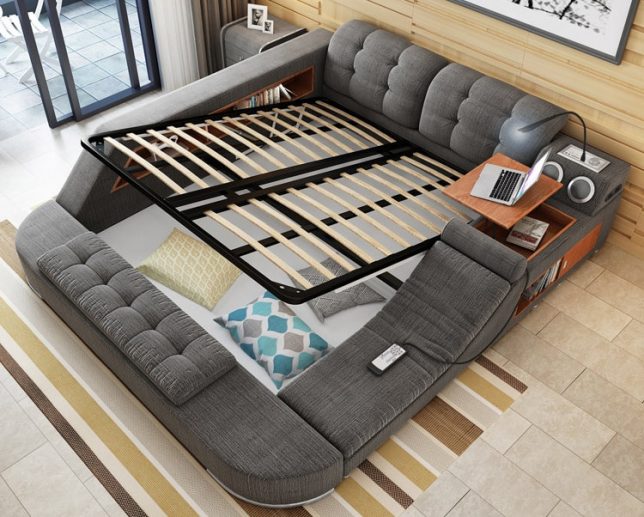
    It’s hard to imagine a more flexible and functional piece of furniture to spend a third of your life in than this one from Singapore, featuring an array of creature comforts and high-tech customizations.

    USB ports and plugs tie into charging and speaker systems for lounging around with tunes and devices, while an optional massage chair can help relax the restless before sleep.

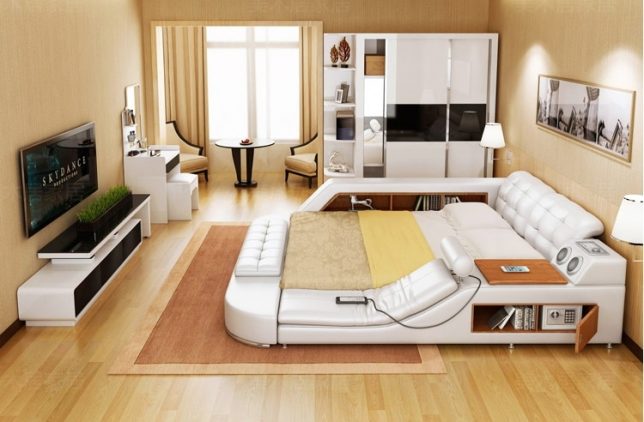
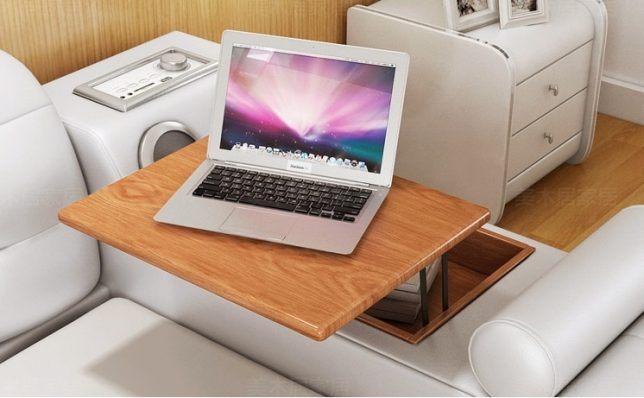
    An array of benches and loungers lets users lay down or sit up in any number of positions, while a fold-out desk attachment allow for laptop use as well. Storage options include a linen-and-pillow trunk beneath the bottom-of-bed bench and a built-in safe for valuables, plus a bunch of shelves and cabinets.

    Perhaps the best part: all of these features can be swapped out because the modules around the bed itself are not permanently fixed. Buyers can choose which ones they want to prioritize then surround themselves with choice luxuries accordingly.

    At $ 500 to $ 1000 depending on options, materials and finishes, they are pretty reasonably priced, too, though be sure to check the measurements: they are designed for the Asian market and shorter individuals, so tall people may want to consider them inspiration rather than potential purchases.

    Share on Facebook


    [ By WebUrbanist in Design & Furniture & Decor. ]

    [ WebUrbanist | Archives | Galleries | Privacy | TOS ]


    WebUrbanist

  • Why should you care about the Sony RX10 IV? Phase detection autofocus, that’s why

    The Sony RX10 IV is a fixed lens camera with a 1″-type sensor and 24-600mm equivalent lens that can shoot 4K video or stills at 24 fps, but that’s not what we think is interesting about it. The addition of phase detection autofocus is pivotal to all of those features. If you have a little over a minute to spare, we’ll tell you why. And for bonus points, we shot this video entirely hand-held with an RX10 IV and continuous AF turned on.

    Sony RX10 IV impressions, sample images and more

    Articles: Digital Photography Review (dpreview.com)

  • Photo of the week: Swimming with Humpback whales in Tonga

    $ (document).ready(function() { SampleGalleryV2({“containerId”:”embeddedSampleGallery_4526175605″,”galleryId”:”4526175605″,”isEmbeddedWidget”:true,”standalone”:false,”selectedImageIndex”:0,”startInCommentsView”:false,”isMobile”:false}) });

    Tonga is the only country in the southern hemisphere where you can actually swim with Humpback whales. Every year, starting around June/July, thousand of whales undertake the longest migration known, crossing half of the world to meet near the island of Tonga.

    Before this, the last time I had had the opportunity to see humpback whales was in Antarctica, but I had never had the opportunity to swim with them. We purposely decided to go early in the season, and so Craig Parry and I headed out to Vava’u, Tonga in July. Going early in the season meant less whales, but also less tourists visiting those islands—a prime time if we were hoping to increase the quality of our interactions. And I have to tell you… we got really lucky.

    Literally 3 minutes later, this young whale was swimming toward us, looking to play with us.

    On day two, while we were swimming with a mother and cub, we noticed a lone teenage whale playing around. We slowly approached him and gently slipped into the water, hoping not to scare him. Literally three minutes later, this young whale was swimming toward us, looking to play with us.

    A scary moment, you might say, when you realize that you can’t fit this airplane-sized animal into your fisheye lens. When his nose and tail are about to touch you… missing by just a few centimeters. This whale would swim in front of us, roll next to us and swim under us, only a few centimeters from our fragile human body.

    We understood that this animal meant no harm to us, and as this realization seeped in confidence replaced fear, and we literally spent the next 2 hours playing with this beautiful creature. Those two hours were magical, intimate, and powerful. Having previously shot whale sharks underwater, I didn’t believe Craig when he told me that I would constantly need an ultra-wide angle lens. I couldn’t have been more wrong, and both of the shots you are seeing were taken with a fish lens.

    We understood that this animal meant no harm to us, and as this realization seeped in confidence replaced fear, and we literally spent the next 2 hours playing with this beautiful creature.

    In fact, I used the following configuration for this trip: Aquatech underwater housing, Sony A7r II, and a 28mm with Fisheye adaptor (16mm). I also used the Sony 11-22mm.

    I decided to shoot 7 bracketed exposures in 0.3 stop increments, hoping to either get (1) A high dynamic range composition or (2) A correctly exposed photo (given how fast the whale was coming to us, I had no time to adjusting the metering of the camera). Regarding autofocus, those two lenses seems to focus too much on the picoplankton at wide aperture. Reducing the f-stop from F6.3 to F8 increased the amount of keepers. And finally, regarding shutter speed, I wouldn’t recommend going below 1/640s, given the movement of water and the speed at which the whale moves around.


    Josselin Cornou is an explorer, contemporary and landscape Photographer, and an addict of the unknown. He’s travelled all over the world capturing some of the most stunning photographs you’ve ever seen. You can find more of his work on his website or by following him on Instagram.

    Articles: Digital Photography Review (dpreview.com)

  • Sony packed serious phase detect AF into these new 4K palm-style camcorders

    If you’ve used a palm-style camcorder to try and film action at any point over the past several years, you’ve probably noticed an issue: most of these camcorders are god awful at finding and holding focus, usually relying exclusively on contrast detect AF or simply the deep depth-of-field their small sensors made requisite. Well, not anymore.

    Sony has just debuted three new 4K camcorders with advanced, relatively large sensors aimed at three different tiers of users. But all of them have one thing in common: blazing fast, 273-point phase detect autofocus systems similar to (and, in fact, a bit more advanced than) the system found in Sony’s new RX10 IV. More advanced because the camera allows you to further customize features like AF Drive Speed, Tracking Depth Range and Subject Switching Sensitivity to make sure you nail every shot. We’re also told the focus ramping is more sophisticated, if you ask the autofocus to rack between two subjects. The hi-res touchscreen LCD should make focus easy and intuitive as well.

    All three palm-style camcorders feature this same autofocus system, a 1-inch type stacked Exmor RS CMOS image sensor, and support 4K ‘Instant HDR’ recording using Hybrid Log Gamma (HLG) technology. However, not all three are meant for the same user. The AX700 is for serious amateurs, the NX80 for semi-pro video shooters, and the Z90V packs in some interesting broadcast capabilities such as XAVC L format recording, 3G SDI connectivity, and other features the support news reporting.

    Of course, at $ 1,900 for the ‘cheapest’ model, it was obvious from the get-go that Sony wan’t aiming for the entry-level crowd with this release.

    The most beginner-friendly model, the FDR-AX700, arrives in October for the aforementioned price of $ 1,900. The two higher-end models, the HXR-NX80 and PXW-Z90V, both arrive in December for $ 2,300 and $ 2,800 respectively. To find out more about any of these camcorders, read the press release below or visit the Sony 4K Palm website.

    Press Release

    Sony Unveils First Camcorders with Phase-detection AF

    Sony’s newest camcorders are its first to feature phase detection Auto Focus (AF), and expand its line of 4K and HDR-capable tools for shooting applications ranging from video enthusiasts to corporate and events to broadcast news and TV production.

    The three new palm-style models are the XDCAM PXW-Z90, the NXCAM HXR-NX80 and the Handycam FDR-AX700. The camcorders’ Fast Hybrid AF system ensures highly accurate focusing and tracking — especially useful during 4K shooting — delivered by 273 phase-detection AF points that cover approximately 84% of the shooting area, high-density placement of autofocus points and a newly developed AF algorithm. In movie recording mode, the appearance of phase-detection AF frames indicates the focused area and easily allows users to monitor a subject that is in focus.

    Each camcorder combines fast and reliable AF adapted for video shooting with a 1.0-type stacked Exmor RS CMOS image sensor. The new camcorders support 4K HDR recording with Hybrid Log-Gamma (HLG) offering an Instant HDR workflow to produce high-quality HDR content smoothly. The Instant HDR Workflow enables simple shooting, editing and viewing of HDR content in HLG, without the need for color grading during post production.

    The new camcorders feature a high-resolution OLED viewfinder (0.39-type OLED, 2,359k dots) and advanced touch screen operation, on the 3.5-type large LCD screen (1,555k dots), to allow users to quickly switch focus from one subject to another, while the AF Drive Speed, Tracking Depth Range and Subject Switching Sensitivity can all be configured as required for different subjects and content styles.

    Simple, multi-camera live production

    The PXW-Z90, HXR-NX80 and FDR-AX700 camcorders all work seamlessly with Sony’s MCX-500 live producer, a compact, cost-effective switcher that makes it easy for one operator to run a multi-camera live event. With the switcher and Sony’s RM-30BP controller, a Tally icon appears on each camera’s LCD panel and viewfinder. A red icon indicates when the shot is live (PGM) while Green indicates preview mode (NEXT).

    The MCX-500 supports mixing between eight video sources, four stereo embedded audio channels plus two XLR Inputs, and a dedicated Title Input, up to nine video inputs, and five stereo inputs including XLR. Internal recording and live streaming is also possible via Ustream, Facebook Live and YouTube Live.

    Users can also synchronize timecode among multiple camcorders using Sony’s free Content Browser Mobile 3.0 app with optional CBKZ-WTCL upgrade and devices running iOS® (9.0 – 10.3) or Android® (4.4 – 7.1) operating systems.

    Versatile Shooting Capabilities

    The new camcorders enable the following key technology and features to support versatile shooting, including:

    • 4K full-pixel readout without pixel binning using an enhanced BIONZ X™ image processing engine
    • Super Slow Motion recording up to 960fps, which is industry leading among palm categories and Slow & Quick Motion Full HD recording up to 120fps.
    • S-Log3/S-Gamut3 capabilities for users to create and work with images as they desire.
    • 29mm wide-angle ZEISS® Vario-Sonnar T* 12x optical zoom lens and 18x Clear Image Zoom
    • Less image distortion (rolling shutter phenomenon), in comparison to conventional models, when shooting moving subjects in motion

    Workflow efficiency benefits such as proxy recording, relay recording and simultaneous backup recording are also delivered thanks to the new camcorders’ dual memory card slots and multi-camera operation capabilities supported by TC (time code)/UB (user bit). The new camcorders also have REMOTE terminals, Multi-Interface Shoe™, and HDMI Type A for enhanced operability.

    The new models also feature dual XLR audio input, a detachable handle, and access to Content Browser Mobile a supporting smartphone application to enable Wi-Fi® monitoring, Camcorder remote control and wireless timecode sync between multiple cameras.

    The PXW-Z90 also includes several features to suit broadcast-specific production requirements: XAVC L format recording, which provides high-quality images at 4:2:2 10 bit (HD) and 4:2:0 8 bit (QFHD) in addition to conventional broadcasting MPEG2HD format recording; 3G SDI connectivity for compatibility with existing broadcasting equipment; and networking functions to support news reporting, such as compatibility with XDCAM® air, Sony’s cloud-based ENG subscription service. The HXR-NX80 and FDR-AX700 adopt XAVC S, an extended format of XAVC for consumer use.

    The following is planned availability and suggested list pricing for the new models:

    • FDR-AX700 – October 2017, $ 1,899 USD
    • HXR-NX80 – December 2017, $ 2,299 USD
    • PXW-Z90V – December 2017, $ 2,799 USD

    Articles: Digital Photography Review (dpreview.com)