Blog

  • Lens Rentals test shows all circular polarizing filters work great, price doesn’t matter

    Photo: Roger Cicala/Lens Rentals

    Our friend Roger Cicala over at Lens Rentals is at it again: buying up super expensive optical testing equipment because someone asked him why LR carries the circular polarizing filters they do. The answer, until now, was simple: make the expensive one on the market their high-end rental, and the cheapest one their “basic.” But is there really any difference?

    That’s what Roger set out to figure out, and the answer might save you a little bit of cash.

    You can read the full post and see all of the detailed results on the Lens Rentals blog, but the most surprising and positive conclusion was this:

    All circular polarizers, regardless of price, are 99.9% effective at polarizing light.

    Translation: if you’re looking for a circular polarizer because … well … you want to polarize light then save your money because the cheaper ones work just as well as the more expensive ones.

    In addition to their ability to do what they say they do, Cicala and LR team tested CP filters for overall transmission (how much light to they let through) and transmission by wavelength so you can see what effect each filter has on the colors your camera sees. Check out the results here.

    Articles: Digital Photography Review (dpreview.com)

  • The Profoto A1 is the ‘world’s smallest studio flash’ and Profoto’s first on-camera flash

    $ (document).ready(function() { SampleGalleryV2({“containerId”:”embeddedSampleGallery_4235413921″,”galleryId”:”4235413921″,”isEmbeddedWidget”:true,”standalone”:false,”selectedImageIndex”:0,”startInCommentsView”:false,”isMobile”:false}) });

    As expected after last week’s photo and specs leak, lighting manufacturer Profoto has launched an on/off camera flash unit called the Profoto A1. But if you were expecting a simple speedlight, Profoto is definitely branding this as more powerful than that. In fact, they’re calling it “the world’s smallest studio flash.”

    The new A1 is styled much like most on-camera flash units, but is equipped with the powerful features of a Profoto studio head. The 76Ws unit uses a lithium ion battery that is claimed to be good for up to 350 full power bursts and which charges in under 80 minutes. Profoto also says that the A1 recycles “four times faster than other on-camera solutions,” as it can emit a full power pop every 1.2 seconds.

    A stand-out feature of the A1 is its circular lens, which is said to produce light that is “natural and beautiful with a pleasing soft-smooth fall-off.” The rim of that circular lens housing is also magnetic, and accepts a range of clip-on modifiers that can be changed quickly and easily. The head offers a manually operated zoom function and the rear display is large and easy to read.

    The A1 heads are equipped with Profoto’s Air Remote TTL system so they can work in groups alongside other A1 heads or any other Air Remote studio heads from the Profoto studio head range. Finally, the A1 offers variable power over 9 stops in both standard and HSS modes, and includes an LED modeling light for previewing the effect of the flash or using on its own as a light source.

    The A1 is currently compatible with Nikon and Canon systems, and will be with Sony models in the future… but it doesn’t come cheap. As previously reported, the Profoto A1 will cost you $ 995 USD… quite the pretty penny when you compare it to some of the full-featured speedlights other options out there from brands like Godox.

    For more information on the Profoto A1, visit the Profoto website or watch the introductory video below.

    Press Release

    The world’s smallest studio light

    The Profoto A1 might be the smallest flash we’ve ever made, but it’s still built to the same impossibly high standards we’ve set ourselves over the last fifty years.

    Our focus with the A1 was to create a flash that delivers a truly high quality of light, which is why it features a round head which delivers light that’s both natural and beautiful with a pleasing soft-smooth fall-off, that blends seamlessly with the ambient light.

    Thanks to a smart magnetic mount built into the head, light shaping tools and modifiers can be clicked on and off quickly and easily. Within seconds you’re being creative with light, shaping it. It also has a zoom function that allows you to make fine adjustments to the spread of light by simply twisting the zoom ring on the head, and for accuracy it has a modeling light built-in to the head – so you can see what you’re going to get before you press the shutter.

    We made it our mission to make A1 the first on-camera flash that’s easy to use from the box. The user interface is simple and intuitive with a large high-contrast display at its center. The less time you spend learning and fiddling, the more time you’ll spend shooting. And that’s ultimately what counts. Despite its size, or lack of it, the A1 punches above its weight in a good number of key areas.

    Battery life is key when a photographer is right in the thick of the action, because the last thing they need to have to stop mid flow to change the batteries. The A1 has its own Li-ion high capacity battery built-in which lasts up to four times longer than AA batteries with no performance fade. So, you can shoot for longer with confidence.

    And this is a flash that can keep up with you because it recycles four times faster than other on-camera solutions – that’s every 1.2 seconds at full power. Put simply, you’ll never miss a shot.

    And while it’s true to say the Profoto A1 is our very first on-camera solution it’s also just as effective off-camera as a standalone unit, and integrated into a larger system of lights. That level of versatility is possible because Air Remote is built-in, which means the A1 offers seamless connectivity with freestanding lights like another A1 or bigger Profoto lights like the B1X.

    And with AirTTL you’ll get a perfect exposure super-fast. Better still, you can lock the exposure with a single ‘click’ while still being free to fine tune that exposure in manual, giving you even greater control.

    So, this is so much more than our smallest flash yet. This is shooting on the move, shooting with confidence and shooting with light shaping excellence. This is shooting off-camera and for the first time with Profoto, on-camera. This is the Profoto A1 – the world’s smallest studio light.

    Articles: Digital Photography Review (dpreview.com)

  • This is the story behind that tragic, viral photo of a seahorse holding a Q-tip

    Photo by Justin Hofman

    When photographer Justin Hofman snapped this photo while snorkeling off the coast of the Indonesian island of Sumbawa in 2016, he couldn’t have guessed the environmental impact the snapshot would have. A year later, the photograph is a finalist in the Wildlife Photographer of the Year competition, and has been dubbed “the poster child for today’s marine trash crisis.”

    Hofman is based out of California, but he travels all over the world leading wildlife expeditions. This photo was captured on one-such expedition in Indonesia.

    He was gleefully watching this seahorse bounce from natural object to natural object, hitching rides on the current, when something changed. Here’s a piece of the official image caption:

    “As the tide started to come in, the mood changed. The water contained more and more decidedly unnatural objects—mainly bits of plastic—and a film of sewage sludge covered the surface. The seahorse let go of a piece of seagrass and seized a long, wispy piece of clear plastic. As a brisk wind at the surface picked up, making conditions bumpier, the seahorse took advantage of something that offered a more stable raft: a waterlogged plastic cotton swab.”

    When Hofman shared the photo on his Instagram account last week, it received over 17K likes and 1,100 comments, but it’s a photo he wishes didn’t exist. “This sea horse drifts along with the trash day in and day out as it rides the currents that flow along the Indonesian archipelago,” he wrote on IG. “This photo serves as an allegory for the current and future state of our oceans.”

    A post shared by Justin Hofman (@justinhofman) on

    As for capturing the photo itself, we asked Hofman if he would like to share anything with our audience of photographers directly. This is what he had to say:

    The thing I would really like to tell photographers is to a) Listen to your gut and b) Don’t worry so much about gear.

    If you look at this encounter, on paper it doesn’t really make that much sense: I captured a photo of a 1 inch sea horse using a 35mm lens (16-35mm). Most people, if you had told them of the scenario would say to bring a macro lens. But I never have a macro lens on my camera. I am always afraid that a whale will swim by while I have a 105mm on, which would make it worthless. If I am unsure or just goofing off, I will always bring with me the most flexible lens I can. This ensures that whatever comes by, I have given myself the best opportunity possible to capture the moment.

    Of course there will always be sacrifices, but the flexibility is key. If I had had a macro lens, I can 100% assure you that this photo would not have been possible because we were both bobbing around too much to make a sharp macro shot possible. Even with a 35mm, I only have a handful of photos that are actually in focus.

    And in case you are curious about gear, he also shared that the photo was taken with an A7R II and Sony 16-35mm F4 lens in a Nauticam housing with a Sea and Sea 240mm dome and two Sea and Sea ys-d1 strobes.

    To see more of Hofman’s work, be sure to visit his website or give his account a follow on Instagram. And if you’d like to learn more about ocean conservation, Justin suggests you visit SeaLegacy.org.


    Photo by Justin Hofman and used with permission.

    Articles: Digital Photography Review (dpreview.com)

  • Report: Samsung is developing a 1,000fps mobile image sensor

    According to sources who spoke to Korean publication ETNews, Samsung is planning to kick its mobile camera technology up a notch with a 1,000fps smartphone camera sensor that will compete directly with Sony’s similar sensor. This technology is called a “3-layered image sensor,” and Samsung has reportedly ordered special equipment necessary to start producing the hardware in November. Smartphones featuring this technology, like the Sony Xperia XZ, can record super-slow-motion video.

    ETNews, which has a good track record in relation to Samsung leaks, claims that this 3-layered image sensor is comprised of TSV stacking technology alongside a DRAM chip and system semiconductor. Pilot production of the image sensors will start in October, the sources claim, followed by mass production in November. By comparison, Samsung currently uses 2-layered image sensors in its newest flagship smartphones.

    It is the DRAM chip for temporary data storage that will enable the mobile image technology to capture at 1,000fps, and as we mentioned earlier, Samsung won’t be the first company to develop this technology for mobile devices. Sony was the first to bring this 3-layered image sensor tech to commercial devices, though the sources say Samsung will use TSV stacking rather than thermal compression to avoid the costs that come with licensing other companies’ patents.

    Questions remain about which Samsung smartphones will receive the new 3-layered image sensors. Assuming mass production does start this November, it is reasonable to assume we’ll see the sensors implemented into the next batch of Galaxy smartphones the company will unveil in 2018.

    Articles: Digital Photography Review (dpreview.com)

  • Zenit’s full-frame mirrorless camera will use components made by Leica

    Following an announcement last month that camera maker Zenit would launch a full-frame camera in 2018, USSRPhoto claims the new Zenit model will be based on the Leica SL full-frame camera. Leica will reportedly make components for the Zenit based on the ones found in its Leica SL camera, but will tailor them specifically for the upcoming Zenit model.

    Little is known about Zenit’s plans at this time. In mid-August, an announcement that Zenit would return with a new camera was reportedly made on Moscow Region Radio 1. No camera specifications were provided aside from the fact that it will be a full-frame mirrorless model with a brand-recognizable design and an anticipated 2018 launch date.

    We know that the reborn Zenit company won’t try to compete with the industry’s biggest camera makers, and it was stated at the time that a “leading photographic equipment company” would be used to produce some of the new model’s components. That company wasn’t revealed, but assuming USSRPhoto’s leak is correct, it will be Leica.

    However, and in speaking to PetaPixel, USSRPhoto said the KMZ Zenit factory in Russia will itself produce the new lenses for this upcoming model, and that work on this project has already started. Though the factory isn’t capable of producing electronic components for the camera (hence Leica’s involvement) it does have the equipment necessary to make its own optics.

    Additional information—such as cost, specs, and a more specific release date—still haven’t been revealed.

    Articles: Digital Photography Review (dpreview.com)

  • Review: Nikon D7500 with 18-140mm Kit Lens

    The 7000 series of cameras from Nikon have been very popular since they were first introduced in 2010. It is a mid-range camera in their lineup but sits at the top end of the amateur level cameras. As with many of these cameras the new one in this series, the Nikon D7500 can also be purchased with a kit lens, this one came with the 18-140mm lens.

    Review: Nikon D7500 with 18-140mm Kit Lens

    The Nikon D7500 with the 18-140mm kit lens. Image courtesy Nikon Australia.

    The new D7500 is in the DX format or crop sensor camera. It has a 20.9 megapixel CMOS sensor and is said to be “equipped with a high-performance EXPEED 5 image-processing engine.” Nikon also claims that it is a good camera for video and that it supports 4K UHD. For more technical information please go to the Nikon website.

    Nikon D7500 out of the box

    When you first get the camera out you’ll notice it’s surprisingly light. I use a D800, so most cameras are light compared to that. However, the D7500 is a good size and feels nice in the hands. There is some weight to it, but it’s comfortable. When you have the camera, with the kit lens attached, hanging around your neck the weight doesn’t hurt you.

    They have made the grip deeper so it is easier to hold onto, and also more comfortable to hold. With some models, it feels like you are digging your nails into the camera, but that hasn’t happened with this one.

    Review: Nikon D7500 with 18-140mm Kit Lens

    Holding the Nikon D7500. Image courtesy Nikon Australia.

    Easy to use

    When it comes down to it, what you really want from a camera is one that is easy to understand and use. There is no doubt that you will find both of those with the Nikon D7500. In previous models you had to go into the menu to change some settings, a lot of them are now buttons on the camera. ISO is changed with one up near the shutter button. You can change aperture with the scroll wheel at the front and the shutter with the one at the back. It is easy for your fingers to find everything you need.

    ISO

    It has a high range and will go up to 51200 and the slowest speed is 100. It has enough of a range that would suit most people who want to take photos in both low light and on sunny days.

    With images taken at 12800 during a night show at Sovereign Hill you can see noise in the images, which is to be expected, but the amount isn’t that bad that the images are not useable. When compared with what older cameras did at ISO 3200, this camera takes a good image at the higher ISOs with much less noise as on other models. It fits in with many of Nikon’s cameras for using in low light.

    leannecole-nikon-d7500-review-66

    The Winter Wonderland at Sovereign Hill was dark and to get images the ISO was put up to 12800.

    Autofocus

    Nikon has worked on the autofocus features with the D7500 and it is fast. You can track subjects and get fast focusing to get sharp images of whatever you are trying to capture. It doesn’t take long to get any subject in focus. It means you can work quickly, especially if you like doing street photography or something else where fast autofocus is needed.

    Touch screen

    Like most new cameras it does come with a touch screen which makes accessing sections in the menu easier and faster. You can just click on what you need. You can also use your fingers to scroll through the images you have taken. It turns the menu into a series of buttons, so you can move around it much faster and find what you need to make any necessary adjustments.

    Review: Nikon D7500 with 18-140mm Kit Lens

    Another night image that was hand held and taken with ISO 128000.

    LCD screen

    The screen at the back is tiltable (it’s not full articulating) so you can change it when you want to use Live View. This is especially good for places where you have strange camera angle, for example, when you are photographing something that is close to the ground. You can put the camera in Live View mode, and then tilt the screen so you can see what you are shooting without having to get down on the ground as well.

    Live View is really good, though you always need to be careful with how quickly it can drain the battery. Without a doubt, you will use the battery faster if you use this mode all the time. If you use the viewfinder instead the battery will last a lot longer and you will get plenty of photos.

    Review: Nikon D7500 with 18-140mm Kit Lens

    This image was taken at Abbotsford Convent.

    DoF preview button

    It has been pointed out that the current model, the D7500, does not have a depth of field preview button (shows you what your image will look like with your selected aperture). Though it seems that many cameras are now removing this feature. It is not something that I either use or have looked for in a camera, but if it is an important aspect in your photography then it may be a problem for you.

    Long exposure photography

    You can use any DSLR camera for long exposures, and this one is no different. The images come out very sharp and you get the great effects that you would normally expect. One part that was surprising to me was using Live View with an ND filter on the camera, I could still see the scene. Many Nikon cameras do not do that. When the filter is on you can’t see anything, and you need to remove it to refocus and recompose. This is a great added advantage and makes taking long exposure images that much easier.

    Review: Nikon D7500 with 18-140mm Kit Lens

    Long exposure taken at Banyule Flats using the D7500 and the 18-140mm kit lens.

    Snapbridge

    The camera has wifi, Bluetooth and Snapbridge. You can now connect your camera to your phone and get photos to instantly publish on social media. In other cameras the Snapbridge hasn’t worked well with Android phones, but with the D7500 I had no trouble getting my phone to find it and download images. It worked really well, and so far the best experience I’ve had with this app.

    The 18-140mm kit lens

    This is an interesting lens to include in a kit and many people would be really interested in it. The usual 18-55mm has been replaced with this one. It is a good choice for most people who are starting out with photography.

    It has an aperture of f/3.5 at 18mm and when you zoom to 140mm the aperture range starts at f/5.6. It is much the same as other lenses of this type. For most photography, you are not going to want to go wider than those. It is a kit lens and you aren’t going to get something really amazing. If you want higher quality you need to buy the body separately and then get a lens separately.

    Review: Nikon D7500 with 18-140mm Kit Lens

    The kit lens takes pretty good images of flowers up close. Not quite as close a macro lens, but fairly good.

    Most lenses for cropped sensors are of a similar quality. The images from this lens appear sharp and the quality is good. While testing this camera and lens the combination was used for night photography, long exposures, walking around, and some macro. It performed well in all circumstances.

    The lens does have Nikon’s Vibration Reduction or VR, which a lot of users now want. Though you can choose to turn it off, which you should do if you are using the camera on a tripod. You also don’t have to use this function.

    I tend to turn VR off on my lenses so I don’t leave it turned on when using my tripod. I haven’t found it a problem, but if find that your images have some movement, or you have trouble holding the camera very still then you may find it easier to keep it turned on.

    Review: Nikon D7500 with 18-140mm Kit Lens

    This image was taken as walking around the city.

    Who would buy this camera and lens?

    The Nikon D7500 is the top level amateur or non-professional camera that Nikon makes. It is for serious amateurs who want to get the best out of their photography, but can’t quite justify the extra expense of a full frame camera.

    It would suit someone looking for a second camera after learning how to take photos with one of the entry level Nikon cameras, like one of the D3000 series models. It is a good step up and there are many features that the D7500 is capable of that the others aren’t.

    There is no reason why someone who is new to photography shouldn’t purchase it either. It would be an ideal camera to learn and experiment with as you grow into the camera. The kit lens will also give you a lot of room to advance as well.

    Review: Nikon D7500 with 18-140mm Kit Lens

    Another long exposure that was taken with the D7500 and the 18-140mm lens

    Price

    Amazon has the Nikon D7500 body listed at $ 1246.95, and if you want to buy the kit with the 18-140mm you can get it for $ 1546.95.

    Conclusion

    Overall, the Nikon D7500 would suit someone who is fairly serious about their photography and wants to get the most out of their camera. Someone who wants to take a lot of photos and also wants a model that is capable of doing many different types of photography. It is a camera that will do everything you want it to and you won’t be disappointed.

    The post Review: Nikon D7500 with 18-140mm Kit Lens by Leanne Cole appeared first on Digital Photography School.


    Digital Photography School

  • Instagram is testing a four-photo grid, and some users are freaking out

    Facebook-owned image sharing behemoth Instagram (heard of ’em?) is testing a new change to its app, and the internet is collectively freaking out about it. According to some users, Instagram is already rolling out a new 4-across profile grid to replace the current 3-across setup that people know and (apparently) love.

    Not a huge deal, you might think, but many photographers and casual users alike use that 3-across grid to create interesting mosaics that help their profile stand out. And those people are not reacting well to news of the test:

    Of course, by now Instagram is used to these kinds of reactions—it seems like every change they make is met by a deluge of fear, anxiety and threats of abandonment. The algorithmic feed has been a boon for the company, but it set the community into a panic; and even smaller changes like the ability to block comments automatically or by keyword are usually met with at least some skepticism.

    But for those photographers who have built their Instagram ‘brand’ in part by making creative use of the 3-across grid on their profile, this change would represent a swift kick to the mosaic.

    Articles: Digital Photography Review (dpreview.com)

  • Zero-Carbon, All Bamboo Sports Hall Features Organic 50-Foot Trusses

    [ By WebUrbanist in Architecture & Public & Institutional. ]

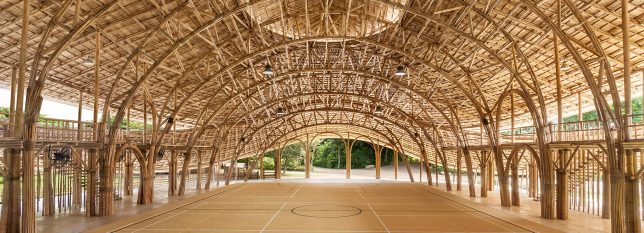
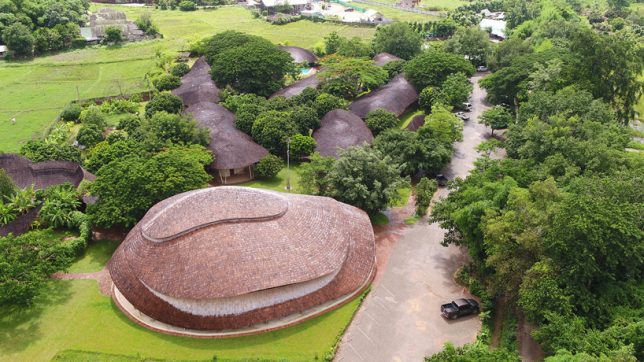
    A new sports hall in Thailand highlights the aesthetic power and physical strength of bamboo, a flexible and fast-growing natural material. In total, more carbon is captured in the bamboo than was used to treat, transport and use it for construction, rendering its carbon footprint neutral.

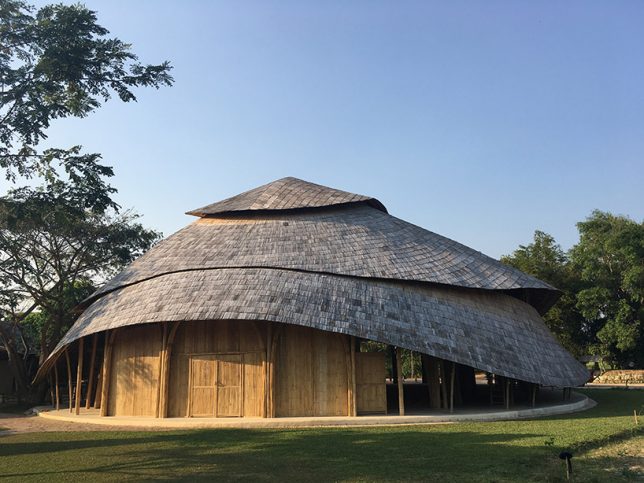
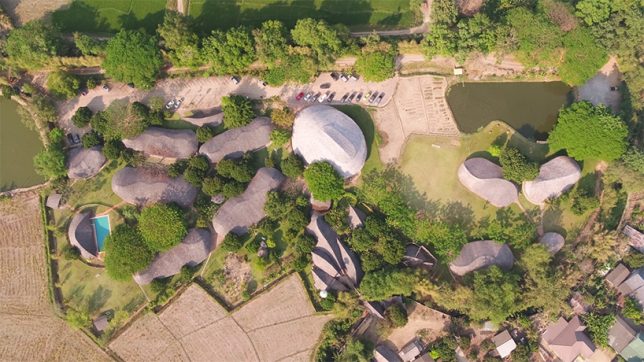
    Located at the Panyaden International School in the Chiang Mai province, the new building was designed by Chiangmai Life Architects, a firm specializing in natural materials like bamboo and rammed earth.

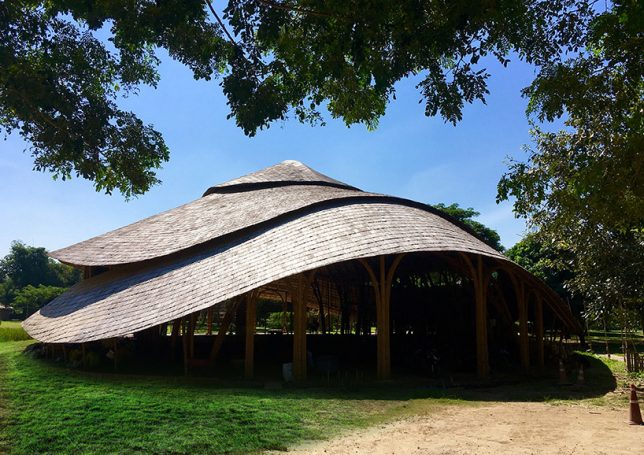
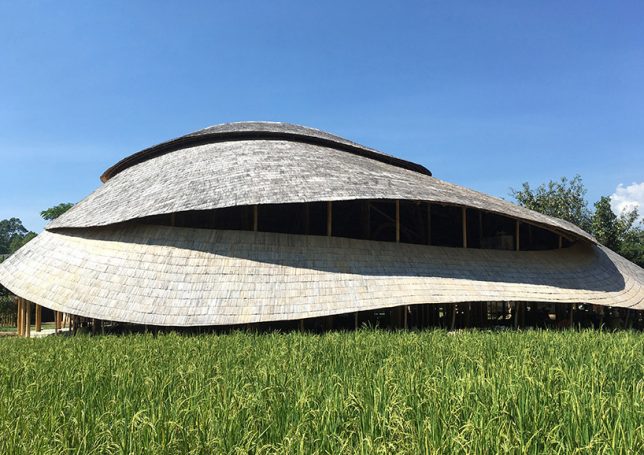
    The symbolic design was inspired by the lotus, an important Buddhist and Thai symbol. Its natural materials tie it to scenic surroundings while open sides allow for passive ventilation for cooling purposes.

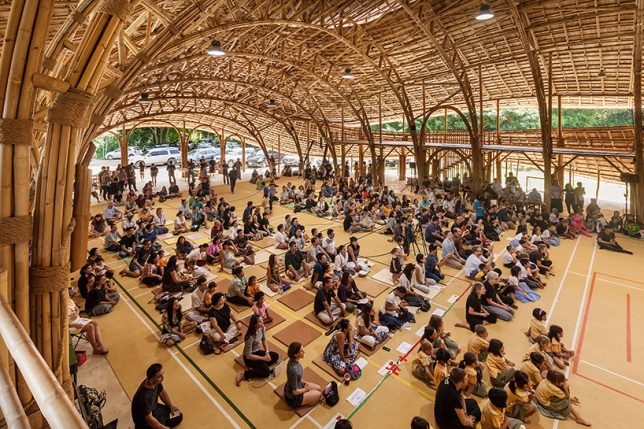
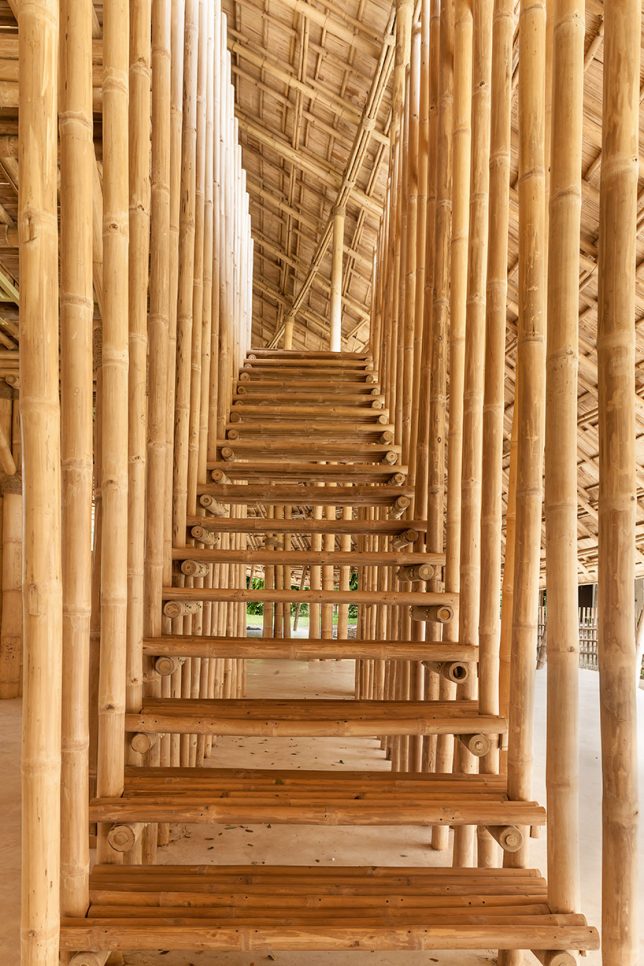
    Despite its organic appearance, the structure is engineered to resist earthquakes, high-speed winds and other forces of nature.

    The complex is able to accommodate 300 students, spanning over 8,000 square feet, and is used to host games of basketball and futsal, a variation on soccer that takes place in a court. It can also be used for student gatherings and visiting speakers.

    Like wood, bamboo is becoming an increasingly appealing material for architectural construction thanks to its rapid growth rate and ability to sequester carbon — the natural look and feel are a nice touch, too.

    Share on Facebook


    [ By WebUrbanist in Architecture & Public & Institutional. ]

    [ WebUrbanist | Archives | Galleries | Privacy | TOS ]


    WebUrbanist

  • Video: 10 Hot Tips for Better Landscape Photography

    Do you enjoy landscape photography and want to take your work to the next level? Here are 10 hot tips to help you do that.

    10 Landscape Photography Tips

    Recap of the tips

    1. Planning is key – How to Find the Best Locations for Landscape Photography
    2. Location – arrive early to be prepared.
    3. Composition – try the rule of thirds or advanced techniques.
    4. Use a tripod.
    5. Prepare your camera gear – take care of it when on location.
    6. Focus using the hyperfocal distance.
    7. Set your exposure – use the histogram, exposure compensation, or even bracket if necessary.
    8. Aperture – set it to get a wide depth of field.
    9. Avoid camera shake by using a remote or the self-timer in your camera.
    10. Filters – using a polarizer and/or ND graduated filters can enhance your landscape photography.

    Do you have any other landscape tips you could add to this list for any newbies? Please share in the comments below.

    The post Video: 10 Hot Tips for Better Landscape Photography by Darlene Hildebrandt appeared first on Digital Photography School.


    Digital Photography School

  • Weekly Photography Challenge – Landscape

    photography, tips, apps, landscape, iOS, Android, Pete DeMarco

    Landscape image by  © Pete DeMarco

    Weekly Photography Challenge – Landscape

    Landscape is one of the most popular genres of photography. So it should be easy to participate in this week’s photography challenge. Show us your favorite landscape photos, use all your skills and techniques to make the best images possible.

    Here are links to a few articles if you need help:

    • 6 of the Best Smartphone Apps for Travel and Landscape Photography
    • 5 Composition Tips for Landscape Photography
    • The dPS Ultimate Guide to Landscape Photography
    • Tips for Processing Landscape Photos – from Basic Edits to Artistic Interpretation
    • How to Process a Black and White Landscape Photo Using Lightroom

    Share your images below:

    Simply upload your shot into the comment field (look for the little camera icon in the Disqus comments section) and they’ll get embedded for us all to see or if you’d prefer, upload them to your favorite photo-sharing site and leave the link to them. Show me your best images in this week’s challenge. Sometimes it takes a while for an image to appear so be patient and try not to post the same image twice.

    Photo by Rob Bates on Unsplash

    Share in the dPS Facebook Group

    You can also share your images on the dPS Facebook group as the challenge is posted there each week as well.

    The post Weekly Photography Challenge – Landscape by Darlene Hildebrandt appeared first on Digital Photography School.


    Digital Photography School