Blog

  • Nikon D850 Review

    Nikon D850 Review

    The Nikon D850 is Nikon’s latest high resolution full-frame DSLR, boasting a 46MP backside-illuminated CMOS sensor. But, in a fairly radical departure for the series, it is also one of the company’s fastest-shooting DSLRs. This combination of properties should significantly widen the camera’s appeal to high-end enthusiasts as well as a broad range of professional photographers.

    Key Specifications:

    • 45.7MP BSI CMOS sensor
    • 7 fps continuous shooting with AE/AF (9 with battery grip and EN-EL18b battery)
    • 153-point AF system linked to 180,000-pixel metering system
    • UHD 4K video capture at up to 30p from full sensor width
    • 1080 video at up to 120p, recorded as roughly 1/4 or 1/5th speed slow-mo
    • 4:2:2 8-bit UHD uncompressed output while recording to card
    • 1 XQD slot and 1 UHS II-compliant SD slot
    • Battery life rated at 1840 shots
    • 3.2″ tilting touchscreen with 2.36M-dot (1024×768 pixel) LCD
    • Illuminated controls
    • 19.4MP DX crop (or 8.6MP at 30fps for up to 3 sec)
    • SnapBridge full-time Bluetooth LE connection system with Wi-Fi
    • Advanced time-lapse options (including in-camera 4K video creation)

    High resolution

    The use of a backside illuminated (BSI) sensor means that the light collecting elements of the sensor are closer to the surface of the chip. This should not only increase the efficiency of the sensor (improving low light performance) but should also be expected to make the pixels near the edges of the sensor better able to accept light approaching with high angles of incidence, improving peripheral image quality.

    Like the D810 before it, the D850 continues to offer an ISO 64 mode, that allows it to tolerate more light in bright conditions. We will be testing whether this gives the D850 the same dynamic range advantage as the D810, as soon as a production version arrives but our initial quick looks suggests it does, meaning it should be able to compete with the medium format sensors used in the likes of the Fujifilm GFX 50S and Pentax 645Z.

    A BSI sensor with ISO 64 setting should be able to match the D810’s low ISO DR while also offering improved performance in at high ISOs.

    The D850 has gained a more usable electronic front curtain shutter option (EFCS), which can now be used quiet shutter modes, as well as live view and Mirror-Up mode. To get the full benefit, though, you need to turn on exposure delay (which has had two sub-second delay settings added). However, exposure delay persists across all shooting modes. Thankfully, and presumably thanks to a redesigned shutter and mirror mechanism, our quick check with a pre-production model suggests that mirror/shutter shock may not be much of an issue, even without engaging it EFCS.

    The D850 has no anti-aliasing filter, which should allow for slightly finer detail capture but with added risk of moiré, if any of your lenses are sharp enough to out-resolve a 45.7MP full-frame sensor. There’s still no sign of the clever design Nikon patented so, unlike the Pentax K-1 or Sony RX1R II, you can’t engage an anti-aliasing effect if you do find false color appearing in densely patterned areas.

    High Speed

    In addition to the increased speed, the D850 also gains the full AF capabilities of the company’s flagship sports camera: the D5. This includes all the hardware: AF module, metering sensor and dedicated AF processor, as well as the full range of AF modes and configuration options, which should translate to comparable focus performance combined with high resolution.

    Given the D5 possessed one of the best AF systems we’ve ever seen and could continue to offer that performance in a wide range of conditions and shooting scenarios with minimal need for configuration, this is an exciting prospect.

    As part of this system, the D850 gains the automated system for setting an AF Fine Tune value. It only calibrates the lens based on the central AF point and for a single distance, but it’s a simple way to ensure you’re getting closer to your lenses’ full capabilities, which is handy given you’ll now be able to scrutinize their performance with 46MP of detail.

    Add the optional MB-D18 battery grip and an EN-EL18b battery, and the D850 will shoot at 9 frames per second.

    Impressively, the D850 can shoot at nine frames per second if you add the optional MB-D18 battery grip and buy an EN-EL18b battery, as used in the D5. As well as increasing the camera’s burst rate, this combination also ups the battery life to a staggering 5140 shots per charge. You don’t get this same boost in speed or endurance if you use a second EN-EL15a in the grip, though.

    An MB-D18 plus an EN-EL18b is likely to set you back over $ 580 over and above the cost of the camera body ($ 399 for the grip, around $ 149 for the battery, $ 30 for the BL-6 battery chamber cover plus the cost of a charger).

    The D850 also includes a sufficiently deep buffer to allow fifty-one 14-bit losslessly compressed Raw files, meaning the majority of photographers are unlikely to hit its limits.

    Video capabilities

    In terms of video the D850 becomes the first Nikon DSLR to capture 4K video from the full width of its sensor. The camera can shoot at 30, 25 or 24p, at a bitrate of around 144 Mbps. It can simultaneously output uncompressed 4:2:2 8-bit UHD to an external recorder while recording to the card. Our initial impression is that the video is pixel-binned, rather than being resolved then downsampled (oversampling), but we’ll be checking on this as part of the review process. This risks lowering the level of detail capture and increases the risk of moiré, though it’s a better solution than line-skipping. There also seemed to be a fair amount of rolling shutter, but again these are only first impressions from a camera running non-final firmware.

    At 1080 resolution, the camera can shoot at up to 60p, with a slow-mo mode that can capture at 120 frames per second before outputting at either 25 or 24p. The 1080 mode also offers focus peaking and digital stabilization, neither of which are available for 4K shooting.

    The D850’s tilting rear screen will make video shooting easier, though we doubt many will use its contrast-detection tap-to-focus system when they do.

    The D850 doesn’t have any Log gamma options for high-end videographers, but it does have the ‘Flat’ Picture Profile to squeeze a little extra dynamic range into its footage, without adding too much to the complexity of grading. It also offers full Auto ISO with exposure compensation when shooting in manual exposure mode, meaning you can set your aperture value and shutter speed, and let the camera try to maintain that brightness by varying the sensitivity.

    As you’d expect from a camera at this level, the D850 also includes the Power Aperture feature that allows the camera to open and close the lens iris smoothly when in live view mode. There’s also an ‘Attenuator’ mode for the camera’s audio capture, that rolls-off any loud noises to avoid unpleasant clipping sounds.

    Articles: Digital Photography Review (dpreview.com)

  • DxO offers Android model, adds Facebook Live support and battery grip to One camera

    $ (document).ready(function() { SampleGalleryV2({“containerId”:”embeddedSampleGallery_8121173966″,”galleryId”:”8121173966″,”isEmbeddedWidget”:true,”standalone”:false,”selectedImageIndex”:0,”startInCommentsView”:false,”isMobile”:false}) });

    DxO has announced version 3.0 of the iOS app for its ‘One’ connected camera as well as a beta USB-C Android version of the device. This significant upgrade adds support for Facebook Live broadcasting, with the ability to utilize the iPhone’s built-in camera(s), as well as the one on the One (no pun intended). The new software allows users to monitor each camera separately, adjust settings as needed and then effortlessly switch from one to another.

    The update also brings with it support for video and still time-lapses. The One uses ‘Auto Ramping’ to maintain white balance and exposure throughout the sequence in order to avoid ‘flicker.’ Still images can be saved in Raw format and can also be combined to create a 4K video.

    New accessories include a battery pack, which holds up two batteries (each adding 1 hour of ‘life’), a tilt stand and a ‘cable back door’ that allows for extended shooting when using the outdoor housing.

    Android users who have been waiting for a One of their own, take note. DxO has developed a One for tablets and smartphones and will be starting an ‘Early Access’ program in the next several weeks. The Android version uses a USB-C connector that may limit compatibility to those with the newest smartphones, though we’ve reached out to DxO to see if a microUSB adapter will work.

    The new firmware for iOS is available immediately from the App Store. The battery pack is $ 50 while the tilt-stand and cable back door are available at no charge.

    The DxO ONE now supports Multi-Camera Facebook Live and Time-Lapse features as well as new accessories and an Early Access Program for Android

    The latest free iOS app update, available free of charge, opens up a number of new opportunities for using the DxO ONE remotely and autonomously, transforming the camera into the perfect photo and video accessory for your iPhone

    PARIS – October 16, 2017 – DxO, a key player in digital image technologies, announced a major update to the DxO ONE, its miniaturized and connected professional-quality camera for smartphones and tablets. Available immediately and free of charge, version 3.0 of the DxO ONE iOS app offers the first pro-quality multi-camera solution for Facebook Live and a new time-lapse option featuring exclusive Auto Ramping technology. The DxO ONE ecosystem of accessories now includes an external Battery Pack that doubles the camera’s battery life as well as a Cable Back Door for the device’s waterproof case, allowing you to use the DxO ONE outside or even underwater for extended periods.

    “While smartphones have made significant progress in terms of image quality, they don’t come close to the photos and videos a real camera like the DxO ONE can offer. Most importantly, you have to hold them in your hand, and you constantly need them for other things, like making calls, sending messages, or checking your social networks,” explains Jérôme Ménière, DxO’s CEO and founder. “The DxO ONE is the first photo and video camera designed to operate as both a handheld and remote device. It’s even able to function remotely over a long period of time — for example, you can use it outside to record a time-lapse or Facebook Live video. Because it works in perfect harmony with your smartphone, it is the ideal photo and video assistant for this device.”

    Multi-Camera Facebook Live capabilities: the ultimate solution for broadcasting professional-quality videos

    With its iOS application update to version 3.0, the DxO ONE revolutionizes video publication using Facebook Live by allowing users to instantly and easily create a live video stream. Its revolutionary Multi-Camera mode, which leverages the DxO ONE and both iPhone cameras, gives users the ability to experiment with shots that can’t be captured with the iPhone’s cameras alone, making it easy to create professional-quality video streams.

    DxO ONE’s Live Facebook solution offers a set of advanced controls, including a mini-control panel that allows the user to preview all three views to compose shots, adjust lighting, or prepare the subject before shooting and streaming live from different angles. Just like filmmakers, users can switch from one camera to another at the touch of a fingertip, as well as record sound from the DxO ONE’s or the iPhone’s built-in microphone, and switch the sound source during playback.

    Wi-Fi control also allows users to control the camera remotely while also sending videos over Wi-Fi or 4G, making it easy to experiment with new compositions. And with its large sensor and ultra-bright optics, the DxO ONE offers a natural bokeh that allows users to capture high-quality video.

    Stunning, ready-to-share time-lapse videos

    Version 3.0 of the DxO ONE iOS application’s Time-Lapse feature lets you capture stunning videos and share them without going through a complex post-processing process. The easy-to-use interface guides users through the appropriate settings — duration, interval, and time of shooting — and warns them if their selected settings are incompatible. DxO ONE’s unique Auto Ramping technology avoids flicker effects by providing consistent exposure and white balance across all images. Once the settings are established, the phone can be used normally while the camera continues to take pictures. The videos it produces can then be shared immediately.

    In addition, the DxO ONE iOS 3.0 application’s Time-Lapse feature uses an intervalometer, transforming the camera into an automatic camera that periodically takes professional-quality images in RAW format at a user-defined rate. Advanced users can also create 4K videos in post-processing.

    For long-term use no matter the weather and even underwater, the Cable Back Door connects the DxO ONE to an external battery when the camera is used with the Outdoor Shell — a must-have combination for superb outdoor video and time-lapse imaging.

    New accessories for optimizing the DxO ONE experience

    The new Battery Pack extends the DxO ONE’s battery life. It includes a Cradle, two rechargeable batteries, and a USB adapter. The Cradle attaches to the bottom of the DxO ONE once the back door has been removed so you can connect either one of the two batteries or the USB adapter. Each battery adds up to one hour of battery life, and the USB adapter allows the DxO ONE to be recharged directly from an external battery.

    The new Tilt Stand lets you hold the camera on any surface and choose between five different tilt directions as well as different angles of view, greatly facilitating use of the DxO ONE in standalone mode, or for hands-free remote use when controlled by Wi-Fi.

    DxO seeks out Android users

    Building on the success of its DxO ONE for iOS, DxO has developed a DxO ONE for Android equipped with a type-C USB connector, making it compatible with recent Android smartphones and tablets.

    The DxO ONE Android will be offered in the coming weeks via an “Early Access” program that is open to all. It will allow users to preview the DxO ONE Android and receiving regular updates with the latest application features. The Early Access program will be an opportunity for participants to share their feedback and help improve the DxO ONE experience on Android.

    “Since its launch, we have added dozens of features to the DxO ONE, thanks to feedback from users,” said Jean-Marc Alexia, Vice President of Product Strategy. “Today, DxO is responding directly to one of the most frequent requests by launching the Android version, and we will continue to listen to market needs. “

    Price & availability

    Version 3.0 of the DxO ONE iOS application, along with the application for the Apple Watch, are immediately available for free via the iTunes App Store.

    Version 1.0 of the DxO ONE Android will be available for free in the coming weeks via the Google Play Store, as part of the “DxO ONE Android Early Access program”.

    The Battery Pack ($ 59,99 | £49.99 | 59,90 €) will be available at dxo.com.

    The Cable Back Door will come with any purchase of a waterproof Outdoor Shell from DxO’s online store.

    The Tilt Stand will be provided with the DxO ONE free of charge.

    Articles: Digital Photography Review (dpreview.com)

  • Ten Times a Backup Power Bank Will Really Save the Day

    Warning: preg_replace(): The /e modifier is no longer supported, use preg_replace_callback instead in /home/forge/content.photojojo.com/content.photojojo.com/wordpress/wp-content/plugins/ozh-better-feed/inc/feed.php on line 134


    Photojojo

  • Canon’s PowerShot G1 X Mark III is a 24MP APS-C compact with DSLR-like autofocus

    $ (document).ready(function() { SampleGalleryV2({“containerId”:”embeddedSampleGallery_0385914408″,”galleryId”:”0385914408″,”isEmbeddedWidget”:true,”standalone”:false,”selectedImageIndex”:0,”startInCommentsView”:false,”isMobile”:false}) });

    Canon has introduced the PowerShot G1 X Mark III – the third and latest model in its premium G1 X-series. The G1 X Mark III borrows its 24MP APS-C sensor, Dual Pixel AF system and DIGIC 7 processor from Canon’s ILCs, such as the EOS 77D and EOS M5, but adds a fixed 24-72mm equivalent F2.8-5.6 zoom and combines them into a relatively compact body weighing just 400g/14oz. In other words, you’re essentially getting a fixed-lens version of the EOS M5 that fits in the palm of your hand.

    We’re already familiar with the sensor and the Dual Pixel AF system and as such, we’re hoping for good results from both. The lens has nine elements, three of which are double-sided aspherical, a built-in three-stop neutral density filter and image stabilization with up to four stops of shake reduction.

    The Mark III can shoot continuous bursts at up to 9 fps with AF/AE locked on the first shot or 7 fps with continuous AF. The buffer fills up after around 19 Raw or 24 JPEGs, depending on which mode you’re using. Battery life is disappointing, with a CIPA rating of only 200 shots per charge (which assumes you’re using the flash 50% of the time). So, while you’ll usually get more than this number from the camera, you’re still likely to appreciate a second battery or get used to constantly worrying about where your next top-up is coming from.

    The Mark III moves away from the blocky design of its predecessors, and now looks nearly identical to its baby brother the PowerShot G5 X, which uses a much smaller 1″-type sensor. The G1 X III has an SLR-style design, featuring dials on the front and back, a built-in flash, an OLED viewfinder and fully articulating LCD. Canon says that the shutter release has been designed in such a way to make it feel similar to a DSLR. The body is sealed against dust and moisture.

    Other features include 1080/60p and time-lapse video capture, Wi-Fi with NFC and Bluetooth, and (long overdue in our opinion) a Panoramic Shot Mode.

    The PowerShot G1 X Mark III is set to ship in November at $ 1299. Optional accessories include a dedicated lens hood ($ 59), underwater housing ($ 499) and leather case ($ 99).

    CANON ANNOUNCES THE NEXT EVOLUTION OF ITS POPULAR G-SERIES CAMERA – THE POWERSHOT G1 X Mark III

    The New Flagship G1 X Mark III PowerShot Camera Features the Largest Imaging Sensor Ever in a Canon Point-and-Shoot Camera

    MELVILLE, N.Y., October 16, 2017 – Canon U.S.A., Inc., a leader in digital imaging solutions, today announced a new flagship addition to its acclaimed G-series of premium compact cameras, the Canon PowerShot G1 X Mark III. Lightweight and portable without sacrificing the very best in Canon digital imaging technologies, the new G-series flagship features a 24.3- megapixel* APS-C CMOS sensor and Canon’s revolutionary Dual Pixel CMOS AF (Auto-Focus) technology, both firsts for a Canon point-and shoot compact camera offering.

    “As we continue to evolve the popular Canon PowerShot G-series line, we remain committed to incorporating both our latest innovations and the features photographers are looking for in an advanced, compact camera,” said Yuichi Ishizuka, president and COO, Canon U.S.A. “With the new PowerShot G1 X Mark III, users will appreciate the quality and overall performance made possible using a APS-C sensor, alongside upgraded capabilities that can enable the capture of amazing photo and video, even in lowlight conditions.”

    Ultimate in Compact Image Quality

    The new Canon PowerShot G1 X Mark III offers dramatic improvements from the series’ previous flagship, the PowerShot G1X Mark II, headlined by a larger, 24.3-megapixel APS-C CMOS sensor, resulting in fantastic image quality in both stills and video. This dramatic sensor upgrade pairs with a wide-angle 24-72mm** (3x zoom) lens with Optical Image Stabilization featuring a wide f/2.8-5.6 aperture to allow for maximum brightness and increased sharpness in images and an ISO range of 100-25,600. This provides users with the versatility to shoot in low-light scenarios like a dimly lit restaurant which can frame subjects with beautiful background blur.

    Technology commonly found in Canon DSLRs and advanced cameras has now arrived for the first time in the PowerShot G-series, as the G1X Mark III will feature Canon’s acclaimed Dual Pixel CMOS AF system. This feature, popular amongst enthusiast and professional users, provides extremely fast and smooth autofocus capabilities across nearly the entire focal plane, allowing for more creative compositions when framing a subject away from the center of a shot.

    Versatile and Intuitive Operation

    Dust and water resistant, the Canon PowerShot G1 X Mark III is a compact and powerful imaging companion ready for a variety of challenging shooting scenarios. Designed for enthusiast and professional users, it offers a host of useful features to help inspire creativity and improve operability. These include:

    • 2.36 million dot Organic LED Electronic Viewfinder provides customization options to match nearly any shooting style or scene
    • Touch & Drag AF allows for intuitive operation linking the Electronic Viewfinder and touch panel monitor to quickly adjust focus targeting without looking away from the viewfinder, or using Smooth Zone AF to effortlessly track subjects with the touch of a finger.
    • 3.0 inch Vari-angle Touch LCD Monitor helps capture the perfect shot from a variety of challenging angles, including overhead or low-angle shooting.
    • The G1 X Mark III is capable of fast continuous shooting up to approximately 7 frames per second (fps), or up to 9fps with AF fixed – working easily with Dual Pixel CMOS AF to track even the most fleeting of subjects with ease.
    • A New Shutter Release function offers a sophisticated sense of operation, similar to high-end EOS models, providing a comfortable hold during continuous shooting

    Canon Technologies Worthy of a Flagship

    With technology ranging from HD video capabilities to the latest in connectivity features, the G1 X Mark III is versatile enough to achieve high-level performance on the go. Additional features include:
    • Instantly connect to a smart device* via built-in Wi-Fi***, NFC^ or Bluetooth^^ to facilitate easy sharing with friends and family or utilize the Camera Connect app to shoot remotely.
    • Panoramic Shot Mode functionality allows users to easily capture panoramic photos, simply be swinging the camera while shooting either vertically or horizontally.
    • Capture Full HD 1080/60p Video with high ISO speed shooting and smooth accurate focus when used alongside Canon’s Dual Pixel AF technology, while 5-axis movie IS helps reduce the effect of camera shake when shooting handheld
    • Easily capture picturesque Time-Lapse Movies with intuitive settings that help determine intervals and exposure

    The Canon PowerShot G1 X Mark III is scheduled to be available in November 2017 for an estimated retail price of $ 1299.00¹. In addition the Canon Lens Hood LH-DC110, Waterproof Case WP-DC56 and Deluxe Leather Case PSC-6300 for the PowerShot G1 X Mark III will be available for an estimated retail price of $ 59.99, $ 499.99 and $ 99.99 respectively ¹. For more information please visit usa.canon.com.

    *Image processing may cause a decrease in the number of pixels.

    ** 35mm film equivalent.

    ***Compatible with iOS® versions 9.3/10.3, Android™ smartphone and tablet versions 4.4/5.0/5.1/6.0/7.0/7.1. Data charges may apply with the download of the free Canon Camera Connect app. This app helps enable you to upload images to social media services. Please note that image files may contain personally identifiable information that may implicate privacy laws. Canon disclaims and has no responsibility for your use of such images. Canon does not obtain, collect or use such images or any information included in such images through this app.

    ^ Compatible with Android™ smartphone and tablet versions 4.4/5.0/5.1/6.0/7.0/7.1.

    ^^ Compatible with select smartphone and tablet devices (Android™ version 5.0 or later and the following iOS® devices: iPhone 4s or later, iPad 3rd gen. or later, iPod Touch 5th gen. or later) equipped with Bluetooth® version 4.0 or later and the Camera Connect.

    ¹Availability, prices and specifications subject to change without notice. Actual prices are set be individual dealers and may vary.

    Canon PowerShot G1 X Mark III specifications

    Price
    MSRP $ 1299
    Body type
    Body type Large sensor compact
    Body material Magnesium alloy
    Sensor
    Max resolution 6000 x 4000
    Image ratio w:h 3:2
    Effective pixels 24 megapixels
    Sensor photo detectors 26 megapixels
    Sensor size APS-C (22.3 x 14.9 mm)
    Sensor type CMOS
    Processor DIGIC 7
    Color space sRGB, Adobe RGB
    Color filter array Primary Color Filter
    Image
    ISO Auto, 100-25600
    White balance presets 7
    Custom white balance Yes
    Image stabilization Optical
    CIPA image stabilization rating 4 stop(s)
    Uncompressed format RAW
    JPEG quality levels Fine, normal
    File format
    • JPEG (Exif v2.3)
    • Raw (Canon 14-bit CR2)
    Optics & Focus
    Focal length (equiv.) 24–72 mm
    Optical zoom 3×
    Maximum aperture F2.8–5.6
    Autofocus
    • Contrast Detect (sensor)
    • Phase Detect
    • Multi-area
    • Center
    • Selective single-point
    • Tracking
    • Single
    • Continuous
    • Touch
    • Face Detection
    • Live View
    Autofocus assist lamp Yes
    Digital zoom Yes (4x)
    Manual focus Yes
    Normal focus range 10 cm (3.94)
    Macro focus range 10 cm (3.94)
    Number of focus points 49
    Screen / viewfinder
    Articulated LCD Fully articulated
    Screen size 3
    Screen dots 1,040,000
    Touch screen Yes
    Screen type TFT LCD
    Live view Yes
    Viewfinder type Electronic
    Viewfinder coverage 100%
    Viewfinder resolution 2,360,000
    Photography features
    Minimum shutter speed 30 sec
    Maximum shutter speed 1/2000 sec
    Exposure modes
    • Program
    • Shutter priority
    • Aperture priority
    • Manual
    Built-in flash Yes
    Flash range 9.00 m (at Auto ISO)
    External flash Yes (via hot shoe)
    Flash modes Auto, on, sl0w synchro, off
    Flash X sync speed 1/2000 sec
    Drive modes
    • Single
    • Continuous
    • Self-timer
    • Remote
    Continuous drive 9.0 fps
    Self-timer Yes (2 or 10 secs, custom)
    Metering modes
    • Multi
    • Center-weighted
    • Spot
    Exposure compensation ±3
    AE Bracketing ±3 (3 frames at 1/3 EV, 1/2 EV, 2/3 EV, 1 EV, 2 EV steps)
    Videography features
    Format MPEG-4, H.264
    Modes
    • 1920 x 1080 @ 60p / 35 Mbps, MP4, H.264, AAC
    • 1920 x 1080 @ 30p / 24 Mbps, MP4, H.264, AAC
    • 1920 x 1080 @ 23.98p / 24 Mbps, MP4, H.264, AAC
    • 1280 x 720 @ 30p / 8 Mbps, MP4, H.264, AAC
    Microphone Stereo
    Speaker Mono
    Storage
    Storage types SD/SDHC/SDXC card (UHS-I supported)
    Connectivity
    USB USB 2.0 (480 Mbit/sec)
    USB charging Yes
    HDMI Yes (micro HDMI)
    Microphone port No
    Headphone port No
    Wireless Built-In
    Wireless notes 802.11b/g/n + NFC + Bluetooth
    Remote control Yes (wired or smartphone)
    Physical
    Environmentally sealed Yes
    Battery Built-in
    Battery description NB-13L lithium-ion battery & charger
    Battery Life (CIPA) 200
    Weight (inc. batteries) 399 g (0.88 lb / 14.07 oz)
    Dimensions 115 x 78 x 51 mm (4.53 x 3.07 x 2.01)
    Other features
    Orientation sensor Yes
    Timelapse recording Yes
    GPS None

    Articles: Digital Photography Review (dpreview.com)

  • What you need to know: Canon G1 X Mark III

    Canon PowerShot G1 X Mark III

    Canon’s G1 X Mark III is, as the name implies, the third iteration in the company’s range-topping large-sensor enthusiast compact series. However, what the name doesn’t make clear is that it’s a significant departure from its predecessors, in terms of both size and capability.

    Rather than mimicking one of the older G series modes, as the original G1 X did, the Mark III most closely resembles the 1″-sensored G5 X: a small, thin body with lots of direct control and a centrally mounted electronic viewfinder. Unlike that model, it’s sealed, to be weather resistant.

    Sensor size difference

    Unlike the G5 X, though, the G1 X III does not use a 1″-type sensor. Despite being packaged in a smaller body than its immediate predecessor, Canon has managed to fit a larger sensor into the camera. It’s a full APS-C-sized sensor or, at least, the Canon 1.6x crop version of that format. This makes it 27% larger than the chip in the G1 X I and 36% larger than the region of its sensor the Mark II could use.

    This means, in equivalent terms, the new camera will receive over 1/3EV more total light, when shot at the same f-number and shutter speed. However, equivalence only tells us about the potential for one system to out-perform another. The actual difference depends on the specific technology used…

    Sensor performance

    And, from our experience with Canon’s 24MP Dual Pixel sensor, we know it’ll perform pretty well: better at high ISO sensitivities than the chip in the older G1 X models and with less noise at low ISO, giving more flexible files with greater usable dynamic range.

    And that’s before we consider the additional utility of its Dual Pixel design: the ability to provide depth-aware phase detection autofocus across most of the frame. So long as the camera can drive its focus fast enough, this should provide the ability to track subjects pretty convincingly, compared to the older G1 X models and most competitors.

    Video spec

    The other thing that Dual Pixel’s depth awareness brings is decisive autofocus while shooting video. This means that getting the camera to track a subject, or ‘rack’ focus smoothly between two points is as simple as tapping on the screen.

    The G1 X Mark III gets a slight tweak over its predecessor, in that it can now shoot 60p video footage, rather than topping out at 30p. This either allows smoother capture of fast motion or the ability to shoot slow-motion (by filming at 60p and outputting via video editing software at 24p).

    The G1 X III also has a built-in 3EV ND filter, meaning that you can shoot video at its wider apertures, even in bright light.

    Sadly, every Canon we’ve seen using this chip produces slightly blurry video with a little less detail than the nominal resolution would imply. Even if the G1 X Mark III somehow manages to improve on previous models, the increasingly pressing question remains: ‘whither 4K, Canon?’

    Lens range

    The main means by which Canon has managed to make the G1 X III smaller than its predecessor is the inclusion of a shorter and slower zoom lens. Whereas the Mark II was able to include a 24-120mm equivalent zoom, the Mark III offers a more modest 24-72mm equivalent. It means doing without the classic 85-100ish millimeter equivalent focal lengths that are especially well suited to portraiture, but the 24-70mm range is a widely used and well-respected range.

    However, while the F2.8-5.6 maximum aperture range of the Mark III might sound like a big step down from the more impressive sounding F2.0-3.9 of its precursor, the practical differences is smaller than this would seem to imply. The larger sensor (and hence lower crop factor) of the G1 X III means its F4.5-9.0 equivalent range isn’t as different from the F3.8-7.5 equivalent of the Mark II as the actual F-numbers make it appear.

    Compared to the G1 X Mark II

    The G1 X Mark I was one of the first large sensor enthusiast zoom compacts, meaning that it defined expectations of what could be achieved. Indeed, we were impressed – back in early 2012 – that Canon had fitted such a large sensor and flexible lens range into a camera so close in size to its small-sensor forebears, such as the G12.

    The G1 X III may have a shorter, slower zoom than its predecessor, but it’s a much smaller camera and one that should have continuous focus performance to do justice to its 7 frame per second shooting. And, with an in-lens leaf shutter, it can flash sync at up to 1/2000th of a second, which its Rebel siblings can’t come close to.

    Compared to the competition

    However, just six months later, ‘what’s possible’ got redefined again. In July 2012, Sony unveiled the DSC-RX100, a 1″ sensor camera with a 28-100mm equivalent zoom in a truly minuscule body.

    So, whereas the G1 X had no peers when it was launched, the Mark III, with its 24-72mm F4.5-9.0 equivalent zoom will have to compete with the cheaper, 24 frame per second capable RX100 V with its 24-70mm F4.9-7.6 equiv. lens and highly capable AF.

    In addition to this potential for slightly better image quality, the RX100 V can also shoot impressive 4K video and, despite its much smaller form factor, promises slightly better battery life (a CIPA rating of 220 shots per charge, rather than 200). As always in reality you’re likely to get more than this number from both cameras, but these are pretty modest figures.

    Impressively small, steeply priced

    The Canon PowerShot G1 X Mark III is an interesting-looking camera. It’s an impressively small camera with a useful zoom and all the benefits that the company’s Dual Pixel sensor should bring.

    However, against the likes of Sony’s RX100 series, Panasonic’s LX10/15 and Canon’s own G5 X and G7 X II models, it will inevitably struggle to set a new bar for enthusiast zoom compacts, in the way its progenitor did.

    It’s also an expensive camera: $ 1299 makes the G1 X Mark III one of the priciest compacts on the market. But the prospect of a compact camera with Canon JPEG color, Dual Pixel focus and extensive control is something we look forward to testing.

    Articles: Digital Photography Review (dpreview.com)

  • Photo of the week: Dubai draped in fog

    I had visited Dubai over a dozen times since 2010, always hoping to capture a glimpse of the rare ground fog that has become famous among photographers. Fleeting as it may be, and either appearing in frequency or scarcity, this weather phenomenon can happen anytime between October and March and is a tremendous reward for the patient. Always I would return and always I’d miss it by a few days here and there.

    While ground fog in Dubai is rare, fog plus clouds is a once-in-a-five-year occurrence. You can imagine my delight when I woke early one March morning in 2016 to find my hotel window completely covered with condensation. Rushing up to the viewing deck of the Shangri-La Hotel, I set up my Fujifilm X-Pro 2 on top of a small Really Right Stuff TFA-01 Tripod and PG-01 Panoramic Gimbal. Already familiar with shooting this location, I started the process of capturing multiple shots in portrait orientation in order to stitch a panoramic image as a result.

    As the morning progressed, I captured a number of panos and settled on the late blue hour being my favorite, as it was the perfect harmony between ambient light from the sky and illumination from the city lights below.

    This is a panoramic image composed of 12 images captured with the Fujifilm X-Pro2 at 13mm, F8, ISO 200, at a 2 second exposure. The resulting Panoramic image is over 10k pixels on the long edge.


    Elia Locardi is an internationally acclaimed professional travel photographer, videographer, writer, public speaker and educator who spends his life shooting some of the most beautiful locations in the world. To see more of his work, visit www.EliaLocardi.com. And for a tutorial on how this shot was edited from start to finish, visit Photographing The World on Fstoppers.

    Articles: Digital Photography Review (dpreview.com)

  • How to do Abstract Nature Photography

    Photography, especially nature photography, is the art of capturing a scene to represent a slice – in space and time – of reality. Right? Well, not exactly, not always. That’s definitely part of it, but from very early on in the history of the art, photographers have experimented with the possibilities and limits of technique and imagination to create abstract art. Art that aims not to be accurate, but to let the imagination run free to create an effect disconnected from the obvious.

    Abstract nature photography 01

    So what exactly is abstract photography? And can nature photography be abstracted? Should it be?

    What is abstract photography?

    The word itself comes from the Latin abstractus, which means drawn away or detached, and is often used in opposition to concrete. In terms of art, the abstract is a space for impression and imagination, for the elusive, for fuzzy borders. That doesn’t mean abstract photography is blurry and dim – it can be bright, clear, and sharp. It just doesn’t aim at the common, concrete representation of the world that we’re used to. That’s why abstract nature photography is so intriguing.

    Abstract nature photography 02

    By creating a distance from form, abstract art opens up a space to explore associations, feelings, and reactions. Because it lacks an anchor for your interpretation, there is room for an uninhibited association. Through detachment from the concrete, you’re allowed to create your own way.

    Abstract nature photography 03

    Capturing nature with photography

    In nature photography, most work tries to clearly capture an object, a scene, or a process – to the point where the photography might cross from artistic into scientific. Abstract nature photography is obviously different in that it doesn’t try to represent physical reality. Its potential is to create something ethereal from the ordinary, to find something unique in the mundane.

    To create abstract nature photographs, you need to step beyond the obvious and try to capture a sensation, a mood, a movement – things that might not be part of physical reality, but are just as real to the artist and the viewer. Think of it as music, using very concrete instruments and elements to create a reaction beyond that of the individual notes and sounds.

    Abstract nature photography 04

    Getting started

    To create something abstract, you need to begin with something concrete. Painters create abstract art using concrete tools: their paints, their substrate, brushes or other painting tools, and their imagination.

    Photographers use different tools, but a more significant difference is that the artist is inescapably aware of the reality from which the abstraction in the finished work stems. However, the viewer’s vantage point is the same, whether the piece of art is an abstract painting or an abstract photograph.

    Abstract nature photography 05

    The camera and your imagination are the only limitations on how you create abstract art. Below I list some easy ideas to begin experimenting with because by now I hope you’re intrigued enough to try your hand at abstract nature photography. To be clear, all of these tips also work for abstract art that has nothing to do with nature photography, but they focus on abstract art rooted in nature photography.

    1. Distance

    Getting very close to something or far away from it are great ways to create abstractions. We don’t often get that view in our everyday life, so it’s easy to disconnect what’s captured from what’s immediately familiar.

    Here is an example from the realm of macro photography:

    Abstract nature photography 06

    And an abstract photograph taking advantage of an unusually distant perspective:

    Abstract nature photography 07

    2. Focus

    Just because something is abstract doesn’t mean it has to be blurry or unfocused, but playing with focus is certainly one way to make a scene abstract. This requires that you use manual focus.

    By either squinting or defocusing your eyes, you can get an idea of what the scene might look like as an out-of-focus image. Use that to find an interesting scene – just because something is out of focus doesn’t mean it’s interesting! Play around, and also try combining it with movement (see next point).

    Abstract nature photography 08

    3. Time

    Time is always of the essence when it comes to photography, and abstract photography is no exception. By combining a chosen exposure time with some movement you can create some really interesting abstract art. Your exposure time can be anything from a tiny fraction of a second to several minutes (or even longer), and in terms of movement, it can either come from the subject moving (e.g., light painting), or from the camera moving (e.g., intentional camera movement).

    Abstract nature photography 09

    A bonus for advanced (and daring) photographers

    Early photographic attempts at abstract art were based on the medium itself: the metallic or glass plates or sensitized paper in combination with the necessary chemicals used to create photographs, and light (without a lens). This kind of extreme back-to-basics experimentation also works with a digital camera.

    For instance, through something called refractography, where a naked sensor is exposed to light reflected from a refractive object. It’s both beyond the scope of this article and my photographic experience, so I won’t talk more about it, but I thought it was worth mentioning. A quick warning, though: removing your lens from your camera always exposes the sensor to dust, so doing photography without a lens is obviously not healthy for your sensor. You’ve been warned.

    Abstract nature photography 10

    Conclusion

    For photography newbies, trying your hand at abstract photography is a great way to get to know your camera and try out different photography techniques: using manual focus, light painting, intentional camera movement, and so much more. For more advanced photographers, it’s a fun way to explore and expand your art and to try something new.

    Abstract nature photography 11

    What do you think of abstract nature photography? Have you tried it? Please share your photos and thoughts in the comments below.

    The post How to do Abstract Nature Photography by Hannele Luhtasela-el Showk appeared first on Digital Photography School.


    Digital Photography School

  • KISS & Mark Up: 10 Bizarre KISS Branded Products

    [ By Steve in Design & Graphics & Branding. ]

    KISS and its hustling frontman Gene Simmons continue to raise the rock music merchandising bar, licensing thousands of products ranging from banal to bizarre.

    KISS my buns? Only if they’re KISS Super-Spicy Chili Tomato meat buns, because one would naturally expect KISS-branded steamed meat-filled buns to be… Hotter Than Hell! Partnering with Japan’s Circle K Sunkus convenience stores (strange things really are afoot at the Circle K) to promote KISS’s late-2013 Japanese concert tour, these frighteningly lava-like buns cost $ 1 each and were packaged in one of five collectible paper wrappers: one for each band member plus one more featuring the entire band.

    The buns are embossed with the well-known KISS logo and their odd grey coloration comes from edible bamboo charcoal. Inside, super-spicy habanero chilies add a fitting dose of demonic heat. Sorry, Red Hot Chili Peppers, looks like Gene Simmons & Co stole your thunder. Kudos to Rocketnews24 for reporting on this weird but tasteful marketing gimmick.

    KISS Gene Simmons Inflatable Tongue

    What’s cosplay without prosthetics and what’s a Gene Simmons Demon outfit without a KISS Inflatable Tongue? In fact, forget the cosplay and outfit, just go with the tongue – always a winning strategy (unless your name’s Harvey Weinstein).

    This official KISS product supposedly inflates to 3 times its original size… think The Grinch but MUCH more disturbing. The package also bears a cautionary “Warning: Choking Hazard” blurb though were not sure if the user or the usee is at risk… maybe both. If you dare, check out this video from Scott Vs Box as our hero, Scott, unboxes the tongue.

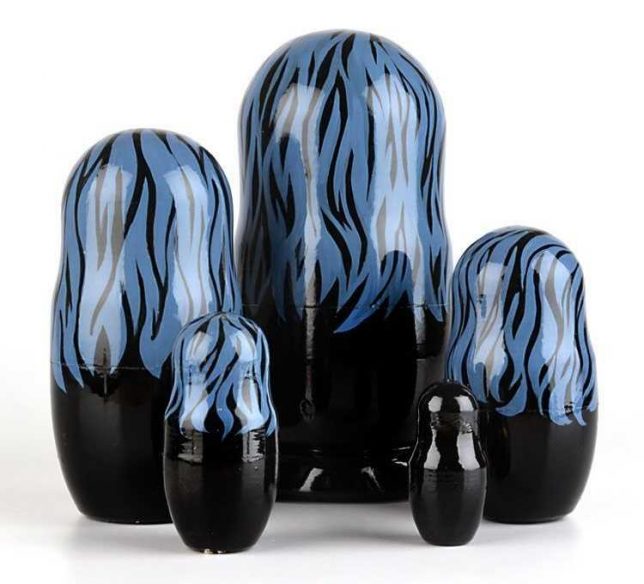
    KISS Matryoshka Nesting Dolls

    Does Putin know about this? Never mind, he’s probably got an autographed set of his own. KISS Rock And Roll Nesting Dolls take the classic Russian Matryoshka concept to a very strange universe indeed. One wonders what goes through the minds of the aging babushkas employed to hand-craft these “stunning glossy” dolls, though it’s probably not the extended version of “Beth”. Offered by The Russianstore, est. 1992 – just after the fall of communism. Thanks, Yeltsin.

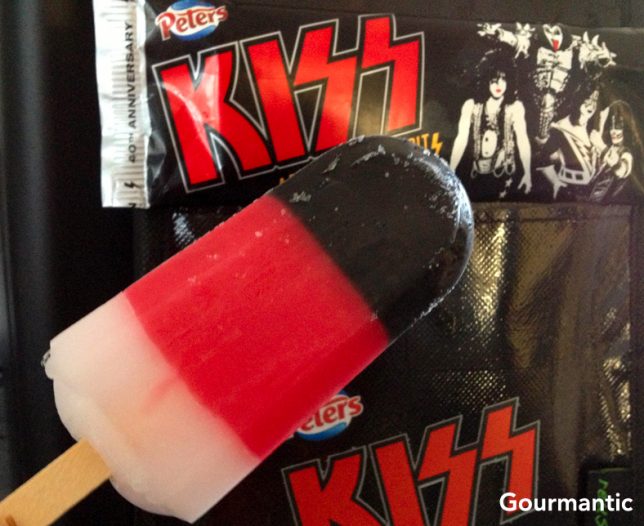
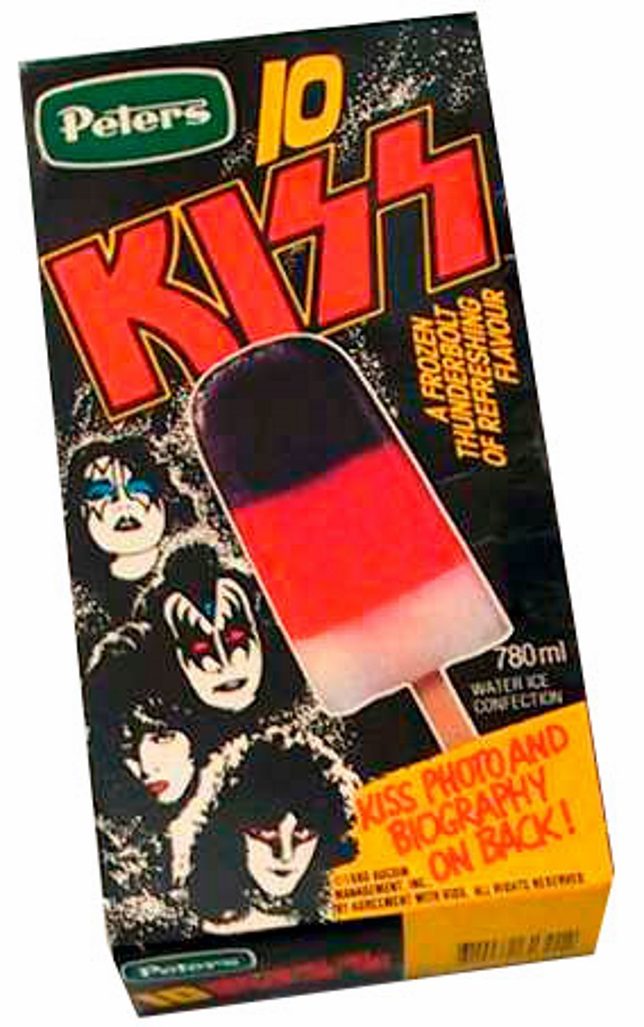
    KISS Frozen Ice Bars

    You’ll have to go all the way back to 1980 (and all the way to Australia, no less) to find KISS Ice Blocks, “a frozen thunderbolt of refreshing flavour”. Manufactured by Peters Ice Cream, the way-cool bars did NOT feature the face of “Cat Man” Peter Criss, who had been fired from the band before KISS left for their hugely successful KISS Monster Tour of Australia and New Zealand.

    Instead of Cat-Man Criss, Eric “The Fox” Carr peers out from the 10-pack box. As for the ice bars themselves, they feature bands of frozen cola, raspberry and lemonade. Yum! Check out a make-up-free Paul and Gene plugging the bars in this short (1:22) official video from Peters.

    Next Page – Click Below to Read More:
    Kiss Mark Up 10 Bizarre Kiss Branded Products

    Share on Facebook


    [ By Steve in Design & Graphics & Branding. ]

    [ WebUrbanist | Archives | Galleries | Privacy | TOS ]


    WebUrbanist

  • ICYMI: Canon 28mm F2.8 IS USM sample gallery

    ISO 100 | 1/800 sec | F8

    Canon’s 28mm F2.8 IS USM may not be the most exciting lens in the company’s lineup, but it’s reasonably affordable, lightweight and solid. As fall weather begins to hit Seattle, we find ourselves visiting the sunny images of this gallery and thinking fondly of summertime past. Take a look to see what this little lens can do.

    Articles: Digital Photography Review (dpreview.com)

  • Five Creative Lenses That Will Make Your Photos Pop

    The drive to be creative is what focuses many people in photography. One variable you can alter to help you create photographs that really stand out is the lens. There are several different options for choosing creative lenses, depending on your taste.

    In this article, you’ll see five very different kinds of lenses, and what they are capable of bringing to your photography. It’s always a good idea to have a lens that capable of something totally different, which will allow your photos to stand out from the crowd.

    Five Creative Lenses That Will Make Your Photos Pop

    The fisheye lens is used in this photo has captured a wide scene. There is some distortion on the edge of the image, but with the lines all leading in, this works well.

    1 – The fish-eye lens

    This lens is always great fun to work with, it’s a versatile lens that can be used for both portraits and landscapes. A fish-eye lens has several great applications so let’s take a look at those:

    • Wide-angle lens – This can act as a super wide-angle lens, and if you decide not to carry a wide angle lens the fish-eye makes a decent alternative. The main constraint is the distortion, this means keeping the horizon line straight.
    • The Earth’s not flat! – You can prove the Earth is not flat with a fish-eye lens. Simply position the horizon line near the top or bottom of the frame, and let distortion do the rest.
    • Embrace the distortion – Using a fish-eye means working with the way lines get distorted. This has great application for portrait photos, as those lines lead up to your model.

    The fish-eye is a great lens to play with, which is why it’s such a popular lens. It’s great for getting a lot of the scene in your frame, but is, therefore, challenging to use. Those who embrace the challenge of this lens will be reward with some amazing results, so go out and try one.

    Five Creative Lenses That Will Make Your Photos Pop

    The fish-eye lens can be great for super wide landscape photos.

    2 – The Lensbaby for something quirky

    Lensbaby is a company that makes a range of lenses that are small, comparatively cheap, and not too heavy. The lenses they make have diversified over the years. The Lensbaby Composer was their original concept. The Composer lens allows the user to change the area in the frame that has the sharpest focus. It does this by allowing you to change the plane of focus using a swivel head.

    • Abstract bokeh – Shifting the angle of the composer lens will give you stretch bokeh. The best way to get this effect is to photograph some fairy lights, that are deliberately out of focus.
    • Portrait photos – Lensbaby lenses are excellent at drawing your eye to the model, by minimizing the background. Once again with the Composer, you can focus your sweet spot on the persons face, and surround them with bokeh!
    • Landscape photos – While not its strength, a Lensbaby can be used for interesting landscape photos. This works best when there is an out of focus area in the frame, which the Lensbaby Composer can further blur out into stretch bokeh. The effect is not dissimilar to a tilt-shift lens, and the subject of the photo should be sharp.

    The Lensbaby Composer creates interesting bokeh around the subject.

    3 – The 50mm f/1.2 is a creative lens

    The nifty fifty is one of the first lenses that many photographers buy, with the less expensive f/1.8 version being a popular choice. There are a plethora of other prime lenses that can be used creatively like the 50mm f/1.2, though f/1.2 is at the extreme end of the large aperture scale. The comparison to make is a fish-eye lens to a wide angle, and here, an f/1.2 to an f/1.8 lens.

    The 50mm f/1.2 is an excellent choice for those wanting to explore bokeh in their photographs. The depth of field is incredibly narrow, and getting sharp focus on your subject can be tricky. In the evening, positioning lights behind the subject, in the out of focus area will produce bokeh.

    Want to get even more creative? Try creating different shaped bokeh, by placing a circular disk with a cut-out area in front of your lens.

    Five Creative Lenses That Will Make Your Photos Pop

    At f/1.2 the bokeh is very smooth in this image, and the plane of focus is very narrow.

    4 – Up close it’s a different world! Use a macro lens.

    The world can look very different with just a little bit of magnification, and macro lenses are a good place to start. This form of photography is a niche all of its own, and there are many pieces to it. Those who wish to really excel at macro photography will need to invest in the correct lighting gear and a good tripod. There is plenty you can achieve with a macro lens to start you on the path of macro photography.

    • Flower photography – A good macro lens is often the starting point for flower photography. Now, of course, you can take photos without doing macro photography, but getting in closer allows for more dramatic results.
    • Water droplets – Combined with the correct off-camera flash there is a lot of photography you can do with water droplets.
    • Detail photos – Macro lenses are very good for focusing on one area, and bringing out the detail. Close up photos of money is one example of how this can be applied.
    Five Creative Lenses That Will Make Your Photos Pop

    Food photography can be a good subject for your macro lens.

    5 – Use a tilt-shift lens for more interesting landscapes

    The tilt-shift lens has two main purposes, these are to correct the perspective of a photo, and to create a miniature world look. These lenses were originally designed with architectural photographers in mind, so that tall buildings didn’t bow inwards in the frame. The more creative use of these lenses is to create a miniature world. The lens can selectively focus the middle area of the frame, with the top and bottom blurred out. The lens is on the expensive end, and as the effect can be produced by

    A tilt-shift lens can selectively focus the middle area of the frame, with the top and bottom blurred out. The lens is on the expensive end, and as the effect can be produced by post-processing you will need to consider whether or not you want to invest in this kind of creative lens.

    Five Creative Lenses That Will Make Your Photos Pop

    The tilt-shift effect miniaturizes objects in the frame. This effect can be achieved both in camera and by post-processing.

    Which creative lens will you choose?

    There are many lenses available, so which of these creative lenses would you choose if you were to buy one? Have you already have a lens like this, how has your experience with it been?

    Is there a project you’d like to work on, where you’d need a lens like one of those listed above? Do you use another creative lens, not mentioned here? As always we look forward to your comments and feedback.

    Five Creative Lenses That Will Make Your Photos Pop

    The macro lens is great for exploring nature, be it flowers or insects.

    Five Creative Lenses That Will Make Your Photos Pop

    The Lensbaby can be used to create abstract bokeh.

    Five Creative Lenses That Will Make Your Photos Pop

    The 50mm f/1.2 lens can create shaped bokeh, this is done by covering the lens with a disc, and cutting the shape in the center of that disc.

    The post Five Creative Lenses That Will Make Your Photos Pop by Simon Bond appeared first on Digital Photography School.


    Digital Photography School