Blog

  • The City is a Canvas: 31 Murals Transforming Urban Spaces

    [ By SA Rogers in Art & Street Art & Graffiti. ]

    colorful-street-art-main

    Psychedelic portals beckon you to enter another dimension, sea monsters lurk at the bottom of the stairs and illustrated figures playfully interact with urban infrastructure in works of art that bring color, levity and natural imagery to urban environments.

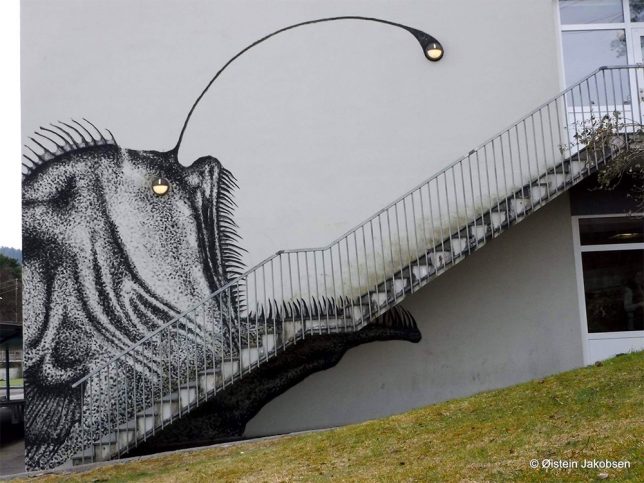
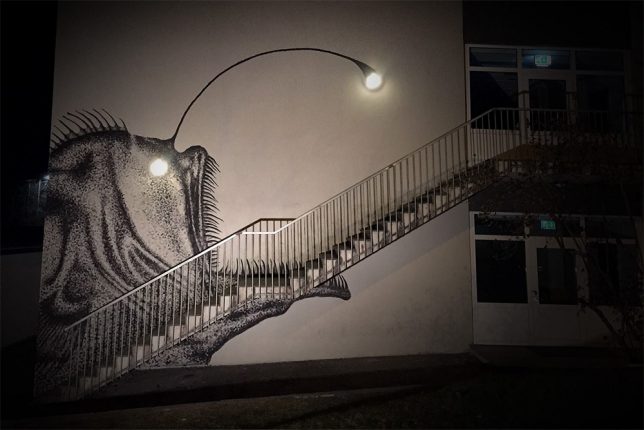
    Sea Monster Stair Steps by Skurk

    interactive-street-art-sea-monster-1

    interactive-street-art-sea-monster-mural-2

    The creepy sea creature lurking at the base of these stairs is enough to make anyone nervous, even in broad daylight – but just wait until the sun goes down. Street artist Skurk used two existing lamps affixed to the building’s exterior as the eye and lure of an anglerfish to terrifying and delightful effect.

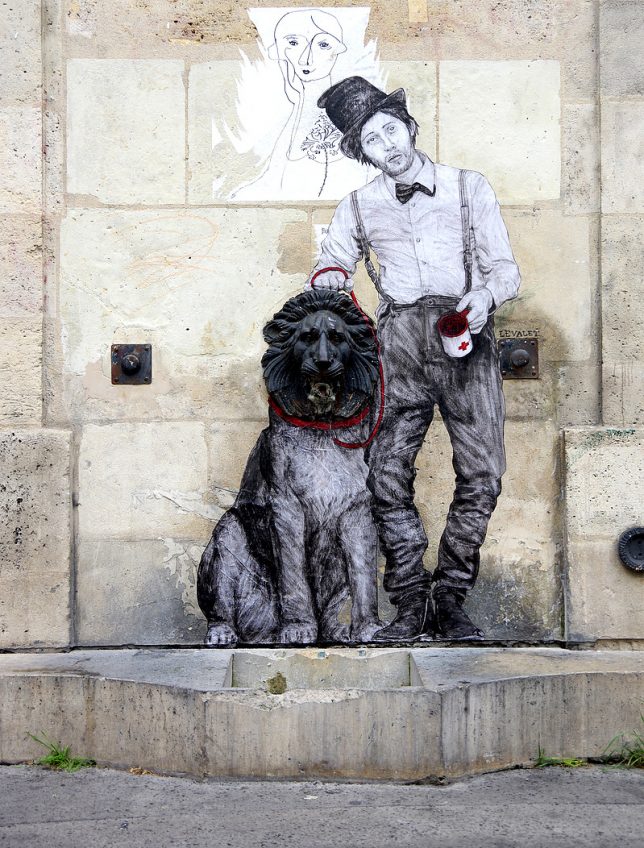
    Site-Specific Wheatpastes by Levalet

    street-art-levalet-1

    interactive-street-art-levalet-2

    interactive-street-art-levalet-3

    interactive-street-art-levalet-4

    Paris-based artist Levalet (Charles Leval) works with existing textures, colors and fixtures in urban environments to create playful site-specific works of art. Some are playful, some are a bit disturbing, but all of them pair sketched human and animal figures with fountain heads, drains, windows, utility boxes, staircases and other elements of the city.

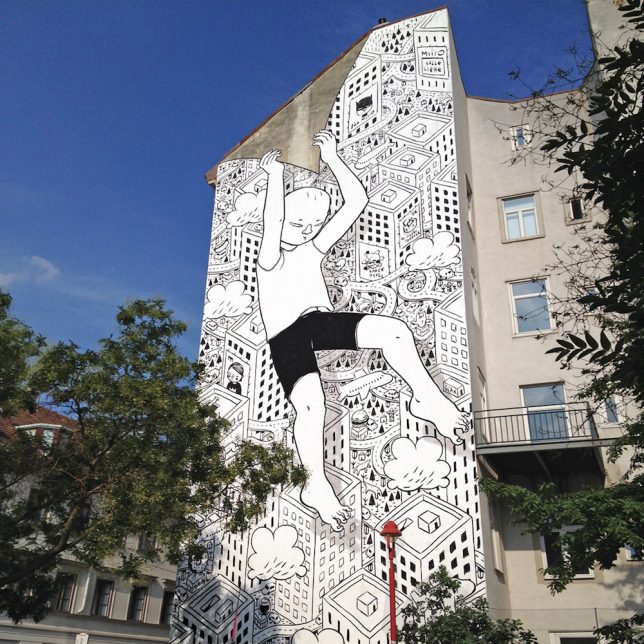
    Massive Murals in Italy by Millo

    interactive-street-art-millo-2

    interactive-street-art-millo-3

    interactive-street-art-millo-4

    An illustrative black-and-white style accented by carefully chosen splashes of bold color characterizes the ground-to-roof murals painted onto buildings by Italian street artist Millo.

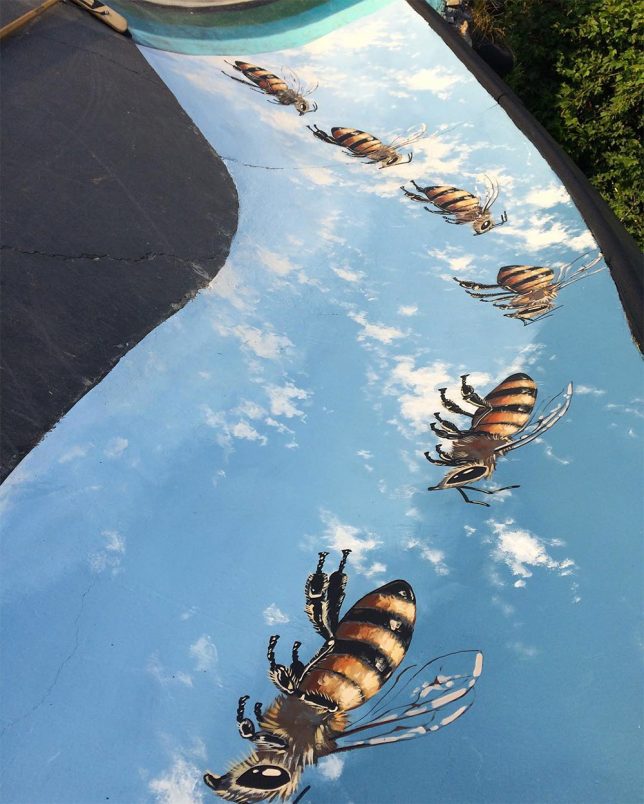
    Giant Bees by Matthew Willey

    interactive-street-art-bees-1

    interactive-street-art-bees-2

    interactive-street-art-bees-4

    50,000 bees now adorn surfaces around the world as part of the Good of the Hive Initiative, a project by artist Matt Willey aiming to raise awareness about the plight of the honey bee. Willey traveled all over the globe to paint a few dozen bees at a time in each location, with the goal number representing how many bees it takes to sustain a healthy hive.

    Next Page – Click Below to Read More:
    The City Is A Canvas 31 Murals Transforming Urban Spaces

    Share on Facebook


    [ By SA Rogers in Art & Street Art & Graffiti. ]

    [ WebUrbanist | Archives | Galleries | Privacy | TOS ]


    WebUrbanist

  • Manfrotto launches stylish Windsor Collection bags

    Manfrotto has launched its new Windsor Collection, a series of camera bags including the Windsor Backpack, Windsor Messenger (small and medium sizes) and the Windsor Reporter. All four bags are designed to carry camera gear in ‘flawless style,’ with the backpack being the largest of the bunch and the Messenger S bag being the smallest.

    The Manfrotto Windsor Backpack can accommodate a DSLR with an attached 70-200mm F2.8 lens and two extra lenses, as well as a 15″ laptop, a tripod (via external leather straps), and various accessories. In contrast, the Windsor Reporter is a shoulder bag large enough for a DSLR with an attached 24-70mm lens and two other lenses.

    The Windsor Messenger S, meanwhile, is large enough to hold a compact system camera with a standard lens, according to Manfrotto, plus one or two other lenses, or an entry-level DSLR plus ‘multiple lenses’ and a tablet. The medium-sized Messenger can accommodate a medium DSLR with an attached 70-200mm F2.8 lens and two or three other lenses, plus a tablet.

    All four bags feature similar styles and materials, including a water repellant coating, the Manfrotto Protection System for protecting gear from bumps and leather trim. All four bags are available now, with the Windsor Backpack priced at $ 170, the small Windsor Messenger at $ 120, the medium Messenger $ 140, and the Windsor Reporter at $ 130.

    Press release

    Manfrotto Launches Lifestyle Windsor Camera Bags

    Four stylish models suitable for different equipment configurations

    Upper Saddle River, N.J. (November 17, 2016) – Manfrotto, a leading global innovator and manufacturer of premium photo, video and lighting support products and accessories, announces the launch of the Manfrotto Windsor Collection, a stylish addition to their Lifestyle camera bag offering. The Windsor Collection features genuine leather trim, premium water-repellent fabric and metal details. The interior of each model is enhanced with a tartan pattern lining. This collection was designed for photographers who enjoy traveling in comfort while having their equipment within easy reach.

    Key features:

    • Superb quality photography carrying solutions
    • Carry gear safely, comfortably and in timeless style on field trips
    • A variety of models to hold different equipment configurations
    • The perfect bags to explore with – even when not taking pictures

    The new Collection caters to a variety of photographic styles:

    The Manfrotto Windsor Camera and Laptop Backpack for DSLRs – a perfect choice for field trips, this bag features a removable padded internal compartment which holds a medium DSLR with up to a 70-200 mm lens attached and two additional lenses. Equipment is always at hand through the quick-access side opening, so no shot is missed. All delicate essentials stay safe in the top compartment. The internal photography insert can be removed to turn what is a camera backpack into a traditional one. A padded compartment fits a 15” laptop and two adjustable leather straps on the front of the bag keep a tripod secured.

    The Manfrotto Windsor Camera Reporter Bag for DSLRs is a shoulder bag designed to keep photography gear safe in flawless style. It fits a medium DSLR with a 24-70 lens attached, an additional 70-200 mm lens and up to two standard lenses. When photography is not on the agenda, it remains a perfect bag for everyday use. With plenty of pockets, it keeps personal items and a 13” laptop securely organized. It also features a hidden side pocket to store a water bottle and two adjustable leather straps on the front of the bag which can keep a tripod secured. An adjustable shoulder strap and shoulder pad provide additional comfort.

    The Manfrotto Windsor Camera Messenger for Compact System Cameras come in two sizes, Medium and Small. The Medium size fits a medium DSLR with up to a 70-200 mm lens attached and two to three additional lenses. A 15” laptop is kept safe in its own padded compartment. The Small size holds a Premium Compact System Camera with a 24/70 lens and two additional lenses. It features a safe compartment for a tablet. All personal items can be safely stored on the inside and outside zippered pockets. The adjustable shoulder strap and the shoulder pad provide additional comfort. A zippered top opening gives you the ability to access your gear in the fastest way possible.

    All four models are engineered with internal dividers, providing maximum protection for photographic equipment and other electronic devices. Lenses and accessories are kept safe in the special protection areas at the heart of the bags. The dividers can easily be configured to accommodate varying photography equipment requirements.

    Model #’s:

    MB LF-WN-BP Lifestyle Windsor Backpack $ 169.99
    MB LF-WN-RP Lifestyle Windsor Reporter $ 129.99
    MB LF-WN-MM Lifestyle Windsor Messenger M $ 139.99
    MB LF-WN-MS Lifestyle Windsor Messenger S $ 119.99

    For additional information about Manfrotto, visit manfrotto.us. Follow Manfrotto on Facebook at facebook.com/ManfrottoSchoolOfXcellence, on Twitter @manfrotto_us or instagram.com/manfrottoimaginemore.

    Articles: Digital Photography Review (dpreview.com)

  • Fotodiox introduces full automatic Nikon to Sony E adapter

    Accessory manufacturer Fotodiox has introduced a new adapter that allows Nikon lenses to operate with a full range of automatic functions when hosted on a modern Sony E-mount camera body. The Fusion Smart AF Adapter accepts Nikon G AF-I and AF-S and provides connections between the lens and a Sony compact system camera body so that the user can enjoy autofocus as well as the ability to automatically stop down the lens and to trigger vibration reduction in lenses that have it. The adapter uses power from the camera to drive the lens, and EXIF data is passed back from the lens to be recorded in the image file created by the camera.

    The company says that the adapter works best with Sony’s latest bodies that feature phase detection autofocusing systems, such as the a7R II. The adapter works with bodies that use contrast detection but the AF is a lot slower.

    As Nikon uses a physical lever to close the iris of its lenses Fotodiox has used a motor within the adapter to handle that function so lenses that have no aperture ring don’t have to used wide open all the time. This also means that metering works without the user having to manually stop the lens down and that the camera’s semi-automatic exposure modes to operate.

    The Fotodiox Fusion Smart Adapter costs $ 370. For more information visit the Fotodiox website.

    Press release

    Fotodiox Pro Announces Nikon to Sony FUSION Adapter for Full Function Control

    Fotodiox Pro, creator and distributor of several lines of specialty solutions for videography, cinematography and photography, has announced their new Nikon to Sony FUSION Lens Adapter. Available now on Fotodioxpro.com, the Nikon to Sony FUSION Adapter allows photographers to mount Nikon lenses onto Sony cameras and maintain electronic communication between the two, delivering decades of legendary Nikon imaging expertise to the hands of full frame or APS-C Sony E-Mount camera users.

    “The Nikon to Sony FUSION Adapter is truly the first of its kind, and we couldn’t be more excited to share it with our customers,” said Bohus Blahut, marketing director for Fotodiox Pro. “What makes it such a breakthrough is the presence of FUSION Drive – a built-in motor that physically moves the lens’ internal aperture control lever. Nikon lenses are notorious for maintaining mechanical aperture control while many other functions are electronic, but FUSION Drive, which we built for the very first time for this Nikon to Sony FUSION Adapter, solves that issue.”

    By installing the Nikon to Sony FUSION Adapter on a full frame or APS-C Sony E-Mount camera, Nikon AF-I and AF-S lenses gain auto-focus, full aperture control for Auto / Aperture Priority / Program AE modes, EXIF data transmission (on compatible models) and image stabilization (on compatible models). The Nikon to Sony FUSION Adapter is also compatible with fully manual vintage Nikon F lenses as a manual adapter.

    Photographers are advised that the FUSION Adapter is designed to work best with newer Sony cameras that have “Phase Detection Auto Focus”, such as Sony a7, a7II, a7rII, a6000, a6300 and a6500 cameras. The Nikon to Sony FUSION Adapter’s performance will be significantly slower with older Sony cameras that rely solely on “Contrast Detection Auto Focus”.

    Articles: Digital Photography Review (dpreview.com)

  • What’s changed? Comparing the Olympus OM-D E-M1 and E-M1 II

    Olympus OM-D E-M1 versus E-M1 II

    The new Olympus OM-D E-M1 II is quite a camera. Capable of shooting at up to 60 fps at full resolution and packing high-bitrate 4K video and in-body stabilization, the E-M1 II is a powerhouse. But if you already have an E-M1, is it worth the upgrade?

    In this article, I’ll compare several of the key areas of differentiation between the E-M1 II and its predecessor, to help you answer that question. 

    Sensor

    The E-M1 II’s maximum output resolution of 20MP might not match the 24MP+ sensors of larger-format competitors, but 20MP is quite enough for most purposes, and a nice step up from the 16MP of its predecessor. 

    If 20MP isn’t enough, the E-M1 II incorporates Olympus’s high-resolution multi-shot mode, first seen in the OM-D E-M5 II. This allows the camera to produce 50MP JPEG and Raw files by combining several exposures taken with the sensor shifted by single-pixel increments. This mode is best suited to still life subjects (to avoid issues created by movement in the scene) but from our initial testing it seems like the E-M1 II does a good job of correcting some of the nasty artifacts that limited this mode’s usefulness in the E-M5 II. 

    Speed

    Resolution isn’t everything, of course. As well as more pixels, the sensor in the E-M1 II can also output data 3 times faster, allowing for full-resolution capture at up to 60 fps in electronic shutter mode. A maximum shooting rate of 18 fps with continuous autofocus makes the E-M1 II a significantly more interesting camera for shooting fast action than the original E-M1.

    The E-M1 II’s high-speed USB 3.0 interface (C-type) is handy for quickly transferring files to a laptop if you’ve forgotten a card reader. Finally – a good reason to buy a new MacBook Pro…

    Autofocus

    The original E-M1 wasn’t exactly a slouch in the AF department, but the E-M1 II takes things to a whole new level. This new, faster sensor features 121 on-sensor phase-detection AF points, which cover 75% of the imaging area vertically, and 80% horizontally. All of these AF points are cross-type. The original E-M1 offered 37 phase-detection AF points, in a smaller central area of the frame.

    The extra phase-detection AF points and the broader coverage mean that the E-M1 II is even more versatile when used with one Olympus’s range of older Four Thirds (non-Micro) lenses.

    AF Tracking

    These improvements, coupled with a dedicated processor for AF, means that the E-M1 II is capable of full-resolution shooting at up to 18fps with AF tracking. Compare this to a maximum frame-rate of 9 fps with AF from the E-M1 (running firmware 4.0). 

    With the new E-M1 II, it’s also possible to use the rear LCD screen as a touch-pad to manually position the active AF point by touch, with your eye to the viewfinder. In addition, adjustable AF-C tracking sensitivity, and four ‘AF Target Modes’ allow the E-M1 II’s autofocus system to be quickly tweaked to suit different kinds of subjects. 

    Ergonomics

    The E-M1 II is ergonomically very similar to the E-M1. A slightly deeper hand grip makes the new camera feel a little more secure in the hand (depending, I suppose, on your hand size) and the tripod socket has been centered in the E-M1 II, in line with the lens axis. This is generally a good thing (and can be very handy for things like nodal panoramas) but it does mean the tripod socket is now closer to the battery door. The door has increased in size thanks to the bigger battery, which combines to incresae the risk of the door being occluded when the camera is mounted to a tripod.

    The only thing that some users might argue has gone backwards in the E-M1 II compared to the original E-M1 is the rear screen’s articulation. If the E-M1 II is incorporated into a video rig, with microphone or headphones plugged in and video output to an external recorder over HDMI, the folding screen can foul these cables when extended. The tilting screen of the original E-M1 is arguably less versatile, but can be used without snagging the I/O ports.

    In-body Image Stabilization (I.B.I.S)

    Both the E-M1 II and its predecessor feature 5-axis in-body image stabilization, but the Mark II improves the feature to offer a maximum benefit of 5.5EV, compared to 4EV in the older model. For anyone used to shooting according to the ‘one over equivalent focal length’ rule this means that at 50mm (equivalent) the E-M1 II should be hand-holdable down to as low as half a second, in favorable conditions, whereas the E-M1 would be safe down to ‘only’ around a quarter of a second. With the new stabilized 12-100mm zoom, the E-M1 II offers up to 6.5EV of shake compensation.

    As well as stills, the E-M1 II’s I.B.I.S is also useful when shooting video footage. The E-M1 was capable of capturing extremely smooth and shake-free video, and the E-M1 II is even better.

    Video

    One of the most significant improvements offered by the E-M1 II compared to its predecessor is a totally revamped video mode. Capable of 4K video at up to 30p, the E-M1 II boasts a maximum bitrate of 237 Mbps during DCI 4K/24p capture. A ‘flat’ picture profile in movie mode is a nice addition to the E-M1 II’s video feature set, too.

    The E-M1 produces very nice-looking video (and as previously noted, it’s tilting screen doesn’t foul the camera’s I/O ports) but it’s limited to 1080/30p in normal use, and isn’t capable of clean output over HDMI to an external recorder. The E-M1 can capture 4K footage, but only in time-lapse movie mode.

    One final note – it’s not really fair to call it a ‘downside’, but if you plan on shooting 4K with the E-M1 II, do make sure to budget for a high-capacity UHS-II or UHS-I Speed Class 3 card. 

    Durability

    The E-M1 and E-M1 II are both tough cameras, built to a high degree of quality and intended to withstand use in unfavorable conditions. As such, both are weather-sealed and both can operate in freezing conditions. The E-M1 and E-M1 II have the same rated operating range of -10 to +40 degrees C, and both can handle being left out in the rain, but the E-M1 II’s shutter is rated to a higher count of 200,000 exposures (the E-M1 is rated to 150,000). Whether this translates to substantially better durability in normal use is hard to say, but more pictures = more better.

    Battery life

    A less abstract measure of durability is battery life, and in this respect the E-M1 II also outperforms its predecessor, offering a maximum endurance of 440 shots (CIPA) in normal use from its larger, beefed-up battery and up to 950 when ‘quick sleep’ mode is used. These figures actually seem conservative judging from our shooting so far, during which we’ve routinely experienced 1000+ shot endurance in normal (stills) shooting.

    The original E-M1 can shoot for a rated maximum number of 350 shots but the same applies – you can expect better endurance if you’re not shooting video or constantly reviewing images. 

    Twin card slots

    Speaking of shots, the E-M1 II offers two SD card slots, as opposed to the E-M1’s single slot. The additional card can be used as overflow or backup storage, or as a dedicated card for storing video clips. Note that only the upper slot is UHS-II compatible, so that’s where you’ll want to save those 4K video clips.

    Verdict

    There’s absolutely no doubt that the new OM-D E-M1 II is a better camera than its predecessor in virtually every way. It’s rare these days that we see successor models which so roundly outperform the models that they replace. We might have expected the viewfinder and / or rear LCD screens to get a bump in resolution, but arguably, neither really needed improvement.

    All told, the E-M1 II is a very impressive update to the original E-M1. But it’s also heavier, and more costly. We’d strongly suggest spending the extra cash if you can afford it (we can’t see the E-M1 II being outmoded any time soon) but if you’re mostly a slow-speed stills photographer, the original E-M1 won’t disappoint. 

    Articles: Digital Photography Review (dpreview.com)

  • Holiday Gift Guide 2016: New This Year

    Get over here, we found the bright side!

    Eight totally great things that came out of 2016.

    See the very best gifts for photographers, that we added to the Photojojo Shop this year.

    (…)
    Read the rest of Holiday Gift Guide 2016: New This Year (0 words)


    © laurel for Photojojo, 2016. |
    Permalink |
    No comment |
    Add to
    del.icio.us

    Post tags:


    Photojojo

  • Camouflaged Solar Panels: Tesla Roof Tiles Power Home Batteries & Electric Cars

    [ By WebUrbanist in Gadgets & Geekery & Technology. ]

    tesla-solar-roof

    Elon Musk is attacking the question of energy storage and consumption at home, first with electric cars, then with home batteries and now the final piece of the puzzle: solar panels people will actually want to show off.

    tesla-material-types

    Developed in collaboration with 3D, their semi-translucent Solar Roof tiles cost less than ordinary roofs, insulate better and best of all they generate energy to charge your electric batteries (Powerwall) and automobiles (Model X). This is effectively the final missing piece from the ultimate sustainable-power smart house.

    teslatiles

    The three-layered design features a normal solar panel at the bottom with a film on top that renders it invisible from below but operational under the sun’s rays coming from above. At the top is a tempered glass that is shatter-resistant, making it more durable than conventional clay (with a lifespan well beyond the typical 20-year roof).

    telsa-powerwall-batteries

    Aside from these benefits, perhaps the single biggest selling point is the array of material styles: Textured Glass, Slate Glass, Tuscan Glass and Smooth Glass. It may sound superficial but looks matter — neighbors complain and residents shy away from too-overt solar tech attached to their house.

    tesla-demo-house

    And people trust Tesla to do more than make better technology: they expect a high level of visual design as part of the package. Also, since they are all coming from the same collection of companies, one can expect superior installation and integration options tying Tesla cars, Powerwalls and Solar Tiles together. Between the tech and its brand backing, this development promises to boost solar adoption to new heights.

    Share on Facebook


    [ By WebUrbanist in Gadgets & Geekery & Technology. ]

    [ WebUrbanist | Archives | Galleries | Privacy | TOS ]


    WebUrbanist

  • Tee’d Off: A Dozen Abandoned Golf Driving Ranges

    [ By Steve in Abandoned Places & Architecture. ]

    abandoned-driving-range-1a

    Golf isn’t the hit sport it used to be and one consequence is the proliferation of abandoned driving ranges closed due to changes in recreational pursuits.

    abandoned-driving-range-1c

    abandoned-driving-range-1b

    The good thing about abandoned driving ranges – at least, for those who photograph and/or write about them – is that they’re usually outdoors and as such, are often overgrown with invasive vegetation. Kinda adds to the post-apocalyptic vibe if you know what we mean (and we think you do). In any case, Flickr user Josh Lightbody visited one such overgrown abandoned driving range in Northern Ireland just this past summer. “No Golfing”, in my abandoned driving range? Indeed, it’s more likely than you think.

    From Swing to Sting

    abandoned-driving-range-3a

    abandoned-driving-range-3c

    abandoned-driving-range-3d

    Welcome to Kejonuma Leisure Land, or maybe “unwelcome” is more apropos. Located in northern Japan, KLL opened in 1979 as a sort of pay-as-you-go themeless theme park: visitors could partake in amusement park rides, a campsite, a six-hole golf course and last but not least: a driving range. The shattered clock in the first photo, by the way, now houses a nest of suzumebachi… “sparrow bees” in the direct Japanese translation, Giant Asian Hornets to the rest of us. Yep, the fun never stops at Kejonuma Leisure Land even though the park itself has.

    abandoned-driving-range-3e

    abandoned-driving-range-3b

    The intrepid urbex explorers from Abandoned Kansai visited Kejonuma Leisure land – with the owner’s permission – in May of 2014. We would have gone during the winer, what with the Giant Asian Hornets and all, but that’s what makes those guys so intrepid… and presumably unaffected by extreme pain.

    Magnum PEI

    abandoned-driving-range-2a

    abandoned-driving-range-2b

    abandoned-driving-range-2c

    Flickr user Brett Sanderson took the strikingly detailed HDR photos above at an abandoned driving range in Charlottetown, PEI, Canada in mid-September of 2013. Bud the Spud unavailable for comment.

    Ball’s-Eye View

    abandoned-driving-range-4a

    Driving ranges can be so large it takes, say, a camera-equipped drone to take them in properly. Cue YouTube Eric Milewski, who accommodatingly brought just such a device to an abandoned driving range in Burnaby, British Columbia in the summer of 2015. Milewski employed his ZMR250 250mm Carbon Fiber Mini FPV Quadcopter drone at the now-closed Hastings Golf Centre. Watch the entire 4:13 video here.

    Next Page – Click Below to Read More:
    Teed Off A Dozen Abandoned Golf Driving Ranges

    Share on Facebook


    [ By Steve in Abandoned Places & Architecture. ]

    [ WebUrbanist | Archives | Galleries | Privacy | TOS ]


    WebUrbanist

  • A colorful journey through Morocco with the iPhone 7 Plus

    $ (document).ready(function() { SampleGalleryV2({“containerId”:”embeddedSampleGallery_2528030905″,”galleryId”:”2528030905″,”isEmbeddedWidget”:true,”standalone”:false,”selectedImageIndex”:0,”startInCommentsView”:false,”isMobile”:false}) });

    Resource Travel Editor Michael Bonocore loves the Northern African country of Morocco, having traveled there previously to lead a team for The Giving Lens. So when an opportunity came along to return to Morocco this October, Bonocore couldn’t resist.

    Although he normally travels with a Sony a7R II, Bonocore noticed that he always managed to come home with lots photos taken on his mobile phone, so he challenged himself to try a new approach to travel photography. Could he tell a beautiful and cohesive story about his journey through Morocco using only his new iPhone 7 Plus? Based on his portfolio of images, we think you’ll agree that the answer is yes.

    Read the full article and see more of Bonocore’s photos at Resource Travel

    Articles: Digital Photography Review (dpreview.com)

  • 2016 Holiday Gift Guide: $500 and up

    2016 Holiday Gift Guide: $ 500 and up

    Shopping for photographers is hard. In fact, shopping in general is hard. We’d like to help everyone involved out a little bit, whether you’re shopping for a photographer or taking a break from the stress of holiday shopping to #treatyoself. If you’re really looking to invest in a gift that keeps on giving, we’ve got some ideas for big budgets.

    Fujifilm X70

    $ 700/£499
    buy now | fujifilm.com

    Photography and travel: the eternal love/hate relationship. Photographers love taking photos while they travel, but hate carrying the gear they need to make high quality images. If you know a frustrated traveling photographer, encourage him or her to slim down and simplify with the Fujifilm X70. With a fixed Fujinon 18.5mm (28mm Equiv.) F2.8 Lens, 16.3MP APS-C X-Trans CMOS II Sensor, 77-point AF system, 1080p video, and a 0.5 second startup time the X70 is not likely to disappoint in the quality image department.

    But perhaps equally impressive is the fact that Fujifilm was able to incorporate physical controls for aperture and shutter speed, shooting modes, exposure compensation and eight customizable buttons all in a compact body that measures 4.45 x 2.52 x 1.73 in (113 x 64 x 44 mm) and weighs just 12 oz (340 g). Your traveling photographer will be able to take this camera anywhere and come home with excellent images.

    DJI mavic pro Drone (ships Dec 1)

    $ 1000/£999
    buy now | dji.com

    Drones are a lot of fun. They allow photographers to photograph and film from angles and locations that would otherwise be extremely expensive (helicopter time is around $ 600/hr) or downright impossible. But until now, high quality drones have been fairly bulky to carry around. The DJI Mavic Pro changes that with a clever folding design that allows the drone to pack up to about the size of a small loaf of bread.

    Despite the small size, the Mavic Pro offers a 4K video/12MP still camera stabilized by a 3-axis gimbal. Flown with the included controller or directly from a smartphone, it has multiple flight modes to assist in tracking, framing, and ground/obstacle avoidance. With a 27 minute flight time, 4.3 mile range, top speed of 40 mph (64 kmh), and a form that fits into a small backpack, the DJI Mavic Pro is ready to go anywhere.

    Microsoft Surface Pro 4 – 256GB / 2.4 GHz Intel Core i5 

    $ 1075/£1050 
    buy now | microsoft.com

    Is it a tablet? Is it a laptop? Since the Microsoft Surface Pro 4 can run the full version of Adobe Photoshop, does it really matter? With up to a 3.4 GHz Intel Core i7 processor, 16GB of ram, and 1TB of storage, the Surface Pro 4 packs a lot of computing power in a very small 1.73 lb (0.8 kg) package. In addition to the ability to run Photoshop and Lightroom, photographers will appreciate the 12.3″ 2736 x 1824 screen, built in SD card reader, 9 hour battery life (depending on usage) and a clever Pixelsense pen/stylus that takes away all the pain of trying to manipulate tiny photo details with fat fingers. For those who think tablets are good for nothing more than Netflix and Angry birds, the Surface Pro 4 will be a real eye opener.

    Olympus PEN E-PL8 w/14-42mm lens

    $ 650/£499
    buy now | getolympus.com

    We often know people who are interested in photography, but don’t know where to start. They would like to step up from their phone camera, but find a trip to the camera store or browsing Amazon to be overwhelming. Not only are there a staggering array of options on the shelves, but the complexity of today’s high end digital cameras make ‘serious’ photography seem inaccessible. A great solution for these people is the Olympus PEN E-PL8 with 14-42mm (28-84mm equiv.) F3.5-5.6 lens kit.

    The E-PL8 strikes a great balance between being easy to use and non-threatening for the new photographer, and producing high quality images. On the outside, the body and controls are clear and straightforward. On the inside, the imaging guts of the E-PL8 are the same as the highly rated Olympus E-M10 II, a 16 MP Live MOS sensor with 1080p HD video capabilities. A 3-axis in-body image stabilization system will help keep images sharp and videos smooth, and 14 Art Modes encourage creativity.

    Perhaps most importantly, the E-PL8 provides an entry into the Olympus Micro Four Thirds system. So when the time comes for an E-PL8 owner to step up to a more advanced camera, lenses and accessories will be able to move along with them.

    Panasonic DMC-LX10 (avail Nov 28)

    $ 700/£600
    shop.panasonic.com | buy now

    If you’ve done any photography equipment research as part of your holiday shopping, you could be forgiven for thinking that the world revolves around DSLRs, mirrorless cameras and a few select compacts. Where are the high-quality-yet-pocketable, large-sensor fixed-lens cameras? Panasonic’s reply is the newly released Lumix DMC-LX10 (also known as the LX15 in some markets).

    With a 1”-type 20.1 MP sensor, a Leica 3x DC Vario-Summilux 8.8-26.4mm (24-72mm equiv.) F1.4-2.8 lens and a shirt-pocket size, the LX10 continues Panasonic’s long history of high-end compact cameras. A 180-degree upward tilting touchscreen, 4K video capability and five-axis image stabilization round out the feature set. Packed in a suitcase for a trip around the world or a purse for a trip to the beach, the LX10 should be an excellent companion.

    Profoto D2 500 Air TTL Monolight two light kit

    $ 3000/£2410
    buy now | profoto.com

    A photographer afflicted with Gear Addiction Syndrome will experience many different stages. Point and shoot to DSLR, small prime lens to big constant F2.8 zoom, and small bag under the desk to camera closet overflowing with cameras and tripods and accessories.

    Lighting upgrades are just as momentous, and the move from speedlights to studio strobes is an important evolution for those who are serious about studio and portrait photography. Speedlights are great learning tools and can produce wonderful results, but they simply do not have the power or flexibility that something like the Profoto D2 500 Air TTL Monolight can provide.

    With 500 Ws of power and an incredibly fast 0.03-0.6sec recycle time, the D2 500 has power and quickness that no speedlight can match. 10 stops of adjustment, up to a 1/8000 high speed shutter sync, built in radio triggering, and optional Canon or Nikon TTL capabilities help to harness and control that power. Upgrading into the world of serious studio lighting is a big step up, but for many photographers, it is an important one.

    Mola Mantti 43.5-Inch Beauty Dish

    $ 800/£642
    buy now | mola-light.com

    One of the most popular lighting accessories in recent years has been the ‘Beauty Dish.’ With a light quality more soft and even than on-camera flash but more directional than a softbox, beauty dishes are a staple of the fashion industry. Unsurprisingly, studio photographers have found that they make excellent portrait options. However, virtually all beauty dishes are 16-28″ in diameter and are more suitable for head and shoulders or 1/2 body shots. To get the beauty dish lighting effect for full-body or group portraits at reasonable working distances requires a particularly big dish.

    They don’t come much bigger than the Mola Mantti 43.5″ beauty dish. It is a beast of a dish and will provide the perfect lighting to make next year’s family holiday photo look like it came from the pages of Elle Magazine.

    Sigma 85mm F1.4 Art lens

    $ 1200/£722
    buy now | sigmaphoto.com

    The 85mm focal length is a classic. These lenses are beloved for their compact size and large apertures. They’re perfect for environmental portraits because of their short working distance and perfect for tighter shots because of their ability to blur the background. An 85mm lens would be a great gift for any photographer interested in boosting their ‘people photography’ game. Right now, there is arguably no better 85mm lens on the market than the Sigma 85mm F1.4 Art.

    With a super fast F1.4 aperture, 14 elements in 12 groups, and a newly updated Hyper Sonic Motor, this lens maybe the most technologically advanced 85mm lens ever designed. With its creamy wide-open bokeh and sharpness across the frame, the Sigma 85mm F1.4 Art lens will make portraits pop like no slow kit zoom lens ever could.

    iPhone 7 Plus

    $ 770/£620 
    apple.com

    One trillion photos were estimated to have been taken in 2015. The camera type that took 75% of those images? No, it wasn’t a DSLR or a mirrorless or any other high-end tool from the photographic industry. It was the camera in our pockets, the smartphone. A smartphone is the camera we have with us for almost every waking minute of our day. As everyone knows, the camera you have with you is better than any camera you leave at home.

    So if 75% of our images are going to come from our phones, it behooves any serious photographer to prioritize camera quality when deciding on a phone. The Apple iPhone 7 Plus should be a strong contender for that choice. A fast F1.8 aperture, 4K video, optical image stabilization, and water resistance are all standout features. Even more impressively, its innovative dual camera design gives you two focal lengths to choose from (28mm and 50mm), allows 2X optical zooming, and can use data from both to simulate narrow depth of field in a special ‘portrait’ mode.

    DNP DS620A dye sub printer

    $ 900/£1120
    buy now | dnpphoto.com

    Do you know someone that simply loves to print photos for friends and family? Do they have a library full of photo albums? Have they taken out a second mortgage to pay for inkjet ink cartridges? Do they spend more time waiting in line at the local photo lab than they do with their family? Maybe it’s time for them to step up to a professional dye sublimation printer.

    The DNP DS620A can produce everything from 2 x 6″ photo strips to 6 x 8″ prints and in high-speed mode will create a 4 x 6″ photo in just 8.3 seconds. More compact than most inkjet printers, the DS620A’s dye sublimation technology will not dry out or clog in between uses. To top it all off, at $ 0.14 per 4×6, prints from the DNP DS620A are cheaper than most photo labs. Plus – no waiting in line.

    Leica M-P ‘Grip’ by Rolf Sachs edition

    $ 15000/£12050
    leica-camera.com

    Looking for that special gift for the photographer who has absolutely everything? Need to make sure that the Ansel Adams in your life stands out from the crowd at the next preschool holiday pageant? Look no further than the Leica M-P ‘Grip’ by Rolf Sachs edition. The already high-end Leica rangefinder’s familiar leather body covering was replaced with red-nubbed rubber (reminiscent of a shower mat) that Leica says, ‘lend the camera a uniquely eye-catching look and simultaneously create an entirely new haptic experience.’

    For most of us, just trying not to drop the $ 15,000 special edition M-P would be enough of a haptic experience. But perhaps that is why Leica and Rolf Sachs thoughtfully provided the extra grip. But if you’re paying that much for a camera, it would be nice to have something more than a shower mat keeping it from hitting the floor. Perhaps something like this handy wrist strap?

    Articles: Digital Photography Review (dpreview.com)
  • Blackmagic Design announces update to Video Assist monitors

    Blackmagic Design has announced a software update to its 5-inch Video Assist and 7-inch Video Assist 4K monitor/recorders. Video Assist 2.3 allows users to load up to six 3D LUTs when monitoring on their devices, making it possible to view output from cameras in a form that approximates the final color grade of the footage.

    In addition, the update adds several features to the 5-inch Video Assist that were previously only available 7-inch Video Assist 4K model. These include the ability to record DNxHD and DNxHR files in MXF format, improved compatibility with Avid systems running on Windows, false color monitoring to accurately judge exposure in different parts of the image, and additional options for customizing focus peaking indicators.

    Video Assist 2.3 can be downloaded from the Blackmagic website.

    Press release:

    Blackmagic Design Announces New? Video Assist 2.3 Update

    Major update adds new 3D LUTs, focus assist features and improved DNxHD and DNxHR support!

    InterBEE 2016, Tokyo, Japan – November 18, 2016 – Blackmagic Design today announced Video Assist 2.3, a major new update for Blackmagic Video Assist customers that adds 3D LUTs to both models. This update also adds features to the 5” Blackmagic Video Assist including improved DNxHD and DNxHR support, false color monitoring, expanded focus options and new screen rotation features. The Video Assist 2.3 update is available for download now from the Blackmagic Design website and is free of charge for all Blackmagic Video Assist customers.

    Video Assist 2.3 Update is being demonstrated at InterBEE on the Blackmagic Design booth 8216.

    Customers using the Video Assist 2.3 update can now load up to six 3D LUTs when monitoring video on set with their 5” or 7” Blackmagic Video Assist. 3D LUTs have become an important part of digital filmmaking because they transform the camera images into a look that closely approximates the final look the director wants. The benefit of monitoring with 3D LUTs is that the crew can see the footage as the director intends it, and it’s completely non destructive because the original camera footage remains untouched. The six x 3D LUTs can be stored and recalled at any time by the user and this new feature is available on both the 5” Blackmagic Video Assist model and the 7” Blackmagic Video Assist 4K model.

    For customers using the 5” Blackmagic Video Assist model, this update adds new features that were previously released only on the 7” Blackmagic Video Assist 4K model.

    These new features include the ability to record to DNxHD and DNxHR files in MXF format which improves compatibility with Avid systems running on Windows. In addition, customers can now choose between DNxHD 220, 145 and 45 bit rates, or between DNxHR HQ, SQ and LB formats when recording.

    The Video Assist 2.3 update also adds false color monitoring exposure tools to the 5” Blackmagic Video Assist model. False color exposure tools make it easier to properly set exposure in different parts of the image by highlighting specific color ranges of luminance with a solid color overlay. For example, green indicates neutral grey, while pink tones are good references for skin, which is typically one stop over neutral grey. Using false color helps camera operators keep exposure consistent from shot to shot.
    In addition, Video Assist 2.3 update also expands the options for focus assist so customers can now choose whether they want to see red, green, blue, black, white or traditional focus peaking indicators. This makes it easier for customers to accurately adjust focus in a wider range of scenes and under a variety of different lighting conditions. Customers will now also have the ability to manually control the screen orientation and turn off the auto rotate feature which makes it easier for customers to use the 5” Blackmagic Video Assist model with handheld gimbals and other equipment designed to move the camera and rig simultaneously.

    “Blackmagic Video Assist is perfect for customers that need better monitoring and higher quality recording,” said Grant Petty, CEO, Blackmagic Design. “This new update adds incredible LUT monitoring to both models, and brings some of the same powerful high end features from the 7” Blackmagic Video Assist 4K model to customers that have the 5 inch Blackmagic Video Assist model. We think the massive number of features on the 5 inch Video Assist model is amazing when you consider it only costs $ 495! Thats why Blackmagic Video Assist has become an essential part of every filmmakers toolkit because they help customers shoot and capture higher quality video with everything from DSLRs to older tape based camcorders, and even the latest digital film cameras!”

    Availability and Price

    Blackmagic Video Assist 2.3 update is available now and is a free download from the Blackmagic Design website.

    About Blackmagic Video Assist 4K

    Introduced at NAB this year, the Blackmagic Video Assist 4K is a portable all in one monitor and video recorder that can be used to add professional recording and monitoring to any SDI or HDMI camera. It features a bright, high resolution 7 inch screen for checking focus and framing, two high speed UHS-II recorders that work with the latest high performance SD cards for non-stop HD and Ultra HD recording. Blackmagic Video Assist 4K has multi rate 6G-SDI BNC connectors for input and output, HDMI in and out, two extremely high quality XLR microphone inputs for professional audio recording, a built in speaker, DC power, dual slots for two LP-E6 batteries and more.

    About Blackmagic Video Assist

    Blackmagic Video Assist is a portable professional monitor and recorder that can be used with any SDI or HDMI camera. It features a 5” full resolution HD monitor that helps you get perfect focus and framing, along with a professional ProRes and DNxHD recorder that uses high speed SD cards and saves files compatible with all modern NLE software. Blackmagic Video Assist has multi rate 6G-SDI inputs and outputs via DIN 1.0/2.3 connections, as well as HDMI in and out. It features a single SD card slot for recording HD resolution video. The touchscreen allows settings, histogram, audio meters, timecode display and much more. Blackmagic Video Assist works with DC power and has dual slots for two LP-E6 batteries.

    Articles: Digital Photography Review (dpreview.com)