Blog

  • Dell announces 4K HDR10 monitor

    At NAB Dell announced its new UP2718Q UltraSharp 27 4K monitor, which is the company’s first HDR10 display. This 27″ monitor, which has earned UHD Alliance Premium Certification, has a peak brightness of 1000 nits (a unit for luminance). It covers 100% of the sRGB, Adobe RGB and REC 709 color spaces, plus 97.7% of DCI-P3 and 76.9% of REC2020.

    Dell says that each monitor is individually calibrated at the factory and, naturally, users can create their own color lookup tables using included software and an optical colorimeter.

    The UP2718Q will be available on May 23rd for a price of $ 1999.99.

    Press Release:

    Dell Reinforces End-to-End Technology for Creative Professionals with New HDR10 Monitor with UHD Premium Alliance Certification

    Date : 4/20/2017

    Las Vegas, Nevada

    • World’s No. 1 monitor brand¹ introduces additional UltraSharp displays at the National Association for Broadcasters 2017 conference
    • Dell uses NAB 2017 to showcase a spectrum of technology for media and entertainment from devices to storage
    • Dell Precision 5720 All-in-One gives creators UltraSharp 4K touch display, 100% Adobe color and full workstation power with VR capabilities

    To celebrate its first appearance at the National Association of Broadcasters conference as part of a combined company, Dell announces new solutions to improve its powerful ecosystem for media and entertainment professionals. The company proudly unveils the latest additions to its innovative, industry-leading monitor portfolio, including the company’s first HDR monitor that meets HDR10 standard and two new premium UltraSharp monitors with InfinityEdge displays. Joining these new monitors will be the new Dell Precision all-in-one workstation, virtual reality (VR) creation powerhouse towers and notebooks, and the innovative Dell Canvas smart workspace. The new monitors and workstation PCs are among the broad lineup of solutions designed for creative professionals in visual effects and filmmaking, post-production, broadcast and photography.

    The Dell UltraSharp 27 4K HDR Monitor (UP2718Q), the company’s first HDR10 display with UHD Alliance Premium Certification, boasts an Ultra HD 4K display, with four times more detail than full HD and the depth of 1.07 billion colors. This monitor allows creative professionals to view and edit HDR10 content to create incredibly realistic images. With a peak brightness of 1,000 nits, the UP2718Q produces the deepest blacks and brightest whites and the REC2020 color coverage makes it an ideal choice for video editors working on color-critical post production. The UP2718Q also offers a broad, brilliant color spectrum with Dell PremierColor – 100 percent Adobe RGB, 100 percent sRGB, 100 percent REC 709, 97.7 percent DCI-P3 and 76.9 percent REC2020. For exceptional color reproduction, each monitor is individually factory-calibrated and users can customize the color parameters using the custom color mode, or make adjustments by storing the preferred color parameters onto the internal Look-Up Table using Dell UltraSharp Calibration software with an optional colorimeter.

    “As the No. 1 monitor brand¹ in the world, we deliver the latest, most innovative display technology to our customers to meet and exceed their expectations, whether that’s at work or at home,” said Bert Park, senior vice president and general manager, Dell Software & Peripherals. “At NAB 2017, we’re proud to continue Dell’s tradition of world-class innovation – our first HDR monitor that meets HDR10 standard – by providing creators with the most strikingly accurate images and lifelike, unparalleled color performance.”

    To provide a full spectrum of displays to meet the needs of customers in media and entertainment, finance, and oil and gas, Dell also is excited to announce the Dell UltraSharp 27 4K Monitor (U2718Q) and Dell UltraSharp 25 Monitor (U2518D), two new monitors from its premium UltraSharp line that feature Dell’s innovative InfinityEdge display. With Dell HDR², visuals are true-to-life with stunning color, terrific contrast and great detail. Both monitors allow industry professionals to push the limits of productivity with an edge-to-edge viewing experience and optimized eye comfort with a flicker-free screen featuring ComfortView. Announced to much acclaim earlier this year, the Dell UltraSharp 32 8K Monitor is now available, raising the visual bar even higher for creative professionals.

    At NAB, Dell is celebrating the recent availability of the Dell Precision 5720 All-in-One workstation for digital content creators, like video editors, animators, designers and sound engineers. The 5720 features Dell’s innovative InfinityEdge display around a beautiful 27-inch 4K 100 percent Adobe color screen. The addition of Jack Joseph Puig Signature Series Audio powered by Waves MaxxAudio® Pro delivers studio-quality production, editing, and play back in one sleek and powerful workstation device. This sets an all new standard of built-in audio visual quality unlike any other all-in-one workstation in the market today.

    The Precision 5720 delivers ISV certifications to optimize the hardware for major creative applications and the latest gen, responsive AMD Radeon™ Pro graphics allow it to keep pace with even the most demanding rendering and graphics-intensive tasks. The Xeon® or 7th Gen Intel® Core™ processors, Thunderbolt™ 3 technology and the exclusive Dell Precision Optimizer automatically tunes the workstation to run specific programs at the fastest speeds possible. The Precision 5720 All-in-One joins the Dell’s leading lineup of VR-ready solutions and is the first all-in-one workstation to boast VR performance.

    Dell will be also be showcasing the Dell Canvas, an all-new smart workspace with touch, totem and pen capabilities that expands creative productivity for content developers and designers. Since its introduction earlier this year, leading partners and customers have been testing and delivering new application support for Canvas. Most recently, Adobe has developed totem functionality for intuitive timeline scrubbing in Premiere Pro for a Canvas environment. Dell is now expanding this early evaluation program to work with more partners and customers in preparation for global availability this summer.

    “With the emergence of industry-shifting technology, we’re at an inflection point for building innovative products that empower creators to do what they do best – create!,” said Rahul Tikoo, vice president and general manager, Dell Precision. “At Dell, we’re working hard with our partners to provide the right solutions that will help revolutionize industries and we’re committed to delivering innovative solutions that will allow creators to do their best work yet.” 

    Pricing and Availability

    • Dell UltraSharp 32 8K Monitor (UP3218K) is available on Dell.com in the U.S. for $ 4,999.99.
    • Dell UltraSharp 27 4K HDR Monitor (UP2718Q) will be available May 23 on Dell.com in the U.S. for $ 1,999.99.
    • Dell UltraSharp 27 4K Monitor (U2718Q) will be available mid-July on Dell.com in the U.S. for $ 699.99.
    • Dell UltraSharp 25 Monitor (U2518D) will be available mid-July on Dell.com in the U.S. for $ 499.99.
    • Dell Precision 5720 All-in-One is available on Dell.com starting at $ 1699.
    • Dell Canvas will be available in early July on Dell.com in the U.S. for $ 1799.

    Articles: Digital Photography Review (dpreview.com)

  • My new evaluation criteria for my portfolio work…

    From the inimitable “Burns Auto Parts Blog”


    So here’s my challenge to you: look at your work on your site. Do you love it–all of it? Does it make you smile/get you excited/make you want to do more of it? Be honest–don’t look at it from its technical side and definitely do not ask “Do I think buyers will want this?” If you do, then look at your marketing.

    If you don’t, then get off your creative butt and start making the work that you make out of love and that weird compulsion that makes you do this and not be a 9-5 “normal” person.


    Words of wisdom indeed.  I have been working on a major portfolio overhaul, with just this in mind.  You know the saying… Show what you wanna shoot!


    Tweet This Post Stumble This Post


    F/1.0

  • I think most “creatives” can relate:

    A great quote from Sebastian Marshall:

    I don’t differentiate between work and play. I think my time is spent in either excellent, good, okay, or bad fashion. If too much of my time is just “okay” or “bad” – I’m doing something wrong

    I think most freelance photographers, painters, writer, and pretty much anyone in a non-“standard” 9-5 job can relate.  Kinda reframes the whole “wasting time” thing – instead of trying to stop wasting time, just aim to increase the amount of time spent in excellent fashion!

    Tweet This Post Stumble This Post


    F/1.0

  • Here’s how much it would actually cost a pro to switch from Canon to Sony

    Read on for a non-scientific look at the cost of switching from Canon to Sony. Note: you’ll need a lot more cash than shown here.

    The Sony a9 is here and with the ability to shoot 20 fps with AF-C, it’s likely to make a lot of sports photographers curious about switching to the Sony mirrorless system. We’re already impressed as heck. After all, it is meant to face off directly with the Canon 1DX II and Nikon D5. 

    We’ve talked about the structural considerations that may prevent some working pros from switching systems. But let’s imagine that those logistical concerns aren’t a problem, or you’re a freelance photographer who isn’t working with an employer’s supply of lenses. What would it actually cost in dollars and cents to switch systems?

    We surveyed four Seattle photojournalists and found out what equipment they consider essential on assignments. Interestingly, their kits all consisted of a lot of the same gear and all four shoot Canon. Once we got a sense of what goes into a pro’s bag, we estimated what kind of money that kit might fetch if it were to be flipped. Finally, using our grand total, we looked at how much kit they could replace if they went Sony.

    Before diving in, it is worth noting that switching brands is never a cost-effective move. And someone truly considering making the move from Canon to Sony, or Nikon to Canon, or Nikon to Sony, can assume a loss going in. Also all pricing estimates are current as of publishing, but are subject to change with time.

    In the bag: the ideal kit

    Below we’ve listed out a sports photography kit based on our feedback from working photojournalists. All four photographers shoot with two bodies minimum, and occasionally use a third. Interestingly, none have upgraded to the Canon EOS-1D X Mark II or 5D Mark IV, though for the ‘Value if purchased new,’ column we used the price of the latest version of each camera, since that’s what they’d likely buy, if anything needed replacing.

    We look to used camera retailer KEH for pricing estimates. Note: selling used gear is not an exact science – you might be able to get more or less depending where you sell – but KEH tends to be a good industry standard. And for the sake of simplicity, we assumed all gear is in well-used but working condition (KEH calls this category ‘Excellent,’ just below ‘Excellent Plus’ and ‘Like new minus’). Below we’ve broken down the payout for the whole haul of gear, plus the cost if purchased new for comparison.

      Estimated value on KEH (w/ accessories) Value if purchased new
    Canon 1DX (x2)  $ 2000 x2 $ 6000* x2 (1DX II)
    Canon 5D Mark III   $ 1200 $ 3500* (5D IV)
    Canon 35mm F2 IS  $ 275 $ 550 
    Canon 85mm F1.8  $ 200 $ 350
    Canon 135mm F2  $ 500 $ 1000
    Canon 16-35mm F2.8 III  $ 1030 $ 2000
    Canon 24-70mm F2.8  $ 435 $ 1700* (version II)
    Canon 70-200 L IS II $ 1030 $ 1900
    Canon 300mm F2.8 IS II  $ 2950 $ 6100
    Canon 580 EX II  $ 140 $ 480* (600EX)
    Canon LP-E6N battery (3)  $ 0 $ 65 x3
    Canon LP-E4N (2)  $ 30 x2 $ 165 x2
    Grand total:  $ 11,820 $ 30,105

    *This number reflects the price of upgrading to the latest version of each piece of gear 

    Wowza that’s a lot of kit. For the most part we’re looking recouping less than half the new value for each lens sold used (ouch!). So with $ 11,820 in pocket, how much kit could be bought back in Sony gear? Read on…

    Making the switch

    It isn’t completely fair to price it out what previously was used equipment against brand new Sony gear. So to make things more even, we’ve included new and used prices where applicable.

    “There is no exact replacement for each
    piece of kit.”

    Also important: the Sony FE system is nowhere near as vast as the Canon EF lens family and as such, there are not exact replacements for each piece of kit, something you can read more about in our recent article Sony a9: Why being better might not be enough.

    One example of this: all four photographers mentioned using a prime tele – either a 300mm F2.8 or 400mm F2.8 (we used the former in our example). Sony does not yet have a 300mm F2.8 – the closest lens they make is the new 100-40mm F4.5-5.6, which is far from a perfect substitute. We’ve included it in our chart below, but this lack of long primes is certainly something that may keep sports shooters from switching.

     Equivalent Sony gear  Estimated price new Estimated price used if applicable
    Sony a9 (x2)  $ 4500 x2  n/a
    Sony a7II  $ 1550 $ 1200 (Ebay)
    Sony 35mm F2.8  $ 800 $ 620 (KEH)
    Sony 85mm F1.8  $ 600  n/a
    Sony Zeiss Batis 135mm F2.8 $ 2000  n/a
    Sony 16-35mm F4 ZA OSS $ 1350  $ 790
    Sony 24-70mm F2.8 GM  $ 2200  $ 2000 (KEH)
    Sony 70-200mm F2.8 GM  $ 2600 n/a
    Sony 100-400mm GM  $ 2500  n/a
    Sony HVL-F60M flash  $ 550  n/a
    Sony a9 vertical grip  $ 350 x2  n/a
    Sony NPFW50 battery (3)  $ 50 x3  n/a
    Sony a9 battery (2)  $ 80 x2  n/a
    Grand total:  $ 24,160  $ 22,870

    Full system switch

    Using our example, the cheapest one could go full-on Sony, with most of the same kit is $ 22,870. After applying the $ 11,820 discount from having sold off all the Canon equipment, a photojournalist would still have to cough up about $ 11,050 to make the switch. Or they could simply take that $ 11,820 and buy a couple of a9 bodies and maybe a lens.

    “A photojournalist would still have to cough up about $ 11,050 to make the switch.”

    But wait…

    Although there’s a drop in performance and features when using Canon glass on a Sony a9 with adapter, for some photographers this lower performance level may still be sufficient (at least in the short term). In that case our photojournalists would only need to switch their cameras, batteries and flashguns.

    Just swap the bodies

    Two Sony a9 bodies with grips, and a used a7 II with batteries and flash would cost about $ 11,760 plus another $ 800 for two metabones adapters bringing the grand total to: $ 12,560. If our photojournalists were to sell their Canon bodies and accessories to KEH, it would put $ 5,400 in their pocket, meaning they’d have to shell out about $ 7,160 to make the switch. This doesn’t sound quite so bad. Another option would be to simply switch one body for the Sony a9 to get the fast burst rate, and hang onto the rest of the gear.

    “Another option would be to simply switch one body for the Sony a9 to get the fast burst rate, and hang onto the rest of the gear.”

    On the other hand, if or when our photojournalist upgrades to the latest versions of their camera bodies – having sold their current models and used the cash to step up – it would cost $ 10,300 to make the upgrade to two 1DX II and a 5D IV, so that cost is probably waiting for them at some point down the line.

    Notably, if they were starting fresh with a new system, the cost of entry is somewhat similar: $ 30,105 for the full kit in Canon and $ 24,160 for the kit in Sony. However, these numbers are skewed by the fact that we are comparing a $ 6100 Canon tele prime to a $ 2500 Sony tele zoom. If we ignore those two, the price difference is even closer: $ 24,005 for the Canon sports kit and $ 21,660 for the Sony.

    The takeaway

    Switching systems is a headache and sports photography gear is crazy expensive. Like cars, cameras lose a lot of value as soon as they go from ‘new’ to ‘used’ condition – essentially, as soon as you take them home from the store. Not for nothing are most pro photographers familiar with the concept of depreciation from their tax returns.

    It’s hard to say whether sports photographers or publications out there are considering making a switch to the Sony system with the introduction of the a9. The four photojournalists we spoke with all seemed intrigued by what it offers, though. Whether they’d actually considering switching is another story.

    “Switching systems is a headache and sports photography gear is crazy expensive.”

    One thing is for certain: Sony is pushing deep into territory previously only inhabited by Canon and Nikon and it is only a matter of time before making the switch to mirrorless doesn’t seem so crazy – even for pro sports shooters. Then again, the camera is only one part of the equation. A 20 fps bursts with continuous AF and no black out seems nice, but if you don’t have the right glass for the job, that spec won’t get you far.

    Articles: Digital Photography Review (dpreview.com)

  • THE HAUS Berlin: Abandoned Building Taken Over By 165 Street Artists

    [ By SA Rogers in Art & Street Art & Graffiti. ]

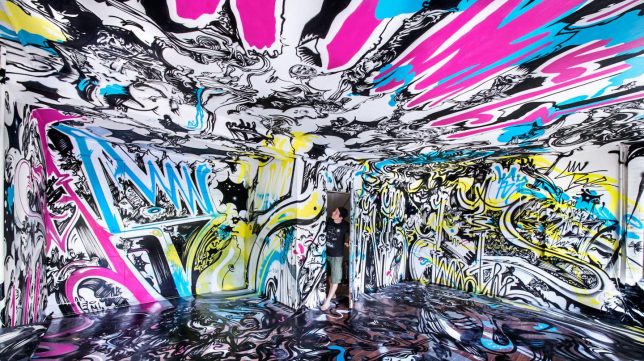
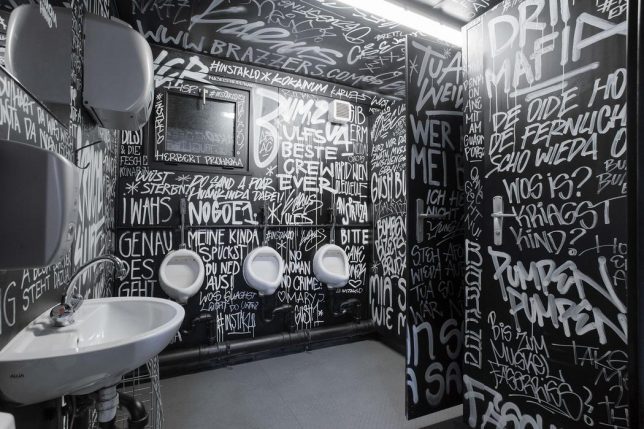
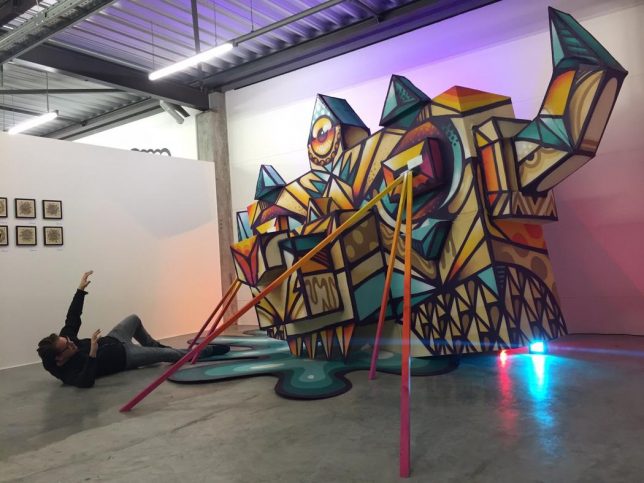
    Set to be demolished in June to make way for an apartment building,THE HAUS in Berlin is a formerly abandoned 5-story building filled with site-specific works by 165 street artists. Dreamed up by artists Kimo, Bolle and Jörni of Die Dixons collective, THE HAUS was once a bank on avenue Kurfürstendamm, but fell into disuse over the years. The artists activated their network of creative contacts to temporarily turn it into a street art free-for-all that’s so popular with visitors, there’s often a two-hour wait outside.

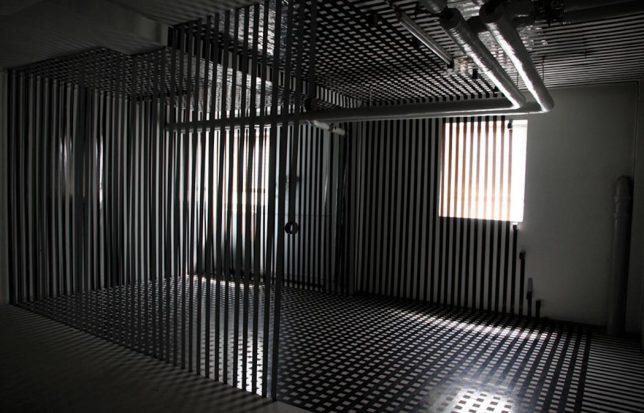
    The artists, who range from Berlin locals to international activists, worked almost nonstop from mid-January through March 9th to complete the project, and installations include geometric patterns made of tape, video projections, interactive exhibits and sculpture.

    The exhibit opened April 1st, and guided tours run almost all day long on Tuesdays through Sundays with a donation-based, pay-what-you-can system and a ‘no phones’ rule. “Look through your eyes and not through the screen of your phone,” the website urges. You can see each individual installation on THE HAUS website, and learn more about the artists who created them.

    Even beyond the art itself, the project is definitely a community effort. Nearly all of the supplies were donated by supportive businesses, and a four-star hotel even put up all the artists free of charge. Berliner Pilsner donated beer. In an interview with Vice’s The Creators Project, Kimo stresses that THE HAUS is “not a marketing joke,” noting that nothing was for sale.

    “Feel the freshest urban art gallery ever with a guided tour!” says the site. “108 dope artworks are waiting to be seen, to be experienced and to be memorized by you. Every single piece is created by one of the 165 artists from Berlin and all over the world. But be aware that THE HAUS is created to be destroyed – in the end of May the gallery is going to close and the wrecking ball will follow.”

    Share on Facebook


    [ By SA Rogers in Art & Street Art & Graffiti. ]

    [ WebUrbanist | Archives | Galleries | Privacy | TOS ]


    WebUrbanist

  • Blackmagic Designs promises scopes for 4K Video Assist monitor/recorder

    Blackmagic designs has announced a variety of professional ‘scopes’ will be added to its Video Assist 4K monitor/recorder. In the meantime, the company has also added support for ten extra languages.

    Firmware v2.5, due in June, will add waveform, RGB parade, vectorscope and histogram options to the device. These can either be displayed on a black background, overlaid on top of the video feed or shown as picture-in-picture frames.

    Waveform, RGB parade and vectorscope are tools used by video professionals for quickly assessing exposure and color. These are powerful tools, each of which gives a different way of understanding the brightness and color makeup of the footage, to help set up and monitor your video as you capture it.

    ‘Scopes’ being added to the Video Assist 4K include this RGB parade, showing the spacial distribution of per-channel brightness values within the scene, helping with exposure and color balance.

    We were recently impressed when the Panasonic DC-GH5 became the first camera we’ve reviewed to provide in-camera scopes, but the addition of these functions to the Video Assist mean that they’re now accessible to anyone shooting with a camera offering HDMI output.

    Update v2.4, available today, adds support for ten additional languages, meaning the device can now be operated in: Chinese, English, French, German, Italian, Japanese, Korean, Portuguese, Russian, Spanish and Turkish.

    The latest firmware can be downloaded from the Blackmagic Designs website.


    Press Release:

    Blackmagic Design Announces New Professional Scopes and Multi Lingual Support for Video Assist

    New software update supports 10 additional languages, plus a beta demonstration of full professional scopes for professional monitoring.

    NAB 2017, Las Vegas, Nevada – April 24, 2017 – Blackmagic Design today announced the immediate availability of Blackmagic Video Assist 2.4 update which adds support for multi-lingual support for 10 separate languages. This means customers can now use Video Assist in their native language. This update is available now as a free update for all Blackmagic Video Assist and Blackmagic Video Assist 4K customers.

    Also demonstrated at the NAB 2017 show are powerful new professional scopes operating on the Blackmagic Video Assist 4K model, including waveform, RGB parade, vectorscope and histogram that can be viewed full screen for accurately evaluating video signals passing through Blackmagic Video Assist 4K. These scopes are shown as a development preview and will also be available in June as a software update free of charge for all Blackmagic Video Assist 4K customers.

    Customers can see a beta demonstration of the new language support and preview the new professional scopes on Blackmagic Video Assist 4K at the Blackmagic Design NAB 2017 booth at #SL216.

    The new scopes make the Blackmagic Video Assist 4K model perfect for live production monitoring, as portable test scope for broadcasters, and even for balancing color when color grading using the RGB parade scope.

    The new localized Video Assist adds interface support for Chinese, English, French, German, Italian, Japanese, Korean, Portuguese, Russian, Spanish and Turkish. This broad language support now makes it easier for more customers to use Video Assist anywhere in the world.

    “Video Assist has become an indispensable part of everyone’s production kit,” said Grant Petty, Blackmagic Design CEO. “It’s the perfect portable field monitor and recorder. The addition of full blown professional scopes makes it even more exciting and useful for customers. Plus, the new multi-lingual interface will make it easier for non-English speaking customers to use it!”

    Availability and Price

    Blackmagic Video Assist 2.4 update is available now from the Blackmagic Design website free of charge for all current Blackmagic Video Assist and Blackmagic Video Assist 4K customers. Blackmagic Video Assist 2.5, which will support scopes on the Blackmagic Video Assist 4K model will be available in June.

    Articles: Digital Photography Review (dpreview.com)

  • Seagate and DJI launch Fly Drive, a 2TB external HDD with a built-in microSD card slot

    Seagate and DJI have jointly announced the Seagate DJI Fly Drive, an external storage drive with up to a 2TB capacity, as well as a built-in microSD card slot. The new drive is targeted at camera drone operators specifically, enabling them to rapidly transfer content from the drone camera’s microSD card onto the Seagate DJI Fly Drive. At 2TB, the Fly Drive is able to hold more than 60 hours of video recorded at 4K/30fps.

    According to the two companies, Fly Drive features a built-in UHS-II-rated hub for rapid transfers of high-resolution content. The case itself features a USB-C cable that is ‘tucked inside of the [shock-resistant] bumper’ when not in use, eliminating the need to carry a separate data transfer cable. The drive supports both Thunderbolt 3 and USB 3.1, and it comes with two months of free access to Adobe Premiere Pro CC.

    The Seagate DJI Fly Drive will hit shelves some time this summer for $ 120.

    Via: Seagate

    Articles: Digital Photography Review (dpreview.com)

  • SLR Magic introduces E-mount Cine 25mm F1.4

    SLR Magic will be showing off a new prime for videographers at NAB: the Cine 25mm F1.4. Costing $ 400 and available at the end of May, the 25mm F1.4 will be available in E-mount and will be compatible with both APS-C and full-frame Sony cameras. The lens is a quite compact 78.4mm / 3.05in and weighs 520g / 18.34oz. A manually controlled aperture uses 13 blades. NAB attendees can take a look at the lens in person at SLR Magic’s booth.

    Press Release:

    Hong Kong, China (April 24, 2017) – SLR Magic extends it’s full frame lens lineup with the SLR Magic CINE 25mm F1.4 wide angle lens. This product will be officially introduced during the upcoming 2017 NAB Show in the Las Vegas Convention Center. There will be a demo at the SLR Magic booth (Central Hall, C2663) during the NAB Show from 24 – 27th April 2017.

    The field of view of the SLR Magic CINE 25mm F1.4 opens up many new creative composition opportunities, particularly in the fields of interior, architectural and landscape cinematography and photography. The compact size of the SLR Magic CINE 25mm F1.4 wide angle lens also makes it a good choice of lens to be used with gimbals.

    We place our highest priority in the development on our lenses to fulfill the demands of professional cinematographers and photographers. The design and build of the SLR Magic CINE 25mm F1.4 is solid and reliable.

    SLR Magic is currently looking for volunteers to test the SLR MAGIC CINE 25mm F1.4 E mount lens at a special price. If interested:

    1 ) Send an email to support@slrmagic.com with the subject ” SLR MAGIC CINE 25mm F1.4 lens volunteer + (your name)”.

    2 ) Include sample videos/photos or link to photo/video reviews you have done in the past.

    THE SLR Magic CINE 25mm F1.4 (MSRP: $ 399 US) will be available from authorized SLR Magic dealers by the end of May, 2017.

    Technical Data

    SLR Magic CINE 25mm F1.4

    Lens Type: Fast standard lens

    Compatible Cameras: FE-mount and E-mount cameras

    Optical Design: 11 elements in 9 groups

    Distance Settings:

    Distance range: 0.25m to ?, combined scale meter/feet

    Aperture: Manually controlled diaphragm, 13 aperture blades, Lowest value 16.

    Filter Mount: Internal thread for 52mm filter; filter mount does not rotate.

    Surface Finish: Black anodised

    Dimensions:

    Length to bayonet mount: approx. 78.40mm (approx. 3.05in)

    Largest diameter: approx. 64.64mm (approx. 2.54in)

    Weight: approx. 520g (approx. 18.34oz)

    Articles: Digital Photography Review (dpreview.com)

  • TriLens triple lens holder coming to Kickstarter

    We’ve seen belt-mounted lens-holders before, but the TriLens from Swedish startup Frii Designs takes things to a new level. This holder lets you attach three lenses to a belt-worn device that is made of steel and fiber-reinforced nylon and can carry up to 100kg weight. 

    “There’s nothing worse than coming home from a photo shoot and realize that you’ve missed irreplaceable moments because you struggled with changing lenses, or that you simply were too lazy to go through the process,” Frii Designs founder Jonas Lundin says. 

    TriLens arranges three lens mounts on a triangle that rotates around its center. This way the heaviest of the attached lenses always points downwards and one open lens mount will be easily accessible at the top. In addition, the system comes with built-in stabilization to keep things less bumpy when walking or even running. The rotational friction of the system is automatically adjusted based on the weight of the attached lenses. 

    TriLens is compatible with Canon, Nikon, and Sony-mount lenses and included in the package is a set of magnets that let you attach your lens caps to an open mount when the corresponding lens is in use. 

    Frii Designs is planning to fund initial production through crowdfunding and will launch its Kickstarter campaign for the TriLens on May 9. The company’s goal is to secure around 600 pre-orders to get production going. Photographers  who think the TriLens could make their work day easier can sign up on the Frii Design website to register interest and for pricing information. You’ll also be notified about the campaign launch. If everything goes to plan, shipping is planned to start in October this year.

    Articles: Digital Photography Review (dpreview.com)

  • Fujifilm X100T in black listed as discontinued on B&H Photo

    Is it the beginning of the end for the Fujifilm X100T? The camera has been listed as discontinued on B&H Photo’s website. This isn’t the first time we’ve seen this camera show up on an online retailer’s website as discontinued; Digital Rev showed it out of stock back in September 2016, though it currently lists one version the camera as ‘in stock.’

    The B&H Photo listing shows only the black version of the X100T as discontinued, while the silver version is still available. In contrast, Digital Rev shows the black version as currently available and the silver version as unavailable. Adorama still lists both the black and silver versions available for a discounted $ 1,099.99.

    Via: FujiAddict

    Articles: Digital Photography Review (dpreview.com)