Tag: world’s

  • CASE Remote Air is the world’s smallest smart camera controller

    CheeringTech, the maker of the CASE smartphone remote for DSLRs, has launched a crowdfunding campaign on Indiegogo for a lighter and smaller next-generation version, the CASE Remote Air.

    CheerinTech says at 2.4″ x 1.6″ x 0.2″ the CASE Remote Air is the world’s smallest smart camera controller. At only 50 grams it is also very lightweight. Like similar devices, it connects to the USB-port of your DSLR and creates a Wi-Fi hotspot that allows for a wireless connection to your smartphone or PC. Using a dedicated app you can then see the camera’s live view image on the display of your smartphone, alter camera parameters, control video shooting or use one of the special modes, such as focus-stacking or time-lapse. In addition, you can download images from the camera to your device, including Raw files.

    CASE Remote Air works with many Canon and Nikon DSLRs and can be controlled from Android and iOS mobile devices or PC and Apple computers. You can currently reserve a CASE Remote Air for $ 79 plus shipping. Delivery is expected for October. More information, including a full list of compatible cameras, can be found on the Indiegogo crowdfunding site. 

    Articles: Digital Photography Review (dpreview.com)

  • Nico360 to be ‘world’s smallest’ 360-degree camera

    A Hong Kong-based startup is looking to fund production of Nico360, a waterproof 360-degree camera. Claiming it will be the ‘world’s smallest’ at 46 x 46 x 28mm, Nicocam says its camera will include two 16MP Sony sensors capable of 25MP still images and 2560 x 1440/30fps video. As with many other 360-degree cameras, Nico360 will be able to produce content for stereoscopic VR headsets. A 1/4″ mount will be used, and the camera will accept microSD cards.

    Users will be offered four video recording options: Flat Mode, Sphere Mode, Planet Mode, and VR Mode. Spherical panoramas will be created via in-camera stitching; Nico360 will also offer live video streaming using either via Bluetooth 4.0 or WiFi 5Ghz/ac. Finally, Nico360 will feature an integrated stereo microphone, stabilization and 32GB of internal storage. 

    Nicocam plans to sell Nico360 for $ 199. A $ 99 pledge will reserve backers a ‘super early bird’ version on Indiegogo, and the camera is estimated to ship to supporters in October 2016. The funding campaign also offers a ‘full accessories pack’ for $ 89 and a 5000mAh Battery Selfie Stick for $ 39.

    Via: Indiegogo

    Articles: Digital Photography Review (dpreview.com)

  • SanDisk says its two new microSD cards are the world’s fastest

    SanDisk has announced a pair of new 256GB microSD cards: the SanDisk Extreme microSDXC UHS-I card and the Ultra microSDXC UHS-I Premium Edition card. These are the fastest microSD cards in the world, according to SanDisk, with the Premium Edition also ‘optimized for mainstream consumers.’ The cards are intended for action cameras, drones, smartphones and other gadgets with demanding storage needs.

    The 256GB Extreme card is the fastest of the two, offering transfer speeds up to 100MB/s (compared the Ultra’s 95MB/s max transfer speed) and write speeds up to 90MB/s. SanDisk presents the Extreme model as being ideal for UHD video recording, saying the card can hold up to 14 hours of 4K video. The Ultra version, meanwhile, is better suited to lower resolutions, and can store more than 24 hours of Full HD video.

    In addition, both microSDXC cards can withstand extreme temperatures and are waterproof, shock-proof, and x-ray-proof. Both are compatible with SanDisk’s Memory Zone Android app. The company will launch the Ultra Premium Edition card globally in August for $ 149.99, and the Extreme card globally in the fourth quarter of this year for $ 199.99.

    Via: SanDisk 

    Articles: Digital Photography Review (dpreview.com)

  • Kerlee 35mm F1.2 is ‘World’s fastest’ 35mm for full-frame SLRs

    $ (document).ready(function() { SampleGalleryV2({“containerId”:”embeddedSampleGallery_4732756521″,”galleryId”:”4732756521″,”isEmbeddedWidget”:true,”standalone”:false,”selectedImageIndex”:0,”startInCommentsView”:false,”isMobile”:false}) });

    Industrial lens manufacturer Shenzhen Dongzheng Optics Technology has announced the Kerlee 35mm F1.2 – which it claims is the fastest 35mm designed for full-frame SLR cameras. The lens is manual focus and features a choice of clicked or silent aperture operation to suit both stills and movie photographers. The company says it will produce units with mounts in Canon EF, Nikon F, Sony E and Pentax K fittings.

    The lens uses 11 elements in 10 groups and includes two high refractive index lenses and one ED low dispersion element. The company says the closest focusing distance is 0.3m / 1ft, but optical performance is said to be at its best when the subject is 1-5m / 3.2-16.4ft from the camera. The smallest aperture is F22 and a depth of field scale is provided.

    Pricing has yet to be released, but more information can be found on the Dongzheng Optics website.


    Press release:

    The world’s first SLR full frame camera support large aperture lens 35mm f/1.2

    KERLEE 1.2/35 lens, specially developed for all lovers of photography,
    is of high performances featuring large aperture, soft Bokeh effect and rich colors.

    Features:
    1. Minimum focus distance is up to 0.3.
    2. Optional switchable aperture lock, allowing for smooth adjustment in video mode.
    3. The optimal distance is within 1-5 meters with the best image quality
    4. Smooth focusing feel, appropriate damping and superior experiences.
    5. ED lens effectively improve image/color differences.
    6. It’s globally the first 35mm F/1.2 large aperture lens that supports single-lens reflex full-frame cameras. When taking an image, set the aperture to Maximum f1.2 can conspicuously emphasize the subject on the background, producing a nice picture atmosphere.
    7. Excellent rendering effect in dim light, also enhance shutter speed to complete a shot

    Articles: Digital Photography Review (dpreview.com)

  • World’s Biggest Indoor Vertical Farm Near NYC to Use 95% Less Water

    [ By WebUrbanist in Architecture & Offices & Commercial. ]

    aerfarms rows

    AeroFarms is on track to produce 2 million pounds of food per year in its 70,000-square-foot facility in Newark, under construction about an hour outside Manhattan. Their efficient operation, based on previous experience at similar but smaller facilities, can accomplish this astonishing output “while using 95% less water than field farmed-food and with yields 75 times higher per square foot annually.”

    aerofarms facade

    This new facility is comparable in efficiency to what is currently the world’s largest vertical farm in Japan, but nearly three times the size. Staggering its crops is part of the success behind AeroFarm’s strategy at their new and existing locations – at a given facility they are able to switch between 22 crops per year. Their all-season growth works with specialized LED lights and climate controls all without the need for sunlight or soil.

    aerofarms diagram

    “We use aeroponics to mist the roots of our greens with nutrients, water, and oxygen.,” explains AeroFarms. “Our aeroponic system is a closed loop system, using 95% less water than field farming, 40% less than hydroponics, and zero pesticides.” Smart pest management and highly-detailed data feedback loops help keep the system operating at peak efficiency and provide opportunities for iterative improvement, respectively.

    aerofarms shelves

    “Our passion is great tasting food and sharing our harvest with the world. In Newark, New Jersey, we are growing and selling into the New York Metro area. There has been tremendous demand for our locally grown, delicious, produce, and we have farms in development in multiple US states and on four continents. There has never been a greater need for safe, dependable, nutritious food, and we are scaling quickly to transform agriculture around the world.”

    aerofarms students

    First Lady Michelle Obama recently visited the Garden State and toured a nearby school, planting seeds in a rooftop garden and sharing healthy snacks with students involved in a youth program as young AeroFarmers.

    Share on Facebook


    [ By WebUrbanist in Architecture & Offices & Commercial. ]

    [ WebUrbanist | Archives | Galleries | Privacy | TOS ]

    WebUrbanist

  • World’s First 3D-Printed Office Building Unveiled in Dubai

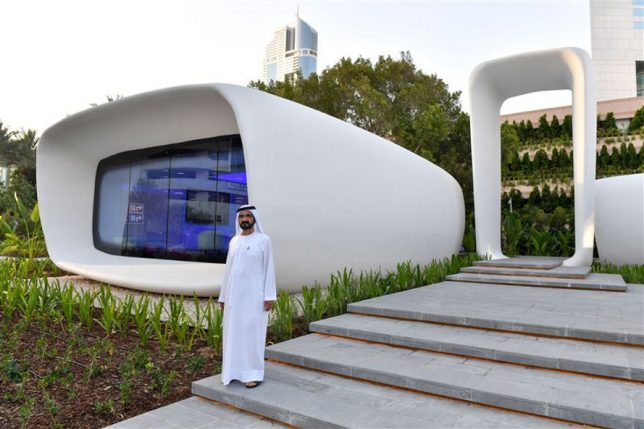
    3d office front dubai

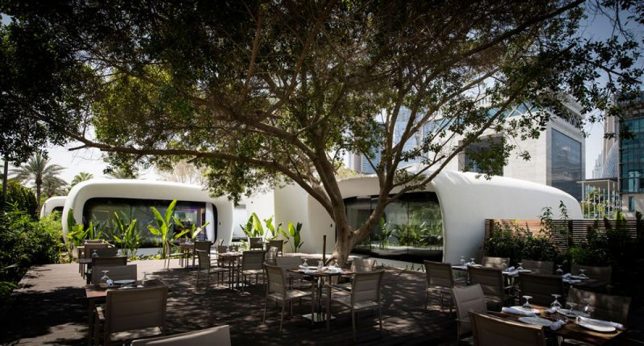
    Printed layer by layer from the ground up using a special cement mixture, this rapidly-produced curvilinear structure is a functional example as well as proof of concept, illustrating the architectural potential of 3D printing.

    3d printed office

    3d scultupre interance

    The entire 2,700-square-foot structure was built for a relatively modest $ 140,000, requiring just one operator to oversee the printer plus an array of electricians, plumbers and detailers to outfit the completed shell for power, water, lighting and telecommunications. The modular machine assembled to do the printing measured approximately 120 by 40 feet and stood 20 feet high, able to build while sitting in one place.

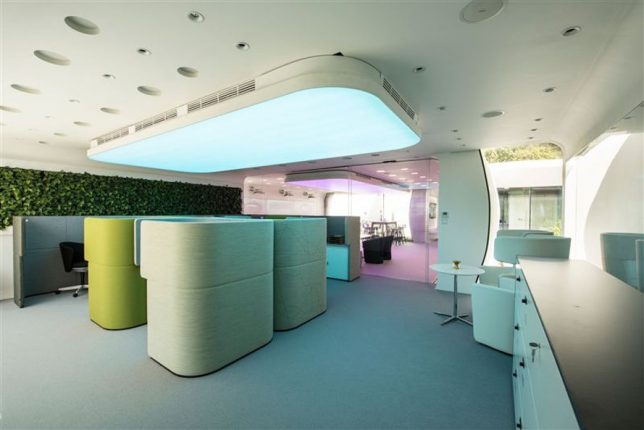
    3d interior curves

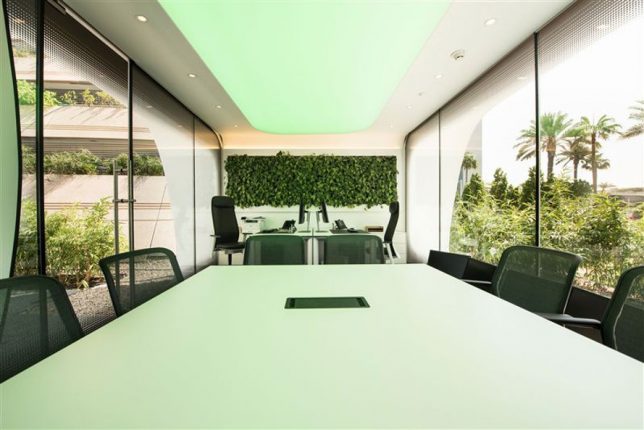
    3d interior

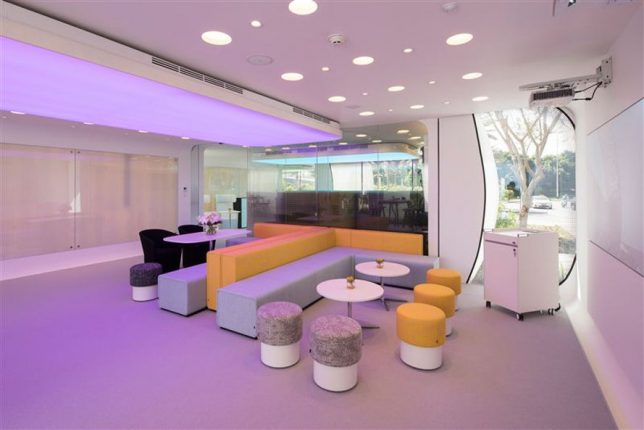
    The new building will (aptly enough) be home to the Dubai Future Foundation, providing space for offices, workshops and events. Global architecture firm Gensler designed the building in partnership with structural experts from Thornton Tomasetti and Syska Hennessy.

    3d lounge meeting area

    3d future foundation

    Complex curves on the interior and exterior were both considered part of the visual design but also a way to showcase the possibilities of 3D printing technology.

    3d office person

    3d bakc yard

    “We announce today the opening of the first 3D-printed office in the world, after less than one month of launching Dubai 3D printing strategy which showcases a modern model of construction. This is an experience we present to the world on utilizing future technology in people lives. It also represents a new milestone for the UAE as a global leader in strategic achievements,” Sheikh Mohammed said.


    WebUrbanist

  • World’s Longest Tunnel Slide Opening at Sculptural London Monument

    [ By Steph in Destinations & Sights & Travel. ]

    arcelormittal slide main

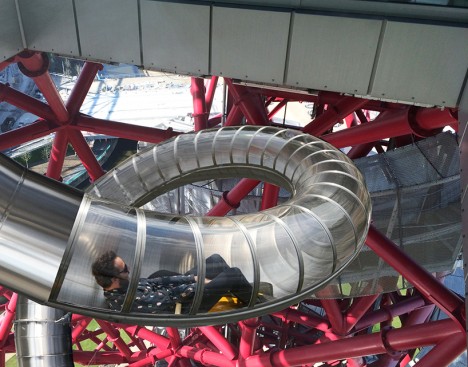
    Experience monumental sculpture like you never have before with a new 15-story tunnel slide that spirals around London’s ArcelorMittal Orbit monument, set to be the world’s longest. The UK is really pushing its public art to the next level by adding a record breaker to a record breaker, as the sculpture already holds the title of tallest in the nation. The slide wraps around the sculpture 12 times, and it takes forty seconds to get from the very top to the bottom in a trip through the tube.

    world's longest tunnel slide 2

    Opening to the public on June 24th, 2016, the Carsten Höller-designed slide features both opaque and transparent sections so riders get brief glimpses of the London skyline before plunging back into darkness. A tight corkscrew section snakes its way around the red geometric structure, ending in a straight run to the ground. The slide’s total length is 584 feet.

    world's longest tunnel slide 3

    world's longest tunnel slide 4

    world's longest tunnel slide 5

    London erected the strange and rather controversial ArcelorMittal for the 2012 Summer Olympics, offering panoramic views of the city from its location in Queen Elizabeth Olympic Park. Tickets for the attraction are already on sale for £15 ($ 22), with a limited number available each day, and you can book more than one ride at a time.

    Share on Facebook


    [ By Steph in Destinations & Sights & Travel. ]

    [ WebUrbanist | Archives | Galleries | Privacy | TOS ]


    WebUrbanist

  • World’s Tallest Wood-Framed Skyscraper Proposed for London

    [ By WebUrbanist in Architecture & Houses & Residential. ]

    wood tower for london

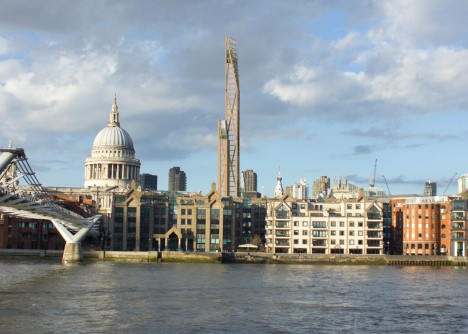
    An angular affair of wood and glass, this proposed skyscraper is designed to reach nearly 1,000 feet in the air and, if it goes forward, will be the first timber-framed tower in London and tallest such structure on Earth.

    wood skyscraper design

    Stick-framed houses are standard in many parts of the world, but using wood for skyscrapers has a lot of potential advantages, including: lower costs, less embedded energy, more renewable resources and a look and feel scaled to human occupancy.

    wood skyscraper skyline

    The obvious worry for most people is, of course, fire. However, timber buildings are famously good at standing up to flames – columns and beams will char in an inferno, and that charred surface can actually stand up longer to heat than exposed steel. While steel heats up and buckles, wood first loses its water weight, then chars and resists the flames.

    wooden architecture tower

    As it turns out, “Wood is one of nature’s most innovative building materials: the production has no waste products and it binds CO2. Wood has low weight, but is a very strong load-bearing structure compared to its lightness.”

    wood human factors

    Rising 80 stories above the city and providing 1,000 housing units, the London stick tower project is a collaboration between PLP Architecture and Cambridge University’s Department of Architecture. Completed, it would be the second-tallest building in the city next to The Shard.

    Share on Facebook


    [ By WebUrbanist in Architecture & Houses & Residential. ]

    [ WebUrbanist | Archives | Galleries | Privacy | TOS ]


    WebUrbanist

  • World’s Tallest Tower: Dubai Superstructure by Santiago Calatrava

    [ By Steph in Architecture & Cities & Urbanism. ]

    worlds tallest tower 1

    Edging out the record-holding Burj Khalifa by just a hair, the world’s tallest tower is set to rise into the Dubai skies by 2020 as the crown jewel of a new waterfront development. Neofuturist starchitect Santiago Calatrava, known for dramatic sweeping structures with complex engineering, won an international competition to design the as-yet-unnamed superstructure offering panoramic vistas of the city in February, and new images and details have just been released.

    worlds tallest tower 4

    worlds tallest tower 2

    Taking design inspiration from the contours of a lily flower, the tower features Calatrava’s signature illuminated cables stretching from its length to the floor of the plaza. Floor after floor of luxury boutique hotel rooms lead higher and higher into the air, topped with the ‘pinnacle room’ observation space. Lushly planted decks envisioned as recreations of the Hanging Gardens of Babylon offer additional views.

    worlds tallest tower 3

    worlds tallest tower 5

    The shimmering spire is meant to be a landmark for Dubai Creek Harbour, a new district that developers hope will become a trendy new residential and leisure destination for the city, and a new tourist attraction completed in time for the Expo 2020. It’s a flashy addition to Dubai’s many flashy projects, from those that have actually been built to those that have been squashed and abandoned. Calatrava calls it “a symbol of an abiding belief in progress.’

    worlds tallest tower 6

    Since so many of Dubai’s announced projects never actually get off the ground, it remains to be seen whether this tower will end up snatching the crown from the 2,722-foot-tall Burj Khalifa, a mega-tall skyscraper completed in 2009 as part of another large-scale mixed-use development.

    Share on Facebook


    [ By Steph in Architecture & Cities & Urbanism. ]

    [ WebUrbanist | Archives | Galleries | Privacy | TOS ]


    WebUrbanist

  • Best of both worlds? Canon patent for DSLR hybrid viewfinder design published

    Canon has applied for a patent for a viewfinder design that combines both optical and electronic displays in a DSLR style system. Via a system of mirrored prism the design allows users to benefit from all the advantages of both EVF and TTL optical systems through the same eye piece. Menus can be overlaid on a normal optical view, or a live view function can be used through the viewfinder – which would be of great benefit to video shooters.

    In Canon’s new hybrid viewfinder design light passes through the lens as usual and is reflected through a ground glass screen into the pentaprism. As it exits the pentaprism is can be supplemented with light from a LCD panel (labelled ‘9’) that is projected through a series of lenses and bounced from a half-mirror (6b) and on to a reflective surface (6). The two sources of light combine and pass to the photographer’s eye via the eye piece (8). When the mirror is in the up position the image recorded by the sensor (12) can be sent directly to the LCD panel (9) so the photographer can get a live view of what the sensor is recording. Thus the system combines the best elements of electronic and optical viewfinders.

    Through a clever use of optics and a mirrored prism, the new design allows a ‘full screen’ display across the whole viewfinder. The significance of the system is that DSLRs will be able to gain some of the advantages of mirrorless systems, such as full menus and playback in the viewfinder, and shooting information could be shown across the larger screen instead of just the bottom or sides of the screen. This would also make possible video shooting through the viewfinder, which could become important if technologies like Dual Pixel AF start to replace secondary-sensor PDAF systems. This would eliminate the need to switch between viewfinder and rear screen shooting to change from stills to video mode, creating a more consistent experience.

    The system allows menus to be viewed and accessed as they are overlaid on the image produced by the optical finder

    The patent description explains that one of the challenges has been to ensure that the image projected from the electronic screen matches that of the optical system, which is why the screen has been placed close to the viewfinder instead of before the prism, where there might have been more room. Being on the viewing side of the prism means less magnification is needed to create an image big enough to coincide with that of the optical view.

    The projection system uses a complex set of lenses to reduce the size of the construction so that the manufacturer shouldn’t have to make physically larger cameras to accommodate it. Canon also indicated that it has taken steps to reduce the impact of the half mirror that has been placed in the optical path. It says that the angle of the mirror is optimized to allow as much light to pass as possible.

    The heads-up display type viewing system is nothing new, and although it has been discussed in camera circles before we have yet to see a good example of technology combining optical and electronic views. The closest we have come is the hybrid viewfinders used by Fujifilm in the X-Pro and X100 series of cameras, but Canon’s method is the first to combine an EVF with a TLL viewfinder, rather than a more rangefinder-style arrangement.

    Canon’s patent was applied for in 2014 and the information only just published, so the company may be in a position to introduce the system quite soon. However, as with any patent there’s a chance nothing will come of it, no matter how good an idea it is. We will just have to wait and see what, if anything, comes of it.

    Articles: Digital Photography Review (dpreview.com)