Month: October 2017

  • iPhone 8 Plus sample gallery

    It’s not exactly a revolutionary device, but the iPhone 8 Plus does promise some evolutionary updates in the camera department. Apple claims that low light image quality is improved, thanks to a new image signal processor, and Portrait Mode gets an interesting update in the addition of a beta Portrait Lighting feature. DPReview contributor Jeff Carlson has been putting the 8 Plus to the test in some everyday shooting situations – take a look at how it fared.

    See our iPhone 8 Plus sample gallery

    $ (document).ready(function() { SampleGalleryStripV2({“galleryId”:”2637450826″}) })

    Sample photoSample photoSample photoSample photoSample photo

    Articles: Digital Photography Review (dpreview.com)

  • Video: DxOMark’s smartphone rating system explained

    Marques Brownlee has one of the most popular photo and video-focused YouTube channels out there—boasting some 5.2 million subscribers—and his most recent video takes on a subject that many in the photo world argue about ad nauseam: DxOMark ratings. The video is currently the #7 trending video on all of YouTube, and it’s definitely worth a look, especially if you don’t fully understand how DxO comes up with its overall ratings, photo ratings, video ratings and beyond.

    The first half of the video breaks down how DxOMark’s testing system actually works, and how scores in individual categories are compiled into an overall Photo and Video score, which is compiled into an overall score for the device. The second half of the video is where it gets really interesting, however.

    Brownlee spends the last 6 minutes or so of the video tackling a few different subjects:

    1. How DxOMark’s role as a consulting firm leads to some speculation about how certain manufacturers might be tuning their devices so they’ll perform better on DxO’s testing system, and whether that always translates
    2. How the scores are NOT based on a maximum score of 100.
    3. How we really ought to expect every new smartphone or camera to be the “best” DxOMark has ever tested, because the tech ought to be getting better every year.
    4. And how the Tech Press at large isn’t very good about explaining DxO scores and often just throws out an overall score for clicks.

    That last part is something we do our best to avoid here at DPReview—diving into individual scores and breaking down some of the more subjective assumptions, like we did with the Pixel 2—but something we’re certainly not immune to either.

    In the end, Brownlee’s video helps to explain how DxOMark scores are arrived at, the questions you should ask when you look at those scores, and the kind of in-depth analysis you should demand from your tech publications when they share those scores. Yep, that includes us.

    Check it out for yourself at the top, and let us know what you think in the comments down below.

    Articles: Digital Photography Review (dpreview.com)

  • Shooting with a used DSLR kit that cost me just $80

    Cameras and lenses are expensive. Really expensive. Even the cheapest entry-level DSLR kit today costs $ 500 and upwards. But what if you would buy the cheapest possible used DSLR? A camera that is over 10 years old? How would it stack up against today’s modern cameras? I was curious about this, and decided to find out for myself.

    After two weeks of watching classified ads closely, and missing a couple of good bargains because I wasn’t fast enough, I finally managed to purchase a Canon 400D(also known as Rebel XTi) with a battery grip and a Canon 50mm f1.8 II lens on it. All this for only $ 80. It seemed like a great deal to me. It even came with a 2GB CF card!

    I took the camera for a long walk the same day I bought it, and to summarize my experience: I was amazed by how good it was!

    The sensor outputs 10 megapixel photos, meaning that they measure roughly 3900×2600 pixels. This is more than enough for posting on social media or viewing photos on a computer screen. And what amazed me even more, was that with a fairly good lens, which the Canon 50mm F1.8 is, these pixels get utilized very well. A 100% crop looks very crisp and sharp in most cases.

    See the video above for image samples and 100% crop examples.

    The only major downside with using an 11-year-old camera is that the dynamic range in the sensor falls far short of my modern Sony A7. If you do not nail the exposure really well when you take the photo, you have far less latitude to correct it later. With my modern cameras I just shoot everything slightly underexposed, and lift the exposure later in Lightroom. That would not be a good idea with the Canon 400D.

    This camera’s weak dynamic range also makes it hard to capture scenes with strong light and deep shadows in the same frame. But other than that, this $ 80 camera kit has already, after a couple of days, given me a lot of photography joy for the money. I will definitely keep this camera—it’s a fun tool to take out once in a while to add some variation to my photo walks.

    This little experiment taught me that if you just want a good camera to take nice looking photos in your everyday life, and you don’t have professional needs (such as 50 megapixel files) $ 80 will take you surprisingly far. And as an added benefit, 10 megapixel files give you such a swift and fast editing experience in Lightroom!


    Micael Widell is a photography enthusiast based in Stockholm, Sweden. He loves photography, and runs a YouTube channel with tutorials, lens reviews and photography inspiration. You can also find him as @mwroll on Instagram and 500px.

    This article was originally published on Micael’s blog, and is being republished in full with express permission.

    Articles: Digital Photography Review (dpreview.com)

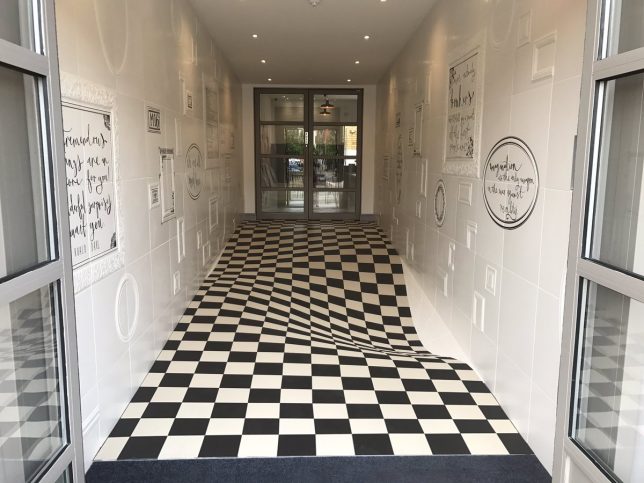
  • Trippy Tiles: Optical Illusion Installation Will Mess with Your Brain

    [ By SA Rogers in Design & Fixtures & Interiors. ]

    Looking at this picture, it seems pretty obvious that something is seriously wrong with the floor… right? And yet, as we should all know by now, things aren’t always as they seem, no matter how hard our brains try to reconcile the fact that a flat surface can look so believably sunken on one side. It’s kind of hard to wrap your mind around the fact that the effect is achieved simply by warping the shape of the tiles as they’re applied to the floor.

    The new entrance floor at Casa Ceramica #Manchester now try and process that this floor is actually flat!! #tile #floorporn #decorporn #decor #tileporn #architectureporn #tiles #trippy #tilelove #love #lookbook #lovetiles #largeformat #largeformattiles #decor #design #detail #designer #decorporn #illusion #instagood #interiors #innovation #illusionist #ihavethisthingwithtiles #ihavethisthingwithfloors #roomdecor #roomforinspo #lovetiles #architectureporn #alice #aliceinwonderland

    A post shared by Casa Ceramica Tile Company (@casaceramicatiles) on

    Casa Ceramica Tile Company created the illusion for the entrance to their own showroom in Manchester, UK. People must have had a hard time believing that the tiles are really flat from initial photos posted to Instagram and Twitter, because the company posted subsequent photos and videos of the installation process, saying “Like our entrance floor made from tiles #sorrynotsorry.”

    Apparently, the illusion only works from one direction, and when visitors are exiting the building, it looks like a normal tile walkway.

    Unsurprisingly, the illusion blew up on Twitter and became something of an internet sensation. You might dig through the company’s website or Instagram hoping for more optical illusions, but it looks like most of their work is pretty standard. Maybe this project will get them some fun commissions.

    Share on Facebook


    [ By SA Rogers in Design & Fixtures & Interiors. ]

    [ WebUrbanist | Archives | Galleries | Privacy | TOS ]


    WebUrbanist

  • The Yashica digiFilm Y35 exemplifies everything wrong with retro styling

    Allen Murabayashi is the Chairman and Co-Founder of PhotoShelter. He’s an avid photographer and frequently speaks on how photographers can use online marketing to grow their businesses. This article was originally published on PhotoShelter, and is reproduced here with permission.


    At the turn of the millennium, Chrysler introduced the PT Cruiser, a retro-styled automobile that echoed design elements from the 1930s.

    People went gaga for it because it was retro cool while retaining modern utility. Turning on the car didn’t require the driver to manually crank the engine. The car had air conditioning, power windows, and all the modern accoutrement that said retro cool need not be inconvenient to be successful.

    In photography, a resurgence of interest in film isn’t a self-flagellating exercise. Film possesses a quality that can only be simulated in digital. Large format digital simply doesn’t exist, and many alternative processes have no digital equivalent.

    Companies like Fujifilm have succeeded in incorporating rangefinder-style design, which feels nostalgic while incorporating incredible technology that place their cameras on par with other top-of-the-line offerings from other manufacturers.

    Then, there is Yashica. A few weeks ago, the company teased their “Coming Chapter” featuring an attractive Chinese model in jumpcut vignette that seemed to take styling cues from Blade Runner (PSA: smoking is bad for your health). Although Yashica never scaled the heights of its contemporaries, Nikon and Canon, it still had a fairly storied history with its SLRs and TLRs before Kyocera sold the trademark rights to a Hong Kong-based firm in 2008.

    An initial announcement about a smartphone lens system brought about a collective yawn, but photographers were still waiting to be delighted with a more substantive announcement of their “unprecedented” return to the camera world. And here is.

    The Yashica digiFilm Y35 is a digital camera with a 1/3.2inch 14-megapixel sensor that uses pretend film—each with different ISO ratings, aspect ratio, and color. They’ve launched a Kickstarter to give you an opportunity to purchase the $ 125 camera. Over 5,100 fools people have backed this project to the tune of nearly $ 1m.

    As I wrote in 2013, the camera of the future isn’t from the past. The Yashica Y35 reminds me of those old DigitalRev videos where Kai and crew would purposely handicap themselves using inferior cameras like the Barbiecam for, well, no purpose at all.

    You can plausibly make an argument that vinyl records have an acoustic advantage over low resolution streamed audio, that a handmade knife is more balanced and sharper than a factory manufactured version, but you can’t convince me that the Y35 yields any advantage in any aspect of photography whatsoever.

    The only unprecedented aspect of this comeback is how unprecedentedly disappointing it is. In the pursuit of brash consumerism, this newly branded Yashica has forgotten a large part of why we take photos in the first place: joy.

    Here’s a suggestion, save your $ 125 to donate to Hurricane Relief in Puerto Rico and use your smartphone instead. You’ll feel better and your photos will look better too.

    Articles: Digital Photography Review (dpreview.com)

  • Weekly Photography Challenge – Light Painting

    Earlier I rounded up a couple videos on how to do two very different styles of light painting. You can see them here. Below are two images of my own where you can see the two different techniques and the results.

    In this image, I have light painted the building with a regular flashlight.

    This shot is a combination of 3 people doing the light painting to make this happen. One on the building with a flashlight, another on the train tracks with an orange colored wand, and me on the wagon making the funky shape.

    Note: the image above was done using some special tools. Read this for more info: Review: Light Painting Brushes – Tools for Creativity.

    Weekly Photography Challenge – Light Painting

    Before you give up before you even start, assuming this is too hard for you – wait!

    Light painting does not have to be hard at all, and I’ll give you some articles to check out that can help you. But you can keep it simple and try a sparkler like this:

    Or a cell phone which was used to light up the car in this shot.

    If you need more help try these articles:

    • How to do Light Painting with a Piece of Fruit and a Cell Phone
    • Beginner’s Guide to Light Painting
    • Light Painting Part One – the Photography
    • Light Painting Part Two – Photoshop
    • How to Make Unique Portraits Using Light Painting
    • How to do Light Painting Photography Art with Endless Possibilities
    • How to Create Beautiful Light Painting Images With an Illuminated Hoop
    • Fire Spinning with Steel Wool – A Special Effects Tutorial

    Share your images below:

    Light painted train caboose.

    This was created using gloves that glow different colors. My husband did the light painting, it’s the name of his favorite beer in Nicaragua.

    The ultimate light painting is fire spinning.

    Simply upload your shot into the comment field (look for the little camera icon in the Disqus comments section) and they’ll get embedded for us all to see or if you’d prefer, upload them to your favorite photo-sharing site and leave the link to them. Show me your best images in this week’s challenge. Sometimes it takes a while for an image to appear so be patient and try not to post the same image twice.

    Share in the dPS Facebook Group

    You can also share your images on the dPS Facebook group as the challenge is posted there each week as well.

    The post Weekly Photography Challenge – Light Painting by Darlene Hildebrandt appeared first on Digital Photography School.


    Digital Photography School

  • Casio launches intense-looking GZE-1 action cam that’s waterproof to 50 meters

    Casio just announced an action camera that it claims is drop-, water- and freeze-proof, and comes with a 13mm f/2.8 equivalent lens. It’s called the GZE-1, and it’s the first of a new line of Gz EYE models that are aimed at extreme sports enthusiasts.

    The camera is said to use G-Shock technology borrowed from the Casio’s sports watch brand, and can be controlled either by a Casio Pro Trek watch, a smart phone or the dedicated (and optional) remote controllers, one of which has a LCD screen that allows users to see the action live. The camera itself doesn’t have a viewing screen.

    CD controller “GEC-10” PRO TREK Smart “WSD-F20”

    Despite having a 21.14-million-pixel 1/2.3-type backlit CMOS sensor, the GZE-1 turns out only 6.9MP still images and FullHD video. It can, however, record frame rates of up to 240fps, and allows users to vary the frame rate during a clip to mix slow-motion with normal motion in the same sequence. This allows action moments to be shown in slow-motion without users having to record the whole sequence at a high frame rate, or having to combined multiple clips of different speeds in post-processing.

    Three-axis electronic image stabilization helps to keep movie footage smooth (though it does nothing for stills) and over-sized buttons make the camera easy to control with gloves on. A resin body coating and a urethane bumper helps the camera withstand drops from 4 meters, high pressure blasts from waves, and water in general to depths of up to 50 meters. The body is also IP 6X dust-proof and can operate in temperatures as low as -10°C.

    No price has been released yet but the Casio GZE-1 is due to go on sale at the end of the month in Japan… we’re still waiting to see if it becomes available elsewhere in the world.

    For more information, see this translated version of the Casio GZE-1 product page.

    Articles: Digital Photography Review (dpreview.com)

  • I Spy With My Little Eye: Macro Photo Gold

    Warning: preg_replace(): The /e modifier is no longer supported, use preg_replace_callback instead in /home/forge/content.photojojo.com/content.photojojo.com/wordpress/wp-content/plugins/ozh-better-feed/inc/feed.php on line 134


    Photojojo

  • WD will use microwave technology to create 40TB hard drives

    Every time you think we’re approaching the ceiling of what’s possible in the world of photo storage, a new innovation comes along that moves that ceiling just a little (or a lot) higher. Case in point: Western Digital has revealed some new proprietary technology that it claims will allow them to create 40TB 3.5″ spinning disk hard drives (HDDs) by the year 2025.

    According to Engadget, the current max you’ll find in the wild is also made by Western Digital (or, rather, one of its subsidiaries) and maxes out at 14TB. So how does WD expect to almost triple that capacity without increasing the size of the drive itself? The answer: microwaves. Or, more specifically: something called “Microwave-Assisted Magnetic Recording Technology”.

    This MAMR technology is built into a new type of drive head that, according to Western Digital, is able to pack more bits of data onto the same size disk by generating “a microwave field.” Once this technology is fully developed, WD expects it to allow drives to pack up to 4 Terabits of data per square inch of disk, leading to “hard drives with 40TB of capacity and beyond by 2025, and continued expansion beyond that timeframe.”

    If you’d like to learn more about this technology, check out the technical video below:

    WD claims this tech is “ready for prime time,” with the first MAMR drives appearing on the market in 2019. Just in time for 8K video to become standard on smartphones, right?

    Press Release:

    WESTERN DIGITAL UNVEILS NEXT-GENERATION TECHNOLOGY TO PRESERVE AND ACCESS THE NEXT DECADE OF BIG DATA

    Company Builds on its Leadership of Delivering Industry’s Highest Capacity Hard Drives with Demonstration of Breakthrough Innovation on Microwave-Assisted Magnetic Recording Technology

    San Jose, CA – October 11, 2017 – At its “Innovating to Fuel the Next Decade of Big Data” event today, Western Digital Corp. (NASDAQ: WDC) announced a breakthrough innovation for delivering ultra-high capacity hard disk drives (HDDs) to meet the future demands of Big Data with proven data center-level reliability. The event, held at the company’s headquarters in Silicon Valley, included a demonstration of the world’s first microwave-assisted magnetic recording (MAMR) HDD and presentations from company executives and the inventor of MAMR technology, Professor Jimmy Zhu from Carnegie Mellon University. The company also showcased advancements in micro actuation and Damascene recording head technology. Western Digital expects to begin shipping ultra-high capacity MAMR HDDs in 2019 for use in data centers that support Big Data applications across a full range of industries.

    “As the volume, velocity, variety, value and longevity of both Big Data and Fast Data grow, a new generation of storage technologies are needed to not only support ever-expanding capacities, but ultimately help our customers analyze and garner insights into our increasingly connected universe of data,” said Mike Cordano, president and chief operating officer at Western Digital. “Our ground-breaking advancement in MAMR technology will enable Western Digital to address the future of high capacity storage by redefining the density potential of HDDs and introduce a new class of highly reliable, ‘ultra-high capacity’ drives. We have a proven track record for identifying, investing in and delivering advanced technologies that create new product categories and enable the world to realize the possibilities of data. Five years ago we introduced our HelioSeal®, helium-filled drive technology. Since then, we have shipped more than 20 million helium drives. That type of leadership and innovation continues today and we aim to leverage it well into the future.”

    MAMR is one of two energy-assisted technologies that Western Digital has been developing for years. The company recently innovated a breakthrough in material and process that provides the required reliable and predictable performance, as well as the manufacturability to accelerate areal density and cost improvements to an estimated average of 15 percent per year. Developments in the other energy-assisted technology, specifically, heat-assisted magnetic recording (HAMR), present new material science and reliability challenges that are not a factor in MAMR. Only MAMR demonstrates the reliability and cost profile that meets the demands of data center operators.

    At the heart of the company’s innovation breakthrough is the “spin torque oscillator” used to generate a microwave field that increases the ability to record data at ultra-high density without sacrificing reliability. Western Digital’s innovative MAMR technology is expected to offer over 4 terabits-per-square-inch over time. With sustained improvements in recording density, MAMR promises to enable hard drives with 40TB of capacity and beyond by 2025, and continued expansion beyond that timeframe.

    “Western Digital’s demonstration of MAMR technology is a significant breakthrough for the hard disk drive industry,” said John Rydning, research vice president, Hard Disk Drives, IDC. “Commercialization of MAMR technology will pave the way to higher recording densities, and lower cost per terabyte hard disk drives for enterprise datacenters, video surveillance systems, and consumer NAS products.”

    Western Digital’s MAMR technology is the latest innovation to significantly improve areal densities. It builds upon a number of other leading innovations from the company. In addition to HelioSeal helium-filled drive technology, MAMR also builds upon the company’s micro actuation and recording head manufacturing technologies. Western Digital’s advanced micro actuation technology for data center applications enables hard drives to accurately and reliably position magnetic heads for writing and reading at ultra-high densities. The company’s head manufacturing operations are the only internal supplier to utilize Damascene processing to manufacture heads with the precise tolerances and complex structures required for reliable and cost-effective recording at ultra-high densities. The Damascene process also provides the capability to embed the spin torque oscillator that enables the manufacturing of MAMR heads. The combination of these technologies deliver superior total cost of ownership (TCO) across all sizes of cloud and enterprise data centers.

    The demonstration of Western Digital’s MAMR technology is the latest achievement in decades of HDD leadership from the company, including over 7,000 issued patents in HDD technology, on-going helium-enabled HDD technology advancements – as highlighted by the recent introduction of the world’s first host-managed shingled magnetic recording (SMR) technology enterprise-class 14TB hard drive – and a long history of world’s firsts in multi-disk design.

    For further information on Western Digital MAMR technology, go to http://innovation.wdc.com.

    Articles: Digital Photography Review (dpreview.com)

  • Video Tips – Two Light Painting Techniques for you to Try

    I personally love night photography and one of my favorite things to do at night is light painting. There are a few ways to do it depending on the look you want. Here are two completely different techniques for you to try out.

    Make a Light Spiral

    In this first video photographer Jason Rinehart shows us how to create a light painted spiral. So there is no subject you are adding light to, the light itself ends up being the subject. See how he does it here:

    Light Paint an Old Barn

    In this second video, you see a different approach where a flashlight is used to light paint the subject, in this case, an old barn in Ireland. There is a right and a wrong way to do this, and they give good examples of both.

    Have you tried light painting before? Which of the two methods do you like better, or do you enjoy doing both styles? Tell us in the comments below.

    The post Video Tips – Two Light Painting Techniques for you to Try by Darlene Hildebrandt appeared first on Digital Photography School.


    Digital Photography School