Blog

  • PMA 2008 – Nikon D60

    Nikon has introduced the D60 DSLR, 10.2 megapixel DX-format with tons of new features (of course) and a new 18-55 VR -vibrations reduction lens. This unit will be available beginning March 2008. We’ll cover some of the excellent, new lenses in another video. Yep, the Nikon-Canon leapfrogging continues.
    Video Rating: 3 / 5

    Lcd battery grip for nikon d40/d40x/d60

  • Nikon D90 with AF Nikkor 50mm 1.8 D

    This is my first uploaded video mode for Nikon D90 with AF Nikkor 50mm 1.8 D lens. I set the aperture to f1.8 to get the blurry background (bokeh). A very reliable video cam at dslr. The video mode configured with 1280×720 16:9. White balance to tungsten at A6.

    Me unboxing my new Nikkor (Nikon) 55-200mm F/4-5.6 G ED VR Telezoom lens. I will be posting pictures in this video’s side info in a couple of days. Stay tuned! Please rate and comment on how you think this video is..

  • PMA 2008 – New Nikon Lenses

    This year Nikon is introducing some very cool new lenses. The 16-85mm zoom has VRII, that means virbration reduction, which can get you up to 4 more stops for exposure in a zoom lens. Then the Tilt/Shift Lens called 24mm PC/E . Like having a View Camera in your hands with perspective control and a tilt feature. Canon has had one of these for years but this update, finally brings the Nikon series in-line. And it’s arguably a better lens.Watch for the 45 and 85 PC/E later. The Micro Nikkor has been around for years and the new 60mm deserves a spot in your camera bag. Visit photoinduced.com for more.
    Video Rating: 4 / 5

  • Beers With: Edward Hopper

    It’s been a while since we got a chance to chat with any dead artists, and Edward Hopper was actually in the news this month.

    So I caught up with him last week at (appropriately) a bar in Fell’s Point in Baltimore to chat about the use of light in his most famous work.
    __________

    Strobist: First of all, Mr. Hopper, I’ll confess to being a big fan. You have long been an influence on my lighting. And also for a lot of other photographers, from the look of things.

    Hopper: Don’t mention it. Really. Influence is one thing, but some of the “homages” are another thing altogether. And please, call me Edward.

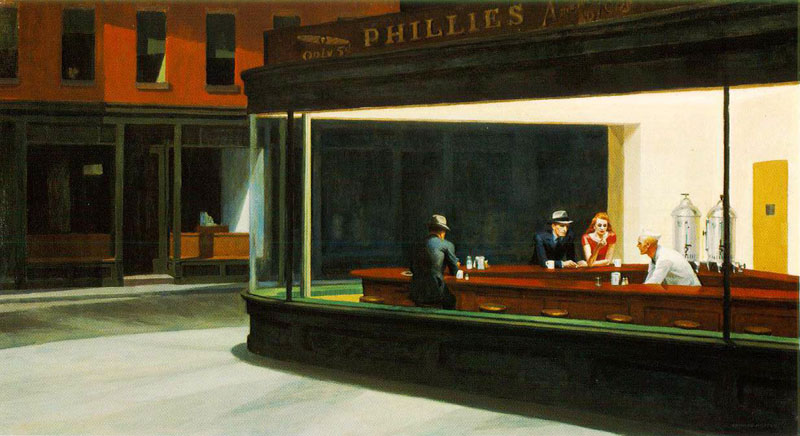
    Strobist: Thanks. I don’t want to waste any time before getting to the painting you are most associated with: “Nighthawks” (1942). It has become a cultural touchstone.

    Hopper: Well, that’s one way of putting it…


    [Ed. Note: Click on the pic to open it bigger in a different window for reference.]

    Strobist: So, here’s the picture. And I think it is damn-near perfect, if you don’t mind my saying. Was that available light?

    Hopper: Oh, no — it was lit.

    Strobist: So … it was also staged?

    Hopper: Yep. The redhead is from Model Mayhem. 0 (and a CD) for three hours.

    Strobist: And the guys?

    Hopper: Locals. They cost me a coupla beers. We did it after hours. We paid the barkeep a C-note to stay late and pose, too. Pretty bootstrapped, really. Fortunately, we did it before that stupid 0 NYC shooting permit crap. Ridiculous.

    Strobist: Indeed. So it is lit, then. Mind if I give it a go?

    Hopper: Be my guest.

    Strobist: Okay, so everyone has front light, and that can only be coming from one place. Direct light up in the ceiling?

    Hopper: Close. It’s actually a tight bounce. Direct might have looked better, but it would have been hard to hide the bare reflection in the coffee machines. With a near-surface bounce, we mostly tone down the reflection in the top dome. I actually considered pulling one of the coffee machines and using that window divider to hide the light’s reflection on the other machine.

    Strobist: Ah, and that would have given you an easy way to use a bare light.

    Hopper: Yep, but what all-nite joint wouldn’t have caf and decaf?

    Strobist: Exactly. Thus the bounce?

    Hopper: Yep. And that was the only interior light we used. It was an Elinchrom Ranger Quadra, by the way. It kicks out 400 watt-seconds, but was small enough to gaffer-tape the whole damn thing to the ceiling fixture. With a Skyport remote, we could control the power remotely, too. But we ended up running full power. The bounce ate up a lot of light.

    Strobist: So, you say that’s the only interior light. Were there more?

    Hopper: Yes, there is one more strobe — another Ranger Quadra.

    Strobist: Where is it?

    Hopper: You tell me.

    Strobist: Well, shadows on the right side of the far window point to the light, so I know it is somewhere around that corner.

    Hopper: Keep going…

    Strobist: Any Photoshop tricks?

    Hopper: Nope.

    Strobist: Then it has to be behind the back right wall, on a very high stand … and a boom?

    Hopper: Yep, thus the tiny little Quadra. Head just weighs a few ounces. You can stick it way out there. Stand goes up behind the back right wall, boom comes out to the left, light is hanging out over the street and hidden by the wall over the window. That give me a hair light on Red, and separation on the guy sitting next to her.

    Strobist: Is that important?

    Hopper: Oh, yeah. Look at the other guy. See how he gets lost against the background on his camera left side?

    Strobist: Yep.

    Hopper: No separation light on him. That kinda makes him secondary to the couple as a subject. That back light is catching the barkeep’s face a little, too. But we gobo’d it to keep it from hitting the area across the street directly behind the bar patrons. We left that nice and dark.

    Strobist: Sweet. And everything else is ambient?

    Hopper: Yeah, about 3-4 stops down. We dragged the shutter for eight seconds — always bring a good tripod when lighting at night. Had the interior lights off in the bar, so no ghosting issues if they sat still. Ambient-wise, the bar is actually darker than the street outside. But the strobes reverse that.

    Strobist: So, do you just wing this kind of stuff, or do you comp it out?

    Hopper: Oh, no. I plan everything. Even did a run-thru a few nights before.

    Strobist: Really? So you just lay it out on a cocktail napkin, McNally style?

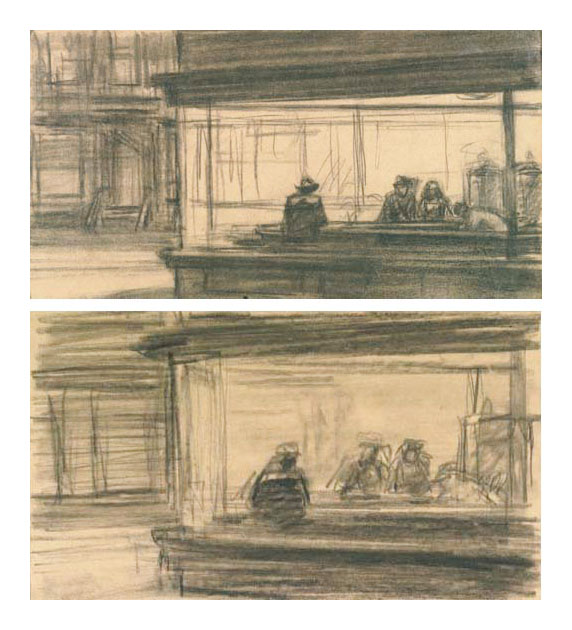
    Hopper: Used to, not any more. Now we do nice charcoals, on acid-free paper.

    Strobist: Wait, what?

    Hopper: Let me explain. Case in point — see this?


    Strobist: Yeah. Nice, I guess.

    Hopper: I guess? That baby went for 2,000 at Christie’s.

    Strobist: The rough draft? Are you kidding?

    Hopper: No kidding.

    Strobist: Wow. I use my iPhone to make lighting diagrams.

    Hopper: Aren’t you cool.

    Strobist: Apparently, not. Let’s get back to the idea of the homage.

    Hopper: You mean, ripoff?


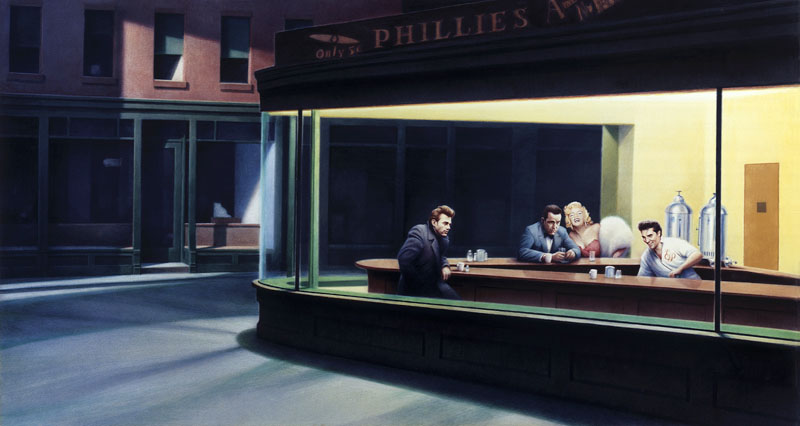
    Strobist: Whatever. So, here is “Boulevard of Broken Dreams II,” (1984) by Gottfried Helnwein. Kinda cool, really — James Dean, Humphrey Bogart, Marilyn Monroe, Elvis. It’s cool because they all died before their time, and here they are in a bar together at night.

    Hopper: Oh c’mon. It’s a watercolor on cardboard, for pete’s sake.

    Strobist: Yeah, but…

    Hopper: Really? You like it? REALLY?

    Strobist: I have another small confession — for the longest while, I thought the Broken Dreams painting was the original one.

    Hopper: Are you friggin’ kidding me? Look. I really gotta go, okay?

    Strobist: But…

    Hopper: Bye.

    Strobist: Well, in that case…

    __________

    Abruptly ended fictional interview aside, this painting was in the news this month. After much painstaking research, it was determined that the bar in Nighthawks — real tho Hopper made it — probably never actually existed.

    You can read more about that, starting here.

    And if you enjoy beers with dead guys, you can read our earlier conversations with Rembrandt and Vermeer.


    Strobist
  • Nikon D90 DSLR Video Test (using 5 lenses)

    Nikon D90 Digital SLR Shitty Goopy Video Test Lenses used: 50mm 1.4 Nikkor 18-105mm 3.5-5.6 VR Nikkor 18-135 3.5-5.6 Nikkor 105mm Sigma Macro 10-17mm Tokina Fisheye

  • Get Correct Exposure On Every Photo From Your Digital SLR

    Obtaining correct exposure for your digital photographs really isn't all that difficult given that the entire process can be automated; but there are circumstances when proper exposure can be tricky.

    Digital Photography Tips: How to get Correct Exposure and Avoid Blurry Photos in Low Light. from Nick Campbell on Vimeo.
    Exposure is more than just regulating the amount of light that passes through your camera's lens and onto the digital sensor. Depth of field is controlled by the F stop setting and the …

    Digital Shot

  • CS | d3x dgl action

    used programs: after effects, sony vegas enjoy!
    Video Rating: 3 / 5

    Now the best of the best

  • Photography WordPress Themes

    As you know I’ve been slowly (very slowly, sometimes) working on a series of reviews of website templates for photographers. This has given me a bit of insight into the advantages and disadvantages of various kinds of solutions.

    Along with the team over at Photocrati, as well as a couple teams of web designers, I contributed that insight to help design a new series of WordPress themes for photographers. I think these are now one of the best low-cost solutions on the market (I’m biased, of course). I’m not going to write a full review of the themes, since it’s hard to objectively review a product you’ve helped design. But I do want to talk about what some of the advantages are, and, yes, some of the disadvantages. I’m going to structure this like my other reviews.

    Let me start by saying that we’ve converted this site and I’ve converted my own phojournalism site to the new Photocrati WordPress themes. Check them out here:

    MORE INFORMATION | DEMO

    photocrati-emulsion-theme

    OVERALL APPEARANCE

    In my view, these templates are beautiful. They have just the look I like, which is a simple, elegant look that emphasizes the images. The rest of the site just kind of fades into the background. They use primarily whites, grays, and blacks for the background, which for me is less distracting from the images than greens/reds/oranges or other bright colors.

    Let’s start with a few screenshots of the themes. Here they are:

    emulsion

    lightbox

    viewfinder

    They have the look of many flash sites, even though they are not flash. The home page is designed with one large image space that contains a flash-style slide show.  The gallery pages contain rows and columns of thumbnails, which I prefer to “filmstrip” style thumbnails that require you to scroll up/down or side/side to see all the thumbnails in a gallery.

    I actually like the gallery look enough that I actually use a gallery as my home page on my new photojournalism site. Below a screen shot of my new homepage. It also shows you want the galleries generally look like (although you can customize those like everything else.

    Grade: A


    erick-danzer-photography

    EASE OF USE

    I’ve often noted that there is an almost direct trade off between Ease of Use and Flexibility. Designers of templates can make thing easier by limiting the number of options you have, or they can give you lots of options, which will complicate things.

    WordPress has lots of options. You can do almost anything with it. One downside of that is that WordPress themes are very much do it yourself solutions. You need to set up your own domain, your own hosting, and install WordPress. If you are familiar with all that, it’s really not too complicated. You can do it all in a few minutes at sites like <a href=”http://www.BlueHost.Com/track/erickdan” target=”_blank”>Bluehost</a> that offer one-click installation of WordPress.

    Once you’ve got your blog and you’ve got to fill it out, and make many of the layout decisions yourself. Again, this is great for flexibility, but less so if you are looking for a plug-and-play-and-don’t-worry-about-it kind of site.

    That said, pound for pound, WordPress is known to be one of the easiest web platforms to learn, giving you a tremendous amount of flexibility for a relatively short learning curve. And once you know WordPress, it IS easy.

    Grade: B

    FLEXIBILITY OF DESIGN

    If these themes have a learning curve for WordPress newcomers, then the payoff is incredible flexibility. There really is very little you CAN’T do with a WordPress site. You can change colors, fonts, layout. Add elements or take them away. Move elements around. Add text where you want it. Integrate with social media. You can even add a full-fledged forum or e-commerce shopping center to your site if you want to.

    The WordPress community is huge, and there are thousands of plug-ins that allow you to do just about anything.

    Grade: A

    BLOGGING CAPABILITY

    WordPress is the world’s most powerful blogging platform. Not much more to say.

    Grade: A

    E-COMMERCE FUNCTIONALITY

    I mentioned just a paragraph or two that there are all kinds of E-Commerce plugin-ins that allow you to add full shopping capability to WordPress. So the potential is there.

    But for the time being, these these don’t offer what many of us want, which is the ability to sell photos directly from our galleries. The Photocrati team is working on this, but doing it in a way that is simple and elegant is tough work.

    So for the time being, unless you are a WordPress guru who can do it yourself with one of the E-Commerce plugins, then you are out of luck until the Photocrati team comes up with an easy method to do it.

    Grade: D

    COST AND FEE STRUCTURE

    Again, it doesn’t really get any better. Right now the Photocrati themes are selling for each – for lifetime rights to the themes any updates. Pay once, low price, and it’s yours for life. Most highly managed template solutions (Photobiz/PhotoShelter/etc) entail ongoing monthly payments ranging from low to very high.

    Grade: A

    SEARCH ENGINE OPTIMIZATION

    Once again, WordPress is widely known to have about the best SEO capability that it’s possible to have. It has an inherent advantage over managed flash solutions, because it is a powerful blogging engine. And search engines love blog-style content – it fits all the qualities that search algorithms look for and therefore does very well. That’s while small mom-and-pop blogs can compete on the front page of Google with major multinational corporations.

    Grade: A

    FREE TRIALS AND GUARANTEES

    Photocrati offers a 30-day money back guarantee that entails sending one email requesting a refund. Easy enough.

    Grade: A

    CONCLUSION

    So, as you can see above, the Photocrati themes are strong in almost every aspect. They have two weaknesses: they do not yet offer the ability to sell your images directly from your site, and there is a learning curve for users who are new to WordPress. The second weakness, however, goes hand-in-hand with overwhelming flexibility. The reason there’s a learning curve is that, with WordPress, you are in control, and you can do just about anything.

    As of now, pound for pound, I think these are best low-cost solution on the market, and it competes effectively with some highly managed solutions that cost 10-20 times more.

    OVERALL GRADE: A-

    DSLRBLOG – Photography Business Blog

  • Nikon CLS Demonstration Video

    A quick demonstration using Nikon’s CLS with SB-800’s and a Nikon D200

  • Lastolite Triflash Sync: Triple Threat

    Multi-speedlight brackets are a great way to gang up your small flashes when you need a little extra oomph, as in when trying to overpower the sun for a portrait.

    Why not just buy a monobloc, you ask? Well, for one thing, it is easy to gang up small flashes. But it is a little more difficult to hack a monobloc into key, fill and background lights. Different folks, different workflows.

    There are a few options for ganging speedlights into a more powerful, single light. And they have all been pretty much the same — until now.
    __________

    Ahead of the Curve

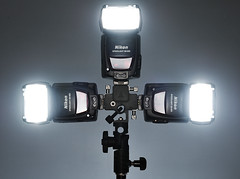
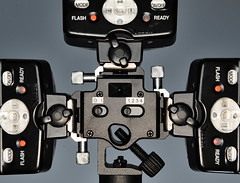
    Unlike most multi-flash brackets, the Lastolite TriFlash Sync includes three hot shoes, as compared to the typical cold-shoe versions.

    And that 1/8″ (3.5mm) jack you see out front? That is parallel-wired to all three, effectively giving you the minijack sync option that frees you from the PC Cord Mafia.

    Which means you can use an audio patch cord as a sync cable. A mono cord is supplied, but my stereo cords also worked with a PocketWizard to sync three speedlights at once.

    You can also even mount the PW on the center hot shoe and have it securely fastened if you just are firing two strobes. Lastolite includes a cold-shoe adapter for that, lest your PW get locked into an endless relay-mode feedback loop from triggering itself.

    Built Like a Tank

    With three SB-800s connected as shown, the bracket/flash combo feels like one solid unit. The shoes all have both clamping rails and locking pin holes for Nikon and Canon models.

    The clamps are really solid, which is important when you consider how much money could potentially be attached to this thing. I’d hang this one out over water without the usual ball bungee wrapped around the shoes for insurance. The tilt mechanism also has locking teeth, and is quite solid.

    (Please note that the above photos are of a beta unit, and the final version may have slight differences.)

    Radio Not Required

    Obviously, you can go with a 1/8″ hard sync cord into the bracket. But if you are, say, filling with an on-axis flash you can trigger a multi-speedlight key light with the built-in slave.

    The slave is intelligent, and battery-powered — which can be good or bad, depending on your perspective.

    First off, batt-powered slaves are generally more sensitive, which is good. And you can set it to ignore from one to four pre-flashes, if you are into combining manual and TTL.

    But that also means that the slave is battery dependent (in this case, a button cell) so if you are going to be using the slave you have to remember to turn the thing off every time.

    It’s a non-issue for me as the PW input is convenient and immune from syncing the flashes from other nearby photographers. And if I needed to use a slave I’d probably opt for the version built into my flashes — the SU-4 mode on the SB-800s is as good as it gets.

    That way, I also have three slave eyes pointing in different directions. So the best-aimed slave would trigger, and that flash would easily set the other two off. But most flashes do not have built-in slaves, and the Triflash Sync is inspired thinking for a multi-flash bracket.

    They are not yet available, but are coming soon. If you are in the UK you’ll get them first (est. in a couple weeks) as they are UK-made and distributed by Lastolite. And they should be trickling out to other countries via the normal Lastolite outlets in fairly short order after that.

    Price is expected to be ~9 in the US. And who knows, UK might even get a relative break this time. Or at least, not have to pay the usual ~1.5x price…


    Strobist