Blog

  • Striking Gravel-Covered Japanese House is a Study in Contrasts

    Monolithic and dramatic, the two-story Ginan House by Keitaro Muto Architects is a wedge-shaped residence with a dark gravel-covered exterior that contrasts beautifully with a stark white interior. Located on the far end of a long and narrow plot, the house features a small swimming pool that extends into a glass-walled niche to create shimmering light effects inside.

    The rough surface of the outside walls continue indoors, producing sharp transitions in color and texture from one wall to the next. Vast expanses of white elongate slanted interior walls, and voids throughout the home let streams of daylight in.

    Another interesting feature of the inside is a metal bridge that extends across one of these voids to enable access to a walk-in closet and bathroom.

    The client requested that the architect leave most of the home site as a garden space. In covering the home with the same gravel that makes up the surface of the garden outside, the architects made the residence seem as if it’s an extension of the garden – one massive sculptural object to contemplate from a quiet place.


    Want More? Click for Great Related Content on WebUrbanist:

    Cloud House Elevates Organic Architecture to New Heights

    An unassuming Edwardian residence in Australia gets an incredibly unexpected cloud-shaped addition perched on the edge of a sky-blue pool.
    Click Here to Read More »»


    Open House(s): 10 Wonderful Open-Plan Home Designs

    Open floor plans allow even the smallest cottage to seem spacious and luxurious. These 10 homes with open plans are the pinnacle of modern architectural design.
    1 Comment – Click Here to Read More
    »»


    WebUrbanist

  • Windows 7 – Title Bar Tricks and Tips Including Keyboard Shortcuts

    Other ways to maximize windows and bring up window options in Windows 7.

    Here are a couple of tricks with window title bars in Windows 7 – some of these tips may work in other Windows versions:

    * Double-click the title bar of a window to maximize it (if the current window supports maximizing). Double-click the title bar again to restore the window to its previous size. …

    Read more at MalekTips.
    New Computer and Technology Help and Tips – MalekTips.Com

  • When Less is Really More: Minimalism in Photography [70+ Examples]

    Who does understand minimalism as a form of art? I guess, quite less people than those who like it. Have you ever noticed that you like a photo, music, video or any other artwork, but you can’t explain why it is so attractive for you? It excites your mind and you can’t take your eyes off of it. Minimalist photography Continue Reading
    Photodoto

  • Microsonic Landscapes: What Music Looks Like in 3D

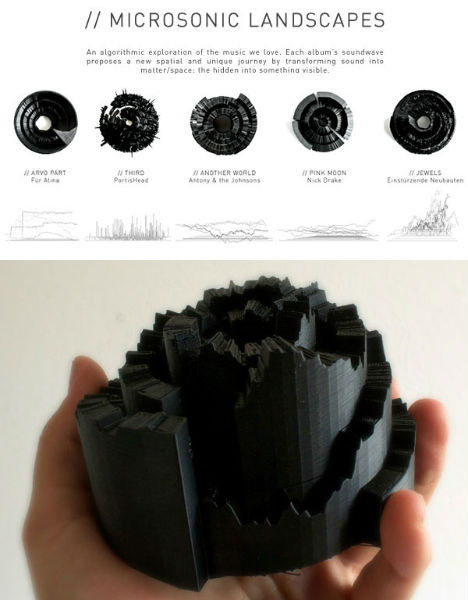
    What would your favorite album look like in three dimensions? Mexico City-based research and experimentation studio Realität proposes “a new spatial and unique journey” by transforming the sounds of five albums into physical matter. ‘Microsonic Landscapes’ translate sound waves into 3D-printed visualizations that resemble circular cityscapes, mountain ranges or volcanic craters.

    Realität chose ‘Arvo Part’ by Für Alina, ‘Third’ by Portishead, ‘Another World’ by Antony & The Johnsons, ‘Pink Moon’ by Nick Drake and ‘Jewels’ by Einstürzende Neubaten, quite a broad range of musical varieties ranging from gentle classical tunes on the piano to pounding German industrial music.

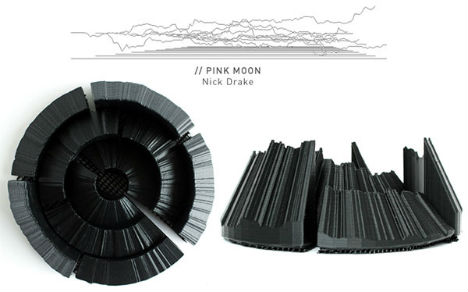
    This array of albums has produced dramatic variations in physical representations. While ‘Arvo Part’ is gently inverted like a colosseum, Portishead’s ‘Third’ is spiky, like a series of towers. ‘Another World’ looks like a spiraling staircase. Nick Drake’s ‘Pink Moon’ starts out slanting upward and then falls down steadily in a series of concentric circles. ‘Jewels’ is the most dramatic of all, with its pinnacle calling to mind a dark tower from a fantasy novel.

    According to Creative Applications, ‘Microsonic Landscapes’ was created using the open-source three-dimensional data visualization programming language Processing, and printed with MakerBot, a machine that can be programmed to print out anything you want in plastic.


    Want More? Click for Great Related Content on WebUrbanist:

    Literary Landscapes: Carved Books by Guy Laramee

    Encyclopedias in English and Chinese are eroded into landscapes by artist Guy Laramee, in a narrative about a dystopian vision of the 23rd century.
    6 Comments – Click Here to Read More »»


    Incredible Underwater Landscapes Made with Swirling Ink

    Italian photographer Alberto Seveso captures incredible swirling landscapes with high-speed photography of underwater ink swirls.
    1 Comment – Click Here to Read More
    »»


    WebUrbanist

  • 20 August, 2012 – Are Museums Destroying Art?

    Many photographers find visiting art museums to be inspirational. But there is another type of photographer – trophy hunting tourists and school kids – who are destroying not just the pleasure of a museum visit, but likely also the art itself.

    Find out more in Mark Dubovoy‘s most recent essay – Are Museums Destrying Art?


     "Every time I go back to a module I had already seen, I learn additional things.  I have never seen tutorials that have the excellent mix of what the features are, 
    how to use them, enough of the under-the-hood information 
    and concepts so that I can utilize the features creatively and efficiently, 
    and just enough humor to keep the motivation level high.  Wow!
    "


    The Luminous Landscape – What’s New

  • The Latest Innovations in Photography

    Technology has never failed to amaze us with its continuous advancements. It has been applied to many different fields including the field of photography. Photography has been improved dramatically through time and more photography advancements are still being developed till present. Before there was only still photograph or pictures but now, a camera can shoot and record videos as well Continue Reading
    Photodoto

  • [MODIFIED] File Extensions – ZIP File Format

    Zip archives defined, including how they are created and unpacked.

    The .ZIP extension signifies that a file is a ZIP archive. This allows people to package a complete game, screensaver, application, electronic book, or whatever as one larger file instead of multiple smaller files, for example before sending them via e-mail. ZIP files are used often in Windows environments, and you will also see them on Mac and Un*x-based machines.

    ZIP files can be created by a third-party external creation tool, but most modern operating systems have the ability to create basic .ZIP files internally without downloading such software. The process takes a group of files and mashes them (“zips” them) together into one “archive” file, sometimes reducing the amount of space the ZIP file takes on the hard drive (“compressing”). After the ZIP file is transferred, the recipient takes the ZIP file and “unzips” it, causing the original files to appear on their hard drive. Again, while third-party unzipping tools exist, most operating systems can do so directly….

    Read more at MalekTips.
    New Computer and Technology Help and Tips – MalekTips.Com

  • How To: Use Fisheye, Wide Angle & Telephoto Lenses – Skateboarding Photographer Sam McGuire-In Focus

    Tune in every other Monday to learn firsthand how to film, edit and shoot like the pros, from your favorite videographers and photographers in skateboarding! Subscribe to Ride: www.youtube.com facebook.com twitter.com instagram @ridechannel
    Video Rating: 4 / 5

    Erin Manning’s Top 5 Posing and Directing Photo Tips Some people are really uncomfortable in front of the camera—they aren’t sure what they’re supposed to do, and they’re afraid they’ll look bad. This can result in stiff, unnatural looking photographs. It’s your job as the photographer to help your subjects feel comfortable and relax. You can do this by talking, interacting, giving them direction and encouragement. When you are photographing people, you are in a relationship, whether it lasts for a few minutes, a few hours, or a lifetime. Following are five tips that can help you direct your subject and capture natural-looking portraits. Tip 1 Have your subjects make a three-quarter turn to camera and shift their weight to the back leg. This position gives the body shape, dimension and makes them look slimmer. Tip 2 Create a sense of movement in your photograph. Direct your subjects to shift their weight back and forth from one foot to the other. Tip 3 Most people are uncomfortable in front of the camera. Help them out by giving them direction. Tell them they look great, give them feedback and interact. The positive energy will show in your photographs. Tip 4 A real expression is always better than a fake one. To alleviate a frozen, unnatural smile, try my Pufferfish technique for relaxing your subjects face. Do it together! Puff out your cheeks, hold, then blow it out. This exercise relaxes your face, and the goofy look is enough to make anyone laugh. Tip 5 Portraits are
    Video Rating: 4 / 5