RSS
 

Posts Tagged ‘redesigned’

Instagram’s redesigned Explore tab is now live: Stories, shortcuts and more

17 May

Instagram has launched a redesigned Explore tab that adds Stories, topic shortcuts, and direct access to ‘more immersive’ IGTV and Shopping experiences. With the update, Explore now provides users with direct access to Stories, a feature utilized by more than 500 million users daily. Users will now see personalized Stories recommendations in the Explore grid.

Explore recommendations include Stories that are relevant to each user’s interests based on topics they interact with. Users will start seeing these personalized Stories recommendations in Explore in the near future; Instagram says it will be rolling out the addition ‘over the coming weeks.’

Additionally, the redesigned Explore tab features shortcuts in the navigation bar that direct users to topic channels, such as Travel and Art. Users will also now see shortcuts that take them directly to IGTV and ‘Shop,’ the latter of which will produce category filters for specific product types directly in the navigation bar. The IGTV link directs users to the recently updated video home page with a personalized feed of suggested video content.

The redesigned Explore tab is intended to help users find new content they’re interested in viewing, and will likewise help photographers gain exposure to potential new followers interested in the types of content they share.

Articles: Digital Photography Review (dpreview.com)

 
Comments Off on Instagram’s redesigned Explore tab is now live: Stories, shortcuts and more

Posted in Uncategorized


Sony’s a9 gets AI-powered AF modes and a redesigned menu in firmware version 5.0

25 Mar

Sony has released a major firmware update for its a9 mirrorless camera that adds new AI-driven autofocus modes, enhances image quality and changes a number of menu settings for improved usability.

The standout feature of firmware version 5.0 is Sony’s Real-time Tracking mode, which uses an artificial intelligence-based object recognition algorithm to detect and keep track of subjects. The Real-time Tracking mode also works alongside Real-time Eye AF, an updated version of its popular eye-tracking autofocus mode that also relies on artificial intelligence to keep the subject’s eyes in focus. Real-time Eye AF also works with a half-press of the shutter now and will continue to track even if a subject’s eyes are temporarily closed or obscured while shooting.

Fast Hybrid AF for video has also been added to the a9. According to Sony, Fast Hybrid AF provides ‘smoother, more accurate focus during video shooting, even if/when objects move in front of the subject.’

On the image quality front, Sony says firmware version 5.0 ‘offers notably improved image processing, which maximizes the capabilities of the full-frame sensor.’ Specifically, Sony says the camera features a better auto white balance mode and more accurately captures subtle changes in light making better tonal gradations.

Moving onto the software side of things, Sony has rearranged the menu settings and added a number of features it says customers have been asking for in regards to workflow and usability. Specifically, Sony has added a new My Dial menu, a revised custom key menu and improved touchpad capability. Also added is a new tagging feature and improved dual-card functionality. Below are a few menu screenshots provided by Sony that highlight the changes and new features:

$ (document).ready(function() { SampleGalleryV2({“containerId”:”embeddedSampleGallery_9274765493″,”galleryId”:”9274765493″,”isEmbeddedWidget”:true,”selectedImageIndex”:0,”isMobile”:false}) });

Keep in mind that when updating the firmware on your a9 camera all settings are initialized returning everything to factory settings and the update cannot be reversed. Sony suggests writing down frequently-used settings for adding and altering after the update has been installed. Sony also warns for this particular update that you might want to get used to the updated menu configuration before heading out to your next shoot as much of the structure has changed.

To download firmware version 5.0 for the Sony a9, head over to Sony’s website to download the macOS and Windows versions.

Press release:

Sony a9 Gains Powerful New Autofocus Capabilities and More Through Software Version 5.0 Update

Sony’s industry-leading a9 camera has received a significant software update that brings AI-driven autofocus capabilities to its award-winning autofocus (AF) system, improves image quality, and introduces a range of customer-requested workflow improvements.

Autofocus Advances

Firmware version 5.0 for the Sony a9 adds Sony’s newly-developed, AI-driven Real-time Tracking mode for precise and robust subject tracking. Real-time Tracking uses Sony’s latest AF algorithm—which includes Artificial Intelligence-based object recognition—to detect and follow subjects with unprecedented accuracy.

Real-time Tracking AF works in conjunction with Real-time Eye AF, also added with Firmware version 5.0. The latest iteration of Sony’s best-in-class Eye AF technology, Real-time Eye AF also uses AI-based object recognition, resulting in an unprecedented level of speed and performance for locking on and holding focus on a subject’s eyes. Additionally, with Real-time Eye AF, users can now activate eye detection via a half-press of the shutter release, and can enjoy focus tracking accuracy even if a subject’s eyes are temporarily obscured during shooting.

Also added with firmware 5.0 is Fast Hybrid AF for video, which now provides smoother, more accurate focus during video shooting, even if/when objects move in front of the subject.

Image Quality

Firmware version 5.0 offers notably improved image processing, which maximizes the capabilities of the full-frame sensor. The camera now more accurately reproduces subtle changes in light for smoother, more natural tonal gradations and improved auto white balance results.

Improved Usability And Workflow

With Firmware version 5.0, the Sony a9 adds several customer-requested features:

  • New My Dial menu
  • Revised Custom Key menu
  • Improved touchpad capability,
  • Enhanced dual-card functionality
  • Enhanced tagging

Imaging Edge

Sony is also announcing the release of Imaging Edge™ mobile applications, plus updates to the ‘Remote,’ ‘Viewer’ and ‘Edit’ desktop applications that brings exciting new features to all Sony imaging customers.

For professional photographers, Sony is also releasing a new mobile application ‘Transfer & Tagging add-on’ that supports instant delivery workflow by allowing users to transfer content to their mobile devices via the camera’s FTP background transfer functionality. It also enables voice input for text captioning to streamline overall workflow between photographers and other team members.

Articles: Digital Photography Review (dpreview.com)

 
Comments Off on Sony’s a9 gets AI-powered AF modes and a redesigned menu in firmware version 5.0

Posted in Uncategorized


Instagram tests redesigned profiles that emphasize user bios, shrink follower count

27 Nov

Instagram has introduced redesigned user profiles that will be rolling out to users over the next several weeks. The company describes the rollout as a test that retains common profile elements, but rearranges them to provide a new look emphasizing bios and taking the focus away from follower counts.

Though user content posted to the grid remains unchanged, Instagram has repositioned buttons, icons, and other profile elements. User bios are given the most focus with a prominent right placement, whereas follower counts are now listed in small text beneath both the bio and links. Total post counts have been eliminated.

The company hopes its redesigned profiles offer easier navigation and a cleaner look. Testing will take place in multiple phases and “combinations,” Instagram said last week. User feedback on the new look will help shape the experiment and potentially the final design. It’s unclear how many users will see the new profile.

Articles: Digital Photography Review (dpreview.com)

 
Comments Off on Instagram tests redesigned profiles that emphasize user bios, shrink follower count

Posted in Uncategorized


500px Home Feed redesigned to increase photographers’ exposure

16 Nov

500px has launched a redesigned Home Feed that was inspired by photobooks, according to the company. The new 500px Home Feed is designed to increase photographers’ exposure and enable them to browse more images without navigating away from the feed. 500px says machine learning powers a new recommendation system to help surface content.

500px explained in a blog post that its new recommendation system will help increase photographers’ visibility on the platform by more evenly distributing exposure. Users will see a greater variety of content on the new Home Feed, as well.

Photo pages have been redesigned to make details, Pulse, views and other info readily accessible without being distracting. Photos are prominently displayed at the top of the page on a dark background for minimized distractions.

The changes apply to both desktop and mobile, the latter of which now supports the ability to view and publish Galleries. The redesign also enables users to add images to existing Galleries and then share them with followers.

Other changes revolve around the recommendation system and include suggested images in a grid format for desktop and carousel for mobile, as well as recommendations based on user activity. Recommendations will also draw from recently uploaded images to improve the discovery of new content.

According to 500px, it will not provide NSFW content on its new mobile Home Feed in order to comply with Google’s and Apple’s respective app store restrictions. The NSFW images will still be accessible on desktop, however, assuming the user opts-in to the content in their account settings. The changes are rolling out now.

Articles: Digital Photography Review (dpreview.com)

 
Comments Off on 500px Home Feed redesigned to increase photographers’ exposure

Posted in Uncategorized


Nikon’s redesigned SnapBridge app adds full manual camera control and ‘intuitive’ UI

30 Nov

Nikon just released a new version of its camera connectivity app SnapBridge. The new SnapBridge Version 2.0—which is available for both iOS and Android devices starting today—has been redesigned with an easier-to-use interface and a bunch of new features like the ability to register up to five devices, and full-manual control of select cameras.

On the UI side, both the screen design and the menu structure have been updated to be ‘more intuitive’ and offer direct access to Help functions. The app has also now been equipped with a ‘power saving mode’ that keeps SnapBridge from draining your smartphone or tablet’s battery when you’re not connected to a camera (i.e. when it’s not in use).

On the feature side, the major addition is full manual control. If you have a compatible camera—according to Nikon, these include the Nikon D850, D500, D7500, and D5600—you’ll now be able to control exposure modes (P/S/A/M), shutter speed, aperture, exposure comp, ISO, and white balance.

You can learn more about the new SnapBridge app by reading the full press release below, or downloading it yourself off of the iTunes App Store or Google Play.

Press Release

Nikon Announces Updated Version of SnapBridge Camera Connectivity App for Seamless Image Transfer and Sharing

Easier to Use, More Intuitive and Simpler Connection with SnapBridge Version 2.0*

MELVILLE, NY (November 29, 2017 at 11:00 P.M. EST) – Today, Nikon is pleased to announce the release of version 2.0 of Nikon SnapBridge, which offers enhanced functionality, stability and ease of use. SnapBridge is the Nikon app that enables users to easily and seamlessly share images and control select Nikon digital camera via Bluetooth** and Wi-Fi® connection with a compatible smart device such as a phone or tablet.

Enhanced Interface and Connectivity

SnapBridge version 2.0 reflects feedback from users of earlier versions of the app and represents a significant update of the user interface (GUI). Screen design and menu structure have been significantly revised in several ways, including the adoption of progress displays to provide visual confirmation of the status of an operation (e.g. when a smart device is paired with a camera or connection is changed to a Wi-Fi connection). Direct access to help functions from the app menu are also now available. The app also offers different instructions for each category of camera to ensure easier setup, navigation and usage.

Additionally, up to five cameras can now be registered with the device running the app. This makes switching between cameras much easier for those who own multiple Nikon cameras.

The app is also equipped with a new power-saving mode that controls the amount of smart device power consumed by the app when it is not connected to a camera for an extended period of time. SnapBridge Version 2.0 also features a location data accuracy setting that allows users to choose between lower power consumption and greater location data accuracy by selecting how often the smart device updates location data.

Greater Remote Photography Functions

For even more creative control with select Nikon cameras, important digital SLR camera settings can now be controlled from the SnapBridge app through remote photography*. The live view display on the smart device can be used to confirm and adjust camera settings, allowing users to enjoy more full-scale shooting. Users also now have access to exposure modes (P/S/A/M), shutter speed, aperture value, exposure compensation, ISO sensitivity, and white balance. Controls will vary among various camera models.

Nikon Image Space Integration

Nikon SnapBridge Version 2.0 has a dedicated tab that makes it easier than ever to use NIKON IMAGE SPACE. With SnapBridge 2.0 and a NIKON IMAGE SPACE account a user can automatically upload an unlimited number 2MB images ideal for sharing on the go. In addition, photos taken using remote photography can now be uploaded to NIKON IMAGE SPACE automatically.

Nikon will continue to enhance the app’s usability and strengthen its functions to provide users with ever increasingly rich imaging experiences well into the future.

For more information about Nikon SnapBridge and the latest Nikon cameras and other products, please visit www.nikonusa.com.

*Functions available with the SnapBridge and SnapBridge 360/170 apps differ.

  • iPhone®, iPad®, iPod touch®, and Android™ devices to which the SnapBridge app has been installed can be used. The SnapBridge app can be downloaded free of charge from the App Store® and Google Play™. See Nikon’s website for further information.
  • Operation of this app is not guaranteed with all devices.
  • Nikon SnapBridge 2.0 Compatible Cameras:
    • Nikon D850, D500, D7500, D5600, D3400,COOLPIX A900, A300, B700, B500, W100, W300, KeyMission 80

**The Wi-Fi® and Bluetooth® functions built into cameras are effective only when connected to a smart device on which the SnapBridge app has been installed.

Articles: Digital Photography Review (dpreview.com)

 
Comments Off on Nikon’s redesigned SnapBridge app adds full manual camera control and ‘intuitive’ UI

Posted in Uncategorized


Peak Design unveils redesigned ‘Greatest Hits’: All new Clip, Slide and Slide Lite

07 Nov

Peak Design—the makers of top rated and much loved camera accessories that have raised nearly $ 15 million on Kickstarter since their first got into crowdfunding—have just launched a special ‘greatest hits’ 5-day Kickstarter campaign to fund their latest products: a totally redesigned Capture Camera Clip and revamped Slide and Slide Lite camera straps.

The campaign launched this morning, and already Peak Design is racing towards its funding goal at record speed—which was, after all, the point.

“We wanted to bring these redesigned products back to Kickstarter because our backer community brought them to life in the first place,” says Adam Saraceno, Peak Design’s Marketing Director. “We also wanted to get gear into folks’ hands before the end of the year. These are busy times so we opted to keep our Kickstarter short and sweet.”

Here’s the company’s Kickstarter video, to give you an overview of the new products:

Capture Camera Clip

First up, the one that started it all: The Peak Design Capture Camera Clip. The first product Peak Design launched on Kickstarter, the Capture clip is a staple in many a photographers’ camera bag (or rather ON their camera bag), but the original design needed some love.

Enter former Apple design engineer Max Maloney, who took some time to show us the improvements they’ve made on the Clip at PhotoPlus this year.

The clip has been totally redesigned to be smaller, sleeker, and more functional all at the same time. It now features an all aluminum built (no plastic parts in sight), a lighter and smaller build that should still fit on almost any belt or backpack strap out there, an embeddable grip on the backplate so you don’t have to tighten the thing so much for it to stay in place, and a much sleeker profile that’s less likely to snag on clothing or gear.

Here’s a closer look at the new Clip, including a side-by-side with the old version:

$ (document).ready(function() { SampleGalleryV2({“containerId”:”embeddedSampleGallery_6667050312″,”galleryId”:”6667050312″,”isEmbeddedWidget”:true,”standalone”:false,”selectedImageIndex”:0,”startInCommentsView”:false,”isMobile”:false}) });

The new Capture v3 will cost you a $ 55 pledge (MSRP $ 70). Find out more on Kickstarter.

Slide and Slide Lite

The Capture v3 is probably the most exciting ‘Greatest Hits’ release, but for those of you who love Peak Design’s camera straps, the Slide and Slide Lite revamp is definitely worth looking into.

The Slide (meant for DSLRs) and Slide Lite (meant for mirrorless cameras) are some of Peak Design’s most popular camera straps, and now they’ve been upgraded with updated dual adjusters that keep a lower profile, a new anchor mount for ‘low-profile connection point to bottom of camera’, smooth and durable nylon webbing for easier adjustment, and updated anchor connectors for easier one-handed use.

Here’s a closer look:

$ (document).ready(function() { SampleGalleryV2({“containerId”:”embeddedSampleGallery_4418407189″,”galleryId”:”4418407189″,”isEmbeddedWidget”:true,”standalone”:false,”selectedImageIndex”:0,”startInCommentsView”:false,”isMobile”:false}) });

The Slide and Slide Lite will MSRP for $ 65 and $ 50, respectively, when they hit store shelves, but if you contribute to the Greatest Hits Kickstarter you’ll be able to get them for $ 50 and $ 35. Click here to learn more.


To see check out either of the new products for yourself or contribute to the campaign—which has already raised nearly $ 50,000 in funding in just a couple of hours!—click here. Estimated delivery for all of the new products is December of 2017.

Articles: Digital Photography Review (dpreview.com)

 
Comments Off on Peak Design unveils redesigned ‘Greatest Hits’: All new Clip, Slide and Slide Lite

Posted in Uncategorized


Flickr’s Redesigned Profile Page

07 Jun

Following on the successful redesign of the Flickr homepage last Fall, today Flickr is announcing the redesign of the photographer profile page. As far back as I can remember the Flickr profile page has remained the same — probably at least over the past decade or so — complete with the odd request for your airport code, even though that information never seemed to actually appear anywhere on your profile.

The new redesign is much more photocentric and offers a beautiful showcase of your most popular photos published to Flickr. Tiny little square thumbnails on the profile page have been replaced by much bigger, bolder versions of your own most popular images in an attractive mosaic format.

The new profile page will start rolling out to users over the next few days so if you don’t already have it, don’t fret, it’s on the way.

The redesign makes several changes in terms of what and how the information on your profile page is presented. Some information has been added, some removed and some streamlined.

Your Most Favorited, Interesting, Commented, and Viewed Photos on the New Flickr Profile Page
Flickr’s new profile page shows your most favorited photos on Flickr.

1. Most dramatically, by default the new Flickr profile page has a beautiful mosaic of large sized photos showcasing your 25 most favorited photos on Flickr. Additionally your profile visitors can use a pull down menu to look at your 25 most interesting (as rated by Flickr’s algorithm) photos, along with your most viewed and commented photos. This is a super helpful way to get a quick impression of the type of photographer you are looking at when you find someone new that you might want to follow on Flickr. Personally this is my favorite feature of the new profile page.

Your Custom Photo Showcase on the New Flickr Profile Page
Flickr’s new profile page lets you customize 25 photos on your page.

2. Because some people would rather show off other photos than their most favorited, popular, commented or viewed, Flickr now also allows you to add a custom collection of 25 photos as chosen by you manually from your stream. So you can showcase up to 50 total photos now on the profile page between your own chosen photos and Flickr’s selections. The organizer used to build your custom mosaic is super intuitive and allows you to review your albums or search for specific photos you want to add. You can change what photos appear here whenever you want. I’m looking forward to the creative ways that users come up with using this mosaic.

Links to Your Other Social Networks on the New Flickr Profile Page
Flickr now makes user view counts public.

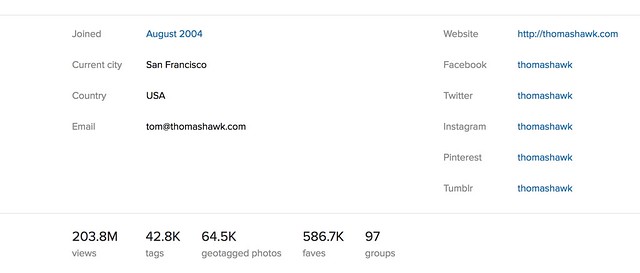
3. With the new profile page Flickr now shows you how many views a user has racked up on Flickr. If there is anything even mildly controversial about the new page design it would probably be this. In the past your total view count was available to you and you only through the stats page if you were a paid Pro account. Now your view count is posted publicly on your profile page for the entire world to see. So for the first time we can see that the Obama White House page has racked up an impressive 303 million views on Flickr, while alas, the current Trump White House has only racked up only a mere 2.1 million views on Flickr thus far.

Not that anyone’s keeping track or cares about these type of things though, am I right? ?

4. On the old profile page Flickr allowed you a single website link. On the new profile you can include a link to your website and also additional links to your pages on Facebook, Twitter, Instagram, Pinterest and Tumblr.

Testimonials Make the Cut in the New Flickr Profile Page
Testimonials make the cut for the new Flickr profile page.

5. Testimonials are still included in the new Flickr profile page. I think it’s been several years since I’ve actually written someone a testimonial, but they were a lot of fun to get and give back in the old school days of Flickr. I’m glad they made the cut on the new page.

6. The old profile page prominently featured a link to everyone you were following on Flickr and featured the avatars of the last 16 people you had followed. This section has now been reduced to a small link at the top of the page linking to everyone you follow listed alphabetically.

7. The old profile page had a link to your favorites from other Flickr members including thumbnails of the last 12 photos that you’d favorited. The new page has a smaller link that just takes people directly to your favorites page.

8. Hometown and current location information has been retained and is still shown on the new profile page, but gender and relationship status has been removed.

9. Additional links on the new profile page include links to a photographer’s tags (listed alphabetically), geotagged photos (shown on a cool interactive map), links to your favorites and your groups.

Large Photos You are Tagged in on the New Flickr Profile Page
Photos you are tagged in are larger.

10. Photos of a user are featured in much larger format with a link to all of the photos you are tagged in on Flickr.

Overall I think the new Flickr profile page is a terrific refresh to the site. It is good to see that Flickr continues to innovate finding fresh new ways to share photos. Although not the largest photo sharing site on the web today, Flickr is still my personal favorite and where I keep my primary archive of images. As a paid pro account (old skool) I am provided an unlimited amount storage for full high res photos at $ 49.99/year — a huge bargain. New Pro users get 1TB instead of unlimited storage so if you are old skool Pro *don’t* let that subscription expire. I also get detailed stats and an ad free browsing experience both for myself and for people who view my photo pages. If you are not Pro on Flickr already you should definitely consider it. It’s a wonderful community of photographers on the web where I personally interact on a daily basis.

Anyways, nice job to team Flickr on another big improvement to the site. Keep up the good work! More details in the help forum on the new page here.

You can follow my own photography on Flickr here. ?


Thomas Hawk Digital Connection

 
Comments Off on Flickr’s Redesigned Profile Page

Posted in Photography


Moment rolls out Kickstarter for redesigned lens and new cases for iPhone 7 / 7 Plus

08 Feb

$ (document).ready(function() { SampleGalleryV2({“containerId”:”embeddedSampleGallery_5370414927″,”galleryId”:”5370414927″,”isEmbeddedWidget”:true,”standalone”:false,”selectedImageIndex”:0,”startInCommentsView”:false,”isMobile”:false}) });

Mobile photo accessory provider Moment is introducing two iPhone 7 / 7 Plus cases via Kickstarter: a battery case for storing extra charge, and a standard case. Both cases are compatible with a new wide-angle attachment lens designed specially for the 7 and 7 Plus.

The Battery Photo Case offers a two-stage shutter release button. When used with Moment’s camera app a half-press will acquire focus. Apple’s stock camera app will only recognize a full press and shoot accordingly. The case does not use Bluetooth to communicate with the phone, unlike previous Moment cases. Instead, it uses the Lightning connector, which the company says is 75% faster.

Moment’s new Photo Case is a cheaper alternative without the shutter button or backup battery. It’s slim and offers basic protection from wear-and-tear, and offers an attachment for a wrist strap.

Both cases provide a mount for the new Wide Lens (as well as an adapter for existing Moment lenses), which can be positioned over the phone’s wide and telephoto lenses. Moment says the lens has been re-designed considering the iPhone 7 and 7 Plus’ wider aperture lenses. The slightly larger lens is also lens prone to vignetting cause by misalignment. 

Planned MSRP for the Wide Lens is $ 100, the Photo Case is $ 30 and the Battery Photo Case is $ 100. The company is well on its way to its $ 500,000 Kickstarter goal, and is offering discounts to early backers. As with any Kickstarter project things might go awry, but if all goes to plan Moment will ship the new cases and lenses starting the end of May.

Articles: Digital Photography Review (dpreview.com)

 
Comments Off on Moment rolls out Kickstarter for redesigned lens and new cases for iPhone 7 / 7 Plus

Posted in Uncategorized


Redesigned Nikon 70-200 F2.8 arrives with improved optics, electromagnetic diaphragm

19 Oct

$ (document).ready(function() { SampleGalleryV2({“containerId”:”embeddedSampleGallery_0289055049″,”galleryId”:”0289055049″,”isEmbeddedWidget”:true,”standalone”:false,”selectedImageIndex”:0,”startInCommentsView”:false,”isMobile”:false}) });

Nikon has released the latest iteration of its workhorse 70-200mm F2.8 lens. The AF-S Nikkor 70-200mm F2.8E FL ED VR, as it is known, has a new optical design, improved Vibration Reduction as well as an electromagnetic diaphragm.

The lens has a total of 22 elements, with 6 ED, 1 fluorite and 1 high refractive index element. A Nano Crystal Coat reduces flare and ghosting while fluorine coatings on the front and rear class helps prevent smudging. Vibration Reduction has been improved, now reducing shake by 4 stops (vs 3.5). The electromagnetic diaphragm allows for responsive adjustment and the ability to adjust the aperture in live view and movie mode on all camera bodies.

You’ll be able to pick up this 1.4 kg (3 lb) beast next month for $ 2799.95.

Press Release:

MASTER YOUR PERSPECTIVE WITH OPTICAL EXCELLENCE: NIKON ADDS TWO PRO-GRADE FX-FORMAT LENSES TO CELEBRATED NIKKOR LENS LINEUP

Extraordinary Next-Generation AF-S NIKKOR 70-200mm f/2.8E FL ED VR Sets a New Standard for Pro Telephoto Workhorse Lenses, While New PC NIKKOR 19mm f/4E ED is Nikon’s Widest Ever Tilt-Shift NIKKOR Offering

MELVILLE, NY (October 19, 2016 at 12:01 A.M. EDT) – Today, Nikon Inc. has announced two exciting FX-format additions to the storied NIKKOR lens lineup, designed to achieve amazing optical performance for the most demanding professional and enthusiast photographers. An evolution of one of Nikon’s most versatile and popular pro-zoom lenses, the newly redesigned AF-S NIKKOR 70-200mm f/2.8E FL ED VR sports an updated optical formula capable of amazing image quality, while optimized for high-speed shooting. Also introduced today is Nikon’s widest perspective control lens to date, the PC NIKKOR 19mm f/4E ED tilt-shift lens, which helps photographers effortlessly control perspective when capturing architecture, interiors, fine art, product photography and landscapes.

“Nikon continues to raise the bar of optical excellence, and our newest FX-format NIKKOR offerings provide experienced photographers with powerful tools to help ensure brilliantly sharp images, whether capturing a high-speed photo finish or creatively framing an architectural marvel,” said Kosuke Kawaura, Director of Marketing and Planning, Nikon Inc. “While the new AF-S NIKKOR 70-200mm f/2.8E FL ED VR builds upon the success of its predecessors to offer a true all-around NIKKOR optic, the PC NIKKOR 19mm f/4E ED will provide fantastic perspective control for a variety of challenging wide-angle applications.”

The Ultimate Workhorse Lens for Seasoned Photographers

Long considered an essential lens in the bag of professional photographers, this updated AF-S NIKKOR 70-200mm f/2.8E FL ED VR sets a new benchmark for fast telephoto zoom lenses, taking image quality and handling to the next level. An indispensable and powerful tool for nearly any photographic scenario, the NIKKOR 70-200mm remains the professional’s choice with a wide f/2.8 constant aperture that is ideal for capturing sports, weddings, stunning portraits and more, even in low-light.

The next generation design of the lens helps ensure the very best in image quality, speed and low-light performance, while offering balance and handling that is nothing short of superb. Nikon’s new 70-200mm provides up to four stops1 of Vibration Reduction (VR) image stabilization, an improvement from its predecessor that helps users to eliminate blur and camera shake even when shooting handheld or in challenging light. During burst shooting, the lens takes advantage of an electromagnetic diaphragm for consistent auto-exposure control. Additionally, a Silent Wave Motor (SWM) enables ultra-fast and quiet AF operation with seamless manual focus override. Discerning photographers will also appreciate assignable function buttons on the lens barrel that offer customization, perfect for engaging pre-set autofocus or other focusing options.

A new optical formula consisting of six ED elements, one Fluorite element, a high refractive element and Nano Crystal Coat helps make for a lighter and more versatile lens, while reducing chromatic aberration and helping to all but eliminate distortion, ghosting and flare. Ready for even the most rugged of assignments, the magnesium alloy lens barrel features superior weather-sealing that achieves anti-dust and waterdrop-resistance, while Fluorine coating on both the front and rear glass facilitates easy cleaning. Whether shooting with a camera like the Nikon D5, D810, D750 or D500, capturing sports or weddings, the AF-S NIKKOR 70-200mm f/2.8E FL ED VR is a fantastic lens choice for experienced photographers.

Seamlessly Control Perspective with the New Super-Wide PC NIKKOR Lens

Also new from Nikon is the latest perspective control lens (designated PC) in the NIKKOR lens lineup, the PC NIKKOR 19mm f/4E ED, a tilt-shift offering that will help photographers master perspective and depth-of-field. For storytellers who yearn to capture optically-challenging subjects like cityscapes and architecture, interiors or unique landscapes, this lens offers 97° of coverage – the widest focal length of any PC lens in the NIKKOR family. Tilt the lens to sharpen focus throughout a scene or create a miniature effect, or shift2 to adjust perspective in-camera, create panoramas or eliminate converging lines. For the first time with a NIKKOR PC lens, the direction of tilt operation can be made parallel or perpendicular to shift, offering users nearly unprecedented ability to control perspective, focus and depth-of-field, without having to lock and unlock to make adjustments.

Sporting a super-wide 19mm focal length, the lens provides a unique perspective ideal for shooting horizontal or vertical panoramas, or even filmmaking. With this ultra-wide angle in mind, the latest FX-format NIKKOR offering was crafted with three ED and two aspherical elements that help combat distortion and glare, while virtually eliminating chromatic aberration and coma, even at the widest aperture settings. The lens also features core NIKKOR technologies such as Nano Crystal Coat to combat ghosting and flare, an electromagnetic diaphragm for fast auto-exposure control, as well as a Fluorine coat that helps resist dirt, water spots and smudges. Ready for a variety of challenging ultra-wide applications, the PC NIKKOR 19mm f/4E ED is a powerful tool for discerning photographers looking for full creative and perspective control. It joins three other Gold Ring Series PC lenses in Nikon’s line-up; the PC-E NIKKOR 24mm F3.5D ED, PC-E Micro NIKKOR 45mm f/2.8D ED and the PC-E Micro NIKKOR 85mm f/2.8D.

Price and Availability

Both the AF-S NIKKOR 70-200mm f/2.8E FL ED VR and PC NIKKOR 19mm f/4E ED will be available starting in November 2016 for suggested retail prices (SRP) of $ 2,799.95* and $ 3,399.95*, respectively. For more information on these new Nikon products and pricing for optional accessories, please visit www.nikonusa.com.

1 Based on CIPA Standard. This value is achieved when FX-format compatible lenses are attached to a FX-format digital SLR camera and zoom lenses are set at the maximum telephoto position.

2 Depending on combination of shift and rotation, operation may be restricted by mechanical interference between the lens and camera when used with certain Nikon cameras.

  • Models that can be used without any limitation: D5, D4 series, D3 series, D810 Series, D500
  • Models that can be used with some limitations: Df, D800 series, D750, D610, D600, D300 series, D7200, D7100, D5500, D5300, D5200, D5100, D5000, D3400, D3300, D3200, D3100
  • Models that are not compatible with PC NIKKOR 19mm f/4E ED: D2 series, D1 series, D200, D100, D90, D80, D70 series, D3000, D60, D50, D40 series, film cameras, Nikon 1 series with FT-1

*SRP (Suggested Retail Price) listed only as a suggestion. Actual prices are set by dealers and are subject to change at any time.

Nikon AF-S Nikkor 70-200 F2.8E FL ED VR specifications

Principal specifications
Lens type Zoom lens
Max Format size 35mm FF
Focal length 70–200 mm
Image stabilization Yes (4 stops)
Lens mount Nikon F (FX)
Aperture
Maximum aperture F2.8
Minimum aperture F22
Aperture ring No
Number of diaphragm blades 9
Optics
Elements 22
Groups 18
Special elements / coatings 6 ED, 1 Fluorite, 1 HRI element + Nano Crystal & Fluorine coatings
Focus
Minimum focus 1.10 m (43.31)
Maximum magnification 0.21×
Autofocus Yes
Motor type Ring-type ultrasonic
Full time manual Yes
Focus method Internal
Distance scale Yes
DoF scale No
Focus distance limiter Yes
Physical
Weight 1430 g (3.15 lb)
Diameter 89 mm (3.48)
Length 203 mm (7.97)
Materials Magnesium alloy
Sealing Yes
Zoom method Rotary (extending)
Power zoom No
Zoom lock Yes
Filter thread 77.0 mm
Hood supplied Yes
Tripod collar Yes

Articles: Digital Photography Review (dpreview.com)

 
Comments Off on Redesigned Nikon 70-200 F2.8 arrives with improved optics, electromagnetic diaphragm

Posted in Uncategorized


Panasonic Lumix DMC-GX85 offers 16MP sensor with no AA filter, redesigned shutter mechanism

06 Apr

$ (document).ready(function() { SampleGalleryV2({“containerId”:”embeddedSampleGallery_7478917503″,”galleryId”:”7478917503″,”isEmbeddedWidget”:true,”standalone”:false,”selectedImageIndex”:0,”startInCommentsView”:false,”isMobile”:false}) });

Panasonic has just announced its Lumix DMC-GX85 (GX80 outside of North America), a less expensive sibling to the Lumix GX8 that features a 16MP Live MOS sensor with no AA filter, a redesigned shutter mechanism, and 5-axis Dual IS. Panasonic claims the removal of the anti-aliasing filter boosts fine detail resolution by 10%, and an electromagnet-driven shutter mechanism aims to reduce blur from shutter shock – an issue we noted when we reviewed the GX8. 

The GX85 offers ‘Dual IS’, which combines its 5-axis in-body stabilization with in-lens OIS, offering up to 4.5 stops of shake reduction. That’s an update to the GX8’s 4-axis in-body system. Naturally, the GX85 carries 4K/UHD 30p video shooting and all of the related photography features, including 4K Photo and Post Focus. Speaking of focus, the GX85 offers the same ‘Depth from Defocus’ system that really impressed us on the GX8.

The GX85 provides a fixed 2764K-dot equivalent electronic viewfinder, and its 3″ 1.04M-dot touch screen monitor tilts up by 80° and downward by 45°. Built-in Wi-Fi and a new L. Monochrome photo style mode are also included.

The Panasonic Lumix DMC-GX85 will go on sale at the end of May for $ 799/£599 with a 12-32mm F3.5-5.6 collapsible kit zoom. UK shoppers will also have body-only (£509) and or a bundle with the 12-32mm and 35-100mm lenses (£729) options.


Press release:

LUMIX GX85 – High Image Quality and High Performance Packed in a Compact Body

Capture Life on the Move

Newark, NJ (April 5, 2016) – Panasonic is proud to introduce a new Mirrorless Interchangeable Lens Camera, the LUMIX DMC-GX85 (GX85) for camera enthusiasts or anyone looking for an alternative to bulky DSLRs, that delivers lighter, more intelligent, uncompromising results. Nearly half the size of most DSLRs, the GX85 delivers impressive large sensor performance in the most compact camera system ever designed by Panasonic LUMIX. Thanks to the elimination of the low pass filter, its fine detail resolving power is boosted nearly 10% over previous 16-Megapixel sensors. 

The LUMIX GX85 incorporates a new 5-axis Dual I.S. (Image Stabilizer) for more effective suppression of blur. Combining an O.I.S.(Optical Image Stabilizer, 2-axis) and a B.I.S.(Body Image Stabilizer, 5-axis), the 5-axis Dual I.S. compensates for a larger range of movement than ever before. Users can enjoy blur-free photo/video shooting from wide to tele, even in low light situations.

The 16.0-megapixel Digital Live MOS Sensor without a Low Pass filter and the new Venus Engine combine to achieve crisp, high resolution images in detail with high contrast, impressive color reproduction. The LUMIX GX85 adopts a new electromagnetic drive in the shutter unit. The shock caused by the movement of shutter diaphragm is dramatically reduced and the shutter sound is also minimized. The Contrast AF System features DFD (Depth From Defocus) technology and excels in both speed and accuracy by exchanging the digital signal between the camera and the lens at max. 240 fps, resulting in ultra-fast auto focusing of approx. 0.07 sec*. A variety of extensive AF functions including Face/Eye Detection AF, Pinpoint AF, One-shot AF and advanced Low Light AF enhance usability to comply with wide-ranging shooting situations.

The GX85 integrates a LVF (Live View Finder) with 2764K-dot equivalent high resolution and approx. 100% color reproduction*. This 16:9 Wide Screen LVF boasts approx.1.39x / 0.7x (35mm camera equiv.) magnification and 100% field of view. The new 3.0-inch large, approx.1040K-dot high resolution static-type touch monitor with approx. 100% of field of view tilts up by 80-degrees and down by 45-degrees which enables shooting at either high or low angle even easier.

For even more creative photography, the LUMIX GX85 integrates the new L.Monochrome mode in Photo Style that offers impressive monochrome capture with rich gradation comparable to that of B/W film. Focus Bracket and Aperture Bracket are also new additions to conventional Exposure Bracket and WB Brackets that allow users to choose the best shot later. Thanks to its Wi-Fi® connectivity, users can connect the camera to their smartphone / tablet to expand the flexibility in shooting/storing/sharing images.

1. 4K capability bringing the evolution in videography/photography – 4K video and 4K PHOTO

Taking advantage of the high speed signal readout capability of the sensor and high speed signal processing, the LUMIX GX85 is capable of recording 4K video. Despite its high performance, it boasts superior energy efficiency and the size is kept compact for high mobility. The LUMIX GX85 records stunningly smooth, high-resolution 4K video in 3840 x 2160 at 30p or 24p in addition to the full-HD 1,920 x 1,080 60p (60 Hz) videos with practical full-time AF. 

Thanks to this 4K technology, users can enjoy 4K PHOTO which users can capture the fleeting photo opportunities at 30 fps by extracting the most appealing frame. Three exclusive modes are available to choose from depending on the situation; 4K Burst, 4K Burst (Start/Stop) and 4K Pre-burst. All these function in 4K PHOTO enable saving pictures in 8-megapixel equivalent high resolution.

The LUMIX GX85 comes with the Post Focus function that enables users to select an in-focus area even after shooting. You can get multiple shots with different focus points with a single shutter release to choose from. It is helpful in situations such as macro shooting where severe focusing is required or for changing expressions by changing focused subject. This function has been developed by combining the DFD (Depth From Defocus) auto focus technology that enables measuring the distance to the subject and the 4K technology.  Operation is quite simple and easy – just shoot an image in a Post Focus mode and touch on the point where you want to set focus while playing it back.

In addition, the LUMIX GX85 incorporates the Light Composition function as a new option of 4K PHOTO mode. The camera synthesizes the images by choosing and saving a brighter pixel. This makes it possible to produce a more luxurious, dramatic image of situations such as fireworks or night scenery in camera with ease. 

The LUMIX GX85 also enables 4K Live Cropping in video that yields stable panning or zooming while video recording. In panning shots, you can just set the viewing angle to start and end to get smooth panning imagery without using special equipment such as a slider. When zooming, you can set the after-zoomed viewing angle first, so that the subject can fit perfectly in the frame. Thanks to the digital operation, the imagery of zooming is smooth because it does not physically move the zoom lens. 

* About motion picture recording / 4K Photo recording
– Use a card with SD Speed Class with “Class 4” or higher when recording motion pictures. 
– Use a card with SD Speed Class with “UHS-I UHS Speed Class 3 (U3)” when recording motion pictures with [MP4] in [4K] or [4K PHOTO].
   (SD speed class is the speed standard regarding continuous writing.)
– Recording stops when the continuous recording time exceeds 29 minutes and 59 seconds or the file size exceeds 4GB with [MP4] in [FHD] [HD] [VGA].
– MP4 motion pictures with [MP4] in [4K]:
  – When using an SDHC memory card: You can continue recording without interruption even if the file size exceeds 4 GB, but the motion picture file will be divided and recorded/played back separately.
  – When using an SDXC memory card: You can record a motion picture in a single file.
– When the ambient temperature is high or continuous recording is performed, the camera may stop the recording to protect itself. Wait until the camera cools down.
** For [4K] video output, use an HDMI cable that has the HDMI logo on it, and that is described as”4K compatible”.

2. New 5-Axis Dual I.S. (Image Stabilizer) to be free of blur

The LUMIX GX85 incorporates the new 5-axis Dual I.S.(Image Stabilizer) for more effective suppression of blur. Combining an O.I.S. (Optical Image Stabilizer, 2-axis) and a B.I.S.(Body Image Stabilizer, 5-axis), the 5-axis Dual I.S. compensates for larger movement which was conventionally uncontrollable, making it possible to use 4-step slower shutter speed*1. By making the most of both O.I.S and B.I.S., it is highly beneficial not only in wide angle but also in telephoto and in the adverse situations such as at nighttime or with one-hand shooting.

The 5-axis Dual I.S. works in both photo and motion picture recording including 4K video. Panasonic LUMIX G DSLM (Digital Single Lens Mirrorless) Cameras offer a wide variety of digital interchangeable lenses and most of them will comply with this 5-axis dual I.S. in LUMIX GX85*2 and the B.I.S. compensates for the camera movement even when a lens without O.I.S. is used.

*1 Based on the CIPA standard [Yaw/Pitch direction: focusing distance f=32mm (35mm film camera equivalent f=64mm), when H-FS12032 is used.] 
*2 Firmware update is required for some lenses.

3. The high image quality with real-to-life detail and impressive color reproduction

The LUMIX GX85 lets users shoot vibrant, true-to-life high quality images with excellent resolution, high contrast and impressive color reproduction. Removing the Low Pass Filter, the limiting resolution is improved by approx.10%* while detecting high frequency components to suppress generation of moiré by the Venus Engine, is designed for the GX85.The Venus Engine reproduces vibrant, impressive color such as clear sky by dividing hue, saturation, and luminosity, and finely adjusts them separately. Taking advantage of this fine tuning capability, LUMIX GX85 enables users to choose a preset of contrast, sharpness, saturation and noise reduction as they choose according to the shooting subject in Photo Style. Notably, L Monochrome is a new option added to the Photo Style, making it possible to shoot impressive monochrome photo with deep black and rich gradation like that of B/W film.

The combination of the Digital Live MOS Sensor and the Venus Engine achieves clear image rendering with minimum noise even in low-lit situations and at max. ISO 25,600.

The LUMIX GX85 adopts an electromagnetic drive in the shutter unit. The shock caused by the movement of shutter diaphragm is dramatically reduced by approx.90% in comparison with a conventional spring-powered shutter units. 

4. High speed response and practical AF/MF options

The Contrast AF in theGX85 achieves even higher speed and higher precision focusing with digital signal communication at max. 240 fps. Furthermore, the DFD (Depth From Defocus) technology*1 calculates the distance to the subject by evaluating 2 images with different sharpness level while consulting the data of optical characteristics of the current lens. As a result, the GX85 achieves ultra-high speed AF of approx.0.07 sec*2 and high speed burst shooting at 8 fps (AFS) / 6 fps (AFC) to capture fast moving subject in-focus.

The Low Light AF makes it possible to set focus on the subject more precisely even without AF assist lamp in extremely low-lit situations to -4EV, which is as dark as moonlight. Plus, the GX85 integrates Starlight AF which allows users to shoot a star in the sky at night with auto focus. This can be achieved by accurate calculation of contrast value in a smaller AF zone.

A total of 49 focus detection areas offers more flexible composition together with Custom Multi AF mode in which users can freely select the blocks to focus out of the 49 in the focusing area. In addition to the conventional Face Recognition AF, the GX85 incorporates Face / Eye Detection AF which automatically sets focus right on the eye of human face. With the Pinpoint AF, users can magnify the target area to set precise focus. 

*1 Contrast AF with DFD Technology works only with Panasonic Micro Four Thirds lenses.
*2 In AFS, at wide-end with H-FS14140 (CIPA).

5. Intuitive control for operational comfort

The GX85 integrates a LVF (Live View Finder) with 2764K-dot equivalent high resolution and approx.100% color reproduction*. This 16:9 Wide Screen LVF boasts approx.1.39x / 0.7x (35mm camera equiv.) magnification and 100% field of view. It comes with the Eye Sensor and the Eye Sensor AF and starts auto focusing by just looking into the LVF not to miss the shooting opportunity. 

The 3.0-inch large, approx.1040K-dot high resolution static-type touch monitor has approx. 100% of field of view. It tilts up by 80-degrees and down by 45-degrees which enables shooting in either high or low angle even easier. 

To further enhance the controllability, the GX85 comes with thick, solid grip for stable holding even in one hand. The front/rear dual dial system enables direct setting – for example, users can adjust white balance with a front dial and set ISO with a rear dial while choosing the shutter speed or seeing the noise effect, which is helpful in complex lighting situations. 

6. Other Features

?Exposure / WB / Focus / Aperture Bracket NEW

In the LUMIX GX85, Focus Bracket and Aperture Bracket are new additions to conventional Exposure Bracket and WB Brackets for users to choose the best shot later. In Focus Bracket, max.999 images can be shot with different focus points. The Aperture Bracket lets users have multiple shots with a different depth of field.

?Creative Control in P/A/S/M Mode

The GX85 integrates a variety of artistic functions that adds fun to digital photography. The popular Creative Control mode features a total of 22 filter options. The effect parameter of each mode is also adjustable. Now it is possible to apply one of these filters even in P/A/S/M mode. Users can combine a favorable setting and filter to make specific effect.. Also theGX85 is capable of taking pictures “with” and “without” filter effect simultaneously, so that users can compare them and choose later.

?Easy Wireless Connectivity via Wi-Fi® with Smartphones

The LUMIX GX85 integrates Wi-Fi® connectivity (IEEE 802.11 b/g/n) to offer more flexible shooting experience and instant image sharing with easy operation. Once connecting the camera and smartphone/tablet installing Panasonic’s dedicated application software Panasonic Image App for iOS / Android, users can shoot / browse / share images remotely. 

?RAW data development in Camera

?AC/USB Power Charging

?Silent Mode

?Multiple Exposure

?Time Lapse Shot / Stop Motion Animation

Optional Accessories
The new compact, lightweight External Flash DMW-FL200L (GN20) is available. The DMW-FL200L offers 90-degree vertical bounce lighting and it can also be used as LED light when video recording. It also features wireless shooting capability.

The LUMIX GX85 will be available at www.shop.panasonic.com  and valued channel partners at the end of May for $ 799.99 in both silver and black versions with a 12-32 kit lens. 

Panasonic Lumix DMC-GX85 specifications

Price
MSRP £509 (body only), $ 799/£599 (w/12-32mm lens), £729 (w/12-32 and 35-100mm lenses)
Body type
Body type Rangefinder-style mirrorless
Sensor
Max resolution 4592 x 3448
Other resolutions 4:3 (3232 x 2424, 2272 x 1704), 3:2 (4592 x 3064, 3232 x 2160, 1824 x 1216), 16:9 (4592 x 2584, 3840 x 2160, 1920 x 1080), 1:1 (3424 x 3424, 2416 x 2416, 1712 x 1712)
Image ratio w:h 1:1, 4:3, 3:2, 16:9
Effective pixels 16 megapixels
Sensor photo detectors 17 megapixels
Sensor size Four Thirds (17.3 x 13 mm)
Sensor type CMOS
Processor Venus Engine
Color space sRGB, Adobe RGB
Color filter array Primary color filter
Image
ISO Auto, 200-25600 (expands down to 100)
Boosted ISO (minimum) 100
White balance presets 5
Custom white balance Yes (4 slots)
Image stabilization Sensor-shift
Image stabilization notes Dual IS uses sensor and lens-shift (when available)
Uncompressed format RAW
JPEG quality levels Fine, standard
File format
  • JPEG (Exif v2.3)
  • Raw (Panasonic RW2)
  • MPO
Optics & Focus
Autofocus
  • Contrast Detect (sensor)
  • Multi-area
  • Center
  • Selective single-point
  • Tracking
  • Single
  • Continuous
  • Touch
  • Face Detection
  • Live View
Autofocus assist lamp Yes
Digital zoom Yes (2x-4x)
Manual focus Yes
Number of focus points 49
Lens mount Micro Four Thirds
Focal length multiplier 2×
Screen / viewfinder
Articulated LCD Tilting
Screen size 3
Screen dots 1,040,000
Touch screen Yes
Screen type TFT LCD
Live view Yes
Viewfinder type Electronic
Viewfinder coverage 100%
Viewfinder magnification 1.39×
Viewfinder resolution 2,764,800
Photography features
Minimum shutter speed 60 sec
Maximum shutter speed 1/4000 sec
Maximum shutter speed (electronic) 1/16000 sec
Exposure modes
  • Program
  • Shutter priority
  • Aperture priority
  • Manual
Built-in flash Yes
Flash range 6.00 m (at ISO 200)
External flash Yes (via hot shoe)
Flash modes Auto, auto w/redeye reduction, forced on, forced on w/redeye reduction, slow sync, slow sync w/redeye reduction, forced off
Flash X sync speed 1/160 sec
Continuous drive 8.0 fps
Self-timer Yes
Metering modes
  • Multi
  • Center-weighted
  • Spot
Exposure compensation ±5 (at 1/3 EV steps)
AE Bracketing ±3 (3, 5, 7 frames at 1/3 EV, 2/3 EV, 1 EV steps)
WB Bracketing Yes
Videography features
Resolutions 3840 x 2160 (30p, 24p), 1920 x 1080 (60p, 60i, 30p, 24p), 1280 x 720 (30p), 640 x 480 (30p)
Format MPEG-4, AVCHD
Videography notes 100Mbps bit rate for 4K
Microphone Stereo
Speaker Mono
Storage
Storage types SD/SDHC/SDXC card
Connectivity
USB USB 2.0 (480 Mbit/sec)
HDMI Yes (micro-HDMI)
Microphone port No
Headphone port No
Wireless Built-In
Wireless notes 802.11b/g/n with NFC
Remote control Yes (via smartphone)
Physical
Environmentally sealed No
Battery Battery Pack
Battery description Lithium-ion battery & charger
Battery Life (CIPA) 290
Weight (inc. batteries) 426 g (0.94 lb / 15.03 oz)
Dimensions 122 x 71 x 44 mm (4.8 x 2.8 x 1.73)
Other features
Orientation sensor Yes
Timelapse recording Yes
GPS None

Articles: Digital Photography Review (dpreview.com)

 
Comments Off on Panasonic Lumix DMC-GX85 offers 16MP sensor with no AA filter, redesigned shutter mechanism

Posted in Uncategorized