Tag: Farm

  • Foundation for World’s Tallest Building Converted to Fish Farm

    [ By WebUrbanist in Abandoned Places & Architecture. ]

    sky city skyscraper

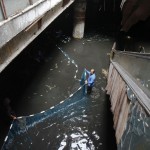
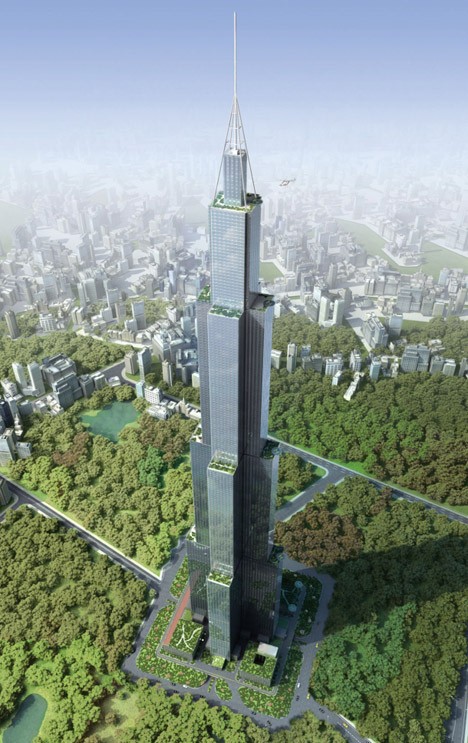
    Ambitious plans construct Sky City in China, designed to be the highest skyscraper in the world and built in just 90 days, stalled at the outset over 2 years ago, leading to an unusual array of impromptu and informal adaptive reuses within and around the void dug for the tower, including an extensive fish farming operation.

    fish farm conversion

    In the absence of other uses, the local community has found new functions for the apparently abandoned 280,000-square-foot foundation, while the ceremonial groundbreaking marker (below) increasingly resembles the tombstone for a deceased architectural dream (rather than the herald of a record-breaking construction project). According to local source Xiaoxiang Chen Bao, one entrepreneurial farmer has invested a significant sum into his fish farm, set in the expansive rainwater-filled void (effectively an artificial lake) formed by deeply excavated sections of foundation, while others are using areas of land on all sides to grow crops or dry grain.

    fish farm reuse

    The tower was to stand 2,750 feet high in Changsha and its smaller sibling (Mini Sky City) has already been successfully built to 57 stories in just 19 days using innovations in prefabrication to rapidly speed up the process (time-lapse sequence shown below). Manufacturing many sections off-site, the development company was able to save significantly on costs but also to assemble the structure and facade in record time.

    fast

    Permitting issues and safety concerns have held back the larger structure, however, and resulted in a number of locals turning the land toward other productive purposes. It is unclear at this time whether any of the issues are tied to the initial and smaller project.
    converted skyscraper footing reuse

    Billionaire Zhang Yue, the man behind both projects, claims that their plans will eventually go forward, but there is no official word from the local or national Chinese government to confirm his assertions as yet, nor any construction activity on or around the site to support such claims His company, Broad Sustainable Building, aims to revolutionize safe and speedy skyscraper construction, using both buildings as examples of their capabilities … or perhaps just the one should the latter be permanently abandoned.

    Share on Facebook


    [ By WebUrbanist in Abandoned Places & Architecture. ]

    [ WebUrbanist | Archives | Galleries | Privacy | TOS ]


    WebUrbanist

  • New 42,000 Sq Ft Rooftop Farm in NYC is One of World’s Largest

    [ By WebUrbanist in Architecture & Offices & Commercial. ]

    rooftop farm nyc

    Retrofitting an existing roof, this project has turned the top of a commercial loft in Long Island City into a working urban farm with close to 1,000,000 pounds of soil supporting tens of thousands of square feet of growing space (able to produce hundreds of tons of produce annually). Efficiently designed, projects of this kind can produce food in cities with 20 times less land and 10 times less water than conventional fields.

    rooftop farm conversion project

    Working with Acumen Capital Partners and the building managers of Brooklyn Grange,  designers from Bromley Caldari Architects, this redesigned roof was conceived of as both a space for retreating from the city but also a functioning laboratory for urban agriculture and source of fresh local greens for surrounding neighborhoods.

    rooftop farming retrofit converted

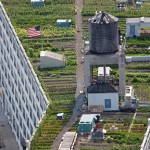
    A series of tightly-packed rows grow a variety of crops, all packed in between existing rooftop features including a water tower, elevator and HVAC system accessories. New York City is home to an increasing number of converted rooftop farms but this is the largest in the area to date and one of the biggest on the planet.

    rooftop farm largest world

    The rest of the 300,000-square-foot building below is a seven-story loft housing businesses in media, architecture, film, fashion, printing, design and other creative industries.

    rooftop gardening aerial view

    rooftop farm plan diagram

    As part of the $ 10,000,000 renovation project, energy-efficient windows, exterior lighting and signage were added to the structure in addition to plumbing, electrical and elevator retrofits.

    Share on Facebook


    [ By WebUrbanist in Architecture & Offices & Commercial. ]

    [ WebUrbanist | Archives | Galleries | Privacy | TOS ]


    WebUrbanist

  • Old New Jersey Factory to House Earth’s Largest Vertical Farm

    [ By WebUrbanist in Architecture & Offices & Commercial. ]

    aerofarm factory floor

    Opening this year in Newark, this 69,000-square-foot space will grow 2 million pounds of pesticide-free produce each year, turning an old steel factory into the largest indoor farm on the planet, 75 times more productive per square foot than open fields. This AeroFarms facility is to serve both as the company’s global headquarters as well as the anchor project for a Maker’s Village designed to grow business in the city and provide a prototype for scaleable urban agriculture.

    aerofarms aerial image

    Plants rooted in reusable microfleece cloth and stacked in modular planters will be sprayed by a nutrient mist and illuminated by LED lights. These crops require no soil, 95% less water and create no harmful runoff.  Located on a 3-acre industrial site in the Ironbound neighborhood, the structure will expand the role of affordable and local urban farming in the community and provide nearly 100 long-term jobs for residents. Such an approach offers a new potential future role to rundown industrial districts around the world, turning unused infrastructure in struggling cities into fresh indoor farming space.

    aerofarm interior space

    More on the process and key materials: a “reusable cloth medium [supports] seeding, germinating, growing, and harvesting.” This critical cloth “has a number of benefits such as durability and reusability, increased cleanliness and sanitation, and the efficient harvest of a dry and clean product.”

    aerofarms hydpropnic indoor agriculture

    In terms of LED innovation and efficiency, the company is “targeting specific wavelengths of light for more efficient photosynthesis and less energy consumption. LEDs can also be placed much closer to the plants, enabling greater vertical growing for even greater productivity per square foot.”

    aerofarm facility rendering market

    Aeroponics is the key to the solution, limiting the need for conventional watering and representing “a cutting-edge type of hydroponic technology that grows plants in a mist. The aeroponic mist most efficiently provides roots with the nutrients, hydration and oxygen needed, creating faster growing cycles and more biomass than other growing approaches. AeroFarms has designed its aeroponics as a closed-looped system, recirculating our nutrient solution and using over 95% less water than field farming.”

    aerofarms leafy greens

    “We are delighted to introduce AeroFarms, a farming and technology leader, to the City of Newark, creating jobs for local residents and greater access to locally grown produce for our community,” said Ron Beit, founding partner and CEO of RBH Group. “AeroFarms will anchor our broader ‘Makers Village’ development project in the Ironbound neighborhood that will compete toe-to-toe with the Brooklyn Navy Yard in terms of a superior cost structure and greater transmodal access, bringing 21st century ‘maker-type’ businesses to Newark and the State of New Jersey.”

    Share on Facebook


    [ By WebUrbanist in Architecture & Offices & Commercial. ]

    [ WebUrbanist | Archives | Galleries | Privacy | TOS ]


    WebUrbanist

  • Sustainable Food in the City: 10 Smart Urban Farm Designs

    [ By Steph in Architecture & Cities & Urbanism. ]

    urban farming korea 3

    The world’s largest indoor farm has already proven just how amazingly successful food production can be outside of standard agricultural setups, and these 10 urban farm designs and concepts take the possibilities even further by taking advantage of disused spaces, reaching high into the sky and employing modular, portable, prefabricated configurations.

    Jenga-Like Urban Farming Ecosystem by OVA Studio

    urban farming jenga 1 urban farming hive inn 2

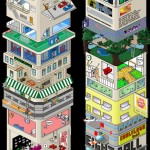
    The Hive-Inn City Farm is a prefabricated, modular farming structure that could brig fresh, locally grown food to busy urban districts. The structure reclaims shipping containers and stacks them in a Jenga-like configuration, with each container dedicated to a specific function from growing a certain type of food to recycling waste. The design echoes that of OVA Studio’s original Hive Inn concept, which uses the containers as individual hotel rooms.

    SPARK Senior Living Center and Vertical Farm Concept

    urban farming spark 1

    urban farming spark 2

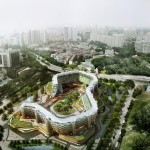
    This concept by SPARK Architects solves two problems in one by combining housing for Singapore’s rapidly aging population with urban food production. The ‘home farm’ creates a lush, vibrant garden environment that’s pleasant to live in while also catering specifically to the needs of seniors and using a vertical system to grow edibles, offering part-time employment for residents in the gardens

    Mini Harvesting Station for Forgotten City Spaces

    urban farming harvesting station

    urban farming harvesting station 2

    On a smaller scale, various spaces around the city that aren’t being put to good use could serve as temporary locations for miniature farms. The Harvesting Station by Conceptual Devices can grow up to 200 plants within 43 square feet, and is topped with a water harvesting tower that irrigates the plants automatically.

    Vertical SkyFarm for Korea

    urban farming korea 1

    urban farming korea 2

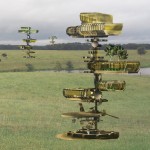
    Downtown Seoul, South Korea could become a powerhouse food production center if concepts like Aprilli’s vertical farm are actually built, potentially sustaining a significant number of the city’s large population. The tree-shaped structure frees up space on the ground while raising ‘leaf’ platforms far above street level for access to sunlight, and serves as an iconic symbol of sustainability.

    Geodesic Rooftop Greenhosue for Urban Farmers

    urban farming geodesic 1

    Another small-scale rooftop ming solution is the Globe (Hedron) by Conceptual Devices, a geodesic dome for flat urban rooftops that’s framed with bamboo and functions as an aquaponic system to produce both fish and vegetables. Each greenhouse can feed four families of four year-round.

    Next Page – Click Below to Read More:
    Sustainable Food In The City 10 Smart Urban Farm Designs

    Share on Facebook


    [ By Steph in Architecture & Cities & Urbanism. ]

    [ WebUrbanist | Archives | Galleries | Privacy | TOS ]


    WebUrbanist

  • World’s Largest Indoor Farm is 100 Times More Productive

    [ By WebUrbanist in Architecture & Offices & Commercial. ]

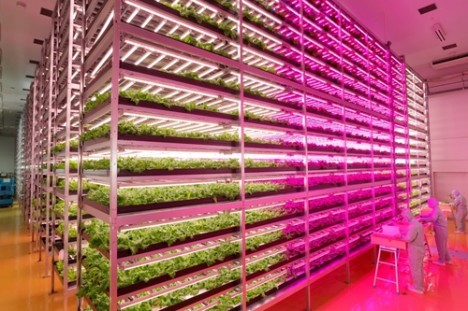
    indoor farm japan interior

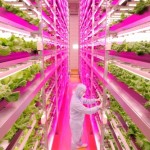
    The statistics for this incredibly successful indoor farming endeavor in Japan are staggering: 25,000 square feet producing 10,000 heads of lettuce per day (100 times more per square foot than traditional methods) with 40% less power, 80% less food waste and 99% less water usage than outdoor fields.

    indoor factory lettuce farm

    indoor farm high yield

    Customized LED lighting developed with GE helps plants grow up to two and half times faster, one of the many innovations employed in this enterprise by Shigeharu Shimamura, the man who helped turn a former semiconductor factory into the planet’s biggest interior factory farm.

    worlds largest indoor farm

    Shimamura has shortened the cycle of days and nights in this artificial environment, growing food faster, while optimizing temperature, lighting and humidity and maximizing vertical square footage in this vast interior space (about half the size of a football field).

    indoor future led farming

    With a long-standing passion for produce production, he “got the idea for his indoor farm as a teenager, when he visited a ‘vegetable factory’ at the Expo ’85 world’s fair in Tsukuba, Japan. He went on to study plant physiology at the Tokyo University of Agriculture, and in 2004 started an indoor farming company called Mirai, which in Japanese means ‘future.’”

    indoor farm interview detail

    The beauty of this development lies partly in its versatility – since it deals in climate-controlled spaces and replicable conditions, a solution of this sort can be deployed anywhere in the world to address food shortages of the present and future. Saving space, indoor vertical farms are also good candidates for local food production in crowded and high-cost urban areas around the globe. Aforementioned strides in waste and power reduction also make these techniques and approaches far more sustainable and cost-efficient.

    Share on Facebook


    [ By WebUrbanist in Architecture & Offices & Commercial. ]

    [ WebUrbanist | Archives | Galleries | Privacy | TOS ]


    WebUrbanist

  • Fungi Farm Prototype Turns Waste Plastic into Edible Treats

    [ By WebUrbanist in Conceptual & Futuristic & Technology. ]

    fungi muratium toxic waste

    Breaking down one of the most difficult types of trash, this incredible working incubator turns sterilized plastic remnants into nutritional biomass humans can consume and digest, in short: food. Texture, taste and flavor depend upon the strain of fungus, but reportedly can be quite strong as well as quite sweet.

    fungus growth system

    fungi plastic utensil set

    fungi eating good

    Livin Studio, an Austrian design group known for innovative work on insect farms, has built a working model of this growth sphere (dubbed the Fungi Mutarium) that takes parts of mushrooms usually left uneaten and grows them into fresh snacks.

    fungi eating growth sphere

    From the creators: “We were working with fungi named Schizophyllum Commune and Pleurotus Ostreatus. They are found throughout the world and can be seen on a wide range of timbers and many other plant-based substrates virtually anywhere in Europe, Asia, Africa, the Americas and Australia. Next to the property of digesting toxic waste materials, they are also commonly eaten. As the fungi break down the plastic ingredients and don’t store them, like they do with metals, they are edible.”

    fungi incubation chamber diagram

    In terms of the process, “Fungi Mutarium is a prototype that grows edible fungal biomass, mainly the mycelium, as a novel food product. Fungi is cultivated on specifically designed agar shapes that the designers called FU.  Agar is a seaweed based gelatin substitute and acts, mixed with starch and sugar, as a nutrient base for the fungi. The FUs are filled with plastics. The fungi is then inserted, it digests the plastic and overgrows the whole substrate. The shape of the FU is designed so that it holds the plastic and to offer the fungi a lot of surface to grow on. “

    fungus diagram design

    For now, the digestion is a relatively slow process, taking up to a few months for a set of cultures to fully mature, but by the standards of plastic biodegrading in nature this is still an extraordinary feat. The team continues to work with university researchers to make the process faster and more efficient. “Scientific research has shown that fungi can degrade toxic and persistent waste materials such as plastics, converting them into edible fungal biomass.”

    fungi edible grown creaiton

    fungi plastic eating design

    This novel application comes just a few years after a group of Yale students discovered a species of fungi on a trip to Ecuador as part of a Rainforest Expedition and Labratory led by a molecular biochemist. Even in the absence of light and air, the species they examined thrived in landfill environments, suggesting potential near-future and larger-scale solution for existing waste sites as well.

    Share on Facebook


    [ By WebUrbanist in Conceptual & Futuristic & Technology. ]

    [ WebUrbanist | Archives | Galleries | Privacy | TOS ]


    WebUrbanist

  • Zombie-Powered Vertical Farm: Post-Apocalyptic Safe House

    [ By WebUrbanist in Architecture & Houses & Residential. ]

    zombie brains

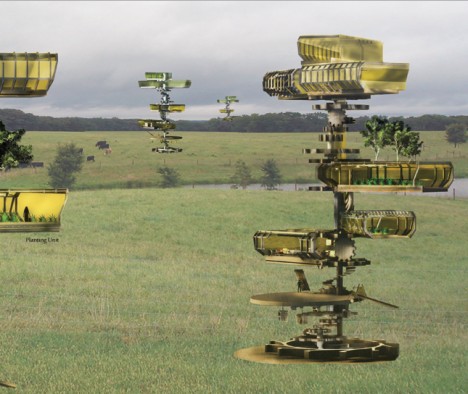
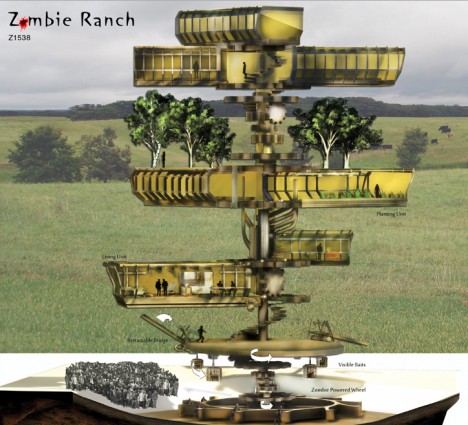
    Strangely sustainable, this towering haven is designed to turn the energy of the undead toward a positive purpose, using zombies to turn a turbine in order to provide both power and water pressure in case of a viral apocalypse.

    zombie ranch design details

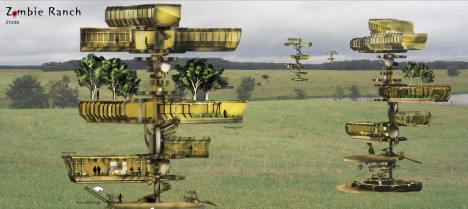
    As part of the Zombie Safe House competition, this Zombie Ranch entry goes above and beyond simply protecting people from risen corpses, turning their lust for blood and brains into a baited trap to keep life going above the ground.

    zombie powered safe house

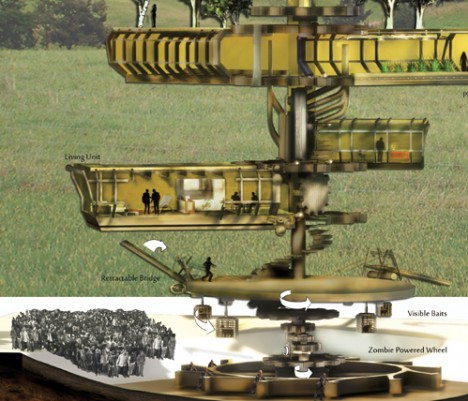
    The slow-moving zombies push a twisting turbine that sends water up for drinking and farming on a second story – residents occupy the top level, presumably for an extra layer of safety and to get some distance from the groaning hordes.

    zombie design raised lowered

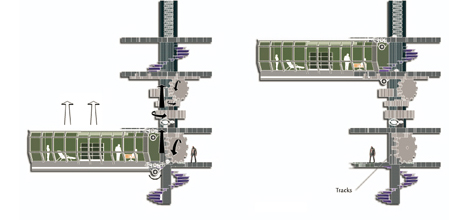
    A series of spiral staircases and drawbridges provide ways to cut off attacks on each floor as well as a means of lifting the entire structure further skyward to make it less accessible when a swarm wanders through.

    zombie ranch above below

    Each zombie-resistant tower is designed to be fully self-sufficient so survivors can remain aloft indefinitely, leaving them free to enjoy the end of the world in relative luxury.

    Share on Facebook


    [ By WebUrbanist in Architecture & Houses & Residential. ]

    [ WebUrbanist | Archives | Galleries | Privacy | TOS ]

    WebUrbanist

  • Deep Roots: Underground Farm in London Air-Raid Tunnels

    [ By WebUrbanist in Culture & Cuisine & Global. ]

    underground tunnel london gardening

    100 feet beneath the surface, below even the level of the London Underground, there is another layer of World War Two shelters where something amazing is coming to life.

    underground hyrdoponic garden farm

    underground farming campaign idea

    Richard Ballard and Steven Dring are behind Growing Underground, experimentally introducing hydroponic systems to 2.5 acres of abandoned subterranean passages right in the UK’s capital city.

    growing subterranean tunnel space

    growing underground urban context

    The closed-loop nature of their approach means that weather and environmental factors (like rodents and runoff) are nothing to worry about. There are other advantages of their situation, too: 70% less water is needed to grow below ground, and their agricultural system is self-recycling, low-maintenance, pesticide-free and carbon-neutral.

    underground crowdfunding green produce

    Their unique and central location means they can provide ultra-local micro-greens to restaurants, wholesalers and retail vendors right above where they grow, all in a matter of hours.

    underground vegetable growing hyrdoponics

    growing underground package design

    Their planned crops so far range from pea shoots and broccoli to garlic chives and mustard leaf, not to mention edible flowers and miniature vegetables. Mushrooms and tomatoes are also on the horizon.

    grown underground farming example

    growing underground founder pair

    From the company: “Because we have total control over their environment, each tiny leaf tastes as amazing as the last and because they are unaffected by the weather and seasonal changes, we can reduce the need to import crops and drastically reduce the food miles for retailers and consumers.”

    Share on Facebook


    [ By WebUrbanist in Culture & Cuisine & Global. ]

    [ WebUrbanist | Archives | Galleries | Privacy | TOS ]

    WebUrbanist

  • Heartwarming Pictures of Children and Animals on the Farm by Russian Photographer Elena Shumilova

    Elena Shumilova’s photographs catch the viewer from the very first moment and take him away from reality into a mysterious world of dreams, childhood and goodness. The most memorable photos are the ones that tell a story. The pictures you’re going to see below are short stories about two adorable photographers’ sons and their animal friends. It’s hard to believe Continue Reading

    The post Heartwarming Pictures of Children and Animals on the Farm by Russian Photographer Elena Shumilova appeared first on Photodoto.


    Photodoto

  • Urban Farm Kit: Modular Chicken Coops, Planters & Benches

    [ By WebUrbanist in Design & Furniture & Decor. ]

    urban kit of parts

    A solution for all seasons and regions, the premise is simple: every would-be urban farmer has space, weather and other growing constraints, and yet draws from the same set of essential needs.

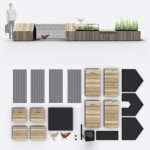
    urban farming exploded axon

    For some folks the focus may be raising chickens and a few hardy outdoor plant varieties that can stand the shifts in weather.

    urban farm detail box

    For others, perhaps in colder climates, built-in storage compartments (that helpfully double as benches) and miniature greenhouse spaces may be the essential or desired accessories.

    urban farm modules benches

    urban farm planting platforms

    urban farm system parts

    A series of wooden slats rhythmically wrap the exterior, creating both material continuity between sections as well as a way to hide joints between separate pieces in plain sight.

    urban farm wood wire

    urban famr chicken coop

    urban farming module prototype

    The currently-built prototype features dark-stained natural wood and examples of most of the potential modules, demonstrating their feasibility. It includes the wired outdoor area and indoor coop for chickens, for instance, as well as a planter and a secret storage bench section.

    Share on Facebook


    [ By WebUrbanist in Design & Furniture & Decor. ]

    [ WebUrbanist | Archives | Galleries | Privacy | TOS ]

    WebUrbanist