Month: November 2012

  • Dreamy Theater 2nd – ?????????????????? [M=Hatsune Miku]

    Please read the Description Box/Info Box. .: Info about this Video :. Game Title: Project DIVA Dreamy Theater 2nd Platform: PlayStation 3 Developer: Sega Publisher: Sega Genre(s): Rhythm game Mode(s): Single-player Project DIVA is a rhythm game created by Sega and Crypton Future Media for the PlayStation Portable featuring the virtual-diva vocaloid Hatsune Miku. The gameplay is based on pressing buttons on the controller when floating gray button icons appear on top of the colored button icons. Project DIVA Dreamy Theater 2nd is an add-on of the sequel, Project Diva 2nd and now supported stereoscopic 3D display. Hatsune Miku (????) is a singing synthesizer application with a female persona, developed by Crypton Future Media. It uses Yamaha Corporation’s Vocaloid 2 synthesizing technology. The name of the character comes from a fusion of the Japanese for first (? hatsu), sound (? ne) and future (Miku (??) sounds like a nanori reading of future, ??, normally read as “mirai”), referring to her position as the first of Crypton’s “Character Vocal Series”. She was the second Vocaloid to be sold using the Vocaloid 2 engine and the first Japanese Vocaloid to use the Japanese version of the Vocaloid 2 engine. Her voice is sampled from Japanese voice actress, Saki Fujita. Hatsune Miku has performed onstage as a projection. [M = Modules] :: Song Titel :: Japanese: ?????????????????? Romaji: Miku Miku ni Shite Ageru?(Shite Yanyo) English: I’ll Make You Do
    Video Rating: 4 / 5

  • Amazing Rio de Janeiro with Robert Voltaire

    Captivating behind the scenes footage of Rio de Janeiro with LA fashion photographer Robert Voltaire. Footage of Ipanema and Copacabana Beaches featuring top Brazilian models. More at: www.robertvoltaire.com http www.facebook.com www.twitter.com
    Video Rating: 4 / 5

  • Should you be shooting RAW?

    You can find many articles online discussing the benefits of shooting in RAW and probably an equal number full of counter arguments stating that it is possible to obtain equally good results shooting in JPEG.  Whilst that is definitely true, I want to discuss the reasons that pushed me to exclusively use RAW in the hope that it can persuade others to do the same.

    I liken RAW processing to taking the camera off ‘auto’ and shooting in ‘manual’ mode.  When people are starting out in digital photography, it can seem like another area full of technical jargon that forms a barrier preventing its uptake.  However, once you have an small understanding of the processes involved and how different settings can impact your results, you will find that letting your camera do the processing can be the limiting factor in achieving your photographic vision.

    What is RAW?

    A RAW file is an uncompressed image file that records the data from the sensor ‘as is’, with minimal processing.  Depending on your camera, this file will most likely contain either 12-bit or 14-bit data.  When shooting in JPEG, the camera will take the RAW file, process it with a number of generic actions (typically contrast/saturation adjustments, correcting for white balance and sharpening) before compressing the image down to an 8-bit JPEG file.

    That difference in ‘bit depth’ is the key here.  The 12-bit image will contain 2^12=4096 tones per channel.  Given that there are three channels per pixel (red, green and blue), that equates to 4096x4096x4096= 69 billion possible tones per pixel.  If we compare that to the other bit depths, you will see the difference:

    Bit depth

    Tones per channel

    Possible tones per pixel

    8-bit

    2^8 = 256

    16.8 million

    12-bit

    2^12 = 4096

    68.7 billion

    14-bit

    2^14 = 16384

    4.4 trillion

    Now those numbers are almost too large to comprehend, however it is quite simple to consider in context.  When you take a JPEG file from your camera into Photoshop to process, there are only 256 possible tones to define the colour for each red, green or blue channel, which means that when you start apply changes to contrast or brightness, there are a very limited number of possible tones for each pixel, which can result in obvious image degradation if pushed too far.  With a RAW image, the number of possible tones is that much greater that more significant changes to can be made without any impact on the final image quality.

    This doesn’t come without a cost though.  Due to the increased bit depth of RAW files, they are anywhere from 2-6 times larger than the corresponding JPEG when recorded in camera.  This will make your vast memory card seem very limited.  Additionally, where as a JPEG is typically printer-ready straight out of the camera, a RAW file will need to be manually processed in your digital darkroom.  So, to answer the obvious question of ‘is it worth it?’, lets consider the benefits…

    The benefits of RAW

    As mentioned above, when shooting JPEG, the camera processes the image internally, before compressing it to a lower bit depth.  The processing applied by the camera is generic, and uniform across the entire image.  In contrast, when you capture RAW images, you have full control over how much processing is applied to an image, and where in that image you apply it.

    Given the increased bit depth of the RAW files, any image you capture is much more forgiving than the corresponding JPEG would be.  For example, if you didn’t nail your exposure, and you over-exposed the sky of a landscape photograph, leaving it nearly white, you will be able to recover much more tonal data in the RAW file and potentially save what, otherwise, may be an image destined for the recycle bin.  Similarly for shadow data, much more information is retained meaning under-exposed regions of an image can be recovered to show detail that would otherwise have been lost.

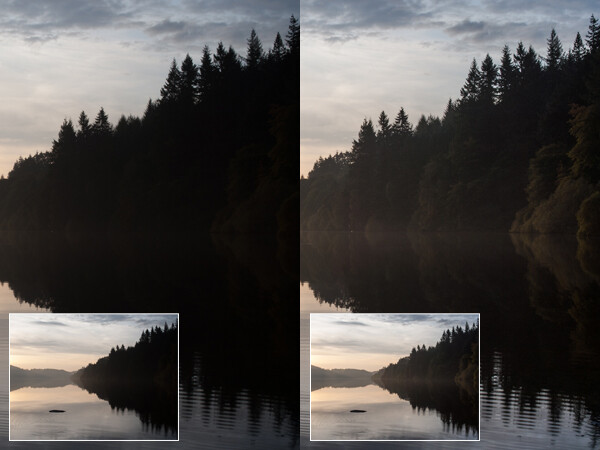
    Shadow detail recovery when shooting RAW

    On the left is the image presented straight out of camera. Exposing to contain the bright sky caused the trees to be under-exposed, and appear and a dense block of dark colour. The image on the right shows the same image processed to boost the shadows to reveal detail that may otherwise have been lost

    Similarly, one image can contain enough tonal detail to create an HDR-style image from one file.  The exposure of the image can be increased/decreased during post processing to give 3 images, as if bracketed, and can be combined to give that effect of increased dynamic range, but all from just one image.

    When shooting in RAW, you no longer need to set your white balance in camera.  The increased bit depth of RAW files means that the white balance can be defined, by precise colour temperature (in Kelvin), during post processing rather than by a limited number of defined presets in camera before the shutter is pressed.  Due to the increased bit depth, significant white balance shifts do not have a negative impact on the final image quality.  No longer do you fire off a few frames before remembering that you left the white balance on ‘incandescent’ even though you are now outdoors.

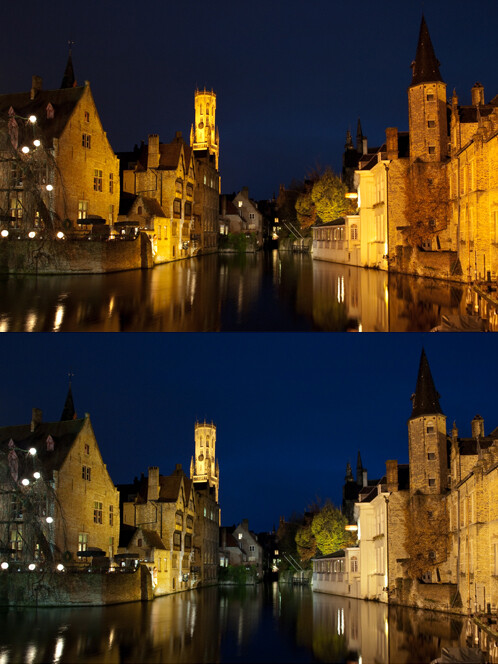
    Colour temperature correction from RAW

    The top image shows Bruges, captured at night, straight out of camera. The white balance of the bottom image has been processed to reduce the colour temperature in order to give a more realistic representation for the colour of the stone buildings, without any impact on the image quality.

    Sharpening can be applied as much as you want and even where you want, without over-sharpening a pre-sharpened JPEG image.  This can be used to emphasise details in one section of an image, or just generally give you control over the final image output.

    Selective sharpening of an image

    This image on the left shows a cheetah that has undergone some sharpening to increase detail. The image on the right is the mask applied to the sharpening effect. Imagine that black and white image superimposed over the top of the cheetah; the area of white represents the portion of the image to which the sharpening effect has been applied and the area of black represents the portion of the image to which the sharpening effect is not applied. Therefore, in this instance, the sharpening has been applied only to the eyes/nose of the big cat, to further emphasise the sharp focus in this area, and increase the impact of the close portrait.

    The added bonus

    As if the above points weren’t enough, what has to be one of my favourite reasons for shooting in RAW is that all image editing is non-destructive.  Unlike a JPEG file, where any changes made to the image are permanent, all changes made to a RAW image are stored in a metadata file associated with the RAW file, leaving the original file untouched.  This means you can never irreparably ruin an image by saving some mistaken changes and also you can go back to an image a few weeks, months or years later and reprocess it, from the original RAW, as your processing skills improve.

    Now, I would be lying if I said there was not a learning curve associated with RAW processing.  You will need dedicated RAW processing software to manipulate your images, but typically cameras that support shooting in RAW should ship with the manufacturers own software for doing so.  There are also a large number of alternative free programs out there, as well as software packages from well know image editing giants, such as Adobe.  With a little bit of research, you will see how easy it is to squeeze the most out of your images, and you will soon wonder why you weren’t shooting in RAW sooner.

    Given that most cameras should give the option of shooting in ‘RAW+JPEG’, where the camera records both the RAW file and processed JPEG file to the memory card, you haven’t got an excuse to not give it a go the next time you are out with your camera.

    Post originally from: Digital Photography Tips.

    Check out our more Photography Tips at Photography Tips for Beginners, Portrait Photography Tips and Wedding Photography Tips.

    Should you be shooting RAW?


    Digital Photography School

  • Sigma USA announces $899 price for 35mm F1.4 DG HSM prime lens

    Sigma_35mm.png

    Sigma USA has announced the price and availability details of the 35mm F1.4 DG HSM it unveiled at Photokina 2012. The 35mm F1.4, which will be available for Nikon, Canon, Sony, Pentax and Sigma DSLRs, is compatible with both full-frame and APS-C cameras. It will have an estimated street price of $ 899, making it significantly less expensive than the big-brand competition. The lens is the first of Sigma’s ‘Global Vision’ lineup, representing the ‘Art’ category of enthusiast-grade lenses.

    News: Digital Photography Review (dpreview.com)

  • How To Set Custom White Balance in DSLR camera

    More tutorials @ learnmyshot.com Watch this photography tutorial video to learn how to set custom white balance in your DSLR camera
    Video Rating: 4 / 5

  • Travel Photography Inspiration Project: Brazil

    Brazil is known for its golden beaches and the Amazon rainforest, but there is more to be had in the largest country in South America. DPS readers like you submitted their photos for a look around the county from the comfort of your computer.

    This is the fifteenth country we are covering the DPS reader fueled DPS Travel Photography Inspiration Project.

    If you would like to be involved in the next country’s post, drop me a line here.

    The Jump

    The Jump by Alexandre Furcolin F.

    Kids playing by the sea at Praia de São Bento, in the state of Alagoas

    DSC_9992

    Barbeiro (Barber), Capim Grosso, Bahia by Julie Orfirer

    As always, getting off the beaten path, staying as long as you can in one place – enough to be a familiar face in a small town if possible – will give you the opportunities to catch life as it is. Brazil is a friendly place with people who are willing to help with communicating and show off what is special about their home towns.

    soft light dune brazil

    soft dune light – Jericoacoara, brazil by Michael Robert Powell

    Shooting in the wet season after rainfall saturates colors and often sees moody skies. I softened this image to give it a lightly-painted effect.  A scene sparse on detail can enhance the composition.

    Angra

    Church and Tree by Jacson Querubin

    An old church in Angra dos Reis. This is an photo taken from a boat tour in Angra. Angra dos Reis is a city near Rio de Janeiro (about 250km). It has more than 200 islands. Angra (nickname that everybody uses) has a lot of hotels and resorts to stay, but it has some hostels too. Great place to rest and se a nature beauty near Rio de Janeiro. Its like a Brazilian Santa Barbara (a city where a lot of rich people and celebrities go rest and take the beach). Prefer between April and November you’ll get of the season and lower prices (exclude July).
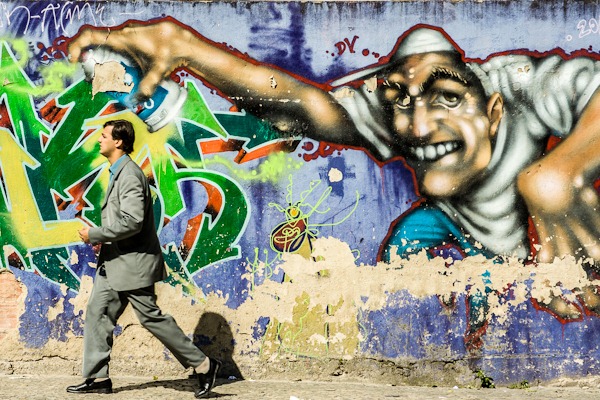
    Spray artist

    Street art, Rua da Carioca, Rio de Janeiro by Angus McIntyre

    Tip: Look out for Rio’s brilliant and colorful graffiti.

    Wild curves

    Wild Curves by Alexandre Furcolin F.

    The breath-taking landscape of Lençois Maranhenses national park, in the state of Maranhão. A huge desert of fine sand dunes permeated by lagoons that accumulate turquoise water after the rain season.  Definitely a must-go.

    DSC_9968

    Feira (Marketplace), Capim Grosso, Bahia by Julie Orfirer

    Market days are becoming more rare in Brazil as the supermarkets take over but in the interior of Bahia they are still weekly events. Photographic opportunities are everywhere and can be overwhelming. I processed this in monochrome to focus on the moment rather than the abundance of color at these events.

    oasis - ceara state brazil

    beach oasis –  cearà state, brazil  by Michael Robert Powell

    The northern coast of Brazil has  some stunning sand dune scenery, often you feel you’re in the Sahara. I had no choice over the timing of this middle of the day shot. I saturated the image further in this stitched panorama and was happy with the bright day effect.

    Honestino

    Bridge to Mothership by Jacson Querubin

    The Honestino Guimarães Museum, in Brasília. This photo was taking on a tour in the Monumental Axis in Brazil’s capital. On Brazil’s capital, Brasília, we has the Monumental Axis where all the 3 power has offices (and all ministries and others federal agencies). In this Axis, we have the Honestino Guimarães museum, planned by the famous architect Oscar Niemayer. With curves and abstract lines, the museum is great (as well as all Niemayer’s projects). The best time to walk (a long walk, BTW) it is in the morning. Take some water and prefer go by bus or car/taki, to see all the famous places. Brasília is an expensive city, so plan ahead and try to avoid big conferences that has there (search, ’cause you can pay a lot more, with this events).
    Egrets

    Carved birds by Angus McIntyre

    Tip: The popular tourist resort of Paraty is almost too picture-postcard pretty; concentrating on details offers the chance for more interesting shots.

    Intimate Window

    Intimate window by Alexandre Furcolin F.

    A nine people family sharing a (barely) 2 room house made of mud and straw in one of the many forgotten poor communities, this one in the state of Alagoas. Numerous family, scarce resources and smiley faces, the typical portrait of Brazilian rural areas families. Looking at those honest happy faces in such a precarious environment always makes me rethink the money-happiness relation. –

    DSC_8108

    Pescando (Fishing), Corumbá, Mato Grosso do Sul by Julie Orfirer

    This is sunset at the Rio Paraguai on the Brazil/Bolivia border in the Pantanal. It’s an example of waiting in the right setting for the right moment. Of the hundreds of birds flocking and fishing, just this one skimmed the water for his meal.

    street people sleeping – rio by Michael Robert Powell

    The streets can be mean in Rio – not just for the homeless but also for tourists: take precautions with cameras. This image I converted to B&W for greater impact and added a soft vignette to focus more on the guy closest. A day earlier he had no mattress, someone had bought him this as he suffered in the street with an infected leg.

    Cataratas

    Iguaçu Falls by Jacson Querubin

    Iguaçu falls is one of the new 7 wonders of nature. This is a long exposure taken in Iguaçu Falls. This photo was taken with a tripod with a ND400 filter. When traveling to Foz do Iguaçu, Paraná State, Brazil, you have a lot of places to visit. One of the beautiful places in the world, the Iguaçu Falls are breathtaking with its nature and beauty. There are about 100 falls counted. When visiting the falls, prefer going in the morning (the park opens at 9 am), be on the first bus going direct on the last stop (so you can have photos with few people on frame). The only access is with the oficial bus tour (you pay at entrance).

    Santa Teresa

    Tram tracks, Santa Teresa, Rio de Janeiro by Angus McIntyre

    Tip: The ‘bonde’ (tram) from Lapa to Santa Teresa offers lots of opportunities, both as a subject and as a platform for taking pictures.

    Asceptic City

    Aseptic city by Alexandre Furcolin F.

    The minimalistic geometry of the monumental federal capital Brasilia, entirely planned and buid in 1956 by Lucio Costa and Oscar Niemeyer, inevitably produces the sense of emptiness that I attempted to reproduce in this picture.

    TIP: If you like architecture and modernism, do not miss Brasilia. If you are short in time, i would agree that you may have more interesting options to visit than Brasilia. But if you are interested in constructivism and in the aesthetic of volumes, shadows, lines and curves, i strongly recommend one day composing pictures with Niemeyer’ reinforced concrete.

    vultures amazon brazil

    vultures on village church – amazon by Michael Robert Powell

    This was simply a lucky shot as I passed thru a village. Have your camera ready for such images that flash by fast and don’t offer a second chance. I was drawn to the juxtaposition of crosses and vultures, converting it to B&W with a bit more central light for punch.

    4Lines

    4 Lines by Jacson Querubin

    Transmission powerlines from Itaipu Dam. This is a long exposure taken in Itaipu Tour. This photo was taken with a tripod with a ND8 + ND400 filter. Another place to visit in Foz do Iguaçu, Paraná State, Brazil. Here
    you get the triple border (Brazil, Paraguay and Argentina), for example. Besides the vast nature surrounding the city, you have the largest hydroelectric powerplant generator in the world (annual generation, not the installed power): Itaipu Binacional. You can have an all day long tour within Itaipu sites: Biological Refuge Bela Vista, Ecomuseum and the Dam. If you don’t have a full day, I recommend go in the afternoon tour (take about 2 hours before sunset).

    You will have to pay a fee to make the visit. You also have a technical visit that you can see inside the DAM – but this visit you will need proper clothes – closed shoes and pants, no shorts allowed.
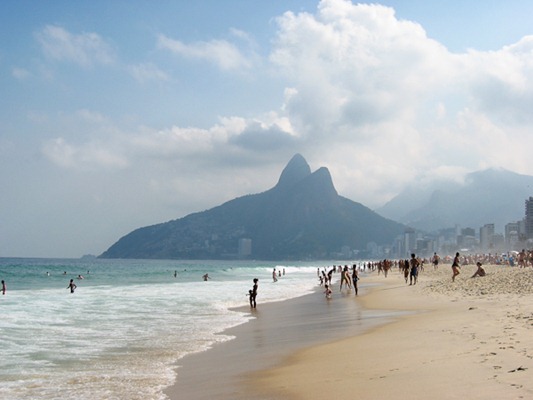
    Ipanema

    View along Ipanema Beach by Angus McIntyre

    Tip: even though the beaches of Rio have been photographed to death, they’re still beautiful; take your camera (but don’t leave it unattended).

    Post originally from: Digital Photography Tips.

    Check out our more Photography Tips at Photography Tips for Beginners, Portrait Photography Tips and Wedding Photography Tips.

    Travel Photography Inspiration Project: Brazil


    Digital Photography School
  • The Jelly Must Flow

    Share on Facebook – on.fb.me Join us on Facebook – fb.me Everything has stopped moving in Jammbo! Everything but Goomo, now he is the only hope to save the planet and his friends. More Jelly Jamm episodes in english: www.youtube.com Discover more Jelly Jamm Music! www.youtube.com Watch the Official Jelly Jamm videoclips! www.youtube.com Subscribe to our YouTube channel to keep up with the latest videos: www.youtube.com www.youtube.com Visit our official Website www.jellyjamm.com Follow us on twitter! http

  • FOCUS: Home

    “The ache for home lives in all of us, the safe place where we can go and not be questioned.” – Maya Angelou A short video highlighting the importance of my home to me. It’s a place where you fill before the world asks anything of you. The vibe it emits is a feeling shared by us all. Third installment of the FOCUS series. And while one may not be as “good” as the previous; I’m trying and experimenting with new ideas. Let me know how you’re liking the series and I’ll see you Honsters next week ^.^ add me on facebook! on.fb.me second channel- www.youtube.com twitter- www.twitter.com The music used is written and performed by Mars Argo, who has given youtubers full permission to use their music in videos online.

  • PEPPER – Drunk Girl [RedBlue 3D]

    Pepper pepperlive.com For your FREE pair of 3D glasses, visit http ***While supplies last*** 3-D Music Video by Pepper performing Drunk Girl. © 2010 Law Records

  • Product Photography Walk-through/Workflow

    Just showing a simple setup of a product and how I created some images that look pretty good in my opinion. In this instance I used a Xbox 260 Elite Controller on white foamcore. I used a Nikon Sb-28 flash with a 43″ Westcott umbrella. All flash, not other external or ambient light. Link to images – www.flickr.com Edited in Lightroom 3.4 and Adobe Photoshop Elements 3