
Hello, New to the hole DSLR thing. ended up buying a Nikon D60. (great camera) Here are the some photo’s from my 1st few month with the camera. Hope you like! Nikon D60 Slideshow
Video Rating: 4 / 5
Hello, New to the hole DSLR thing. ended up buying a Nikon D60. (great camera) Here are the some photo’s from my 1st few month with the camera. Hope you like! Nikon D60 Slideshow
Video Rating: 4 / 5

Sandy Schaeffer Photography Washington DC Photographer 715 14th Street NW, Washington, DC 20005 (703) 926-0666 slsphoto.com slsphotog@aol.com Washington DC Photographer – Corporate, Capitol Hill, public relations, association, portrait, and commercial photography. washington dc…
Video Rating: 0 / 5
Woot woot another cover of an amazing song :3 love it, hate it, I don’t really care cuz I love it and yeah i did dedicate it to my bf LOVE YOU HONEY

3dsMax, max, 3d, toy soldiers, fight, kung-fu, ?????, ?????????, super, animation, ????????, ??????, Flying, Mavrin, ??????, music, clip, good, video, motion, 3dmax, karate, fun, funy, xiao, xao
Video Rating: 4 / 5
Join Diggedy Dozer and his Build Co. Construction crew once again as they try to make the right choices to help a little bird and its home, this time in anaglyph 3D! You’ll need the RED AND CYAN ANAGLPYH GLASSES to experience the 3D depth effects, and the video should be viewed in HD where possible FOR MAXIMUM DEPTH EFFECT. A special treat from Flypaper Creations. Happy Holidays everyone! Visit Diggedy Dozer at www.diggedydozer.com

Red-Cyan 3D glasses needed!
Video Rating: 5 / 5

Created by Vancouver Film School student Teh-Wei Yeh through the VFS 3D Animation & Visual Effects program.
Video Rating: 4 / 5

My entry for the Golden Gnomes award in the category of “Animated Short Story”
Dieser Artikel hat eine kleine Vorgeschichte, die ich (Hannes) Euch nicht vorenthalten will. Als ich beim BrowserFruits Picknick am letzten Sonntag das von Florian gezeigte Video gesehen habe, musste ich sofort an die Arbeiten von Wilfried Kaiser denken, in dessen Portfolio ich eine ähnliche Arbeit mit einem Zirkusfoto gesehen hatte. Natürlich habe ich ihn sofort gefragt, ob er Lust hätte einen Gastartikel zu schreiben. Und die hatte er. 😉
 Das ist ein Gastartikel von Wilfried Kaiser. Wilfried ist in den Bereichen Grafik Design, Branding, Marketing und VFX tätig und studiert derzeit bei Hyper Island in Stockholm “Motion Designer and Developer”. Seine Website und Portfolio ist unter WilfriedKaiser.de zu erreichen.
Verfügt man bereits über Kenntnisse in Adobe Photoshop, kann man mit seinen Fotos in dem ebenenbasierten Motion-Design, VFX und Compositing Programm After Effects sehr schnell erstaunliche Animationen erstellen. Eine dieser leicht erlernbaren Möglichkeiten ist die Dimensionalisierung eines Fotos.
Das zugrunde liegende Prinzip ist, dass man die auf dem Foto abgebildeten Motive in die verschiedenen, räumlich voneinander getrennten Elemente zerlegt, diese Ebenen auf sogenannte “Sprites” projiziert, um dann im letzten Schritt eine Kamerafahrt zu erstellen. Im Grunde teilt man also After Effects mit, wie weit und in welche Richtung die Motive auf dem Foto voneinander entfernt waren, um mit diesen Tiefeninformationen das Bild “verräumlichen” zu können.
Benutzt man ein Foto, auf dem alles gestochen scharf und ohne Bewegungsunschärfe abgebildet ist, kann man mit After Effects leicht die korrekte Menge an Schärfentiefe oder Bewegungsunschärfe hinzufügen- also die “Artefakte”, die auch bei einem wirklich in Bewegung gefilmten Motiv auftreten würden und der Animation ihre realitätsnahe Dimensionalität verleihen.
Sobald man ein Foto mit einem komplexeren Hintergrund wie zum Beispiel ein Publikum nutzt, muss man natürlich beachten, dass durch die Bewegung der Kamera in der Animation nun Bildbereiche aufgedeckt werden, die auf dem Foto nicht existieren und diese deshalb mit dem digitalen Pinsel ersetzt oder aufgefüllt werden müssen.

In unserem Beispiel wollen wir dieses Foto animieren, welches ich vor ein paar Jahren in New York aufgenommen habe. Diese Szene habe ich gewählt, weil sie dank der Klon- und Kopierwerkzeuge in Photoshop sehr schnelle und daher sehr eindrucksvolle Ergebnisse verspricht.

Ich habe das Foto in die verschiedenen Entfernungsebenen aufgeteilt und die verdeckten Bereiche um einige Pixel erweitert, um später “Löcher” in der Animation zu vermeiden. Tip: Falls ich mir nicht sicher bin welchen Weg die Kamera in der Animation später zurücklegen wird solltet ich das Ersetzen dieser Bereiche einfach verschieben. Ich kann dann einfach mit Steuerung e die jeweils in After Effects markierte Ebene automatisch in Photoshop öffnen und dann sehr Zielgenau nur die Bereiche ersetzen die ich tatsächlich benötige.
Leidet das Foto unter Bildrauschen oder unter stärkerer Linsenverzerrung, sollte man beides am besten noch in Photoshop entfernen.

Nun importiere ich diese Photoshop Datei als “Komposition” in After Effects und behalte somit die Originalgröße in Relation zu der Komposition bei. Das ist wichtig um uns später beim skalieren der Ebene das Leben zu erleichtern.

Ich aktiviere den 3D Modus bei den einzelnen Ebenen und erstelle eine neue Kamera mit der 35mm Voreinstellung im Menüpunkt Ebene, Neu.

Jetzt verschiebe Verschiebe mit dem Auswahl Werkzeug v die Ebenen in der 3D Ansicht auf der Z Achse – der Blaue Pfeil – entsprechend ihrer wirklichen Entfernungen.
In die Hauptansicht zurückgekehrt, muss ich nun die Ebenen mit s wieder so skalieren, dass sie ihre ursprünglichen Abmessungen in Relation zur Kamera erreichen.
In meinem Fall sind das 235% für den Himmel, 174% für das Empire State Building, 143% für den hinteren Mittelgrund und 118% für den vorderen Mittelgrund. Die Ebene mit der Laterne habe ich nicht verschoben und muss deshalb die Skalierung nicht verändern.
Mit p kann ich nun die Position der Kamera auswählen, Schlüsselbilder setzen und so die Kamera animieren.
Zum Schluss füge ich der Animation noch etwas Bildrauschen, Schärfentiefe und eine Vignettierung hinzu. Fertig ist meine Kamerakranfahrt durch New York!
Die kompletten Arbeitsdateien könnt ihr übrigens herunterladen und genauer unter die Lupe nehmen. Es stehen zwei Downloads zur Verfügung; nur die Arbeitsdateien (24 MB) oder die gleichen Arbeitsdateien inklusive des gerenderten Resultats (134 MB). Für Fragen steh ich natürlich gerne in den Kommentaren zur Verfügung.
***
Werbepause: Buchtipp – Vom Alltäglichen zum Besonderen!
Phase One has released an updated version of its Capture One 5, PRO and DB RAW workflow software bringing in a host of improvements, additional features and bug fixes. Version 5.2 extends the programs’ Lens Cast Calibration (LCC) feature that aims to remove lens casts to DSLR RAW files and adds LCC based dust removal. It also improves handling of a number of Nikon camera files and supports Leica X1 Raw files. The update can be accessed via Capture One’s update feature for existing users or is available as a free 30 day trial.
News: Digital Photography Review (dpreview.com)
The Sony A55 promises to be one of the hottest new cameras of the season. Following my earlier first review I’ve had an opportunity to work with one for another couple of weeks on my home turf. Today sees my latest article, Sony A55 – A Further Evaluation.
If you just logged onto the site for the first time in a while you may have noticed a slight change in the cosmetics, and also a new box in the upper right corner for "Contributor Log-In".
While the appearance change is small, underneath the skin there have been massive changes which have been in development for the past 12 months.
In the days ahead we will be rolling out a number of new services to readers, so stay tuned.
PS: Try the new site search box on the left panel or here. I think you’ll find it helpful in finding content among the 4,000+ pages on the site.
Michael Reichmann will be interviewed live online on Smibs TV this coming Wednesday, September 15th at 1:30pm Pacific, 4:30pm Eastern. That’s 20:30 GMT. I hope that you can watch.

"Awesome video presentation.
I have learnt so much more after looking through this on the weekend. The tip about pushing blacks and fill light in the Basic Module was worth the price alone. My images of a recent trip to the Australian Outback are popping and punching with delight!
Thanks Michael and Jeff – I really appreciate you taking the considerable time to share your in-depth knowledge and insights."

In my previous post Thoughts on the iPad: Where Will Your Audience Be Next Year? I noted that current tablet computer trends are painting a picture of a transformed landscape where one’s audience might be interacting with online content in a radically different manner and frequency. Not only does mobile access through a device like the iPad impact navigation & content structure, it has the ability to shift expectation in how web viewers pay for content. There are some very clear signs pointing to this shifting trend and it begs the question, “Has the code to web revenue been cracked?”
Advent of the App Store
One thing is certain Apple’s iTunes App store has changed the landscape before us since its release in mid-2008. With the release of the iPhone 2.0 OS software came the App Store, supplementing the iTunes music store, and soon others were quickly trying to duplicate the wild success of this newly created platform. Now Apps downloads are on course to surpass music downloads from the Apple iTunes store by the end of 2010. In roughly 2 years time that is an amazing accomplishment considering the current rate of music sales on iTunes has taken 7 years to reach its current level. The larger phenomenon of the app craze has even spawned an App convention that is taking place here in San Francisco this week.
While Apple wasn’t the first to create an App platform (Facebooks App platform was released in 2007), they’re the first to tie it to a wildly popular consumer device, the iPad. As previously noted in my first post to this series All Eyes Are On The iPad. Are Yours?, it has been predicted that Apple will ship 12.9 million units this year, with shipments rising to 36.5 million next year and 50.4 million in 2012 and by any means that should be an eye opener. An eye opener because the combination of device sales and App download forecasts might just be indicators of a perfect storm on the horizon that shifts how many people interact with content on the web.
Revenue: Has the Web Found It?
Will the web as we know it be replaced by Apps? I doubt it, but where the web failed to convert user activity into revenue Apps just might be the long sought after holy grail many web entrepreneurs have been waiting for. While Apps have proven to be a potentially lucrative revenue creator not all App stores are created equally. In February 2010 Distimo reported that 75% of Apple Apps and 43% of Android Apps were paid apps and later in August 2010 Pingdom reported similar findings that 70% of Apple Apps and 36% of Android Apps were paid apps.
Interesting findings from the May 2010 AdMob Mobile Metrics report is that on average users of the iOS (Apple) and Android platforms spend at least 79 minutes a day using apps (note: Apple iOS users spend 89 minutes a day) and download 9 apps per month. The user activity is definitely a positive as most web sites are lucky to break the double digits in user activity sessions. The phenomenon of app dowloading has spawned an interesting trend as well… a mild addiction to downloading apps. In passing I’ve talked to several iPad/iPhone users that enjoy downloading apps almost as much as using the apps themselves. Nielsen reports that iPhone users for example download on average 40 apps versus Android users at 25 apps, both of which are an increase over 2009 findings.
Pricing
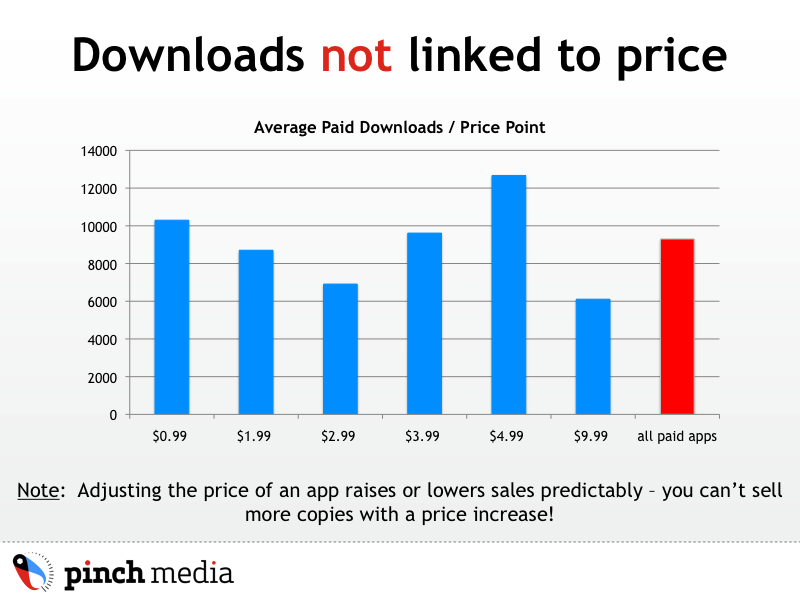
App pricing best practices seems to be the big mystery at the moment and is something I’m still researching. One interesting piece of data I surfaced concludes that downloads are not linked to price. This was in relation to game apps which might very well carry a different customer expectation to the photography market. While I can’t say much in definitive terms about app pricing I can say that higher prices will only be supported by app content/services that are of high value to users. There have been no shortage of apps commanding upward of .99 or more that have found themselves in the iTunes top-revenue/grossing list. Ultimately pricing will have to be tailored to the nature of the app. A photographer may very well want to release a free portfolio app in an effort to draw as many eyes as possible to their work versus charging for an eBook.
Looking into the Crystal Ball?
The web certainly will not be shrinking into oblivion, but content or services being produced to generate revenue may very well be predisposed to the app world. What apps have going for them, unlike standard web content, is that they come bundled with the expectation they cost money to acquire and use. For the truly creative who frame content of value in an app there is certainly money to be made. On the flip-side of that sentiment with hundreds of thousands of apps in the current marketplace not all apps cost money. Free is not just an attempt to standout, for the savvy developer, it’s part of a calculated strategy. It’s important to note that vast majority of apps are not likely to be profitable, falling into the category of loss-leaders (see my series starting with Assumptions of Free and Taylor Davidson’s great article Free isn’t a problem, it’s an opportunity), but they do offer a unique opportunity to engage & introduce your work and services to others.
In my eye the iPad holds great promise for photographers with the right application. As to how photographers can get the most out of the iPad and take advantage of these trends you’ll want to read my next post on the subject. Stay tuned…
Technorati Tags: photography, photo, Apple, iPad, app
.gif)
Copyright Jim M. Goldstein, All Rights Reserved
Thoughts on the iPad: Cracking the Code to Web Revenue?
Brynlee is amazing. Our third test shoot… hopefully the future will hold many more!




Links will take you directly to the B&H Photo Video product page for the individual item. You’re welcome.