Blog

  • GIMP Tutorial: Using Curves to Improve Night Shots

    Please comment and rate videos – this will help other people find them by ranking them higher…it takes a second 🙂 — Another tutorial for the heavenly Curves tool. This should help you remove unwanted colour casts from your photos and make you favourite pictures actually evoke the memories of your favourite scenes! This technique is more an art than a science – open up curves and play around with it…it’s the best way to experiment. — Next week: Using the Curves tool to get chores around the house done and make you more appealing to the opposite sex…(ok, maybe curves can’t do *everything*)

  • Olympus to ship E-5 digital SLR from October 29

    Olympus has announced that its E-5 digital SLR will start shipping from October 29 at a suggested retail price of 00. Announced at Photokina 2010, the weather-sealed camera offers a 12MP Live MOS sensor, 920k dot 3.0" articulated LCD, Live View with Contrast AF, HD video recording and shutter speeds of up to 1/8000th sec. In addition, the company will start shipping its  M.Zuiko Digital ED 40-150mm 1:4.0-5.6 Micro Four Thirds zoom lens from October 29 as well at a suggested retail price of  ¥47500 (~ 0).
    News: Digital Photography Review (dpreview.com)

  • On Assignment: Standing Behind Their Work


    Ever see a thriller movie where someone (usually Matt Damon) is talking to the bad CIA guys while they sit in their office even as Damon has them zeroed in from across the street?

    That’ll soon be implausible if Dianna and Wayne Wilhelm any say about it. They are building (and retrofitting) government buildings with normal-looking, 1/2″ glass that will stop a metal jacketed 9mm round at point blank range. And within two months, glass of that same thickness will be stopping rounds from high-powered rifles. Really cool stuff.

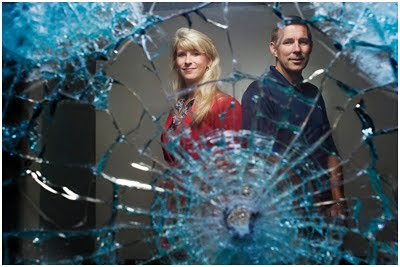
    I was assigned to shoot the Wilhelms for a BizMo cover, and thought I would take advantage of the fact that this new laminated ballistic glass is also optically decent. So I shot them through a piece of glass that already had stopped five 9mm rounds in an earlier demonstration.
    __________

    Most bullet-resistant (never say bullet proof) glass is thick and wavy. Think of the encased cashier at a high-security bank branch. But this stuff was thin enough (and clear enough) to where you could actually shoot through it with a camera and keep the subject reasonably sharp.

    Normally, I prefer SB-800s when shooting indoors and save the Profotos for when I am battling and overpowering sun. But to hold the impact marks in the glass in decent focus, I new I would need a very small aperture. So I brought my big lights to what would normally been a cut-and-dried speedlight portrait.

    f/16 and Be There

    The process was to set up my lights on a modest power setting, so I could get really fast recycle times. Then I would adjust the ratios and tweak my ISO until I was able to shoot at f/16. On a D3, anything at ISO 800 or below looks pretty much the same to me. So as long as I have DoF, I valued recycle time over marginal grain.

    This photo was shot with a Nikkor 35 f/2 AIS, a screaming sharp manual focus wide-angle lens. And even after the optical trip through the half-inch glass, the sharpness was acceptable if not perfect.

    I used three light sources. The first was a Profoto head in a large Paul Buff octa, positioned to do two things. First, I wanted it to edge-light the glass shatter marks from a hard angle. You need that lighting angle to get the crack lines to pop. Second, I wanted it to provide a small amount of (near) on-axis fill for Dianna and Wayne.
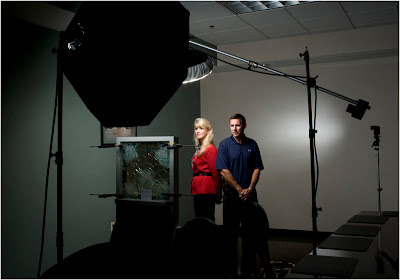

    You can see it just above the glass, in the photo above. This position gets me twice the bang for the buck. I was more concerned with the exposure level of the glass marks than the subject fill level. But by tweaking the position and angle I could get both effects pretty close.

    The key light was a boomed Profoto head in a beauty dish, slightly in front of and above the subjects. The dish is silver on the inside (efficient, but specular) so I socked it to turn it into a smallish, diffused light source.

    The separation light was a hard-angle kiss on the back wall from a slaved, gridded SB-800 seen at right. The wall was not black before the separation light hit it — it was getting some illumination from the dish and the octa. So the speedlight just created a small gradient to separate the subjects better.

    It was a pretty straightforward shot, as far as the lighting goes. Honestly, the hard part was positioning the camera at the exact spot where the subjects’ faces would each appear inside of an intact pieces of glass.

    It was harder than it looked. It is a three-dimensional solution, made more complicated by the fact that the subjects are always moving to some degree. I was bobbing and weaving like a boxer behind that glass to constantly compensate for the three variables.

    And in the end, I thought it was a little ironic that I was able to do what the bad guys aren’t — shoot both Dianna and Wayne right through a pane of their very special glass.


    Strobist

  • Canon updates firmware for EOS 5D Mark II

    Canon has released a bug-fixing firmware update for its EOS 5D Mark II full-frame DSLR. Firmware v2.0.8 addresses specific issues with video recording, live-view and flash settings. The latest version can be downloaded from Canon’s website.
    News: Digital Photography Review (dpreview.com)

  • solitude


    solitude, originally uploaded by Ontheway2it.

    Catchy Colors Photoblog

  • 19 October, 2010 – Composing With Color : Part 4

    Alain Briot‘s latest essay is titled Composing With Color : Part 4. For those following Alain’s essay series this long overdue installment (my fault, not Alain’s) will be welcome. If you haven’t yet read the first three parts, now is a good time to get caught up.


     "Awesome video presentation.
     
    I have learnt so much more after looking through this on the weekend.  The tip about pushing blacks and fill light in the Basic Module was worth the price alone.  My images of a recent trip to the Australian Outback are popping and punching with delight!
     
    Thanks Michael and Jeff – I really appreciate you taking the considerable time to share your in-depth knowledge and insights."


    The Luminous Landscape – What’s New

  • How to Change Skin on Logitech Z-5450 (see descritption)

    How to Change Skin on Logitech Z-5450. Amazing do it. Steps 1)stand by your system by pressing the blue button 2) hold the buttons “input”, “effect”, “settings”, “mute” until red led become to purple.(6 second) 3) and its done.
    Video Rating: 4 / 5

  • Bunnies: Princess Bride

    As you wish! The 30-Second Bunnies is a troupe of bunnies parodies, a collection of movies by re-enacting them in 30 seconds, more or less. Watch them all at www.starzbunnies.com 30 Second Bunnies Animated Animation Flash Romance Princess Bride

    Takaya is forced to confront his anger and mixed emotions about himself and Naoe. He must come to grips with these emotions quickly before he injures himself or someone else maliciously.
    Video Rating: 5 / 5

  • D300 Gen2 DEP Night Vision

    Night vision on a cloudy night in the snow

  • Are You Just Dying to Get Into a New Studio?


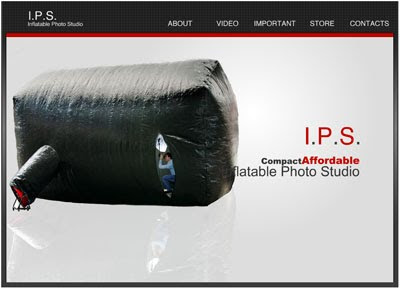
    I swear, I could not make this stuff up. The “Important” page on the new Inflatable Photo Studio (yes, I said Inflatable Photo Studio) includes the following among its several warnings:

    “It is not recommended that you smoke, cook or have any open flames in the studio. Also lights can become very hot and melt the studio. Do not rest lighting or position it against the sides. Curling irons, hair driers (sic) irons, and steamers can also melt the plastic causing rapid deflation or possible fire.”

    But wait, there’s more!

    For instance, in the event of a “rapid deflation,” not to worry! You have four minutes to get out alive — if you remember to crawl and “keep your arms up at an angle in front of you.” (Um, okay!)

    Hat tip: Andy | Tweet this

    -30-


    Strobist