The E-M5 is the first of Olympus’ OM-D range of Micro Four Thirds cameras and is styled to look like the its classic OM series SLRs. We’ve had a chance to use one of the most rumored and speculated-about cameras of recent years and have prepared a full, hands-on preview. We take a look at the camera’s features and explain its levels of customization. Click here to find out more about what goes on behind the E-M5’s pretty exterior.
Reader Jefferson, from California in the US, asked via Twitter:
"How do you deal with glare on dark wood in background for portraits? Is this covered in Lighting 101 or 102?"
Actually, it is covered in L102, if a little obliquely. And yes, pretty much any time you light into dark wood as a background you are gonna get some blowback.
But rather than look at this as a problem, I prefer to think of it as a feature… Read more »
Fully animated turret models which will be deployed with Incarna. This video was made on Duality server, so these babies are still in beta. Also, it seems that medium autocannons don’t have any animations yet. The music is Akat Mountains by Jon Hallur, it’s from EVE’s soundtrack. And don’t mind russian text, I have no idea why market menu is on russian. PS Looks like I forgot about tractor beams and salvagers, sorry. PPS No, no missile launchers for now. Here’s what CCP Atropos said about this on official forums: “I’m not involved with the project, but I remember a fellow dev posting a link (or maybe it was at Fanfest, I forget) detailing the hows and whys of this. Currently all ships that can fit a turret require nothing more than the turret being reskined (although that in itself is no mean feat!) however for missile bays to be shown requires more significant rework. For one, it requires the game engine to handle missiles differently with their trajectory being sourced from their respective launchers. This means touching the physics simulation a not inconsiderate undertaking in itself. Secondly every ship with a missile launcher spot must be revisited and edited to remove ‘fake’ missile bays, such as the Drake, Crow and many other Caldari ships have. This means extensive remodelling time. All the other missile capable ships must be modified to have sensible placement areas for missile lanuchers either added (again more editing of models and textures) or designated. We …
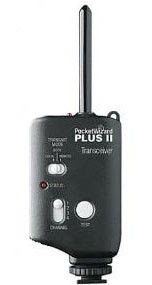
There are two things you should always remember about radio remotes:
One, radio can be fickle. This is true whether you are using your time-honored PocketWizards or a brand new Chinese offering.
Two, radio waves — and success with your remotes — are all about the physics. So a little knowledge can go a long way toward ensuring good range and reliability.
Some basics that every lighting photographer should know, inside. Read more »
During his month long artist in residency at the Ace Hotel in NYC, photographer Chase Jarvis explores and celebrates the art of the snapshot and invites the world to further pursue their own creative endeavors. Video Rating: 4 / 5
Kenko-Tokina will exhibit a mockup of a 70-200mm F4 telephoto zoom that features both a ring-type ultrasonic autofocus motor and optical image stabilization at the CP+ trade show in Japan. The AT-X Pro SD 70-200 F4 (IF) FX will be the company’s first stabilized lens, and will likely be especially interesting to Nikon SLR users who currently have no option that’s directly comparable to Canon’s popular and highly-regarded 70-200mm F4 designs. Further details are limited, but the lens appears to feature both internal zoom and focus mechanisms, and has a usefully-close minimum focus distance of 1m. (via Megapixel.il)
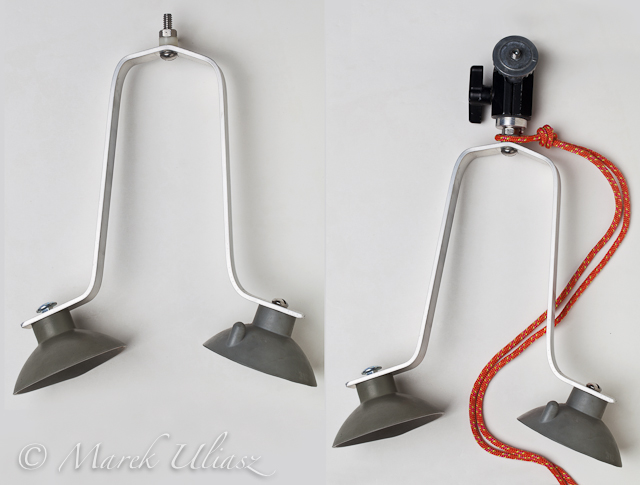
I discussed applications of suction cups from Sticky Pod in numerous posts in this blog – mounting different cameras or GPS units on a kayak deck. A single suction cup works usually pretty good for small waterproof cameras like GoPro Hero or Pentax Optio. However, things are getting a little bit awkward if your kayak has a steep deck with a ridge in the middle. It is the case of JKK Supernova kayak where it is not so easy to level and center a camera on a front deck. I also wanted to set up the camera a little bit above the deck.
The problem was solved with the two suction cup mount. I used the following basic ingredients:
– two suction cups (you can order then directly from Sticky Pod or from Amazon.com, for about $ 3 each)
– aluminum flat bar (1/8″ thick, 1″ wide) from your local hard store, the length depends on your design
– three 3/8″ bolts, two 3/4″ long and one 1/2″ (or you may need some spacers) and one nut
– a piece of some cord for a tether
It took me about 10 minutes to cut the aluminum bar, drill 3 holes, smooth sharp edges and bend it to a shape.
I added a small knuckle (ball head) to my mount. It provides easy way to control the camera position and is really useful for Pentax Optio or a similar camera. I needed a tripod mount adapter for the GoPro Hero. The knuckle is really not necessary in this case since a hinge allows for up and down camera adjustment, but it is still helpful. The picture shows the knuckle from Sticky Pod. I am also using a smaller and cheaper one made by Giotto.
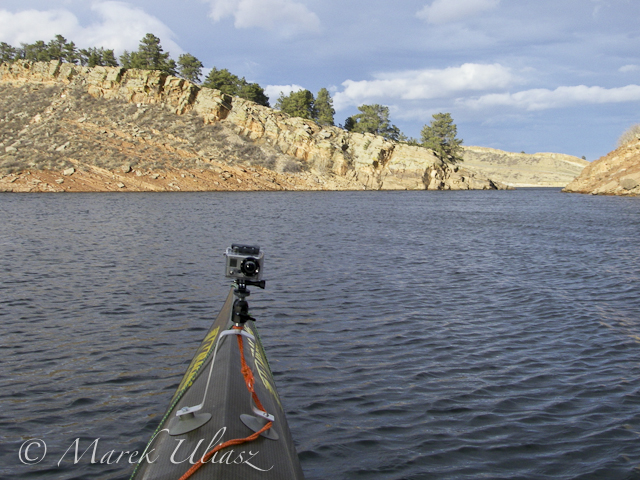
Here is the GoPro Hero camera mounted on the front deck of JKK Supernova kayak (shot from a cockpit with Pentax Optio W30) and some pictures from a January paddling on the Horsetooth Reservoir. The mount worked fine in very windy conditions. The camera mounted about 12″ above the deck is less likely to be hit by water splashes from my paddle.
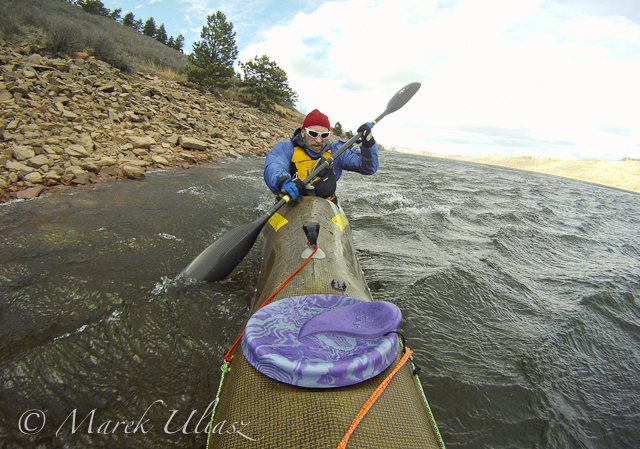
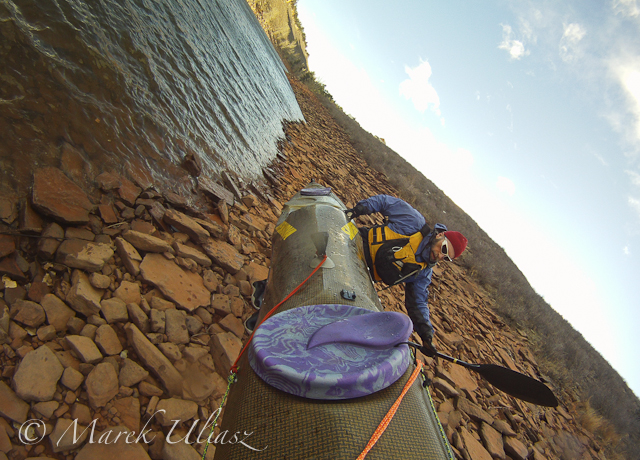
During another paddling workout on the Horsetooth I set up the GoPro Hero a little closer to the cockpit, see picture examples here and here.
Related posts:
A Bird’s-Eye View of Kayaking with GoPro Hero Camera
Kayak Video Camera Mast – Sticky Pod Combined with Monopod
Paddling with Canon PowerShot G11 Camera on a Monopod Mast
A New Shooting Angle – Camera Video Mast on Thunderbolt Kayak
Sticky Pod Review – A Suction Cup Camera Mount for Kayak Photography
South Platte River with GoPro Hero HD Camera and Thunderbolt Kayak
A Simple Suction Cup Mount for Garmin Forerunner 305 GPS
Are High Dynamic Range photos appropriate for illustrating news? That’s the debate that’s been started by the Washington Post’s use of an HDR image on its front page in January. Sean Elliot, president of the National Press Photographers Association came down firmly against it, saying, ‘HDR is not appropriate for documentary photojournalism.’ John Omvik, Marketing VP with HDR software maker Unified Color understandably disagrees. He’s written us a response arguing that what we see is closer to HDR than, say, a mono photo shot with Tri-X film.

 Reader Jefferson, from California in the US, asked via Twitter:


 There are two things you should always remember about radio remotes: