Blog

  • LG Optimus 3D/ AT&T Thrill 4G Hands on @CTIA 2011| Booredatwork

    twitter.com LG Optimus 3D otherwise known as the AT&T Thrill 4G, was on hand at CTIA wireless 2011. uses aa dual core dual channel OMAP 4 processor and two stereoscopic 5-megapixel cameras to record 3D photos and videos in full 720p HD resolution, 1GB rom and 4GB ram. Built in 8GB of built in storage The cool thing about the Optimus 3D is that you don’t need glasses to watch 3D video on the device. Also the device might be coming to T-mobile

  • Nikon D3s save my job

    This is a true story about a photojournalist from Malaysia National News Agency (BERNAMA) who crashed his D3s and had no choise but to continue using it to complete his assignments during Le Tour Langkawi Malaysia round.
    Video Rating: 4 / 5

    Nikon Flex TT5: bit.ly and TT1: bit.ly are reviewed by Lee Morris and Patrick Hall of Fstoppers.com. To learn more about these units and view high res images of the final images visit: www.fstoppers.com

  • Snakadaktal – Chimera

    Check out the brand new video for our new single, Dance Bear! www.youtube.com We are very excited to announce to you; THE DANCE BEAR TOUR. This August, we will be bringing back our live show for our biggest tour yet, to celebrate the launch of our new single Dance Bear. These are the biggest rooms we have ever headlined, so please make it a bit less nerve-wracking by coming along and having a dance. It will also be the last run of shows we play for a while, as we will be taking a break from live performances to begin work on the creation of our debut album. We are very excited as we will playing some all ages and 18+ shows in venues we have dreamed of playing for years. We will also be showcasing some brand new songs and would love to see you all there! For The Dance Bear Tour we will be joined by impressive Sydney pop outfit SURES as main support. TICKETS ARE ON SALE NOW. Pedestrain.TV and I OH YOU proudly present: THE DANCE BEAR TOUR – w/ special guests SURES FRI 3 AUGUST — The Gov, Adelaide – LIC & ALL AGES Tickets +BF. admin.moshtix.com.au With Sures and The Salvadors SAT 4 AUGUST — Astor Theatre, Perth — LIC & ALL AGES Tickets +BF. www.bocsticketing.com.au With Sures and Bastian’s Happy Flight FRI 10 AUGUST — Hi Fi, Brisbane Tickets +BF. www.moshtix.com.au With Sures and Palindromes SAT 11 AUGUST — Metro Theatre, Sydney – LIC & ALL AGES Tickets +BF. premier.ticketek.com.au www.metrotheatre.com.au With Sures and Fishing FRI 17 AUGUST — Corner
    Video Rating: 4 / 5

  • How to Make Glowing Photo Spheres


    Extra photos for bloggers: 1, 2, 3

    We’ve seen record temperatures this summer. Sometimes, it’s just too hot to be outside!

    But that doesn’t mean you can’t enjoy scenic views from the comfort of your living room (and air conditioner).

    Learn how to turn your photos into glowing photo spheres!

    You’ve seen those plain paper lanterns at the store, and now you can convert them to show off your own bright and colorful photographs.

    And when the temperature drops, you can take your photo spheres out on the porch. Your neighbors will appreciate the view.

    Make Photo Lanterns that Light Up the Night

    p.s. Now hiring: World’s Best Web Designer. Learn more.

    Why it’s cool:

    ingred-sm It doesn’t take much to transform ordinary paper lanterns into pieces that will make your room shine.

    These photo spheres look great in the daylight, and even better at night!

    You can bask in the glow of your very own photos. What could be better?

Ingredients:

paint-sm

  • Photos to print
  • Printer
  • 11×17 copy paper
  • 12″ Paper Lantern
  • Gel Medium
  • Sponge Brush
  • Tape
  • Xacto knife
  • Cutting Surface
  • Sphere template (optional)

STEP 1: Size It Up

paint-smMeasure the surface you want to cover and determine how big you need to print your images.

We printed four 11×17′s to wrap around our 12″ diameter lantern.

We found a good price on lanterns at World Market, but you can find them at Target, Michael’s, and a variety of online vendors. The bulb kit is usually sold separately, so make sure to pick that up as well.

Step 2: Print It Out:

paint-sm After sizing your images in Photoshop or another editing program, print them out.

We printed on regular copy paper. We found it to be easier to wrap around the sphere.

Photo paper will work, too. You might need a little extra glue. Keep in mind the thickness of the paper will affect the translucency of the sphere when lit. Photo paper will give off a more subdued light.

Step 3: Cut It Up

paint-smYou’ll need to make vertical slits on your photo in order to get it onto the sphere. Here are your two options.

You can use the sphere template to cut an elliptical pattern. Size this template to fit your photos. Use photoshop to crop it to 11″x17″ before you print. This method will keep the overlapping paper parts to a minimum.

TIP: Make sure the length of your template covers the entire sphere before cutting. You also want to make sure not to cut all the way through. You want your center “equator” to stay in tact, and use the strips to be able to bend around the thinner parts of the sphere.
paint-sm

The other option is to cut straight lines vertically along your photo, again leaving the center in tact. This is the easier version, but will have more overlap at the top and bottom.

These overlapping sections are apparent in the final product, but can also produce cool effects.

Step 4: Stick it Down

paint-smStart by taping down the “equator” of your first section to hold it in place.

Coat the backside of the image with gel medium and press into place. Gel medium is a glue like paste available at any art supply store. It’s a lot like modge podge, but has a nice clean finish when it dries.

Tuck the corners over the inside edge of the lantern. You may want a little extra gel/glue here to secure them.

Step 5: Do it Again

paint-sm Repeat the previous step for each section of the photo.

Overlap each strip slightly to create a continuous image. Tuck the edges, and keep going.

TIP: Work in sections vertically across your lantern, i.e. glue the top of the first strip, then the bottom of that same strip, before moving on to the next section.

Step 6: Seal it Up:

paint-sm This step is optional, but can help give your lantern a nice, finished look.

After each section is in place, brush a thin layer of gel medium over the photo, sealing in any cracks and smoothing out areas on your sphere.

TIP: You can use your hand on the inside of the lantern to press out any parts that may have been crinkled in the process.

Step 7: Dry it out:

paint-sm Let it dry completely before hanging it.

Depending on how much gel medium was used, this can take from one hour to several hours.

Step 8: Hang it up!

paint-sm Follow the instructions that came with your lantern for connecting the bulb and socket.

Pick your favorite place and hang up your glowing photo creation.

Enjoy your photos in all of their glory!

Why Stop There?

  • Make a string of these beauties using paper lantern Christmas lights.
  • Make glowing portraits. Put a face on one orb, torso on another, legs and feet on a third.
  • Try printing photos on transparencies to make other worldly glowing orbs.

Related posts:

  1. Make a Tennis Ball Photo Frame in 3 Easy Steps Extra photos for bloggers: 1, 2, 3 ~Reach 290,000 photo…
  2. Make a DIY Photo Flip-Flap — Hipper Than Your Average Photo Album Extra photos for bloggers: 1, 2, 3 Move over humdrum…
  3. How to Make Your Photo Gadgets See-Through! Extra photos for bloggers: 1, 2, 3 We’ve always suspected…


Photojojo

  • [MODIFIED] Buying a Digital Camera – What Does “Body Only” Mean?

    When viewing digital camera listings for sale, why are some cameras listed as body only?

    When comparing digital cameras and looking through sales ads, you may notice some cameras are listed with the phrase “body only”.

    A “body only” camera means that the camera is most likely not a compact or prosumer camera but a higher-end digital SLR (single lens reflex) camera. Unlike other digital cameras, digital SLRs allow you to replace the lens, allowing for different degrees of wide-angle and telephoto shots (think skyline photos versus close-ups of birds high in trees). Plus, some lenses are ‘faster’ than others (ones with a larger aperture), allowing you to shoot even clearer photos in low-light conditions without necessarily using a stabilizing device such as a tripod (although these are always recommended when they can be used)….

    Read more at MalekTips.
    New Computer and Technology Help and Tips – MalekTips.Com

  • 3D walkthrough of Yotel New York

    3D tour of Yotel’s newest hotel in New York – opening May 2011

  • FOTR Bag End Front Door Footage in 3D!

    I couldn’t resist giving this video the anaglyph 3D treatment.. and as before you need a pair of the famous red and blue glasses to view.. also the further away you are the better 3D effect… 🙂 Year: 2002 source: www.thelordoftherings.net

  • Street Art In Drogheda

    A few nice visual art images I found:

    Street Art In Drogheda
    visual art
    Image by infomatique
    Visual Arts

    October 2006 saw the opening of the town’s first dedicated municipal art gallery and visual arts centre, the Highlanes Gallery, housed in the former Franciscan Friary on St. Laurence Street. The Highlanes Gallery holds Drogheda’s important municipal art collection which dates from the 17th century as well as visiting exhibitions in a venue which meets key international museum and gallery standards.

    The original Drogheda bypass bridge over the river Boyne, known locally as the "Bridge of Peace", is well-known regionally for its aerosol graffiti murals. Under the bridge, on each side of the river there are two large concrete supports that measure approximately 8 metres high, and 20 metres long. Starting in the 1980s with the breakdance craze, these supports were painted and sprayed with murals by aerosol artists. This activity at the time was technically illegal and frowned upon by the local authorities. Today the murals are frequently updated and limited sponsorship of the artists is provided by local businesses.

    Street Art In Drogheda
    visual art
    Image by infomatique
    Visual Arts

    October 2006 saw the opening of the town’s first dedicated municipal art gallery and visual arts centre, the Highlanes Gallery, housed in the former Franciscan Friary on St. Laurence Street. The Highlanes Gallery holds Drogheda’s important municipal art collection which dates from the 17th century as well as visiting exhibitions in a venue which meets key international museum and gallery standards.

    The original Drogheda bypass bridge over the river Boyne, known locally as the "Bridge of Peace", is well-known regionally for its aerosol graffiti murals. Under the bridge, on each side of the river there are two large concrete supports that measure approximately 8 metres high, and 20 metres long. Starting in the 1980s with the breakdance craze, these supports were painted and sprayed with murals by aerosol artists. This activity at the time was technically illegal and frowned upon by the local authorities. Today the murals are frequently updated and limited sponsorship of the artists is provided by local businesses.

  • 24 July, 2012 – Landscape Astrophotography

    The night has always fascinated photographers. Night-time urban photography presents its own challenges. But with a bit of work, and some easy-to-master technique, combining landscape and astrophotography opens up a new world of possabilities.

    Find out more in Landscape Astrophotography, by Manel Soria.


    Sales always slow down in the summer. We wanted to do something to motivate you to spend a bit, here on your favourite web site.

    So, we’re doing a give-away. Every order for one of our download videos – tutorials as well as Video Journals, entitles you to a chance to win a new Olympus O-MD E-M5 camera, one of the hottest cameras of the year.

    This contest is open to anyone, anywhere in the world. All you need to do is purchase something. Come on. Don’t just sit there – make a purchase and become eligible to win!


    The Luminous Landscape – What’s New

  • Games Off: Artistic Echoes of the Lost Olympic Games

    [ By Steve in Art & Drawing & Digital. ]


    Three Summer Olympic Games and two Winter Olympic Games have been canceled since Athens hosted the inaugural games of the modern Olympiad in 1896. Few visual records of these “lost Olympics” exist besides prototypical promotional and/or postal artwork. The nostalgic glimpses of alternative Olympic history presented here were designed to glorify Mankind’s competitive spirit in a utopian world untainted by war.

    1916: Games of the VI Olympiad, Berlin

    (image via: Maison)

    The International Olympic Committee‘s official records system is based on the concept of an “Olympiad” – an Olympic Year, as it were. Once that year has passed and regardless if any Games were held, the next Olympiad is denoted by applying the next consecutive Roman numeral. Thus the 1912 Games of the V Olympiad held in Stockholm, Sweden, were followed by the 1920 Games of the VII Olympiad held in Antwerp, Belgium. The Games of the VI Olympiad, scheduled to be held in Berlin, Germany, never took place after being officially canceled shortly after World War I began in the summer of 1914.
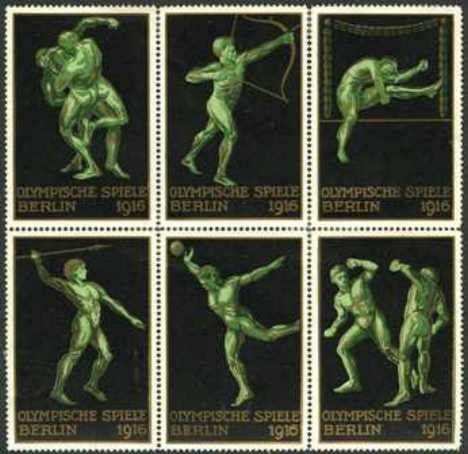
    (images via: British Library)

    Planning began on the 1916 Olympic Games almost immediately after Berlin was selected as the host city during the 14th IOC Session in Stockholm. Among other cities that applied to host the Games were Alexandria, Amsterdam, Brussels, Budapest and Cleveland.

    (images via: Olympic-Museum.de)

    The 64,000-seat Deutsches Stadion, or “German Stadium”, was built over the course of one year and was officially dedicated on June 8th of 1913 – it was closed in 1934 and the Berlin Olympiastadion was built on the site. Posters, travel brochures and postage stamps were designed with very little material seeing the light of day due to the Games being canceled two years before they were to begin.

    1940: Games of the XII Olympiad, Tokyo

    (images via: Bryan Pinkall’s World of Opera, Stamp Circuit and Newmexico51)

    It may seem odd that the Summer and Winter Olympic Games were awarded to both Germany and Japan amidst the obvious increase of militaristic policies espoused by these nations’ governments in the 1930s. Then again, the Olympic Movement has always striven to keep athletics and politics separate. The 1940 Summer Games were scheduled to be held in Tokyo from July 20th to August 4th of 1940, with the Olympic flame to be flown non-stop from Germany via a never-before-flown Messerschmitt Me 261 airplane.

    (images via: The Ephemera Network, Olympic-Museum.de and Carter’s)

    The government of Imperial Japan never really got behind the 1940 Tokyo Olympics as Japan’s leaders fundamentally disagreed with the Games’ peaceful precepts and concepts… not to mention they had other, more pressing concerns.

    (images via: Olympic-Museum.de)

    By 1938 the Second Sino-Japanese War was raging and both Japan and the IOC seemed eager to find some excuse to abandon the 1940 Games. Things came to a head in July of 1938 when the government of Japan officially withdrew their support.

    (image via: Wikipedia)

    Though the 1940 Tokyo Olympics were still two years away, much preparatory work had been done in anticipation of the first Olympic Games held in Asia. The images shown here include both official and unofficial efforts to paint a positive picture of the host country though the stylized, helmet-wearing soldier in one poster may have undermined efforts somewhat.

    1940: Games of the XII Olympiad, Helsinki

    (images via: Harvey Abrams Books, Rlanvin and RigaStamps)

    With little time to spare, the IOC scrambled to find a new host city and settled on Helsinki, Finland, which was the runner-up to Tokyo in the original bidding process. Helsinki was reasonably prepared to shoulder the burden of hosting a Summer Olympics having completed the Helsinki Olympic Stadium in 1938.

    (image via: International Poster Center)

    The 1940 Olympics were to see the debut of a new Olympic sport: gliding. War clouds were gathering over Helsinki as well, however, and the outbreak of World War II in September of 1939 prompted the IOC to cancel the 1940 Helsinki Olympics. Just as well… on November 30th, 1939, the USSR declared war on Finland and Soviet bombers appeared over Helsinki.

    (images via: Olympic-Museum.de)

    Finland would manage to hold off the Red Army in several wars outside World War II’s main theaters and Helsinki’s Olympic Stadium survived relatively unscathed. It was to be the centerpiece of the 1952 Summer Olympic Games which had the character of a postponement – even some of the promotional material from the lost 1940 Helsinki Olympics was revised and reused 12 years later.

    (images via: ABC RadioNational and Telegraph UK)

    Sharp-eyes are required to note one salient difference between the two Ilmari Sysimetsä-designed posters above: the outline of Finland in the 1952 poster is slightly smaller than on the original poster as the country lost territory to the USSR with the signing of the Moscow Peace Treaty in 1940.

    1940: V Olympic Winter Games

    (images via: German Postal History and Olympic Source)

    A similar situation occurred regarding the 1940 Winter Olympics originally scheduled to be held in Sapporo, on Japan’s northern island of Hokkaido. The IOC first offered the Games to St. Moritz, Switzerland, but conflicts with the Swiss town’s organizing committee over the eligibility of professional ski instructors saw the IOC offer the games to Garmisch-Partenkirchen, Germany, where they had been held in 1936.

    (image via: USHMM)

    A limited amount of promotional artwork was created in the very short time frame between June 1939 when the Games were awarded to Garmisch-Partenkirchen and November 1939 when Germany (and not the IOC) withdrew their official invitation.

    1944: Games of the XIII Olympiad, London

    (images via: Bryan Pinkall’s World of Opera and Olympic Games Marathon)

    “Lucky 13″ strikes again? Never have an Olympic Games been as DOA as the 1944 London Olympics and their cold-season counterpart, the VI Olympic Winter Games awarded to Cortina-D’Ampezzo, Italy. The official IOC election for the 1944 Summer Olympic Games’ host city took place in June of 1939, in London, England. The defeated applicants (in order of votes) were Rome, Detroit, Lausanne, Athens, Budapest, Helsinki and Montreal.

    (images via: Covers of the World and Stamp Circuit)

    The year 1944 happened to mark the 50th anniversary of the IOC’s founding, however, and Switzerland issued a series of stamps commemorating the event. The stamps are display the name of Lausanne, the Swiss town where the IOC’s headquarters is located. Other stamps marking the never-held 1944 Olympics were handmade by Polish prisoners at the Woldenberg POW camp after being granted permission by their German captors.

    (image via: MWB)

    Surprisingly enough, modern-day designers haven’t completely forgotten the so-called “forgotten Games of 1944″. Topman has released a new line of A.D shirts displaying graphics influenced by the stillborn 1944 London Olympics. The graphics offer an intriguing look at what might have been though it’s much more likely the ’44 Games would have been much like the post-war Summer Olympics hosted by London four years later.

    (images via: IWM and Uncle Eddie’s Theory Corner)

    Italian dictator Benito Mussolini had already placed his bets on Rome winning the 1944 Summer Games, and had commissioned several pieces of statuary (above) to be placed in the “The Mussolini Forum”. As for Cortina-D’Ampezzo, the IOC continued its practice of postponing instead of canceling: the Italian alpine town graciously and successfully hosted the VII Olympic Winter Games in 1956.

    (image via: Healey & Wise)

    Lost in any discussion of the Lost Olympic Games are the crushed hopes of the athletes, many of whom trained for years leading up to a promised moment of glory. Four years is a long time in the life of an athlete; eight years can be a lifetime. Five canceled Olympic Games (and several boycotts) are more than enough – and that goes for the catastrophic global events which led to their cancellation.


    Want More? Click for Great Related Content on WebUrbanist:

    8 Pivotal Olympic Villages And Venues Then And Now: From Moscow to London and Beyond

    A look back on critical Olympics venues and villages, historical Olympic architecture from around the world from games gone by in locations of historical significance. 9 Comments – Click Here to Read More »»


    Olympic Disguise: Titanium Fish Screen Installation for London

    An 820-foot-long titanium school of fish was installed in London for the summer to hide a 1970s shopping center from view of Olympic visitors. Click Here to Read More »»


    Share on Facebook


    [ By Steve in Art & Drawing & Digital. ]

    [ WebUrbanist | Archives | Galleries | Privacy | TOS ]


    WebUrbanist