Ein Beitrag von: Leslienie

dombowerphoto.blogspot.com In this video I answer another question about flash. this time Why do i use nikon speedlights and not studio lights for my shoots” well here is the answer If you enjoy my videos please post them on your Facebook page and let others know about this channel, please subscribe and share on Facebook and twitter. Also check out the links below. If you really like my work please feel free to check out or buy a copy of the my PHOTOGRAPHY BOOK: Getting There With Photography: By Dom Bower www.blurb.com FACEBOOK Critique/advice GROUP www.facebook.com FACEBOOK PAGE www.facebook.com TWITTER page twitter.com WEBSITE www.dombower.com PHOTOGRAPHY CLOTHING Point and destroy clothing http For my AZ of Weightloss Tips check out: dombowerexercise.blogspot.co.uk And to donate to The Cancer Charity that I am doing a Trek for please visit www.justgiving.com
Video Rating: 4 / 5
A Wildlife photographer learns something new every day – be it about the behaviour of the subjects one photographs or the technique one uses to capture that unique image.
Wildlife photography, for most part, involves investing a large amount of time and energy – both on and off the field – in studying about the subject you want to photograph, identifying the best habitats to photograph your subject in and then waiting and waiting and waiting…
But then again, once in a while, your subject may just present itself right in front of you when you least expect it. A case in point is this Sparrowhawk that I managed to photograph the other day. There was a thunderstorm brewing and I was standing in my living room looking up into the sky hoping to capture a lightning bolt. I had the Canon 70-200mm lens mounted on my Canon 50D and was expectantly waiting for a lightning bolt to strike when, out of the blue, I see a bird of prey land on a fence right in front of me. At first I was not sure of what species the bird was except that it was a bird of prey. It was only after I locked focus on it did I realise that it was a Sparrowhawk. A good friend of mine, and photography buddy, had told me that there was a Sparrowhawk in the area and I’d kept an eye out for it but never managed to spot it and here it was sitting right in front of me, when I least expected it. I fired off a few shots, one of which can be seen below:

© Kurien Koshy Yohannan
She looked like she was not going anywhere and so I took a calculated chance of changing my lens to the Sigma 50-500mm to try to capture a few close up images (as can be seen below). I could not have asked for a more willing subject.
The one thing I have learnt in my very short time as a Wildlife photographer, and from this particular incident, is the fact that one’s got to be ready to capture a shot at any time. When an opportunity presents itself, one’s got to try to grasp it tight with both hands.
Links:
Website: www.igallopfree.com
Facebook: http://facebook.com/BlackStallionPhotography
Yay Kirby. 😀 Liked it? Subscribe! Wanna request a game? Tell me at youtube.com See me and many other Nintendo 3DS fans at the 3DS Forums! 3dsforums.com
More 3D goo.gl This is a 3D video of when i went kayaking down a river.this is in 3d so use ONE of the following 3d glasses, 3d tv. evo 3d a 3d smart phone or 3d shutter glasses. 3D LINKS 3D SHOP: www.the3dshop.net FREE 3D Glasses www.3dn3d.com 3D Facebook: www.facebook.com View cool 3D Photos: www.3dn3d.com LIKE ME: www.facebook.com Follow ME: twitter.com BEST 3D EVER: www.youtube.com
Video Rating: 4 / 5
There are few things better in life than having something go wrong that leads to the discovery of something even better.
Such is the case with my plan to test out a Canon 8-15mm fisheye lens courtesy of BorrowLenses.com. My intent with the lens was to take it with me to the wilds of Arches and Canyonlands National Parks in Utah for some crazy, circular images. The problem is I lack a full frame Canon camera, but would be traveling with Michael Riffle, who owns a Canon 5D Mark III. He accepted the challenge to test the lens, being familiar with fisheyes himself.
One thing led to another and we never got around to testing the lens on his camera. Instead, I often found myself using the lens on my Canon 7D, a crop sensor camera. The Canon 8-15mm is intended to fit a full frame sensor and produce, at 8mm, a fully circular image, much like this example from a Sigma 4.5mm on a crop sensor camera.
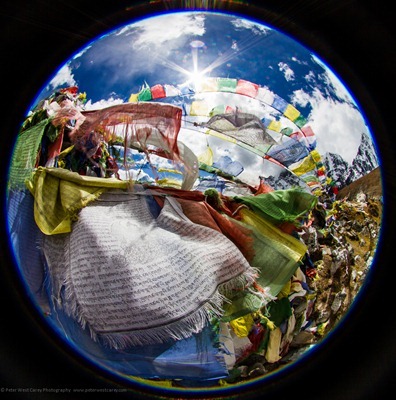
What happened instead was a cross between this full circle and a more traditional 15mm on a crop sensor. The 8-15mm lens will show edges of the circle when below 10mm but will otherwise fully cover the sensor from 10mm-15mm. A major difference from a non-fisheye lens, though, is the curving in the image.
For instance, here are two shots, both taken at 10mm. The difference: the first lens is a non-fisheye Canon EF 10-22mm lens and the second is the Canon 8-15mm fisheye.
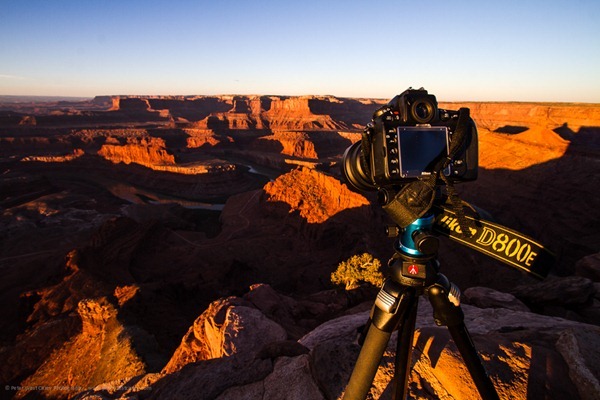
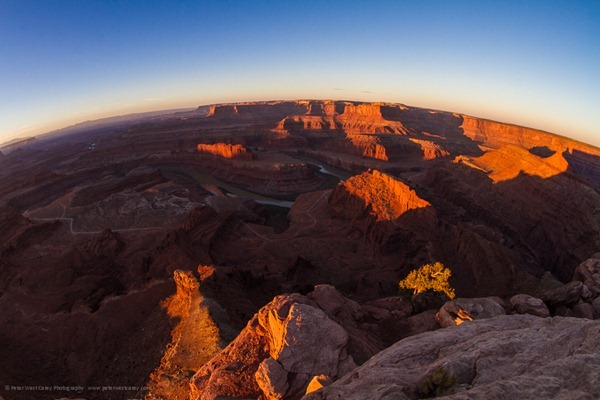
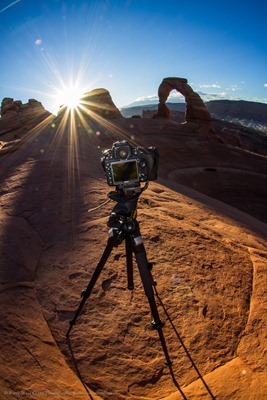
Both shots are taken from nearly the same perspective (the fisheye is taken from the position of the Nikon D800E in the first image) but the fisheye gives a different feel. I only made slight clarity and level adjustments in the photos and did not crop them, so this is what you can expect at 10mm.
Below 10mm the black edge of the area outside the fisheye is seen. How bad is it? It depends.
At first it annoyed me to have the incomplete image. Neither full fisheye nor filled frame. Like this:
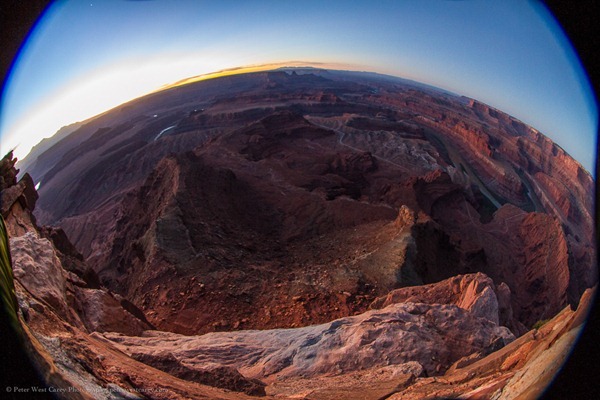
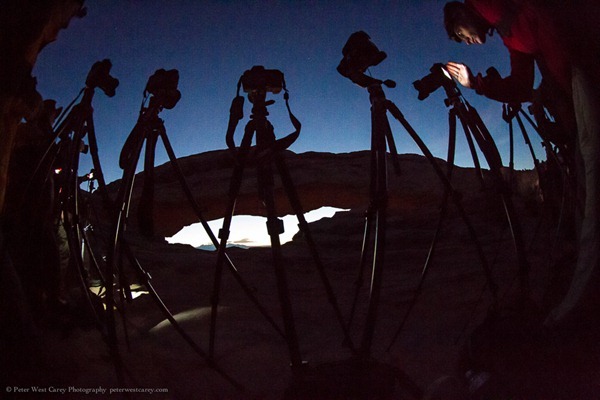
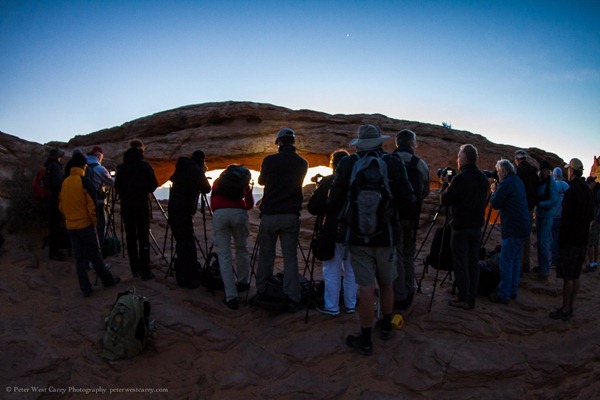
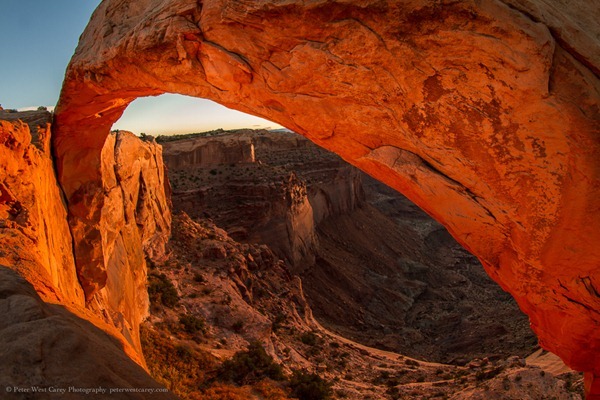
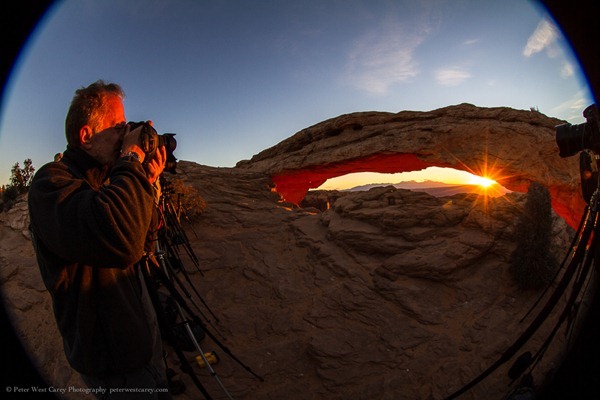
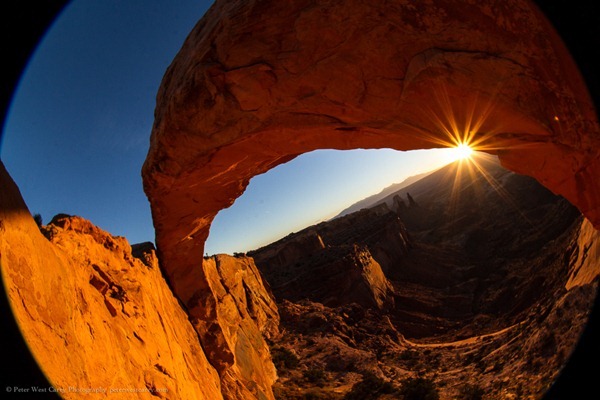
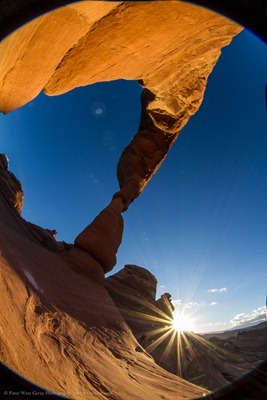
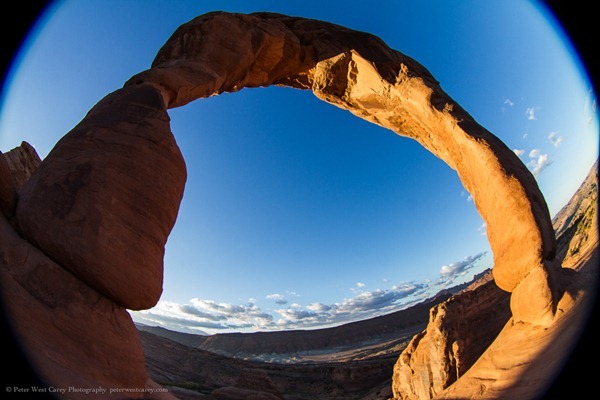
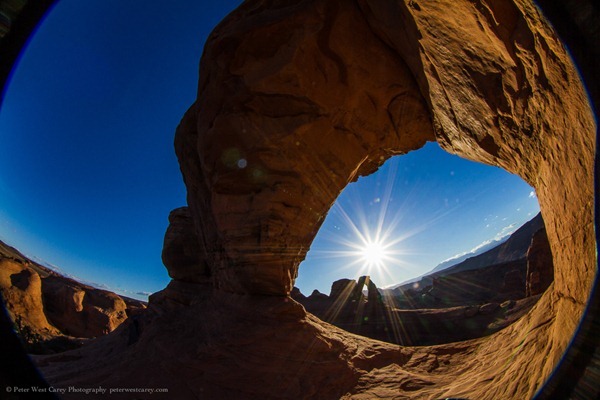
But then I started finding instances where it worked well. The arches found in these parks lent themselves naturally to the form factor. The more I experimented, the more I enjoyed the effect.
I realize not everyone will like this look. By the time you read this, there might be a dozen notes in the comment section below stating how horrible it is. But this is photography and it is art, so it doesn’t really matter what I like or the commenters like. It matters what you like.
Below are more examples from my short trip. If they intrigue you to give the lens a try, all the better. Some have the corners blacked out and some are zoomed in slightly. Experiment, play, have fun.
(Click on an image for a 1000px version)
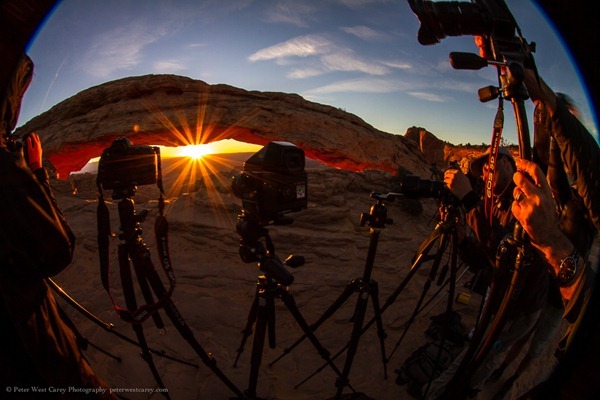
The first set of images are from Mesa Arch in Canyonlands NP at sunrise which was packed with 20 or more photographers. The second set is from Delicate Arch in Arches NP at sunrise with absolutely no one else around.
A special thank you to BorrowLenses.com for giving me the chance to play with the lens.
Post originally from: Digital Photography Tips.
Check out our more Photography Tips at Photography Tips for Beginners, Portrait Photography Tips and Wedding Photography Tips.
Why You Might Want To Consider A Full Frame Fisheye Lens Even If You Have A Crop Sensor Camera
The best photo collection of Marinshe (2007) + Feist song – Amourissima! For more visit marinshe.deviantart.com or http Enjoy!

Review of Nikon D3 Information about the camera, systems, performance and menues
Video Rating: 5 / 5
Chase Jarvis explores Laura’s humble journey as a runner. Shot on Nikon D3’s and RED ONE cameras, integrating slow motion with stop action video.
Video Rating: 4 / 5
sigma 50mm f1.4 review With pics www.youtube.com
Video Rating: 4 / 5
Die Fotos von Alexander Khokhlov wirken auf den ersten Blick zu schön, um wahr zu sein. Irgendwie leicht, bekannt, gewöhnlich. Und dann doch wieder nicht. Von dieser Spannung leben die Werke, die Khokhlov nicht „allein“ erstellt hat, wie sich im Folgenden herausstellen wird.
„Die Hauptidee und der Name – ‚Weird Beauty‘ – entstanden, als drei Arbeiten schon finalisiert waren“, so der Fotograf. „Ich und Valeriya Kutsan, die Make-up-Künstlerin, wollten eigentlich nur mal etwas andere monochrome Portraits für unseren neuen Kalender machen.“


Interessant ist es, an diesem Punkt der Ideenfindung festzustellen, dass das Projekt aus einem Versuch, einer Spielerei entstand. Häufig – oder gar sehr häufig – finden Künstler und Fotografen so zu neuen Ideen und Kreationen.
„Doch jedes neue Foto zeigte uns, dass da mehr dahinter war. Ich war beeindruckt von der Art und Weise, wie die einfachen Formen und echten menschlichen Gesichter miteinander kollaborierten. Es war zeitgleich einfach, stylisch, effektiv und … bizarr (weird)! So entschied ich mich, das Projekt Weird Beauty zu nennen.“

So wuchs die Idee zu einem groß angelegten Projekt. Make-up-Künstlerin Kutsan und Khokhlov wählten mehr als 30 Ideen, die sie umsetzten. Sie lehnten banale Formen wie das Yin-Yang-Symbol oder ein Schachbrettmuster ab und die möglichen Kombinationen aus schwarz und weiß waren irgendwie anders und ungewöhnlich.
Das Team benutzte einen Projektor, was Kutsan dabei half, die Konturen zu zeichnen, manche Formen jedoch sind gänzlich frei Hand gemalt.


Khokhlov setzte alle Fotos im Studio mit diversen Softboxen, Striplights und Reflektoren um. Er berichtet:
„Und wie man sieht, wurde der Kontrast durch die Zeichnungen und zusätzliche Bearbeitung erzeugt. Das war auch gar nicht anders möglich, da es sehr schwer ist, ideale Zeichnungsebenen und Abgrenzungen zu erzielen. Streckenweise war die Retouche sehr zeit- und energieaufwändig.“

Im Einsatz waren eine EOS 5D Mark II, das Canon EF 70-200mm f/4L und Profoto D1 500 Monolights.
