Tag: ultracompact

  • Ricoh spins off its 360-degree camera division, announces new ultra-compact selfie camera

    Ricoh has announced it’s spinning off its 360-degree camera division into a new startup called Vecnos and simultaneously releasing the first product from the Ricoh-backed venture.

    The Vecnos venture started back in 2018 when Ricoh decided, as part of its new business development initiatives, to create a team tasked with creating ‘specialized cameras for a new generation of consumers.’ This new team, led by Shu Ubukata (now Vecnos’ CEO), proved entrepreneurial enough to Ricoh that it decided to turn it into a separate startup, with Ricoh as the investor.

    There’s not much information about Vecnos, aside from a bare Twitter account, but to drum up some interest, Vecnos has announced its first product, a 360-degree ultra-compact camera that’s designed to ‘reinvent the selfie for social media natives.’

    Specifications are scarce for the prototype camera, but Vecnos does say it will feature a proprietary four-lens optical system with a single lens on the top and three lenses around the perimeter of the wand-like device. Vecnos says the camera will work with an upcoming mobile app that will allow users to ‘users can easily enhance and share their images and videos on social media platforms.’

    Based on the above promotional video, the camera appears to function almost identical to the Ricoh Theta cameras, with the ability to capture 360-degree photos and video and recompose the content as you see fit using the accompanying mobile app. The device itself features a power button, a shutter button, a dedicated button for switching between still and video mode and a what appears to be a pair of holes for an internal stereo microphone.

    No pricing information has been shared, but Vecnos says the camera will be available in 2020.

    Ricoh spins out Vecnos to focus on consumer 360-degree camera segment

    First product aims to reinvent the selfie for social media natives

    MARCH 10, 2020, YOKOHAMA, Japan – Vecnos Inc., the visual revolution company, today unveiled its vision to be a leader in the consumer 360-degree camera market and announced its first product, an ultra-compact camera that aims to reinvent the selfie for social media natives. Vecnos is a new startup venture spun out of and funded by Ricoh Company, Ltd.

    Vecnos was founded by the core team that designed and launched the pioneering Ricoh Theta 360 camera in 2013. At Vecnos, the team—led by CEO Shu Ubukata—will leverage its expertise in optical and artificial intelligence (AI) technologies to develop new approaches to 360-degree and other specialized cameras, software and apps with a goal of making advanced imaging accessible to and enjoyable for broad consumer audiences.

    “Enabled by advances in technology, combined with new social networking platforms, we are building a new generation of cameras, with our first product designed to reinvent the selfie and be used by a younger consumer,” explained Ubukata. “Our objectives are to combine ease of use with advanced capabilities for shooting, enhancing and sharing images, in beautiful and elegantly designed products that people will want to use. We aim to inspire a new generation.”

    Vecnos’ first product will be a 360-degree camera that achieves new levels of miniaturization in a sleek and sophisticated design. A proprietary four-lens optical system, with three lenses on the side, and one on the top, enables the camera to be ultra-slim and pen-shaped. Using the Vecnos app, users can easily enhance and share their images and videos on social media platforms. The 360-degree camera and app will be available in 2020.

    Emerging from Ricoh’s new business development initiatives, Vecnos was founded on the principles of open innovation and leveraging third-party knowledge, said Ricoh Company, Ltd. President and CEO Yoshinori “Jake” Yamashita. He explained: “Ricoh has always been committed to supporting innovation in visual communications. As part of our new business development initiatives, a team led by Shu Ubukata was formed in 2018 to create specialized cameras for a new generation of consumers. Ultimately, we all realized that it made sense for this highly entrepreneurial team to be spun out into its own venture. And with that, Vecnos was born. Ricoh is proud to be the lead investor in a young company with a Ricoh pedigree and a vision to build revolutionary products.”

    Articles: Digital Photography Review (dpreview.com)

  • PNY unveils two ultra-compact portable SSDs and MOBEE mobile gimbal

    Flash storage and accessories company PNY has introduced the MOBEE gimbal 3-axis stabilizer for smartphones, as well as its new Elite Portable SSD and PRO Elite SSD.

    Despite PNY’s claimes, they’re not the fastest portable SSDs on the market, but the new PNY models make up for their slightly slower speeds by offering very compact sizes. The Elite Portable SSD model measures 6 x 3.6 x 0.9cm (2.3 x 1.4 x 0.3in) and the PRO Elite is slightly larger at 13.3 x 10.2 x 5.7cm (5.2 x 4 x 2.2in).

    The PNY Elite model is offered in 240GB and 480GB capacities with up to 430MB/s read and 400MB/s write speeds. The PRO Elite model is offered in 250GB, 500GB, and 1TB capacities with up to 890MB/s write and 900MB/s read speeds. The Elite Portable SSD 450GB costs $ 125 USD; the PRO Elite model ranges from $ 70 USD to $ 162 USD.

    The new PNY MOBEE gimbal, meanwhile, is compact at 10.8 x 28.9 x 7cm (4.2 x 11.3 x 2.7in) with a weight of 1.4kg (3lbs). The 3-axis stabilizer features a rechargeable Li-ion battery offering up to 12 hours of operation per charge, as well as a USB port for charging a smartphone while shooting.

    A companion mobile app offers access to different shooting modes, including object and face tracking, slow motion and time-lapse. The gimbal is only listed on Amazon.uk at this time with a price of £87.13 ($ 107.14 USD).

    Articles: Digital Photography Review (dpreview.com)

  • Ultra-compact Canon EOS Rebel SL3 offers eye-detect AF and cropped 4K capture

    $ (document).ready(function() { SampleGalleryV2({“containerId”:”embeddedSampleGallery_4686843819″,”galleryId”:”4686843819″,”isEmbeddedWidget”:true,”selectedImageIndex”:0,”isMobile”:false}) });

    Canon has introduced the EOS Rebel SL3, its smallest and lightest DSLR ever. It uses the same 24MP APS-C CMOS sensor as its SL2 predecessor but adds a DIGIC 8 processor, eye-detection when using Dual Pixel AF, improved battery life and 4K video capture with a substantial crop.

    The SL3 manages to shave a little of the SL2’s size and weight, making it a very trim 15.84oz / 450g. The camera’s most notable upgrade is its new DIGIC 8 processor, and it maintains the SL2’s fully articulated 3″ 1.04M-dot touchscreen, 5 fps burst shooting rate and Wi-Fi capability. The SL3 does boast significantly better battery life than its predecessor; a very healthy 1,070 shots per charge compared to the SL2’s 650-shot rating.

    The SL3 seemingly improves on the SL2’s 1080p video spec with 4K/24p recording, but this is unfortunately accompanied by a heavy crop like the one we saw on its M50 mirrorless sibling. Dual Pixel autofocus is also unavailable when shooting 4K video.

    The Canon EOS Rebel SL3 will be available at the end of this month in either black or white color options for $ 600 body-only or $ 750 with 18-55mm F4-5.6 IS STM lens included.

    LIGHT IN WEIGHT, HEAVY IN FEATURES: INTRODUCING THE EOS REBEL SL3 COMPACT DIGITAL SLR CAMERA

    Empowering Users with an Easy Way to Express Themselves, the New Camera Delivers Stunning Photos and 4K Videos in a Lightweight Body

    MELVILLE, N.Y., April 10, 2019 – Combining ease-of-use with high-image quality, Canon U.S.A., Inc., a leader in digital imaging solutions, today unveiled the EOS Rebel SL3 DSLR camera, the smallest and lightest product within the current EOS lineup. Weighing just 15.84 oz1, the EOS Rebel SL3 offers users a compact system delivering high-resolution images – complete with an APS-C imaging sensor, DIGIC 8 Image Processor and 3.0-inch vari-angle LCD touchscreen as well as 4K video, a first for the EOS Rebel lineup. Compatible with Canon’s full line of interchangeable EF and EF-S lenses, along with the ability to instantly send images to compatible smartphones through Auto Image Transfer via Wi-Fi® connectivity2, the EOS Rebel SL3 is the tool needed to empower aspiring photographers to capture gorgeous shots quickly and easily.

    “Since its inception, the EOS Rebel product line has aimed to provide imaging excellence for entry-level visual storytellers,” said Kazuto Ogawa, president and chief operating officer, Canon U.S.A., Inc. “Therefore, it was imperative that the next step in the EOS Rebel journey include innovative features such as 4K video and DIGIC 8 Image Processor to meet the needs of emerging photographers, while living up to the high-image quality and compact size EOS Rebel DSLRs are known for.”

    The EOS Rebel SL3 carries a powerful 24.1 Megapixel CMOS (APS-C) sensor, enabling users to snap photos and express themselves across a multitude of settings – whether it be a beautiful night scene, stunning family-vacation destination or a picturesque landscape. The camera is equipped with Canon’s DIGIC 8 processor – first introduced in the EOS M50 and later built into the revolutionary EOS R full-frame mirrorless system. DIGIC 8 helps improve autofocus performance and allows for the processing of 4K video and 4K time-lapse movies – helping budding videographers record scenes such as the colorful evening skyline in brilliant detail.

    The EOS Rebel SL3 features autofocus (AF) capabilities, delivering nine AF points across the optical viewfinder. This includes a new Spot AF which allows users to focus on a precise area within the subject. The EOS Rebel SL3 is the first DSLR in the Canon EOS line to feature Dual Pixel CMOS AF3 with Eye Detection AF in Live View shooting mode. With its optical viewfinder and Live View LCD monitor, photographers can enjoy two different ways of shooting and customize their experience based on the scene. The system is also the first Canon EOS SLR to incorporate a Smooth Skin setting, which can help render skin tones as well as Creative Assist – an interface by which users can check and seamlessly change shooting conditions in Live View4– such as white balance or brightness – in real time.

    Additional key features of the EOS Rebel SL3 camera include:

    • Feature Assistant that guides and offers tips for more effective shooting
    • Continuous shooting mode up to 5.0 fps
    • Digital Lens Optimizer that corrects optical shifting automatically, even without a computer5

    The EOS Rebel SL3 will be available toward the end of April for purchase in black and white color options for an estimated retail price of $ 599.99, for the body only and $ 749.99 for the body with a EF-S 18-55 f/4-5.6 IS STM lens*. For more information, please visit usa.canon.com.

    1 Includes battery and SD memory card (confirms with CIPA standards).1 Includes battery and SD memory card (confirms with CIPA standards).

    2 Compatible with select smartphone and tablet devices (Android™ version 5.0 or later and the following iOS® devices: iPhone 4s or later, iPad 3rd gen. or later, iPod Touch 5th gen. or later) equipped with Bluetooth® version 4.0 or later and the Camera Connect app.

    3 Based on results of AF speed tests in accordance with CIPA guidelines. Results may vary depending on shooting conditions and lens in use. Relies on internal measurement method. • Shutter speed: 1/500 or more• Lens used: EF 50 mm f/1.8 STM• Aperture: within three steps of maximum aperture• Using a fully charged battery pack LP-E17, at 23?C

    4 Available AF points may decrease when shooting with AF cropping or in movie mode, or depending on camera settings or lens attached.

    5 Up to three lenses can be registered at once within the camera.

    *Availability, prices and specifications are subject to change without notice. Actual prices are set by individual dealers and may vary.

    Canon EOS Rebel SL3 specifications

    Price
    MSRP $ 599 (body only), $ 749 (w/18-55mm F4-5.6 lens)
    Body type
    Body type Compact SLR
    Body material Composite
    Sensor
    Max resolution 6000 x 4000
    Image ratio w:h 1:1, 4:3, 3:2, 16:9
    Effective pixels 24 megapixels
    Sensor photo detectors 26 megapixels
    Sensor size APS-C (22.3 x 14.9 mm)
    Sensor type CMOS
    Processor DIGIC 8
    Color space sRGB, Adobe RGB
    Color filter array Primary color filter
    Image
    ISO Auto, 100-25600 (expands to 51200)
    Boosted ISO (maximum) 51200
    White balance presets 6
    Custom white balance Yes
    Image stabilization No
    Uncompressed format RAW
    JPEG quality levels Fine, normal
    File format
    • JPEG (Exif v2.3)
    • Raw (14-bit Canon CR2)
    • C-RAW (compressed)
    Optics & Focus
    Autofocus
    • Contrast Detect (sensor)
    • Phase Detect
    • Multi-area
    • Center
    • Selective single-point
    • Tracking
    • Single
    • Continuous
    • Touch
    • Face Detection
    • Live View
    Autofocus assist lamp Yes
    Manual focus Yes
    Number of focus points 3975
    Lens mount Canon EF/EF-S
    Focal length multiplier 1.6×
    Screen / viewfinder
    Articulated LCD Fully articulated
    Screen size 3
    Screen dots 1,040,000
    Touch screen Yes
    Screen type TFT LCD
    Live view Yes
    Viewfinder type Optical (pentamirror)
    Viewfinder coverage 95%
    Viewfinder magnification 0.87× (0.54× 35mm equiv.)
    Photography features
    Minimum shutter speed 30 sec
    Maximum shutter speed 1/4000 sec
    Exposure modes
    • Program
    • Shutter priority
    • Aperture priority
    • Manual
    Scene modes
    • Portrait
    • Smooth skin
    • Group photo
    • Landscape
    • Sports
    • Kids
    • Close-up
    • Food
    • Candlelight
    • Night portrait
    • Handheld night scene
    • HDR backlight control
    Built-in flash Yes
    External flash Yes (via hot shoe)
    Flash X sync speed 1/200 sec
    Drive modes
    • Single
    • High-speed continuous
    • Silent single
    • Silent continuous
    • Self-timer
    • Continuous shooting after self-timer
    Continuous drive 5.0 fps
    Self-timer Yes (2 or 10 secs)
    Metering modes
    • Multi
    • Center-weighted
    • Spot
    • Partial
    Exposure compensation ±5 (at 1/3 EV, 1/2 EV steps)
    AE Bracketing ±3 (3 frames at 1/3 EV, 1/2 EV steps)
    Videography features
    Format MPEG-4, H.264
    Modes
    • 3840 x 2160 @ 25p / 120 Mbps, MP4, H.264, AAC
    • 3840 x 2160 @ 23.98p / 120 Mbps, MP4, H.264, AAC
    • 1920 x 1080 @ 60p / 60 Mbps, MP4, H.264, AAC
    • 1920 x 1080 @ 50p / 60 Mbps, MP4, H.264, AAC
    • 1920 x 1080 @ 30p / 30 Mbps, MP4, H.264, AAC
    • 1920 x 1080 @ 25p / 30 Mbps, MP4, H.264, AAC
    Microphone Stereo
    Speaker Mono
    Storage
    Storage types SD/SDHC/SDXC (UHS-I compatible)
    Connectivity
    USB USB 2.0 (480 Mbit/sec)
    HDMI Yes (Mini-HDMI)
    Microphone port Yes
    Headphone port No
    Wireless Built-In
    Wireless notes 802.11b/g/n + Bluetooth
    Remote control Yes (via wired or wireless remote or smartphone)
    Physical
    Environmentally sealed No
    Battery Battery Pack
    Battery description LP-E17 lithium-ion battery & charger
    Battery Life (CIPA) 1070
    Weight (inc. batteries) 449 g (0.99 lb / 15.84 oz)
    Dimensions 122 x 93 x 70 mm (4.8 x 3.66 x 2.76)
    Other features
    Orientation sensor Yes
    Timelapse recording Yes (videos only)
    GPS None

    Articles: Digital Photography Review (dpreview.com)

  • Ultra-compact Canon EOS Rebel SL3 offers eye-detect AF and disappointing 4K capture

    $ (document).ready(function() { SampleGalleryV2({“containerId”:”embeddedSampleGallery_4686843819″,”galleryId”:”4686843819″,”isEmbeddedWidget”:true,”selectedImageIndex”:0,”isMobile”:false}) });

    Canon has introduced the EOS Rebel SL3, its smallest and lightest DSLR ever. It uses the same 24MP APS-C CMOS sensor as its SL2 predecessor but adds a DIGIC 8 processor, eye-detection when using Dual Pixel AF, improved battery life and 4K video capture with a disappointingly huge crop.

    The SL3 manages to shave a little of the SL2’s size and weight, making it a very trim 15.84oz / 450g. The camera’s most notable upgrade is its new DIGIC 8 processor, and it maintains the SL2’s fully articulated 3″ 1.04M-dot touchscreen, 5 fps burst shooting rate and Wi-Fi capability. The SL3 does boast significantly better battery life than its predecessor; a very healthy 1,070 shots per charge compared to the SL2’s 650-shot rating.

    The SL3 seemingly improves on the SL2’s 1080p video spec with 4K/24p recording, but this is unfortunately accompanied by a heavy crop like the one we saw on its M50 mirrorless sibling. Dual Pixel autofocus is also unavailable when shooting 4K video.

    The Canon EOS Rebel SL3 will be available at the end of this month in either black or white color options for $ 600 body-only or $ 750 with 18-55mm F4-5.6 IS STM lens included.

    LIGHT IN WEIGHT, HEAVY IN FEATURES: INTRODUCING THE EOS REBEL SL3 COMPACT DIGITAL SLR CAMERA

    Empowering Users with an Easy Way to Express Themselves, the New Camera Delivers Stunning Photos and 4K Videos in a Lightweight Body

    MELVILLE, N.Y., April 10, 2019 – Combining ease-of-use with high-image quality, Canon U.S.A., Inc., a leader in digital imaging solutions, today unveiled the EOS Rebel SL3 DSLR camera, the smallest and lightest product within the current EOS lineup. Weighing just 15.84 oz1, the EOS Rebel SL3 offers users a compact system delivering high-resolution images – complete with an APS-C imaging sensor, DIGIC 8 Image Processor and 3.0-inch vari-angle LCD touchscreen as well as 4K video, a first for the EOS Rebel lineup. Compatible with Canon’s full line of interchangeable EF and EF-S lenses, along with the ability to instantly send images to compatible smartphones through Auto Image Transfer via Wi-Fi® connectivity2, the EOS Rebel SL3 is the tool needed to empower aspiring photographers to capture gorgeous shots quickly and easily.

    “Since its inception, the EOS Rebel product line has aimed to provide imaging excellence for entry-level visual storytellers,” said Kazuto Ogawa, president and chief operating officer, Canon U.S.A., Inc. “Therefore, it was imperative that the next step in the EOS Rebel journey include innovative features such as 4K video and DIGIC 8 Image Processor to meet the needs of emerging photographers, while living up to the high-image quality and compact size EOS Rebel DSLRs are known for.”

    The EOS Rebel SL3 carries a powerful 24.1 Megapixel CMOS (APS-C) sensor, enabling users to snap photos and express themselves across a multitude of settings – whether it be a beautiful night scene, stunning family-vacation destination or a picturesque landscape. The camera is equipped with Canon’s DIGIC 8 processor – first introduced in the EOS M50 and later built into the revolutionary EOS R full-frame mirrorless system. DIGIC 8 helps improve autofocus performance and allows for the processing of 4K video and 4K time-lapse movies – helping budding videographers record scenes such as the colorful evening skyline in brilliant detail.

    The EOS Rebel SL3 features autofocus (AF) capabilities, delivering nine AF points across the optical viewfinder. This includes a new Spot AF which allows users to focus on a precise area within the subject. The EOS Rebel SL3 is the first DSLR in the Canon EOS line to feature Dual Pixel CMOS AF3 with Eye Detection AF in Live View shooting mode. With its optical viewfinder and Live View LCD monitor, photographers can enjoy two different ways of shooting and customize their experience based on the scene. The system is also the first Canon EOS SLR to incorporate a Smooth Skin setting, which can help render skin tones as well as Creative Assist – an interface by which users can check and seamlessly change shooting conditions in Live View4– such as white balance or brightness – in real time.

    Additional key features of the EOS Rebel SL3 camera include:

    • Feature Assistant that guides and offers tips for more effective shooting
    • Continuous shooting mode up to 5.0 fps
    • Digital Lens Optimizer that corrects optical shifting automatically, even without a computer5

    The EOS Rebel SL3 will be available toward the end of April for purchase in black and white color options for an estimated retail price of $ 599.99, for the body only and $ 749.99 for the body with a EF-S 18-55 f/4-5.6 IS STM lens*. For more information, please visit usa.canon.com.

    1 Includes battery and SD memory card (confirms with CIPA standards).1 Includes battery and SD memory card (confirms with CIPA standards).

    2 Compatible with select smartphone and tablet devices (Android™ version 5.0 or later and the following iOS® devices: iPhone 4s or later, iPad 3rd gen. or later, iPod Touch 5th gen. or later) equipped with Bluetooth® version 4.0 or later and the Camera Connect app.

    3 Based on results of AF speed tests in accordance with CIPA guidelines. Results may vary depending on shooting conditions and lens in use. Relies on internal measurement method. • Shutter speed: 1/500 or more• Lens used: EF 50 mm f/1.8 STM• Aperture: within three steps of maximum aperture• Using a fully charged battery pack LP-E17, at 23?C

    4 Available AF points may decrease when shooting with AF cropping or in movie mode, or depending on camera settings or lens attached.

    5 Up to three lenses can be registered at once within the camera.

    *Availability, prices and specifications are subject to change without notice. Actual prices are set by individual dealers and may vary.

    Canon EOS Rebel SL3 specifications

    Price
    MSRP $ 599 (body only), $ 749 (w/18-55mm F4-5.6 lens)
    Body type
    Body type Compact SLR
    Body material Composite
    Sensor
    Max resolution 6000 x 4000
    Image ratio w:h 1:1, 4:3, 3:2, 16:9
    Effective pixels 24 megapixels
    Sensor photo detectors 26 megapixels
    Sensor size APS-C (22.3 x 14.9 mm)
    Sensor type CMOS
    Processor DIGIC 8
    Color space sRGB, Adobe RGB
    Color filter array Primary color filter
    Image
    ISO Auto, 100-25600 (expands to 51200)
    Boosted ISO (maximum) 51200
    White balance presets 6
    Custom white balance Yes
    Image stabilization No
    Uncompressed format RAW
    JPEG quality levels Fine, normal
    File format
    • JPEG (Exif v2.3)
    • Raw (14-bit Canon CR2)
    • C-RAW (compressed)
    Optics & Focus
    Autofocus
    • Contrast Detect (sensor)
    • Phase Detect
    • Multi-area
    • Center
    • Selective single-point
    • Tracking
    • Single
    • Continuous
    • Touch
    • Face Detection
    • Live View
    Autofocus assist lamp Yes
    Manual focus Yes
    Number of focus points 3975
    Lens mount Canon EF/EF-S
    Focal length multiplier 1.6×
    Screen / viewfinder
    Articulated LCD Fully articulated
    Screen size 3
    Screen dots 1,040,000
    Touch screen Yes
    Screen type TFT LCD
    Live view Yes
    Viewfinder type Optical (pentamirror)
    Viewfinder coverage 95%
    Viewfinder magnification 0.87× (0.54× 35mm equiv.)
    Photography features
    Minimum shutter speed 30 sec
    Maximum shutter speed 1/4000 sec
    Exposure modes
    • Program
    • Shutter priority
    • Aperture priority
    • Manual
    Scene modes
    • Portrait
    • Smooth skin
    • Group photo
    • Landscape
    • Sports
    • Kids
    • Close-up
    • Food
    • Candlelight
    • Night portrait
    • Handheld night scene
    • HDR backlight control
    Built-in flash Yes
    External flash Yes (via hot shoe)
    Flash X sync speed 1/200 sec
    Drive modes
    • Single
    • High-speed continuous
    • Silent single
    • Silent continuous
    • Self-timer
    • Continuous shooting after self-timer
    Continuous drive 5.0 fps
    Self-timer Yes (2 or 10 secs)
    Metering modes
    • Multi
    • Center-weighted
    • Spot
    • Partial
    Exposure compensation ±5 (at 1/3 EV, 1/2 EV steps)
    AE Bracketing ±3 (3 frames at 1/3 EV, 1/2 EV steps)
    Videography features
    Format MPEG-4, H.264
    Modes
    • 3840 x 2160 @ 25p / 120 Mbps, MP4, H.264, AAC
    • 3840 x 2160 @ 23.98p / 120 Mbps, MP4, H.264, AAC
    • 1920 x 1080 @ 60p / 60 Mbps, MP4, H.264, AAC
    • 1920 x 1080 @ 50p / 60 Mbps, MP4, H.264, AAC
    • 1920 x 1080 @ 30p / 30 Mbps, MP4, H.264, AAC
    • 1920 x 1080 @ 25p / 30 Mbps, MP4, H.264, AAC
    Microphone Stereo
    Speaker Mono
    Storage
    Storage types SD/SDHC/SDXC (UHS-I compatible)
    Connectivity
    USB USB 2.0 (480 Mbit/sec)
    HDMI Yes (Mini-HDMI)
    Microphone port Yes
    Headphone port No
    Wireless Built-In
    Wireless notes 802.11b/g/n + Bluetooth
    Remote control Yes (via wired or wireless remote or smartphone)
    Physical
    Environmentally sealed No
    Battery Battery Pack
    Battery description LP-E17 lithium-ion battery & charger
    Battery Life (CIPA) 1070
    Weight (inc. batteries) 449 g (0.99 lb / 15.84 oz)
    Dimensions 122 x 93 x 70 mm (4.8 x 3.66 x 2.76)
    Other features
    Orientation sensor Yes
    Timelapse recording Yes (videos only)
    GPS None

    Articles: Digital Photography Review (dpreview.com)

  • Lexar launches trio of ultra-compact SSD drives

    Lexar has announced the SL100 Pro Portable SSD lineup, a trio of compact solid state drives that offer USB 3.1 speeds in a tiny, durable form factor.

    The SSD, which weighs just 70.5g / 0.155lbs and measures in at a 73.4mm x 55mm / 2.89in x 2.17in, features a USB-C connection that offers read speeds up to 950MBps and write speeds up to 900MBps. Although the SSD isn’t ruggedized, it is protected against rough vibrations and has temperatures, with an operating temperature range of 0°C to 70°C and a storage temperature range of -40°C to 85°C.

    Lexar includes its DataVault Lite software to keep files onboard the SSD safe throws in a three-year limited warranty for good measure.

    The Lexar SL100 Pro Portable SSD comes in 250GB, 500GB and 1TB capacities and is available for purchase at B&H for $ 87.99, $ 134.99 and $ 239.99, respectively.

    Articles: Digital Photography Review (dpreview.com)

  • Canon developing six new RF lenses, including ultra-compact 70-200 F2.8

    $ (document).ready(function() { SampleGalleryV2({“containerId”:”embeddedSampleGallery_4014773327″,”galleryId”:”4014773327″,”isEmbeddedWidget”:true,”selectedImageIndex”:0,”isMobile”:false}) });

    Canon has announced the development of six RF lenses which are expected to be released at various points in 2019.

    The most captivating has to be the RF 70-200 F2.8L IS USM. The lens is almost impossibly small, yet manages to be as fast as Canon’s EF model. The 70-200 will be stabilized, though we won’t find out how many stops of shake reduction it provides for some time, as Canon has not yet published specs for any of the upcoming lenses.

    Canon will be offering two versions of its RF 85mm F1.2L USM: a ‘regular’ model and a ‘DS’ variant. DS stands for Defocus Smoothing, which Canon says ‘offers a combination of beautifully smooth defocused bokeh.’ While we don’t know exactly what that means yet, it seems likely that the DS model includes an Apodization element, of the kind we’ve seen before in ‘APD’ and ‘STF’ lenses from other manufacturers.

    The dual model approach echoes Fujifilm’s decision to market two versions of its XF 56mm F1.2 – a standard model and an ‘APD’ variant optimized for bokeh.

    Meanwhile, there are two fast zooms on the way: the RF 15-35mm F2.8L IS USM and the RF 24-70 F2.8L IS USM.

    Lastly, there’s a versatile (but slower) travel zoom lens in the works too – the RF 24-240mm F4-6.3 IS USM.

    Press Release:

    CANON ENSURES THE SUCCESSFUL FUTURE OF ITS RF MOUNT WITH THE DEVELOPMENT OF SIX NEW LENSES

    New Lenses Under Development Cover a Range of Core Focal Lengths

    MELVILLE, N.Y., February 13, 2019 – Continuing with the message of “optics at its core,” Canon U.S.A. Inc., a leader in digital imaging solutions, today announced that its parent company, Canon Inc, is developing six new RF-series lenses, further displaying the company’s commitment to the EOS R full-frame mirrorless camera system. Canon’s new RF mount allows for fast, light, and high-performing optics with a large opening diameter and short back focus distance. Each new lens in development will help fulfill the needs of amateur and advanced amateurs to professional photographers and videographers, covering critical focal lengths. In 2019, Canon’s already well-established optical lens heritage will celebrate a production milestone of 140 million EF and RF lenses and the celebration starts with the development announcement of these six lenses[i].

    The six new RF lenses under development include:

    • RF 85mm F1.2 L USM
    • RF 85mm F1.2 L USM DS
    • RF 24-70mm F2.8 L IS USM
    • RF 15-35mm F2.8 L IS USM
    • RF 70-200mm F2.8 L IS USM
    • RF 24-240mm F4-6.3 IS USM

    “Optics are the critical piece of the visual puzzle that bend light and capture an image as the artist envisioned,” said Kazuto Ogawa, president and chief operating officer, Canon U.S.A., Inc. “That is why it is so important for us to strengthen our family of RF lenses for the EOS R camera system. With this collection of new lenses, customers will have more of the tools they need, for the images they desire to create.”

    All six RF lenses under development are built around Canon’s new RF mount, which features a large 54mm diameter and shorter back focus distance than on current EOS DSLR cameras. In addition, the RF mount enhances communication and power transmission between the lens and camera body, which has helped Canon to achieve the world’s fastest autofocus speed for a full-frame mirrorless camera system[ii].

    The details of the new Canon RF lenses under development are as follows:

    The RF 85mm F1.2 L USM is a large aperture mid-telephoto prime lens. It offers excellent performance for advanced and professional portrait photographers and is a widely popular focal length and aperture speed combination for users.

    The RF 85mm F1.2 L USM DS, with Defocus Smoothing lens technology, is a uniquely designed lens that offers a combination of beautifully smooth defocused bokeh. Featuring a super-fast F1.2 aperture, the lens will help produce breathtaking portraits that will surely stand out from the crowd.

    The RF 24-70mm F2.8 L IS USM is a high-performance, standard zoom lens for professionals and photo enthusiasts alike – ideal for shooting portraits, landscapes, documentaries or weddings.

    The RF 15-35mm F2.8 L IS USM, offering a wide angle and fast aperture in a single package, is ideal for a variety of shooting applications including architecture, interiors or landscapes.

    The RF 70-200mm F2.8 L IS USM is a must-have for any professional photographer, especially for those shooting weddings, sports or wildlife. This lens is a great all-around, high-speed, medium telephoto zoom lens and does well to round out any camera bag.

    The RF 24-240mm F4-6.3 IS USM is the ideal lens for amateurs and advanced amateurs who love to travel, no matter the destination. The versatile, all-purpose lens offers a range of focal lengths for capturing extraordinary shots in a form factor that is both compact and lightweight.

    Availability

    All six of the new Canon RF lenses under development are expected to be available later in 2019*. To learn more about the lenses under development and to follow along for the official announcement, please visit usa.canon.com

    [i] 140 million milestone figure is the accumulated production as at 19th December 2018. Figure includes RF lenses and Cinema lenses

    [ii] As of 13 February 2019, among interchangeable lens digital mirrorless cameras incorporating a 35mm full frame equivalent image sensor with contrast detection AF and phase detection AF on the image plane. Calculated from the results of measured AF speed, based on CIPA guidelines (differs depending on shooting conditions and lens used). Measured using internal methods. Measurement conditions: EV12 (ambient temperature/ISO 100), Manual Mode, using the RF 24-105mm F4 L IS USM (at a focal length of 24mm) with the following settings: shutter released using the shutter button, 1-point AF (Center AF), One-Shot AF)

    *Specifications, availability and prices are subject to change without notice. Actual prices are set by individual dealers and may vary.

    Articles: Digital Photography Review (dpreview.com)

  • LumaPod is an ultra-compact tripod that uses tension to keep your shots steady

    Tripods are one of the few pieces of camera equipment that haven’t seen a lot of innovation over the years. LumaPod is hoping to change that though, with its all new tripod that’s currently available to back on Kickstarter.

    Deemed the ‘world’s fastest tripod,’ the LumaPod is a compact tripod that uses patented tension technology to stabilize your shots without weighing a ton. It comes in two models — the Go85 and Go120 — for varying camera sizes and can also be used as a monopod and selfie stick.

    Unlike traditional tripods, which rely on three legs attached to a centralized column and mounting point, the LumaPod is essentially two tripods in one that folds down into a single tube that looks something like the handle of a lightsaber. The base of the LumaPod is similar to a standard tripod in that it uses three rigid aluminum legs to keep the thing upright and steady. These low-profile legs serve as the attachment point for a telescoping column and three kevlar cables that hold the central column in place using tension.

    The Go85 LumaPod weighs just 400g/0.88lbs, measures in at 85cm/33.5in and can hold 1kg/2.2lbs of camera equipment. The larger Go120 weighs 690g/1.65lbs, measures in at 120cm/47.3in when closed, and can hold 2kg/4.4lbs of camera equipment.

    The Go85 includes a collection of accessories designed to make the most of shooting with smartphones and GoPro cameras, while the Go120 includes a compact Z-plate for more versatile mounting of mirrorless and DSLR cameras. Other accessories are available as add-ons through the Kickstarter. These include a Bluetooth remote, quick release plate, travel sling, compact ball head, and more.

    The lower legs of both LumaPods are modular and adaptable to fit your shooting needs. They can be hot swapped with rubber feet, terrain levelers, dolly wheels, and other accessories by simply swapping them out. LumaPod claims it takes just four seconds to set up the tripod.

    It remains to be seen just how stable this setup is, but it’s an interesting design that may very well work for smaller camera setups.

    The Go85 starts for a pledge of €69 (approximately $ 80), while the Go120 starts at €85 (approximately $ 99). Both models are expected to ship in May 2019. To find out more and secure your pledge, head on over to the Kickstarter campaign.

    Articles: Digital Photography Review (dpreview.com)

  • Get to know the Compass Camera, an ultra-compact pocketable film camera from 1937

    The quest to make a ridiculously small, yet still fully-featured camera is not a new one. For historical examples, look no further than the Compass Camera. Made by Swiss watchmaker LeCoultre, it was designed by Englishman Noel Pemberton Billing and sold by Compass Cameras of London starting in 1937. It features a collapsible design and accepts 24x36mm plate film (a roll film back was later introduced).

    Take a look at the video above for a full tour of the camera. Only around 5000 were produced, and they’re now highly sought after by collectors. In fact, you can pick one up now on ebay if you have $ 7450 to spare.

    Articles: Digital Photography Review (dpreview.com)

  • Ultra-compact: Sony Cyber-shot RX1R II review

    Sony CyberShot RX1R II Review

    The Sony Cyber-shot RX1R II is a full-frame, 42MP compact camera with a fixed 35mm F2 lens. The successor to the 24MP RX1R, the Mark II inherits a lot of technology from Sony’s flagship a7R II mirrorless interchangeable lens camera. 

    Between the continuing evolution of the RX100 and a7-series’, Sony is on a big roll when it comes to small tech. And in this case, ‘small’ doesn’t mean ‘insignificant’. With many of its recent cameras, Sony has achieved the miniaturization of technology and functionality traditionally reserved for bulkier DSLRs and the like.

    With the Cyber-shot RX1R II for example. Sony has somehow managed to cram a high-res electronic viewfinder, a Zeiss Sonnar T* 35mm F2 lens and the same full-frame 42MP BSI CMOS sensor and autofocus system from the a7R II into a coat-pocketable body. For many photographers that probably sounds like a dream come true, but as you might expect, there have been a few compromises along the way.

    Key features

    • 42MP BSI CMOS full-frame sensor
    • BIONZ X processor
    • Fixed ZEISS Sonnar T* 35mm F2 lens
    • Hybrid autofocus system
    • Variable low-pass filter
    • Tilting 3″, 1.23 million dot LCD
    • Pop-up 2.36M-dot OLED electronic viewfinder
    • 1080/60p video recording
    • Wi-Fi with NFC

    Though the RX1R II bears more than a passing resemblance to its predecessor, there are a lot of changes. And since the introduction of the RX1 and RX1R back in 2012, Leica introduced the Q, a full frame compact with a fixed 28mm F1.7 lens. Though it sits above the RX1R II in price and offers a wider lens, a lot of photographers will see them as natural competitors – at least in spirit. Take a look at how they compare.

      Sony RX1R   Sony RX1R II  Leica Q
    MSRP $ 2799 $ 3299 $ 4250
    Sensor 24MP CMOS 42MP BSI CMOS 24MP CMOS
    Low-pass filter No Variable No
    ISO range
    (expanded)
    50-102400 50-102400 100-50000 
    Lens 35mm F2 35mm F2 28mm F1.7
    Min. focus distance 14cm 14cm 17cm
    AF system Contrast det. Hybrid Contrast det.
    AF points 25-pt 399-pt 49-pt
    EVF resolution No EVF 2.36M-dot OLED 3.68M-dot LCOS
    LCD 3″ 1.23M-dot fixed 3″ 1.23M-dot tilting 3″ 1.04M-dot fixed touchscreen
    Burst rate 5 fps 5 fps 10 fps
    Video 1080/60p 1080/60p 1080/60p
    Wi-Fi No Yes, with NFC Yes
    Battery life (CIPA) 220 shots 220 shots N/A
    Dimensions 113 x 65 x 70mm 113 x 65 x 72mm 130 x 80 x 93mm
    Weight 482 g 507 g 640 g

    For some more preliminary impressions of the RX1R II, check out Barney’s Gear of the Year article, and the accompanying video below.

    Now, let’s get to the full spec sheet of the RX1R II. 

    Articles: Digital Photography Review (dpreview.com)

  • Tiny Apartment Tricks: 13 Ideas for Ultra-Compact Spaces

    [ By Steph in Design & Fixtures & Interiors. ]

    tiny apartment hammock 2

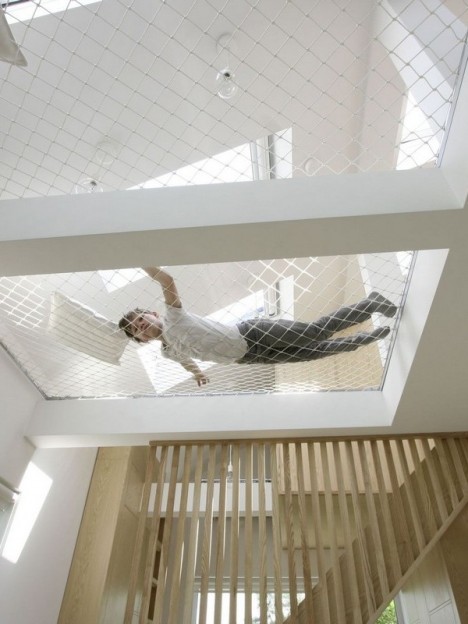
    If you want to live in a tiny apartment without murdering your significant other or feeling like your home is a jail cell, you might want to employ a few of these clever small-space tricks, like roll-away closets, double-duty room dividers and multi-level built-ins. These organization ideas include everything from IKEA hacks to full-on remodels and even a hammock that takes up the entire second level of a studio space.

    How to Fit An Apartment Into 182 Square Feet
    tiny apartments 182 square feet 2

    Tiny Apartments 182 square feet 1

    tiny apartments 182 square feet 3

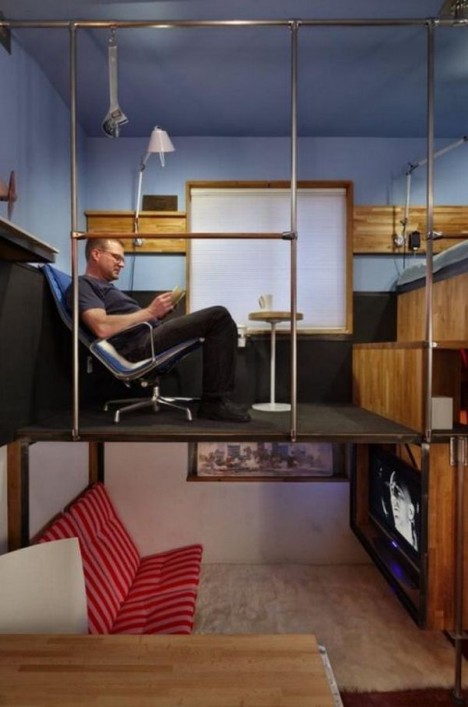
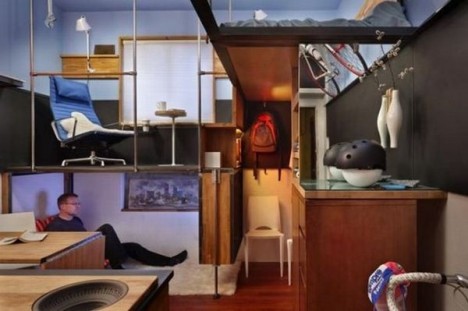
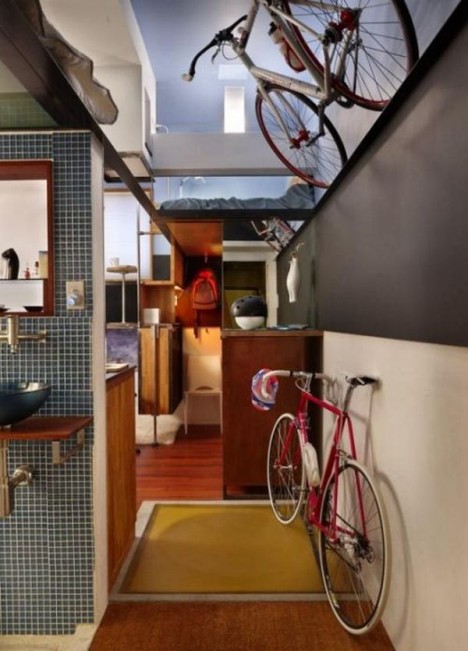
    How do you cram an entire apartment worth of stuff, including two bicycles, into a 182-square-foot basement – making it comfortable enough for a 6’2” occupant? Engineer Steve Sauer took inspiration from boats when he designed the layout for his personal space, noting that the most important aspect of making it work is ensuring that everything has its place. Sauer split the space vertically in thirds to create a seated lounge area, an office and a lofted bedroom.

    Studio with a Crawl-In Library

    tiny apartments library

    crawl in library

    crawl in library 2

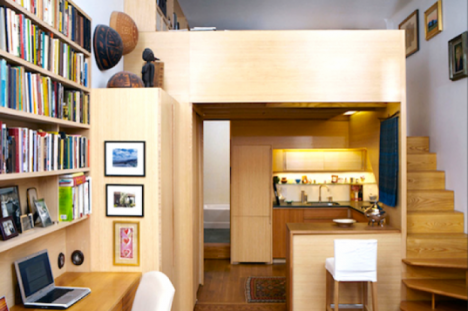
    Think you don’t have room for a library in your apartment? This imaginative remodel shows that pretty much anything is possible, even when you’re living in 240 square feet. Inspired by the cabinetry of furniture maker George Nakashima, the wood-paneled addition is built over the kitchen and includes a crawl-in, cubby-like library beside the bed.

    Bed Nooks, Built-Ins and a Second-Floor Hammock

    tiny apartment hammock 2

    tiny apartment hammock 1

    tiny apartment hammock 3

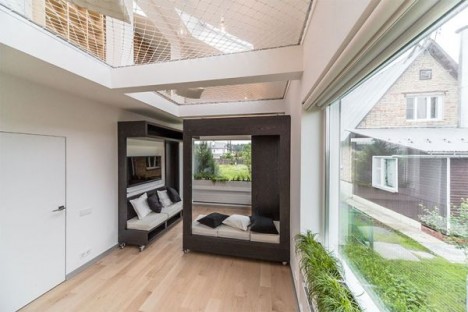
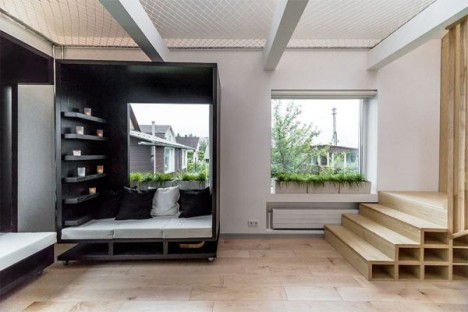
    Two students designed this 33-square-meter apartment to be as functional as possible with a few fun and unexpected tricks: a series of rolling modules in the living space that can be rolled together or apart to create custom couches, lounge areas or beds, and a hammock stretching across the space leading to the awkwardly shaped upper level. The slanted ceiling didn’t leave much room for furniture, so the hammock makes the space usable.

    Lego-Like Tetran Cubes

    tiny apartments tetran cubes 3

    tiny apartments tetran cubes 2

    tiny apartments tetran cubes 1

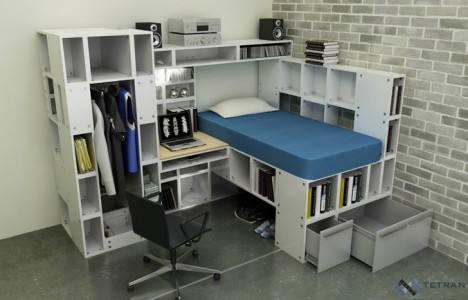
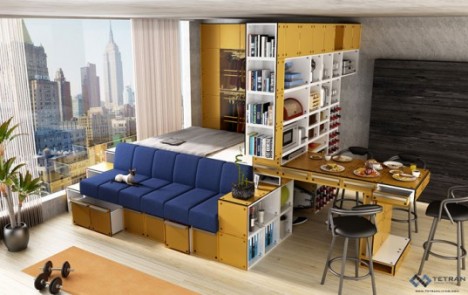
    Put your living space together like a set of Lego blocks, assembling just the right shapes to fit your home and lifestyle, with modules by Tetran. These storage cubes can be stacked and assembled in all sorts of ways to form the basis of couches, beds, side tables, desks, bookcases and practically any other kind of furniture you need.

    Bed Stows Away Under the Kitchen Floor

    tiny apartment roll away bed 3

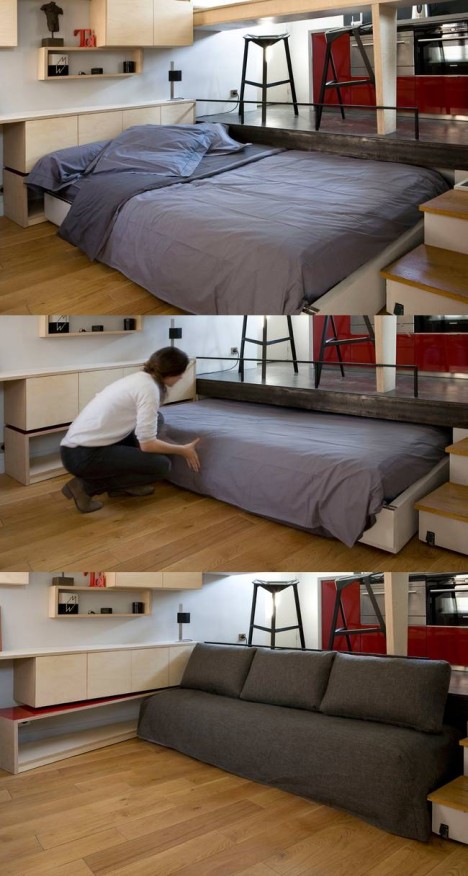
    Architects Marc Baillargeon and Julie Nabucet collaborated to convert what was once the master bedroom of a larger living space into a micro-apartment measuring just 130 square feet. The kitchen is elevated onto a platform that hides a roll-away bed, which can be partially pulled out for use as a couch. A coffee table hides under a counter when not in use, and the steps double as storage.

    Next Page – Click Below to Read More:
    Tiny Apartment Tricks 13 Ideas For Ultra Compact Spaces

    Share on Facebook


    [ By Steph in Design & Fixtures & Interiors. ]

    [ WebUrbanist | Archives | Galleries | Privacy | TOS ]


    WebUrbanist