© pcsiteuk
Software reviews are an excellent way for those in the world of technology to check out digital media software by relying on the expert advice of trusted members in the field. Various sites will try out every new software release and provide readers with the ins and out of the software. Staff members or website owners try out the software, putting it through the paces so users will know the best and worst features of the downloads. Major sites that conduct reviews will …
Tag: REVIEW
-
Popular Software Review Sites
-
Nikon 14mm f/2.8 Lens Review

Rent this and many more lenses at: www.borrowlenses.com See my photos at momentsofnaturephotography.com Detailed review of the nikon 14mm f fixed lens. Includes a look at some sample images taken with the lens on the nikon d3x to check out the image quality of the lens. See many more wide angle lens reviews under my wide angle lens review playlist on my main page.
Video Rating: 5 / 5 -
Nikon 16-35mm f/4 Lens Review

Rent this and many more lenses at: www.borrowlenses.com See my photos at momentsofnaturephotography.com Detailed review of the nikon 16-35mm f lens. Includes a look at some sample images taken with the lens on the nikon d3x to check out the image quality of the lens. See many more wide angle lens reviews under my wide angle lens review playlist on my main page.
Video Rating: 4 / 5 -
sigma 10-20mm f/4-5.6 Lens Review
Rent this and many more lenses at: www.borrowlenses.com This is a detailed review about the performance of the Sigma 10-20mm lens for nikon cameras, including first thoughts, image quality and field testing. Also see Tokina 12-24mm vs. Tokina 11-16mm lens review and the Ultra Wide dx Lens Comparison videos under the wide angle lens review playlist on my main page. This lens was thoroughly tested on the nikon d3x camera.
Rent these and many more lenses at: www.borrowlenses.com A comparison between the tokina 12-24mm and the tokina 11-16mm for nikon DSLR cameras. The purposes of each lens are explained in this video. A nikon D3x was used to test these lenses. See more videos on wide angle lenses and comparisons under wide angle lens review playlist on my main page.
Video Rating: 5 / 5 -
24 September, 2010 – Review of Sony’s NEX Firmware Update
When the Sony NEX 3 and NEX 5 started to ship a few months ago Sony was taken to task, by both reviewers and end users for its poor user interface. At the time I called the menu design "a dog’s breakfast".
But now, just three months later, Sony has announced a firmware update and plans to make it available by mid-October.
I have been testing this new firmware for the past few days, and my report on what it does and how well it addresses the failings of the original design is now online in my exclusive Sony NEX Firmware Update Review.
___________________________
Mark Dubovoy’s Photokina Blog
Has Been Updated with
A Day Four Report
___________________________

"Awesome video presentation.
I have learnt so much more after looking through this on the weekend. The tip about pushing blacks and fill light in the Basic Module was worth the price alone. My images of a recent trip to the Australian Outback are popping and punching with delight!
Thanks Michael and Jeff – I really appreciate you taking the considerable time to share your in-depth knowledge and insights." -
Nikonian Academy’s Nikon D90 Review

Video shot completely using the new Nikon D90 digital SLR. Shot by the trainers of Nikonian Academy, Malaysia. Part of a review of Nikon D90.
Video Rating: 4 / 5 -
Tokina 11-16mm f/2.8 Lens Review
Rent this and many more lenses at: www.borrowlenses.com This is a detailed review about the performance of the Tokina 11-16mm lens for nikon cameras, including first thoughts, image quality and field testing. Also see Tokina 12-24mm vs. Tokina 11-16mm lens review and the Ultra Wide dx Lens Comparison videos under the wide angle lens review playlist on my main page. This lens was thoroughly tested on the nikon d3x camera.
Video Rating: 4 / 5Rent this and many more lenses at: www.borrowlenses.com This is a detailed review about the performance of the Tokina 12-24mm lens for nikon cameras, including first thoughts, image quality and field testing. Also see Tokina 12-24mm vs. Tokina 11-16mm lens review and the Ultra Wide dx Lens Comparison videos under the wide angle lens review playlist on my main page. This lens was thoroughly tested on the nikon d3x camera.
Video Rating: 5 / 5 -
Epson Stylus Photo PX710W Multifunction Printer Review

If you need a printer, that is fast and produces superb quality prints, then you need to check out this review of the Epson Stylus Photo PX710W Multifunction Printer. Oh, and I should also mention that it scans, copies and prints direct from memory card too. THIS IS A GEEKANOIDS GOLD AWARD PRODUCT! Manufacturer website: www.epson.co..uk Sponsor: www.academyclass.com Check out more great reviews on my YouTube Channel: www.youtube.com Or on the website: www.geekanoids.co.uk
Photography Lighting set up for chroma key green screen useful for video lighting and for still digital photography, featuring smick.co.uk continuous lighting high power kit and lightbank 350 cool lighting.
Video Rating: 4 / 5 -
Nikon D300s video review
A full review of the Nikon D300s DSLR by Nigel Atherton of What Digital Camera
Video Rating: 4 / 5 -
Octagonal Softbox Review
First of all, I have no idea why there isn’t a standard name for octagonal softboxes, every company uses their own name – Elinchrom Octa, Photoflex Octodome, Hensel Octaform… it gets confusing! That said the Octagon shaped soft-box is one of my favorite light modifiers. Not only does it make for beautiful catchlights it also wraps around the face and body in a way other soft boxes just can’t seem to pull off.
I wanted to get a new one but I couldn’t really find any good reviews on the differences between brands, so I asked B&H to send me a couple to take for a test drive, thanks so much! A few days later they arrived and the match was set!

Versus

I’m not a professional reviewer so I set out to simply experiment with both softboxes and report on which one I liked best. I selected the Photoflex for the very simple reason that Photoflex soft-boxes have speed-rings that will adapt them to several different brands of strobes and I chose Elinchrom because that is the brand of strobe I currently use in my studio. For this particular test I used the Elinchrom Style 600RX.
In order to keep the results between the two soft-boxes as fair as possible I used the same settings on the strobe without moving the light stand at all between shots, I also kept all the camera settings exactly the same. I had Bailey (the beautiful model) try to hold the same pose between shots. We did this a few times with slightly different styles to get as broad of results as possible.
I didn’t have any expectations going into it, I have used Elinchrom and Photoflex soft boxes and have had great success with both brands. What I found out surprised me.
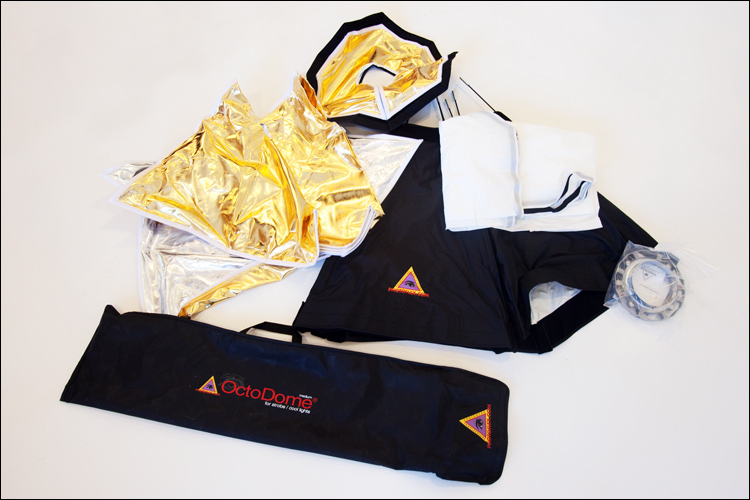
What’s in the box

Rotalux by Elinchrom Midi Octa
- Octa Softbox with textured silver lining
- Removable Inner/Outer Baffle
- Tent poles
- Speed Ring
- Case with shoulder strap

Photoflex Octadome
- Octadome Softbox with white lining
- Double sided lining, gold or silver
- Octagon lining for back of softbox
- Removable Inner/Outer Baffle
- Speed Ring
- Case with small handle
Thoughts after opening the boxes
Photoflex comes with a lot more stuff, but Elinchrom’s design eliminates the need for a lot of the extras. For instance, the octagon shaped cover for the back of the softbox isn’t needed by Elinchrome simply because the design of the softbox fits perfectly snug with the Elinchrom strobe. This may be because Photoflex is designing their light for maximum compatibility across multiple brands of strobes.
The double sided lining that comes with the Photoflex box is kind of a cool idea. Why you would use a gold reflector? Well if you ever shoot in the shade on a bright sunny day you’ll notice that there is a blue-ish color cast. The reason you get a blue color cast is because the ambient light is blue – mainly because it comes from the blue sky. Since gold is a yellowish color (yellow is opposite Blue on the RGB color wheel) the gold reflector can help correct the blue cast in shadows. If you’re shooting the octa mostly inside a studio (like I am) then the gold reflector is pretty much useless… it is cool to have but it’s also a little bit of a pain to put on.
The texture of the two inner linings is significantly different, the Elinchrom has a raised, pebble like texture that you can see and feel. The Photoflex lining is completely flat (both gold and silver). I’m interested to see if this has any affect on the final images.
Also, the baffles are made out of markedly different material. The Elinchrom material feels more cloth-like whereas the Photoflex baffle feels more plasticky. The cases don’t really affect how they’ll shoot but it’s worth mentioning that the Elinchrom case is much cooler and better quality.
Assembly
I hate putting together softboxes, especially big ones. It’s a hassle.
As far as hassles go the Photoflex was much less stressful putting together, even though I had to put on all the linings the built in tent poles were much easier to manage during set-up. It’s a trade-off though, once finished the Elinchrom had a smoother front to it, all the edges were crisp, it was much, much lighter, and the back of the softbox fit snuggly to the light which eliminated all the nasty spill light. Also, the Elinchrom has zero velcro on it and the Photoflex feels like it was born in a velcro factory.
The Photflex does sell a mesh grid which fits the front of the softbox. An equivalent option is not available from Elinchrom. For this review I both soft boxes without a grid the entire time, I’ll do a separate review on the mesh grid in a later post.
All-in-all, if I were choosing soft-box that I was going to take apart and put back together often I’d probably go with the Photoflex, though if I had the option to leave it constructed most of the time (which I do) then the Elinchrom’s light weight and more solid construction make it a bit more convenient moving around the studio.
Shoot One: Beauty Portrait

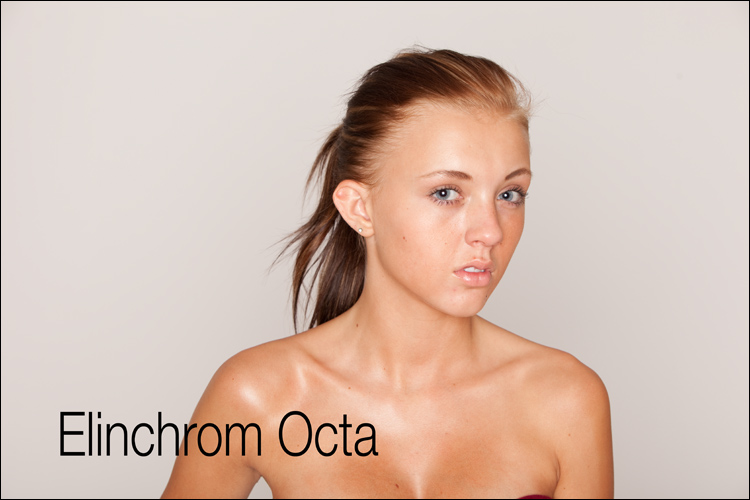
On first glance many of you will notice one difference between the two images, the Photoflex seems to be brighter – especially near the center of the image (right around the middle of her face). I think the brightness has to do with the different fabric on each of the softboxes, the Elinchrom’s cloth baffle simply disperses or absorbs the light more than the Photflex.
Brightness aside the Photoflex seems to be a more specular light source than the Elinchrom. Specular vs. diffuse is one of the main principles in the quality of light and generally speaking the smaller the light source the more specular it is, and the more specular a light source is the harder the shadows and highlights are. That’s why an overcast sky (the biggest light source of all) creates nearly zero shadows.
What’s confusing to me is that since the Photoflex soft box is bigger it should be putting out a more diffuse light, but that’s not what is happening.
It’s a very, very subtle difference though, so we’ll take a closer look at what I’m talking about.

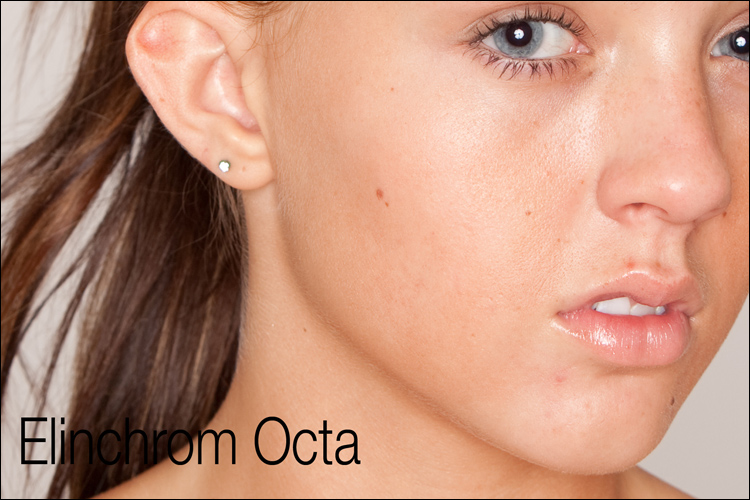
Look at the shadows just below her cheekbone on each of these completely un-retouched images. Notice how the edge of the shadow on the Photoflex is just a tad bit more defined than the edge of the Elinchrom? I’m not talking about darkness of shadow, I’m talking about the edge where it transitions from shadow to light. You may need to squint to see it but you’ll notice that the bottom edge of the Elinchrom is very soft, whereas the Photoflex is a little more defined.
This is the exact opposite result of what I would have expected since Photoflex should be the more diffuse light source. I’m not saying that a more diffuse shadow is better in any way. Many jobs call for more defined shadows, in which case a more specular light source is ideal, but a 5′ foot octagon softbox is designed to modify a light into a diffuse source. Certainly this difference is not a major one at all, though it is noticeable to me.
Also, the Elinchrom seems to have slightly yellow color cast to it, again, easily corrected before or after I took the shot – but I wanted these to be with identical settings.
I think both would be an excellent choice for a beauty headshot. I do prefer the Elinchrom mainly because of the subtle hot spot from Photoflex in the center of the image.
Shoot Two: Full Body Side Lighting

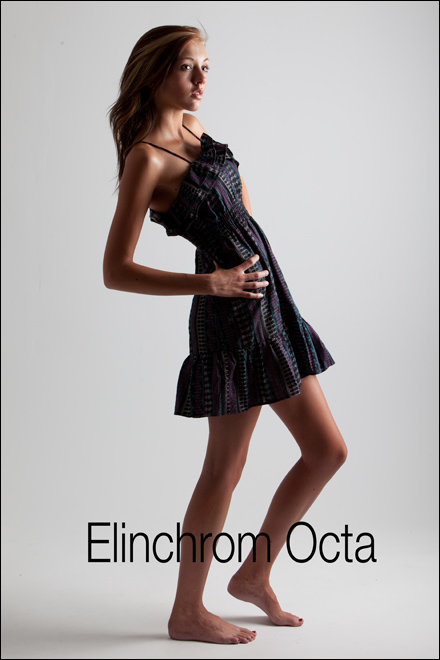
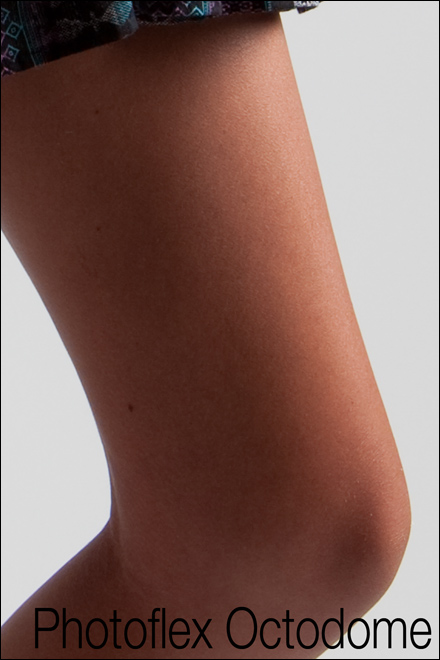
Again, the Photoflex appears brighter overall. Both create very useable results. It was only after very careful observation that I realized something really strange. It has to do with the light hitting the model’s left thigh.
On careful inspection (you have to look at how well the light reflects off the top of the thigh) you’ll notice that the light on the Elinchrom image is brighter than the Photoflex image. Which is strange for a couple of reasons, first of all the Photoflex softbox is larger so her leg should be closer to the light source, and the closer the subject is to a fixed intensity light source the brighter that light will appear. Of course spreading the same amount of light across more surface area would definitely decrease the intensity slightly but we already know the Photoflex is producing brighter images overall. Maybe it was just because her leg is bent slightly more towards the light-source in the Elinchrom version – that would definitely cause a brighter light… but I don’t think the difference would be this much. I could absolutely be wrong though, I decided to do another experiment to find out.

Like any 5th grade science teacher will tell you, in order to create a successful experiment you need to develop a hypothesis and then create an experiment to test your hypothesis.
I developed a theory, even though the Photoflex was larger I figured the strobe was not actually spreading it’s light very equally across the front baffle. To test the theory I came up with a plan. I set my aperture to as high as it will go (f32) and shot the front of each softbox directly, at three different power settings. 1.5 | 3.0 | 4.5
The results are below (Elinchrom is on the left, Photoflex is on the right)


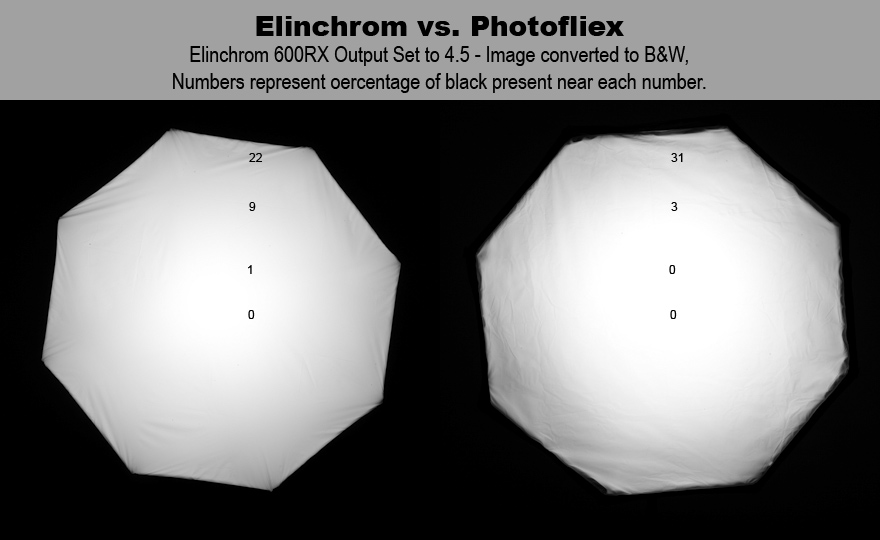
After converting these images to black and white I used the eyedropper tool along with the info tab in photoshop to measure the amount of black present at similar points in both lights. I labeled each of these as seen above. This test verifies my theory and explains both issues I was having with the Photoflex soft box, there is a ring of more intense light (with a darker center) in the center of the Photoflex softbox and as the light goes out it stays brighter for longer but then drops off much faster than the Elinchrom.
Shoot 3: Front full Body
Even though the Photoflex appears brighter throughout the entire image you can see that the transition from the tones in her face to the tones in her legs is more drastic than in the Elinchrom version. Not much, but when I look for it I can definitely tell.
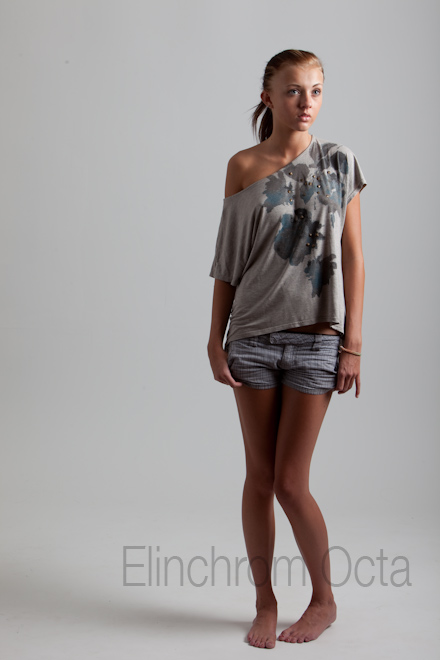

Of course I could have shot still images of cubes and cylinders for this light test and we could have eliminated the tiny movements of the model in between tests but overall I think the best kind of test is a real life one. That makes the beautiful Bailey a perfect choice for this experiment and I would like to thank her for her patience while I yelled at her to hold still while I swapped out lights.
The Conclusion?

All in all both, of the soft boxes performed well. If I’m being honest I prefer the Elinchrom. Not only does the light transition more smoothly (with a less-pronounce center hot-spot) but the lighter weight and tighter construction makes it something that is just easier to move around in the studio.
One big complaint about Elinchrom though – I’d really love it if the Elinchrom softboxes weren’t nearly IMPOSSIBLE to remove from the Elinchrom 600RX!
However, it needs to be said that I am certain I could get very useable results from the Photoflex.

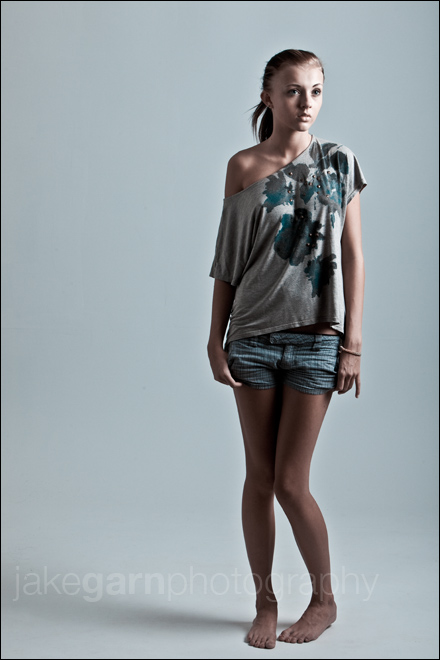
Final Retouched Images




Other Equipment used to achieve these images
- Camera: Canon 5D Mark II
- Lens: Canon 70-200 f/2.8L IS USM
- Tripod: Manfrotto 190XPROB
- Tripod Grip: Manfrotto Ballhead (322RC2)
- Memory Card: SanDisk Extreme 16GB
- Strobes: Two Elinchrom 600RX Monolights
- Software: Adobe Lightroom & Adobe Photoshop CS5