Tag: Plants

  • Using Scanography to Create Images of Plants

    black and white flower - How to Create Images of Plants With Scanography

    Since its inception, photographers have found weird and wonderful ways to create photographic images in amazing styles and mediums. The first photograph, or more specifically, the earliest known surviving photograph made in a camera, was taken by Joseph Nicéphore Niépce in 1826 or 1827. He used a polished sheet of pewter coated with a thin layer of bitumen, a naturally occurring petroleum tar, which was dissolved in lavender oil, applied to the surface of the pewter and allowed to dry before use.

    As cameras developed, the popularity of photography increased and the possibilities of the medium grew, opening new artistic avenues.

    How to Create Images of Plants With Scanography - leaves

    We’re a creative bunch, so it’s only natural that as technology progressed into the contemporary climate, advances in office technology such as the printer presented a whole new realm of artistic possibilities. Printers not only allowed for new aesthetics but provided the opportunity for more economical distribution too.

    It’s the same with scanners. Modern scanners are considered the successors of early telephotography and fax input devices. The first modern scanner developed for a computer was a drum scanner built in 1957 at the US National Bureau of Standards. Led by a team headed by Russell A. Kirsch, the first image ever scanned on this machine was a 5cm square photograph of Kirsch’s then-three-month-old son, Walden.

    Companies such as Acer, Microtek and HP began offering flat-bed scanners in the late 1980s, although hi-res (600 DPI or more), color versions didn’t become popular until the mid-1990s. Once the technology moved into mainstream use, people began experimenting with the flatbed scanner’s artistic potential. What they discovered was a new form of digital photography, called scanography.

    How to Create Images of Plants With Scanography

    Making your own scanography

    The process of scanography is as simple as arranging objects on the scanner and capturing the resulting image. But a few extra steps can help refine the process for more successful images.

    What you’ll need

    • Computer
    • Flatbed scanner
    • Objects to scan (flat, mailable objects like plants make great subjects)
    • Glass cleaner and cloth
    • Square of glass approximately A4 in size
    How to Create Images of Plants With Scanography

    For this image, I have combined two scanned images together and included the duct-tape frame that was on the piece of glass I used to compress the branches flush against the scanner bed.

    Before you start

    Because the scanning surface is made of glass, you’ll have to take care that the bed doesn’t get scratched or cracked. If you are particularly concerned about marking your scanner, try using a layer of glad-wrap as an extra barrier between your objects and the glass. Keep in mind that a scanner bed can only hold so much weight and exceeding this weight will break the scanner.

    Method

    First, open your flatbed scanner and give it a good wipe-down with glass cleaner and a cloth. This will reduce the amount of dust that will show up in your scanned image. Next, arrange your objects face-down directly on the scanner glass. For a nice, sharp image, I place a layer of glass over the top of my objects so they are flush with the scanner bed.

    The depth of field of most scanners is very limited, usually no more than half an inch (12 mm), but the built-in light source provides excellent sharpness, color saturation, and unique shadow effects on objects pressed close to the bed. This is why flat objects like plants produce the most successful scanographic results.

    How to Create Images of Plants With Scanography

    Using a pane of glass will help keep your subject flush with the scanning bed, emphasizing detail. I’ve included the duct-tape border of the glass to create a more dynamic image.

    The next step depends on whether you would like a black or white background for your image. For a white background, simply close the scanner lid and activate the scanner. For a black background, leave the lid of the scanner open and activate the scanner in a dark room. Once your scanner has finished processing, observe the results on the computer screen and make any necessary adjustments until you are happy with the finished result.

    Post-processing

    Once you are happy with your scanned image, open it up in Photoshop for a better look. Photoshop will allow you to remove any pesky dust marks or scratches that appear on your image. Personally, I don’t mind a few imperfections in the capture, as it embraces the quirks of the medium.

    How to Create Images of Plants With Scanography

    Experiment!

    Once you have the technique down, the possibilities are endless. Why not try “branching out” and scanning some other objects?

    How to Create Images of Plants With Scanography

    Here are several scanned images of my pet rat that I’ve combined in Photoshop. I think it makes an interesting (and cute) study of movement, detail, and the scanner technology itself.

    How to Create Images of Plants With Scanography

    This creepy wavy effect was done by slightly moving my hands from side-to-side as the scanner arm passed over my fingers.

    The post Using Scanography to Create Images of Plants appeared first on Digital Photography School.
    Digital Photography School

  • Lush Life: 12 Verdant Architecture Projects Making Plants a Main Priority

    [ By SA Rogers in Architecture & Houses & Residential. ]

    Not all architecture incorporating lots of living greenery is doomed to remain an unrealistic rendering, depicting buildings that can’t structurally support the weight of all the soil and water needed to keep full-sized trees alive. Architect Thomas Heatherwick built ultra-strong concrete pillars into his 1000 Trees design, for example. Other buildings take a subtler approach, choosing ivy, potted plants or existing trees rooted in the ground. All of these projects attempt to meld urban architecture with lush gardens in the hopes of cleansing the air, storing CO2 to mitigate climate change and providing enhanced access to green spaces in cities.

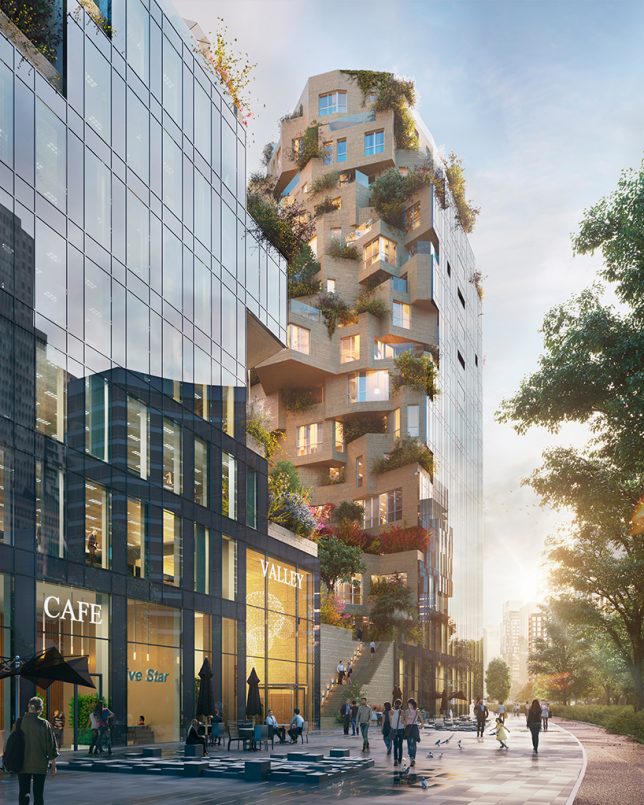
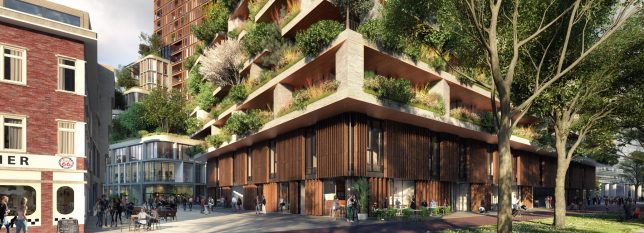
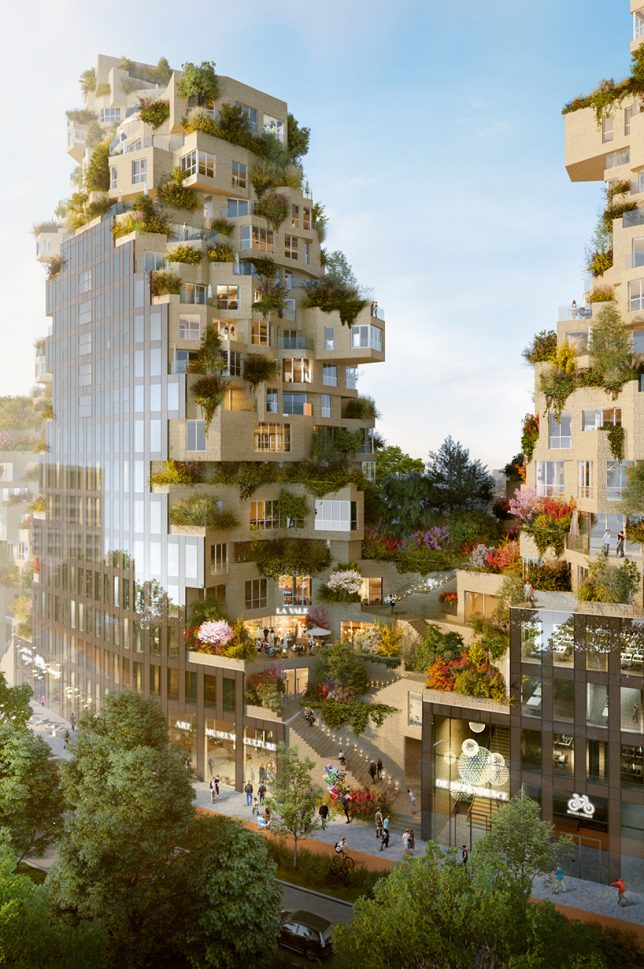
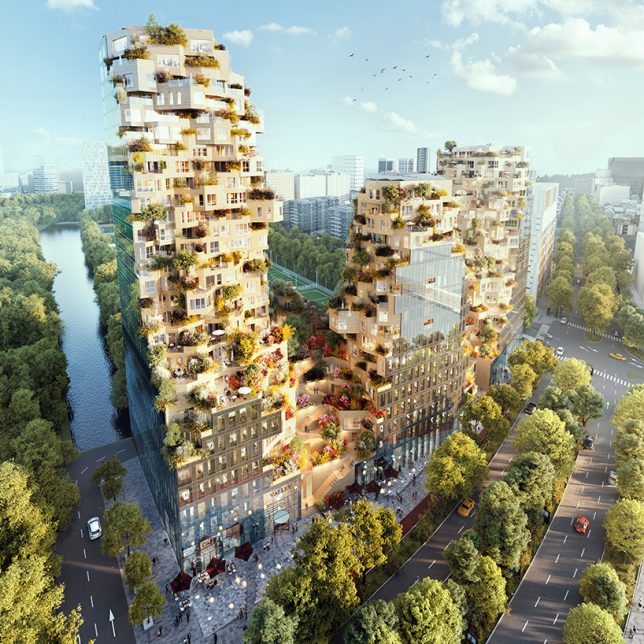
    Valley: Green-Terraced Towers by MVRDV in Amsterdam, The Netherlands

    Construction began in August 2017 on MVRDV’s ambitious ‘Valley,’ a mixed-use complex of green-terraced towers in Amsterdam’s central business district. ‘Valley’ is notable not only for its unusual offset stacking of volumes , creating an irregular shape, but also for all the greenery it supports. The towers include 196 apartments, 7 stories of offices, shops, restaurants, cultural facilities and a three-story parking lot.

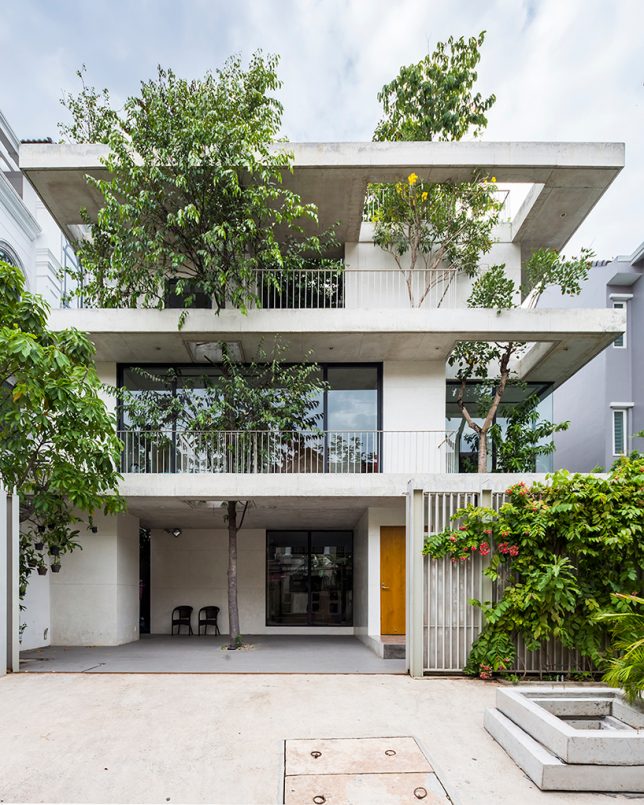
    House for Trees by VTN Architects in Ho Chi Minh, Vietnam

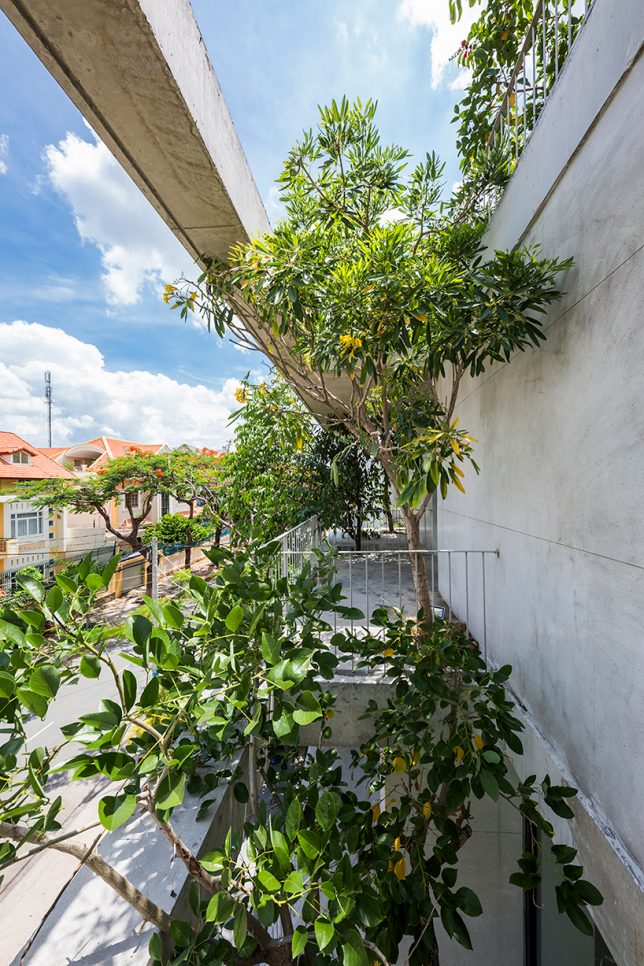
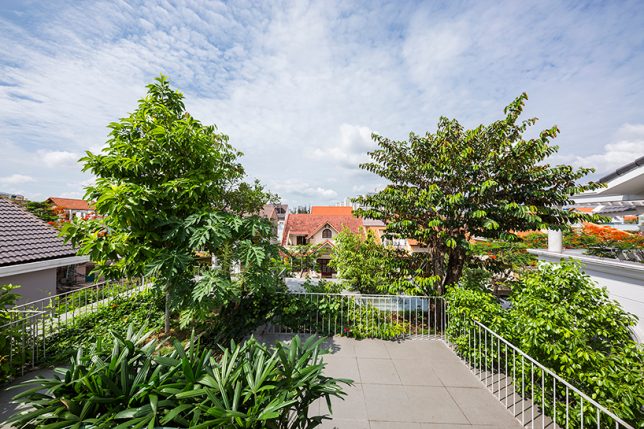
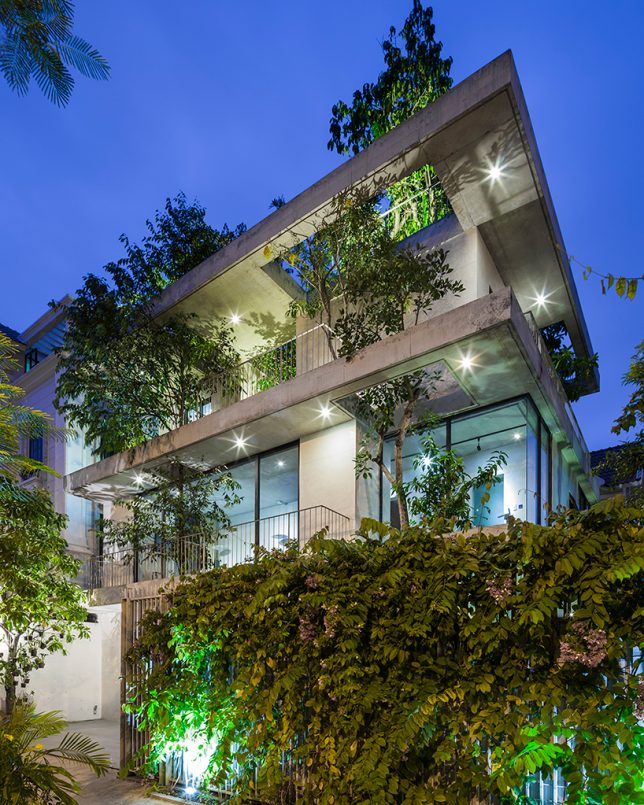
    VTN Architects approached ‘House for Trees’ as a way to alleviate the lack of access to green spaces as well as poor air quality found in big cities like Ho Chi Minh. This residential project incorporates trees into its design, envisioned by the firm as a “small park in a dense neighborhood.” The trees are set into deep planter boxes disguised among the concrete volumes of the house, with cut-outs allowing their crowns to rise as high as they like.

    Nautilus Eco Resort by Vincent Callebaut in the Philippines

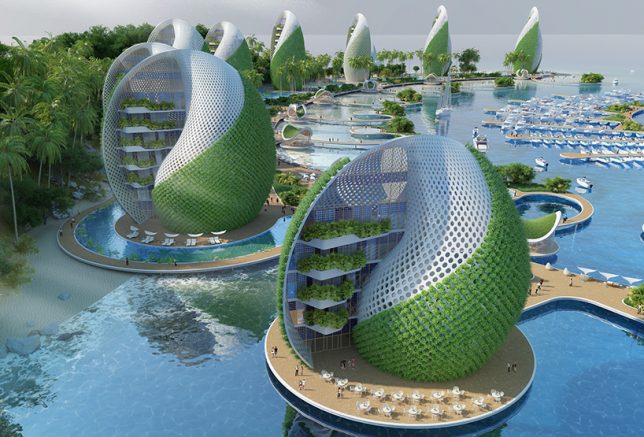
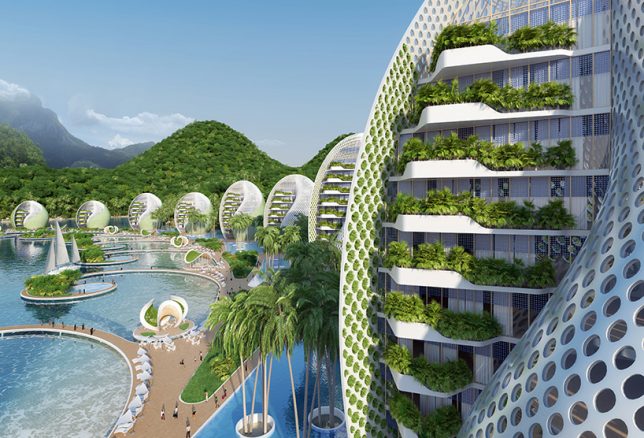
    The Nautilus Eco Resort by Vincent Callebaut is designed as a ‘zero emissions, zero waste, zero poverty’ development for the Philippines in response to environmental and social problems in the country, like overfishing, pollution and mass tourism. The project would be built from reused or recycled materials, self-sufficient in producing its own energy and food, and engage volunteer ecotourists in cleaning up plastic waste that washes up onto the area’s beaches. It consists of a series of shell-shaped hotels and apartment towers spiraling around a central island housing a nautical center and scientific research laboratories. The plant walls cool the buildings as they grow food.

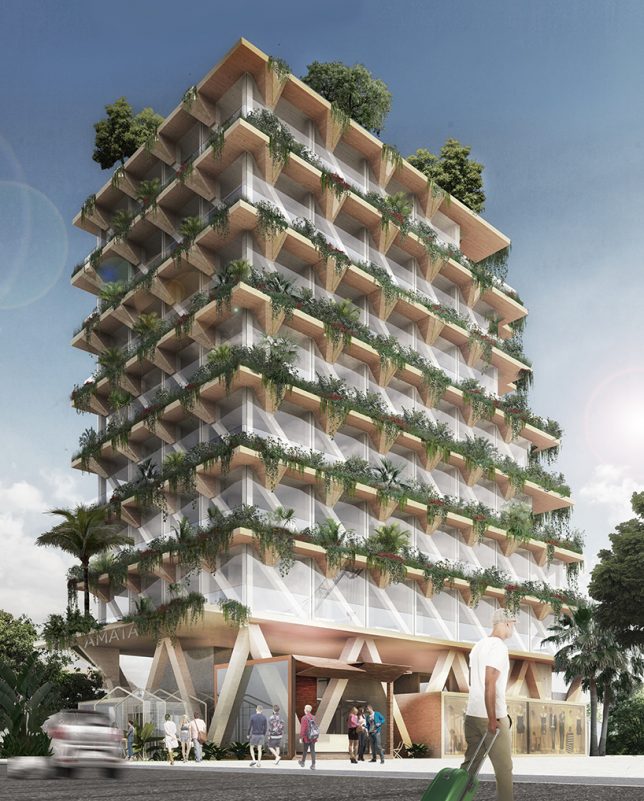
    Amata + Triptyque Timber Building in São Paulo, Brazil

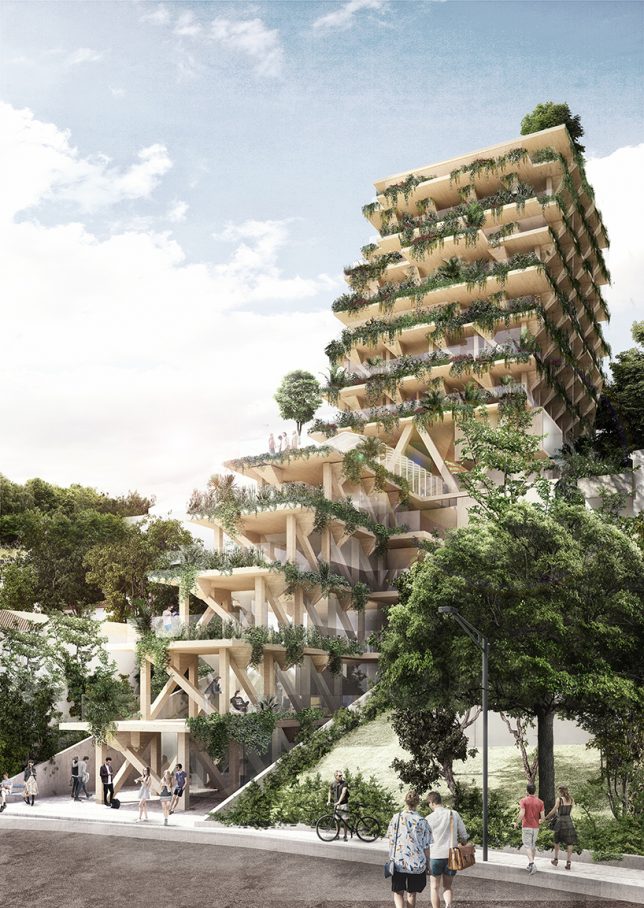
    Constructed entirely from Brazilian timber, this building is a collaboration between architecture studio Triptyque and forest management company Amata. The building aims to be a giant carbon sink, contributing towards the fight against climate change. Each square meter of wood is capable of absorbing a metric ton of carbon dioxide from the environment. The 13-story building contains co-working, co-living and dining spaces, the edges of its terraces dripping with living plants.

    Next Page – Click Below to Read More:
    Lush Life 12 Verdant Architecture Projects Making Plants A Main Priority

    Share on Facebook


    [ By SA Rogers in Architecture & Houses & Residential. ]

    [ WebUrbanist | Archives | Galleries | Privacy | TOS ]


    WebUrbanist

  • Pillars of Green: 85,000 Plants on World’s Largest Vertical Garden Facade

    [ By WebUrbanist in Architecture & Houses & Residential. ]

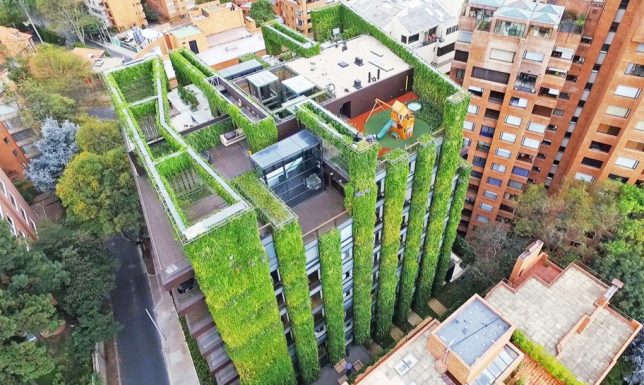
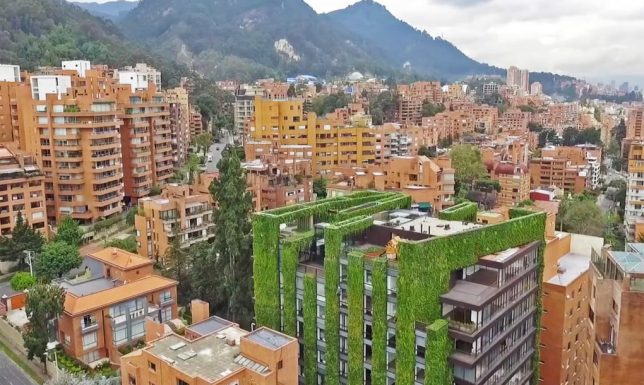
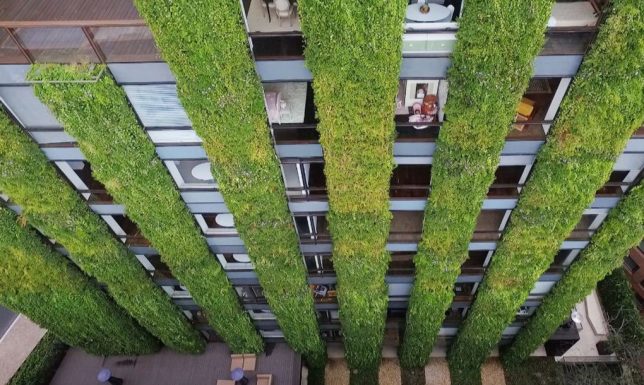
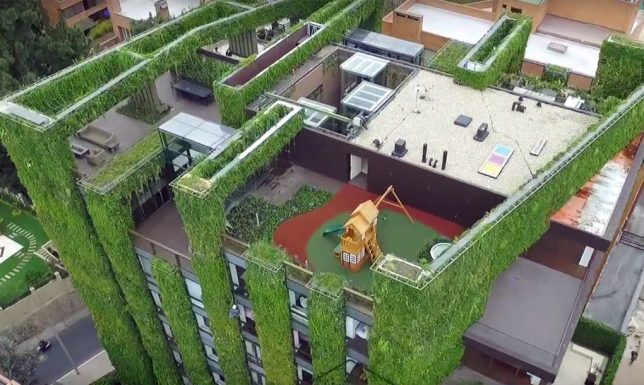
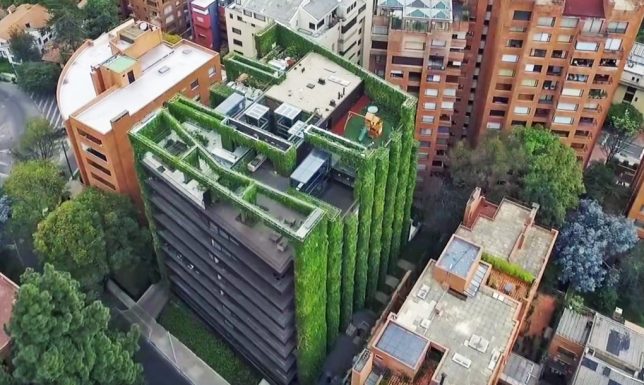
    An extensive living facade system in Bogota, Columbia, represents growth in the right direction, away from unrealistic tree-covered skyscrapers toward more sustainable and useful vertical greenery.

    The Santalaia building has plants spanning over 30,000 square meters of its surface area, able to produce oxygen for over 3,000 people annually (and filter tons of heavy metals, harmful gases and other airborne particulates). Paisajismo Urbano installed this specific system, developed by Ignacio Solano.

    The recent trend (in renderings and to some extent reality) of putting trees onto tall towers is problematic from engineering and ecological standpoints. “Intensive” greenery requires thicker layers of soil and more complex systems for watering, maintenance and structural support. “Extensive” greenery, by contrast, provides many of the same benefits with lower cost and less wasted energy.

    Many architects are naturally tempted to place trees on buildings, which do have a few functional advantages (like providing shade and making for nice-looking renderings). Still, building residents as well as the public would be better served in most cases by systems like this one. Even then, it is important to determine in advance what the goals and intended benefits are, since any green installation is complex and requires ongoing support.

    Share on Facebook


    [ By WebUrbanist in Architecture & Houses & Residential. ]

    [ WebUrbanist | Archives | Galleries | Privacy | TOS ]


    WebUrbanist

  • Modern Babylon: Hanging Plants Serve as Green Walls & Window Shades

    [ By WebUrbanist in Architecture & Houses & Residential. ]

    green-screen-wall

    A single-story house in Vietnam echos an ancient world wonder, the Hanging Gardens of Babylon, but on a domestic scale and with minimalist contemporary design sensibilities and a functional purpose.

    green-wall-design

    green-wall-interior

    Created by MIA Design Studio, the home is both open to its surroundings but also shielded by a veil of greenery reaching up to the rooftop above.

    green-house-pools

    green-kitchen

    green-space-exterior

    “The boundary between the interior and exterior is being diminished, letting man sense the fluctuations of nature. Space is opened up but maintains the privacy of the individuals. This is the daunting problem of living in a metropolitan area with cramped space and pollution.”

    green-floor-plan

    green-bedroom

    green-deck

    green-hallway-creepers

    The green screen is a theme carried between three distinct volumes of the house, lining a connective hallway that joins disparate living, sleeping and working spaces. A series of outdoor gardens between the interior areas and perimeter wall create a natural sanctuary for the residents, providing access to a personal forest within the a bustling built environment.

    Share on Facebook


    [ By WebUrbanist in Architecture & Houses & Residential. ]

    [ WebUrbanist | Archives | Galleries | Privacy | TOS ]


    WebUrbanist

  • Power Plants: Scientists Grow Conductive Wires in Living Roses

    [ By WebUrbanist in Conceptual & Futuristic & Drawing & Digital & Technology. ]

    wired rose plant

    A group of Swedish scientists has developed a successful method for integrating conductive wire systems into plants, naturally soaked up from a gel into leaves and stems to create complete circuits in bionic hybrids. The implications, like the currents, run in two directions: power can be harvested from plants, but the plans can also be changed through the application of external energy.

    rose robot

    Botanists and mechanical engineers from the Laboratory of Organic Electronics at Linköping University added the gel at the base of test plants, which in turn hardened into flexible wires within the stems and leaves, all without damage to the organic components. They were then able to send electrical impulses through the plants, lightening and darkening flowers and leaves.

    rose hybrid bionic plant

    “Although many attempts have been made to augment plant function with electroactive materials, [until now] plants’ ‘circuitry’ has never been directly merged with electronics,” write the researchers in their paper Electronic Plants. “With integrated and distributed electronics in plants, one can envisage a range of applications including precision recording and regulation of physiology, energy harvesting from photosynthesis, and alternatives to genetic modification for plant optimization.”

    rose hacked

    A number of material combinations were tried before the effective solution was discovered. Some hardened and harmed the plants while others proved toxic or provided insufficient connectivity to be effective. The transparent organic polymer they settled on is able to fully wire a living rose, creating a bionic hybrid without compromising its natural functions.

    wired rose detail

    More from the abstract: “The roots, stems, leaves, and vascular circuitry of higher plants are responsible for conveying the chemical signals that regulate growth and functions. From a certain perspective, these features are analogous to the contacts, interconnections, devices, and wires of discrete and integrated electronic circuits. The four key components of a circuit have been achieved using the xylem, leaves, veins, and signals of the plant as the template and integral part of the circuit elements and functions.”

    Share on Facebook


    [ By WebUrbanist in Conceptual & Futuristic & Drawing & Digital & Technology. ]

    [ WebUrbanist | Archives | Galleries | Privacy | TOS ]


    WebUrbanist

  • Vegan Antlers: Mount Wall Trophy Plants Instead of Animals

    [ By WebUrbanist in Design & Fixtures & Interiors. ]

    wall mounted deer

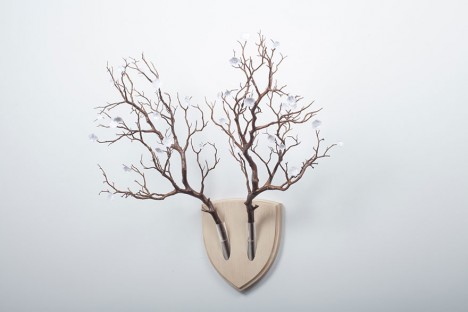
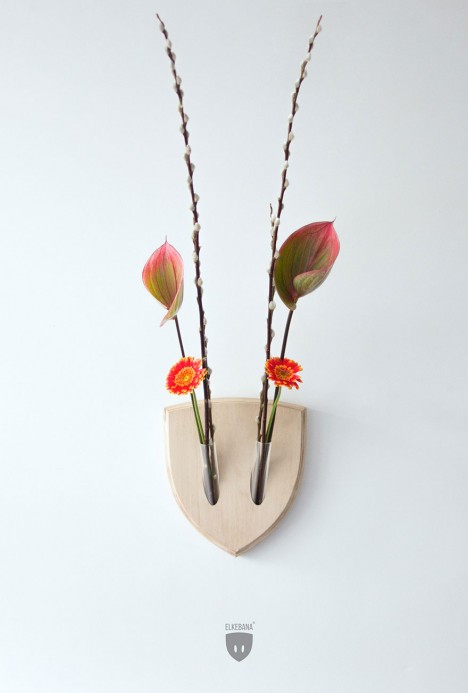
    Combining a Japanese floral arrangement tradition (ikebana) with the hunting convention of mounted trophies, these plant holders allow for clever, colorful and ever-changing organic displays.

    wall mounted flower pink

    The Elkebana consists of a pair of glass flower holders set into a familiar wooden wall plaque, designed by Fabio Milito & Paula Studio and hand-crafted in Italy.

    wall flower horns design

    Its creators have had quite a bit of fun naming some of their experimental arrangements, including Nora the Angora, Girgenta the Goat, Jason the Aries, Isidoro the Oryx and Frank the Buck.

    wall mounted creative flowers

    Unlike the more morbid mounts that inspired this creation, there is also a greater degree of flexibility – change the flowers or their organization and you change the piece.

    wall mounted plant antlers

    And unlike traditional tabletop vessels for botanical displays, this one works well for small living spaces where surface area cannot be sacrificed.

    wall mount maker

    wall mount glass wood

    Made of high quality birch plywood, solid walnut, solid oak or cork shield, the wall mounts hold your botanical arrangements in the two hand-blown glass vases.

    wall mount branches spoof

    From its makers: “The ‘ikebana is the ancient Japanese art of arranging floral elements in harmonious compositions. Elkebana brings the ancient art of ikebana to the wall, in order to transform the wall trophy idea into a continuously mutating, colourful creature.”

    Share on Facebook


    [ By WebUrbanist in Design & Fixtures & Interiors. ]

    [ WebUrbanist | Archives | Galleries | Privacy | TOS ]


    WebUrbanist

  • Course Correction: Deserted Golf Greens into Solar Power Plants

    [ By WebUrbanist in Abandoned Places & Architecture. ]

    abandoned golf green solar

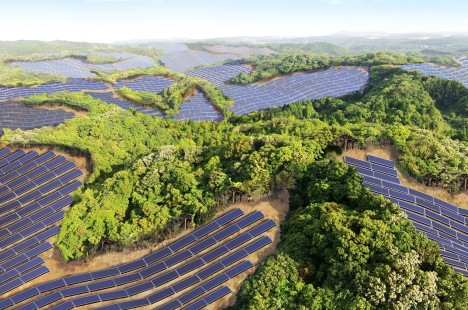
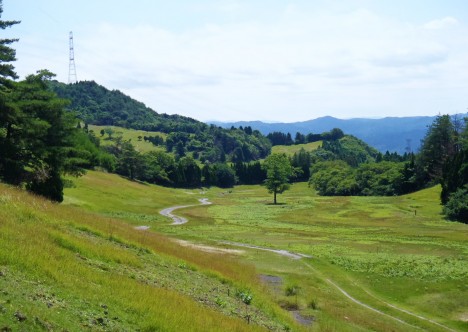
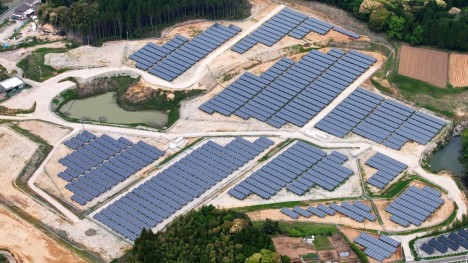
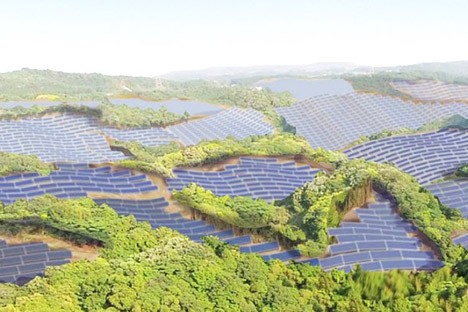
    Derelict putting greens will be put to greener uses in Japan, where an abandoned golf course near Kyoto is being converted to the area’s largest solar energy-generating facility.

    Solar power production represents an ideal type of landscape reuse in this context for many reasons: expansive areas with little shade and high sun exposure are perfect for laying out panels for maximum effect and efficiency. Developed by Kyocera, “the plant will generate an estimated 26,312 megawatt hours (MWh) per year — enough electricity to power approximately 8,100 typical local households.”

    golf green conversion

    Also under construction, a similar project in the Kagoshima Prefecture is being located on an area originally cleared for a golf course that was never finished and occupied. Critical to a country facing power issues in the wake of the Fukushima nuclear incident, these projects are also a sign of land use awareness and changing times. Just a few decades ago country club memberships sold for millions in Japan, but “overdevelopment of golf properties during the real-estate boom of the 1990’s and 2000’s has led to hundreds of idle courses today that are now under analysis for repurposing or redevelopment.” 

    green golfing

    Of course, closed golf courses are also an international problem well beyond the Japanese archipelago, giving this solution potentially global applications as well, particularly in the United States. Together, these projects should help inspire other countries to turn some of the most environmentally unsound landscapes toward more productive and sustainable uses.

    Share on Facebook


    [ By WebUrbanist in Abandoned Places & Architecture. ]

    [ WebUrbanist | Archives | Galleries | Privacy | TOS ]


    WebUrbanist

  • Flowerworks: Pictures Capture Plants Exploding Like Fireworks

    [ By WebUrbanist in Art & Photography & Video. ]

    flower red starburst white

    A novel take on a New Year’s staple, crafty photography and flower power, these bright botanical arrangements (set against dark night-like) backgrounds seem to burst in midair.

    flower plant art photos

    flower tracer arc light

    flower orange purple explode

    This Flowerwork photo series from Berlin-based artist Sarah Illenberger stemmed from her combined interest in art, photography and graphic design as well as a fascination with other dimensions of everyday options.

    flower purple green explosion

    flower green white buds

    flower like firework art

    Working together with photographer Sabrina Rynas, buds and blossoms were set against a faux night sky, appearing to be much larger fireworks shot from off-screen at first glance. In some cases the stems trail like streamers or one plant seems nested in another like some kind of grand finale.

    flower burst light dark

    flower fire photography shoot

    More about the artist: “Sarah Illenberger is a multi-disciplinary artist based in Berlin working at the intersection of art, graphic design, and photography. With a focus on analog craftwork using everyday items, Sarah is renowned for creating vivid, witty images that open up new perspectives on seemingly familiar subjects.”

    flower exploding firework botanical

    flower draping falling sequence

    flower grand finale art

    “Her ability to transform ordinary materials into complex and unexpected visual experiences has been utilized to develop concepts for clients from the fields of culture and business in several countries. In her aim to explore the fertile overlap between art and design, she’s collaborated with numerous photographers and artists, and filled exhibition spaces with self-initiated projects in Paris, Tokyo, and Berlin.”

    Share on Facebook


    [ By WebUrbanist in Art & Photography & Video. ]

    [ WebUrbanist | Archives | Galleries | Privacy | TOS ]


    WebUrbanist

  • Flowering Potholes: Lovely Tile Plants Fill Ugly Street Voids

    [ By WebUrbanist in Art & Street Art & Graffiti. ]

    flower art street rose

    An uniquely elegant solution to a dirty everyday problem, these gorgeous handcrafted tile mosaics are turning unfilled potholes back into functional pieces of city street surface all over Chicago.

    flower art context view

    This time with an emphasis on beautification, mosaic maker Jim Bachor is back at it again. He is somewhat widely known in the area for using Chicago flags and and other city-themed infill to patch problematic holes in the urban fabric previously.

    flower tiles city streets

    flower tile chicago artwork

    More on the artist’s background and inspiration: “Volunteering to work on an archaeological dig in Pompeii helped merge these two interests in to my art. In the ancient world, mosaics were used to capture images of everyday life. These colorful pieces of stone or glass set in mortar were the photographs of empires long past. Marble and glass do not fade. Mortar is mortar. An ancient mosaic looks exactly as intended by the artist who produced it over two millennia ago. What else can claim that kind of staying power? I find this idea simply amazing.”

    flower artist tile chicago

    In part, his work on the streets aims to draw attention to the 500,000+ potholes that remain unfixed at any given time, in part a byproduct of the harsh temperature shifts from winter to summer and back again (or as is said in the Midwest: ‘winter and road repair’ seasons).

    flower pothole infill art

    flower mosaic pot holes

    “Using the same materials, tools and methods of the archaic craftsmen, I create mosaics that speak of modern things in an ancient voice. My work locks into mortar unexpected concepts drawn from the present … it surprises the viewer while challenging long-held notions of what a mosaic should be. Like low-tech pixels, hundreds if not thousands of tiny, hand-cut pieces of Italian glass and marble comprise my work.”

    Share on Facebook


    [ By WebUrbanist in Art & Street Art & Graffiti. ]

    [ WebUrbanist | Archives | Galleries | Privacy | TOS ]


    WebUrbanist

  • Big Miss Steak: 10 Eerie Abandoned Meat Packing Plants

    [ By Steve in Abandoned Places & Architecture. ]

    abandoned Swifts meat packing plant Fort Worth Texas 1
    As the disconnect between the meat we eat and the places it’s processed grows, so does the number of urban and suburban abandoned meat packing plants.

    abandoned Swifts meat packing plant Fort Worth Texas 2

    abandoned Swifts meat packing plant Fort Worth Texas 3

    Take the former Swift and Company meat packing plant in Fort Worth, Texas. The plant first opened in March of 1904 but by the 1950s, the consequences of local droughts and the reduced importance of the historic Fort Worth Stockyards saw the Swifts plant enter a long period of decline – it finally closed in 1971.

    abandoned Swifts meat packing plant Fort Worth Texas 4

    Even closure and abandonment couldn’t reverse the Fort Worth Swifts meat packing plant‘s spiral into decay. In the 1970s, two major fires reduced most of the plant’s buildings to ruins leaving only the firm’s administrative offices still salvageable: in the 1980s the building housed an Old Spaghetti Warehouse restaurant. More recently, one of the plant’s buildings acted as a very believable prison in the TV series Prison Break. Kudos to Flickr user Noel Kerns for capturing the Swift plant’s eerie afterlife in 2008 and 2009.

    Forst To Close

    abandoned Old Forst meat packing plant Kingston NY 1

    abandoned Old Forst meat packing plant Kingston NY 2

    abandoned Old Forst meat packing plant Kingston NY 3

    Flickr user richie 59 fired up the wayback machine to post these two images of the decrepit red brick Old Forst meat packing plant in Kingston, New York. The first two photos date from early 1982 while the third was snapped in 1985. As for Old Forst, it was demolished in 2006 when developers planned to build a 7-story hotel (which ended up not being built).

    Hello, Neuhoff

    abandoned Neuhoff meat packing plant Nashville TN 1

    abandoned Neuhoff meat packing plant Nashville TN 2

    abandoned Neuhoff meat packing plant Nashville TN 3

    The former Neuhoff Meat Packing plant is located in northern Nashville, Tennessee, just six blocks from the State Capitol building… one imagines summer legislative sessions must have been unbearable when the wind rose. The plant closed in 1979 after decades of operation on a site that hosted a slaughterhouse for some time before the Neuhoffs even arrived. The abandoned meat packing plant is at long last being cleaned up, however, as the main buildings are being re-purposed as a mixed-use development focused on arts and ecology. A tip of the hat to Flickr user Eva Wood who snapped these striking scenes of neglect and decay in October of 2008.

    Next Page – Click Below to Read More:
    Big Miss Steak 10 Eerie Abandoned Meat Packing Plants

    Share on Facebook


    [ By Steve in Abandoned Places & Architecture. ]

    [ WebUrbanist | Archives | Galleries | Privacy | TOS ]


    WebUrbanist