Tag: Plant

  • Abandoned Nazi Bunker Converted to Power Plant & Cafe

    [ By Steph in Architecture & Public & Institutional. ]
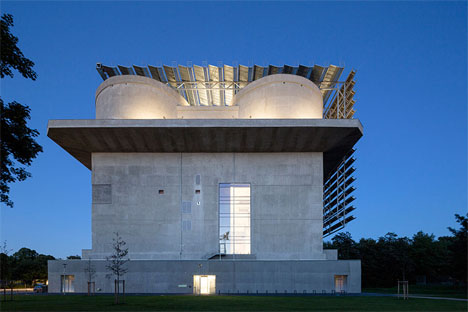
    Converted Nazi Bunker 2

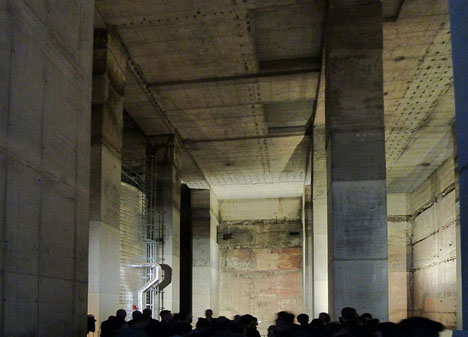
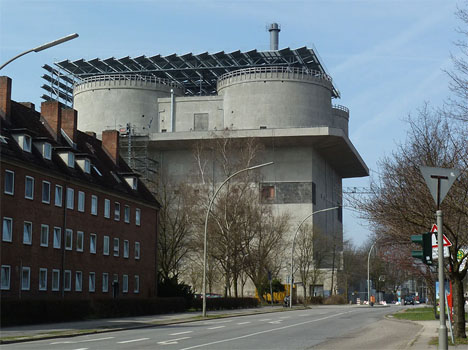
    The words ‘Nazi power’ have taken on a new meaning in Hamburg, Germany as an abandoned bunker formerly equipped with anti-aircraft turrets has been transformed for a surprising new use. The Hamburg-Wilhelmsburg flak bunker helped shield city residents from aerial attacks for four years during World War II and was abandoned for decades until its conversion by IBA-Hamburg into a renewable energy power plant and memorial in one.
    Converted Nazi Bunker 1

    Converted Nazi Bunker 3

    Converted Nazi Bunker 4

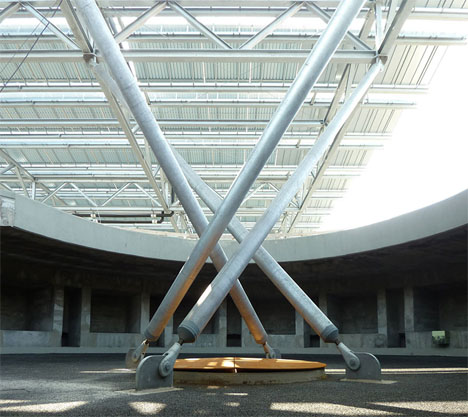
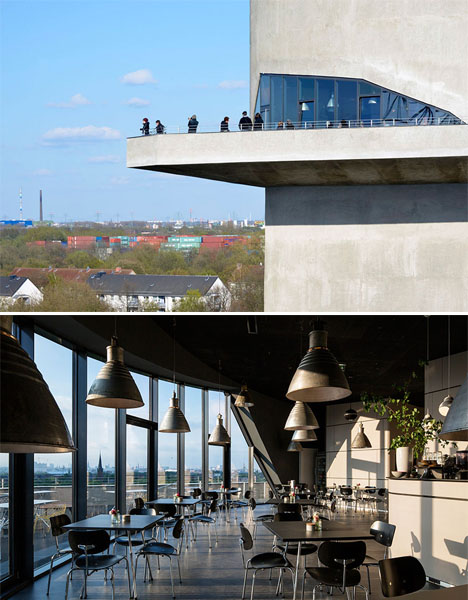
    The fortress now meets the heating demands of 3,000 local households using 85% renewable energy including a biomethane-fired heat and power plant and a solar array on the roof that heats a 2-million-liter water tank for dwellings in the Weltquartier district. 30 meters above the ground, a cafe has opened for business inside one of the aircraft turrets.
    Converted Nazi Bunker 5

    Converted Nazi Bunker 6

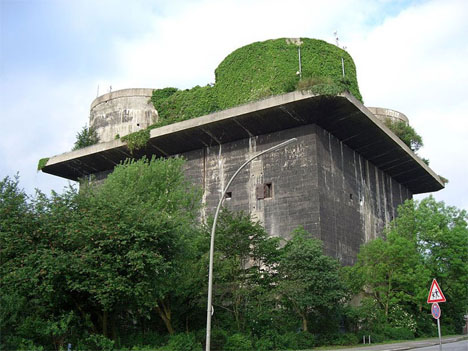
    The conversion project stands as both a symbol for the ‘Renewable Wilhelmsburg’ Climate Protection Concept, which aims to incorporate sustainability into urban planning, and a historic attraction. Before it was restored, the bunker was stained and shrouded in ivy.

    Share on Facebook


    [ By Steph in Architecture & Public & Institutional. ]

    [ WebUrbanist | Archives | Galleries | Privacy | TOS ]


    WebUrbanist

  • Carnivorous plant image wins Olympus BioScapes competition

    2013-1-large-olympus-bisocapes-photos-670x440.jpg

    The open ‘mouth’ of a floating humped bladderwort plant (Utricularia gibba) took first prize in Olympus’ microscope image competition. Igor Siwanowicz, a researcher from the Howard Hughes Medical Institute’s Janelia Farm Research Campus in Ashburn, Virginia, took the winning image of the carnivorous plant, beating more than 2,000 entries from 71 countries. See gallery

    News: Digital Photography Review (dpreview.com)

  • Only in Russia: World’s First Floating Nuclear Power Plant

    [ By WebUrbanist in Technology & Vehicles & Mods. ]

    russian floating power plant

    It sounds at best far-fetched and at worst frightening, at least at first, but this unique water-based energy station is already under construction and is designed to (safely) generate power and fresh water to over 200,000 people.

    russian nuclear power station

    The Akademik Lomonosov is being built at a submarine construction facility and is set to launch before 2020. While it is set to be stationed offshore, it opens up a new world of possibilities for fueling remote settlements, temporary outposts, research stations or floating cities.

    russian power plant design

    The vessel will produce an impressive 70 megawatts of electricity – more than enough to support a mid-sized city. It will also desalinate ocean water to increase regional freshwater supplies.

    russian mobile energy source

    With the world wondering about the fate of the Fukushima plant in Japan, following its fateful impact by a tsunami and subsequent fallout, it seems like a strange time to be working on projects where water meats nuclear power. Still, in this case the uranium is far less enriched and of the same type being used in Russian icebreakers already. The power plant is a project of LLC Baltiysky Zavod Shipbuilding, a St. Petersburg division of United Shipbuilding Corporation (USC).

    Share on Facebook


    [ By WebUrbanist in Technology & Vehicles & Mods. ]

    [ WebUrbanist | Archives | Galleries | Privacy | TOS ]


    WebUrbanist

  • Carnivorous plant timelapse sundew

    Timelapse of a the carnivorous plant, known as a sundew or drosera capensis, folding over a fly. This is my first attempt at time lapsing one of my plants. Sorry it is jumpy in a few places, the camera occasionally focused on other parts of the plant or the fence behind, so I had to chop those frames out and reposition the camera so it would stay in focus. Notice just over 3/4 into the movie, on the leaf to the right, the tentacles move inwards aswell so its obviously caught something.

    Not sure if this kind of clip makes any sense. Anyways, here are 5 different patches from clean to extreme.

  • Anaglyph Video of Frozen Plant

    Red-blue (or green) glasses are necessary to view this video properly. This is the anaglyph version of the video at: www.youtube.com There is no sound with this video. You will need red-blue (or green) glasses to view. This is an example of using color keying to digitally clear plant tissue and allow visualization of internal structures in 3D. For another example see Arabidopisis flower in 3d at: www.youtube.com . The technique is ideally suited for in situ hybridization analysis to detect mRNA in an anatomical context This is not a cartoon. This 3D volume was reconstructed from JPEG photographs of individual slices of plant tissue stained with Safranin and Fast Green. Photos were taken with a consumer-grade camera (Sony DSC707) mounted on a Nikon Eclipse 50i microscope using a 4X plan apo objective. JPEG images were imported into Adobe After Effects where they were aligned and the 3D volume was constructed. The full HD version is ½ the full resolution available. When the technology catches up, we will re-post at higher than 1080. Distortion-free sections were prepared by Research Associate Tan Tuong. Graphic consulting was provided by Randy Gelman, BeltlineMedia, www.beltlinemedia.com For more information see Livingston et al 2010. 3D volumes constructed from pixel-based images by digitally clearing plant and animal tissue. Journal of Microscopy. PDF was on my website at www.ars.usda.gov but video embedded in PDF did not work. Will post soon. Contact: David Livingston
    Video Rating: 0 / 5