Seattle-based band Ever So Android are an indie rock trio who have played all over the western USA. Their energetic live shows pack venues throughout the year in their hometown, but recently, they performed their single ‘Moment’ for a different crowd: a small crew of filmmakers armed with Samsung NX1 and NX500 cameras, led by director Brad Strain. Read more
Tag: Music
-
Polyphonic Playground: Making Music with Fun Movement
[ By Steph in Design & Products & Packaging. ]
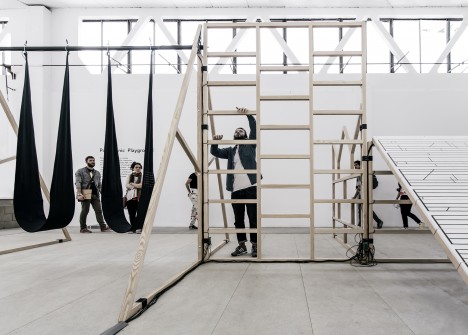
Climb a ladder, swing on a hammock-like seat and run your hands along various wooden surfaces on this strange polyphonic playground, and your movements will create a unique song. Studio PSK teamed up with beatboxer Reeps One to create this multi-sensory play experience for this year’s London Design Festival, encouraging people to interact with an unusual physical fusion of music, design and technology.
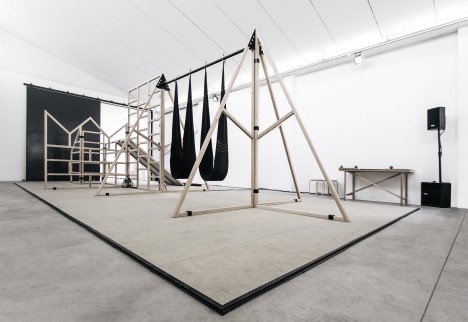
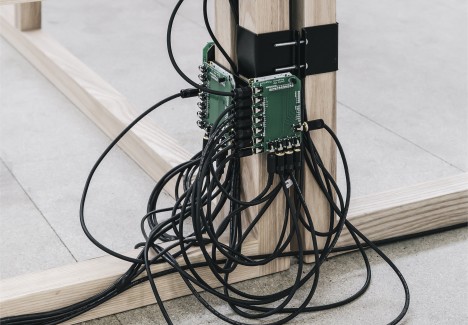
Designer Patrick Stevenson-Keating d Reeps record a bunch of different sound banks of samples, which were then loaded onto the program Ableton Live and mapped to trigger points on the playground. A product called ‘Electric Paint,’ which sends signals to the computer, is screen-printed onto paper tiles and covered in protective acrylic, acting as giant keys on a keyboard.
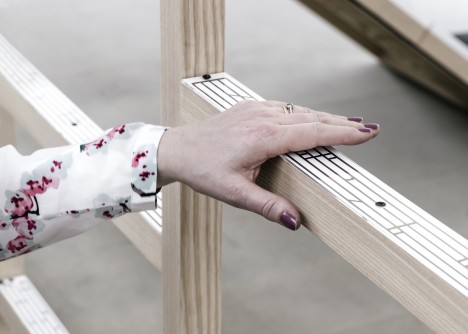
The wooden playground frame is like one big musical instrument in this sense, setting off cascades of sound as participants clamber up the steps or take a trip down the slide. In addition to the conductive paint on the wooden elements, the team integrated copper tape into the slide and conductive thread in the swings.

“We were always very clear from the start that we wanted ‘play’ to be an important part of the project,” the designer tells Bare Conductive. “…Often we communicate quite complex ideas or narratives, but by employing a playful strategy to do so, we can engage with the audience in more meaningful ways. This was certainly the hope for the Polyphonic Playground.”
Want More? Click for Great Related Content on WebUrbanist:

Beats on Fire: Music Visualized with Movement of Flames
We’ve seen what audio frequencies look like in mesmerizing resonance experiments using sand – so how does the same concept translate to a more …
Click Here to Read More »»
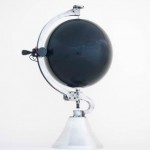
Sound of the Earth: Vinyl Globe Plays Music of the World
Spin this black globe and you’ll hear the music of the world. The Sound of the Earth by Yuri Suzuki is a spherical, interactive record player.
Click Here to Read More »»
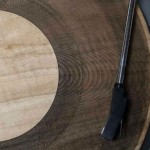
Laser-Cut Record: Music Etched Onto Slices of Wood
Slices of wood take the place of traditional vinyl in these beautiful hand-crafted, laser-cut records by designer Amanda Ghassaei.
Click Here to Read More »»


[ By Steph in Design & Products & Packaging. ]
[ WebUrbanist | Archives | Galleries | Privacy | TOS ]
-
Synth Series: Yarn Installation Represents Music in 3D
[ By Steph in Art & Installation & Sound. ]

An abandoned building becomes the setting for a surreal installation of colorful criss-crossing yarn as artist duo Toki seeks to render music in physical form. Recent architecture grads Toluwalase Rufai and Khai Grubbs present their visual soundscape as part of their ‘Synth’ series, temporarily altering public space “through establishing rhythm, movement, transparency, and ephemerality.”


The setting is a dilapidated building on the corners of Channing and Reed streets in Washington, D.C. It took the artists two days to install an undisclosed amount of yarn, winding it around support columns and occasionally using nailed-on boards for extra support. The project was completed guerrilla-style, and D.C. residents who tried to get in to see it in person report that it has since been cut down, with ‘No Trespassing’ signs posted on the property.


The first yarn piece Toki created was carried out in a more accessible place, enabling the public to watch the piece take form over a period of three days. They hoped that occupying an abandoned building would “engage the viewer on an urban exploration… inciting a sense of wonder.” This edition of the series may not have been up long, but there will be more installed throughout the Washington D.C. metropolitan area.


“Our initial decision to create this series was more impulsive than planned, and influenced by the desire to express the music we hear three-dimensionally,” say the artists. “These creations allow us to represent the sound of music as physical worlds. They start with lines of distinct colors you can follow and the more you immerse yourself, the more they blend in and the more you surrender to the symphony of color. Similar to music, the space we create allows you to slip between worlds, to be in two places simultaneously.”
Want More? Click for Great Related Content on WebUrbanist:
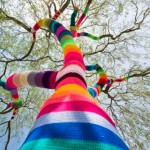
Yarn Bombs! 51 Victims of Knitted Graffiti
Yarn bombing is graffiti that grandmothers approve of! They consist of quickly knitted additions to street objects and sculptures. Why? Because it’s fun!
Click Here to Read More »»

Yarn Bomb Bus: Knitted Double Decker Cruises Around London
Has there ever been a cozier-looking bus cruising around the streets of London than this neon yarn-bombed double decker dubbed the No. 7up? The beverage brand …
Click Here to Read More »»
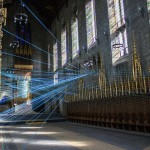
Light Lines: Stunning String Installation Inside Abandoned Church
What seems at first to be narrow rays of turquoise light streaming in through the stained glass windows of a vacant Gothic Revival church turn out to be over …
Click Here to Read More »»
[ By Steph in Art & Installation & Sound. ]
[ WebUrbanist | Archives | Galleries | Privacy | TOS ]
-
Weekly Photography Challenge – Music
This week the theme of the image collection was music – view the 35 magical musically inclined images here.

By Phil Hilfiker
Carrying forward, naturally your challenge this week will be involving music as well. That could look a few different ways depending on your own situation, what you have access to, and what’s in your area, including:
- photos of musical instruments (check with stores, they may be willing to lend you one to photograph or find a friend who has one)
- photos of people actually playing an instrument
- a rock concert
- a marching band or parade
- music CD, DVDs or old-time LPs
- a singer
- street musicians
What other ideas can you come up with for music?
Weekly photography challenge – music
Here are a few ideas to get you started:

By martinak15

By Caroline

By francesco ?2015?

By Adrien Sifre

By tanakawho

By Michael Kötter

By Fabrizio Lonzini

By Jorge Américo

By Georgie Pauwels

By JH Images.co.uk
Share your music images here:
Simply upload your shot into the comment field (look for the little camera icon in the Disqus comments section) and they’ll get embedded for us all to see or if you’d prefer upload them to your favourite photo sharing site and leave the link to them. Show me your best images in this week’s challenge. Sometimes it takes a while for an image to appear so be patient and try not to post the same image twice.
googletag.cmd.push(function() {
tablet_slots.push( googletag.defineSlot( “/1005424/_dPSv4_tab-all-article-bottom_(300×250)”, [300, 250], “pb-ad-78623” ).addService( googletag.pubads() ) ); } );googletag.cmd.push(function() {
mobile_slots.push( googletag.defineSlot( “/1005424/_dPSv4_mob-all-article-bottom_(300×250)”, [300, 250], “pb-ad-78158” ).addService( googletag.pubads() ) ); } );The post Weekly Photography Challenge – Music by Darlene Hildebrandt appeared first on Digital Photography School.
-
How to Secure Your First Music Gig Photo Pass
The hardest part about gaining a photo pass for a large gig is in needing a strong portfolio of concert photos – getting a portfolio of works together when you can’t get access to shows makes things quite tricky. This article will explore how to build your first portfolio and in turn how to secure your first photo pass.
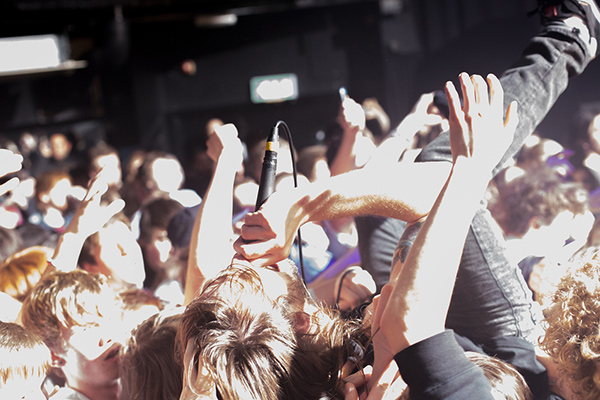
While She Sleeps, shot for Brighton Noise
Get the gear
A lot of photographers will say it doesn’t matter which gear you have, and that it’s all about how you use what you’ve got. I completely disagree with this for music photography, you will need a fast lens – gigs are one of the darkest and dingiest places you will ever shoot, you will need something with at least an f/2.8 aperture. I highly recommend, for those on a budget, a 50mm f/1.8 – these can be picked up for around $ 100, and when shot with the aperture wide open will immediately put your work above those shooting with an f/3.5-5.6 kit lens.
As you shoot more shows, you’ll find the style you want, and as such will slowly upgrade your kit. I find my current set-up a dream, the Canon 6D mounted with the Tamron 24-70 f/2.8, a coupling that is perfect for low-light gig photography.
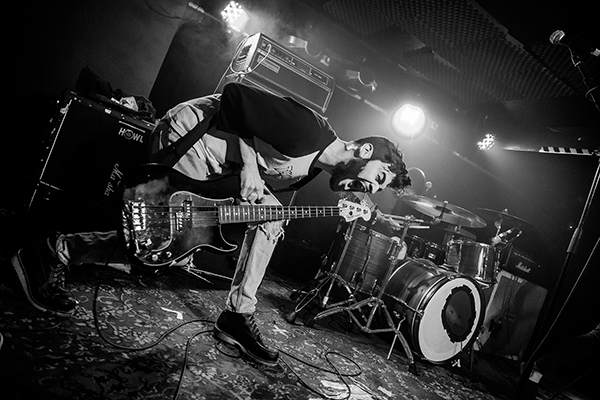
Howls, shot for Make a Scene Promotions
Know the rules
Before shooting any shows, it is important to know the rules. Unless you have explicit permission from the bands, managers or promoters, only shoot for the first three songs and don’t use a flash. These are rules you will have to stick to when shooting big shows so get used to them early. Learning to shoot in low light without a flash will push you as a photographer; while only having 10-15 minutes to cover a performance will make you think on your toes and focus on every opportunity.
Start local
Once you know the rules and have the right gear it’s time to start networking. A lot of photographers will just turn up to a gig and start shooting without knowing the bands, promoters or managers, or without asking. This can cause issues and I would not recommend it. Sometimes bands can be very protective about their image and might not actually want their photos taken, so always secure some sort of permission.
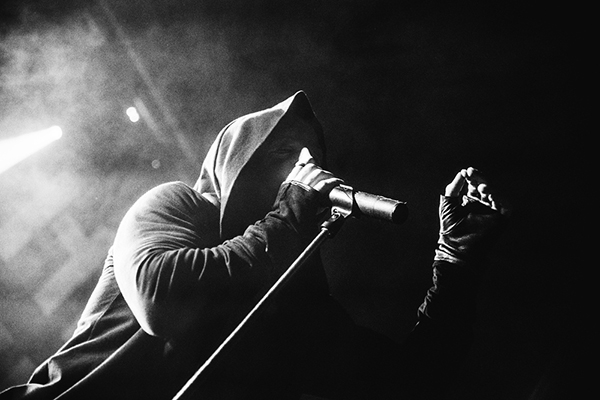
The Dillinger Escape Plan, shot for Brighton Source
The best way get in with the right people is to find a local venue and become a regular. Get to know the staff, the punters, the bands, and start networking. This isn’t to say push it in everyone’s face, but after you’ve watched a good band let them know you enjoyed it and mention that you’d love to shoot them live sometime, swap details, shake hands and continue drinking your beer while watching the next band.
Starting locally will offer you a chance to network with bands that are eager for good photos of themselves. They are all after strong imagery to promote themselves and will often be keen to have a photographer cover their shows. They will also be pretty poor, so don’t expect to get paid for anything when you first start. Shooting locally, in this way, will spread your name and will help you to start building a strong portfolio – thus give you the starting blocks for talking to the larger bands, promoters, venues and even magazines.
Once you’ve covered a good number of local gigs and have a variety of photos from different shows, it’s time to start looking for larger opportunities and looking at the bigger bands and venues.
Aim big
So now that you’ve got a portfolio of great photos from all the local shows you’ve covered, it’s time to market yourself. Chances are most of the people who have control of the photo passes have no idea who you are, so ensure you have an online presence. When talking shop you’ll need a simple way to show your work, so a website is best. You won’t need any big bands in the portfolio but simply proof that you’re an awesome band photographer. I’d also recommend getting a Facebook page, and a Flickr or 500px page that only shows your best work. You will be judged on the worst photo in your portfolio.
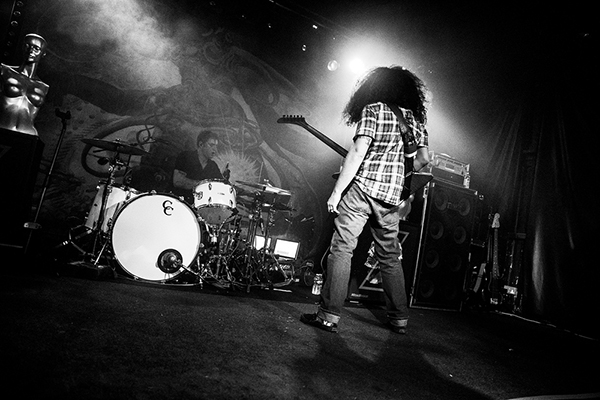
Coheed & Cambria, shot for Brighton Source
So the tricky part is now in finding a publication to work with, to get you your first major photo pass. I started by checking out all the gigs at the local major venues and Googling them a few days after the show to find out who covered it. Try something as simple as “Coheed and Cambria Brighton”. This will give you a list of publications to contact, and then simply drop them an email saying that you are looking to cover a few upcoming shows for them, and that they can see your work at your website. Chances are they will say that they already have it covered. However, it’s putting yourself in front of them so that when a photographer drops out of a show they will have someone to call, you.
What if there aren’t any local publications covering shows in your area? Then it gets a bit trickier, but the methodology is the same, find shows you want to cover and find out who is running them. Email the promoters and the band managers, show them your work, and offer them high resolution copies of all the best photos for them to use to promote themselves. The promoters will likely want these to show how good their shows are – although it’s important to remember that these bigger bands probably already have an awesome collection of photos, so you have to really shine both in your conversation and your portfolio.
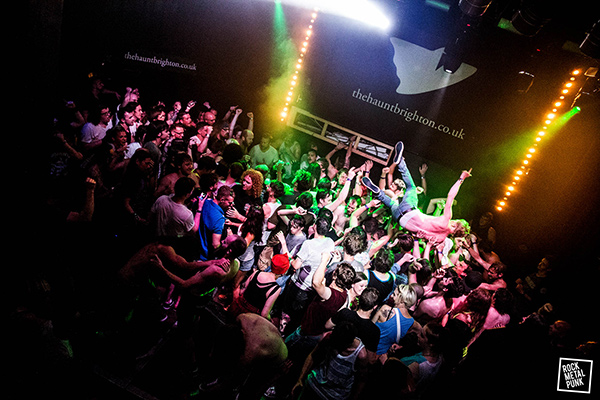
Andrew WK, shot for RMP Magazine
Success
So it’s finally happened, the local publication got back to you saying they love your work and they want some coverage of the next big show in town, now it’s time to do your thing. Remember to prepare everything way before hand; charge your batteries, empty your memory cards, clean your lenses, prepare your photo pass (if this is simply an email print it out), arrive on time, be polite to everyone and abide by the first three songs, no flash rules.
Once the show is over it’s important to ensure you get the photos to the relevant contact as fast as possible. I will normally edit all the photos as soon as I get home and submit them straight away. This is important because shows are time sensitive, people will be looking for the reviews and the photos the next day, so you need the photos with the promoters, bands or publications literally ASAP.
At this point you will now have an even bigger and stronger portfolio, so now you can start to outreach with even bigger publications, bands and promoters. Before you know it you’ll be the centre-fold of your favourite magazine.

Bleed from Within, shot for ALT.promotions
A few tips
You will likely get offered drinks at some point. Remember, don’t drink too much, you are representing either a promoter, a band or a publication, being a drunk photographer will not reflect well and will likely lose you access to the next show – drink Red Bull instead.
Also don’t forget how you managed to get to cover that Dillinger Escape Plan or Andrew WK show, it all started locally with small bands – always remember those guys and continue working locally where you have time. It will improve your techniques, give you an even bigger portfolio and will make you feel good for creating great photographs for local talent.
Are you ready to give it a go and get your first gig photo pass?
The post How to Secure Your First Music Gig Photo Pass by Will Barnes appeared first on Digital Photography School.
-
Beats on Fire: Music Visualized with Movement of Flames
[ By Steph in Gadgets & Geekery & Technology. ]

We’ve seen what audio frequencies look like in mesmerizing resonance experiments using sand – so how does the same concept translate to a more volatile medium? The science video blog Veritasium carried out an experiment that uses flammable gas to create the pyromaniac music lover’s dream: an audio visualization in the form of fire.

It all comes down to the vibrations produced by sound. Veritasium teamed up with physics and chemistry demonstrators to create a ‘Pyro Board’ based on the Rubens’ Tube, also known as a standing wave flame tube. Invented by a German physicist, the Rubens’ Tube shows the relationship between sound waves and sound pressure.

Sealed at both ends and perforated along the top, the pipe is attached to a speaker or frequency generator at one side and a supply of flammable gas at the other. Variations in sound cause vibrations in the air to affect the flow rate of the gas, causing the flames to change in height.

The team translated this idea to two dimensions with what’s essentially a plane of bunson burners, with 2,500 holes. The louder the music is played, the higher the flames become.
Want More? Click for Great Related Content on WebUrbanist:
Sound of the Earth: Vinyl Globe Plays Music of the World
Spin this black globe and you’ll hear the music of the world. The Sound of the Earth by Yuri Suzuki is a spherical, interactive record player.
Click Here to Read More »»
Laser-Cut Record: Music Etched Onto Slices of Wood
Slices of wood take the place of traditional vinyl in these beautiful hand-crafted, laser-cut records by designer Amanda Ghassaei.
Click Here to Read More »»

SoundTank: Mobile Sound System or Armored Vehicle?
The SoundTank is an imposing sound system with a speaker-covered, faceted hydraulic lid capable of pushing out 4,000 watts.
Click Here to Read More »»
[ By Steph in Gadgets & Geekery & Technology. ]
[ WebUrbanist | Archives | Galleries | Privacy | TOS ]
-
Can’t Stop the Music: Submerged Turntable Plays Perfectly
[ By Steph in Art & Installation & Sound. ]
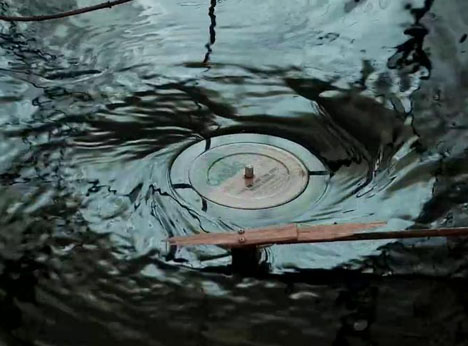
What will become of all that humans have created when we’re no longer on the planet to preserve it? This project by artist Evan Holm is both a nod to the grief that the mere thought of losing so much art, architecture, music and other culturally significant creations can incite, and hope for a new beginning. ‘Submerged Turntables’ play music perfectly even when placed underwater, spinning in a black pool.
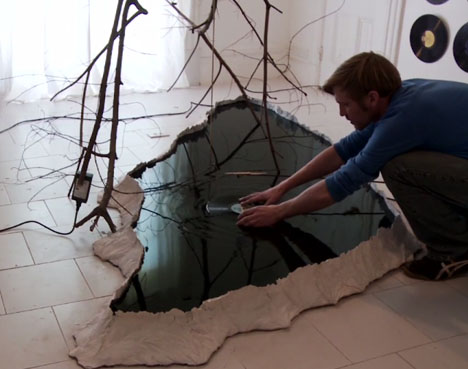
Watching the record swirl in the water is an eerie sight, powerfully evoking visuals of the monster floods we’ve watched wipe out human settlements in epic disaster movies as well as in real life. The knob to control the record player is built into a branch that hangs over the pool. The video below shows the process of setting up the installation.
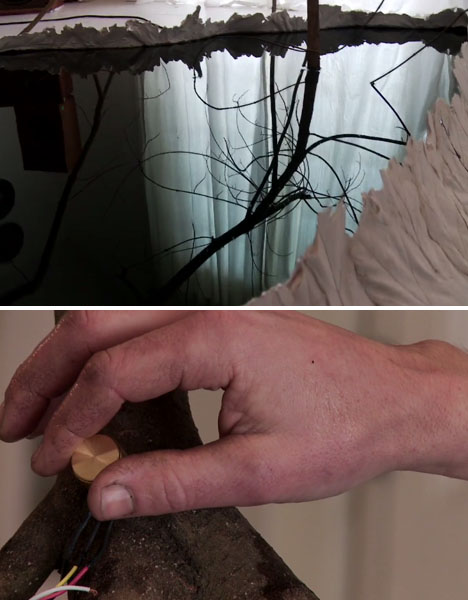
“There will be a time when all tracings of human culture will dissolve back into the soil under the slow crush of the unfolding universe,” says Holm. “The pool, black and depthless, represents loss, represents mystery and represents the collective subconscious of the human race. By placing these records underneath the dark and obscure surface of the pool, I am enacting a small moment of remorse towards this loss.”
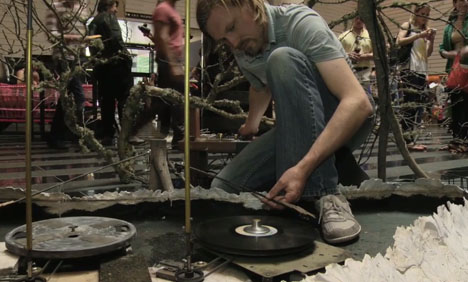
“In the end however this is an optimistic sculpture, for just after that moment of submergence; tone, melody and ultimately song is pulled back out of the pool, past the veil of the subconscious, out from under the crush of time, and back into a living and breathing realm. When I pe
Want More? Click for Great Related Content on WebUrbanist:
Sound of the Earth: Vinyl Globe Plays Music of the World
Spin this black globe and you’ll hear the music of the world. The Sound of the Earth by Yuri Suzuki is a spherical, interactive record player.
Click Here to Read More »»
Laser-Cut Record: Music Etched Onto Slices of Wood
Slices of wood take the place of traditional vinyl in these beautiful hand-crafted, laser-cut records by designer Amanda Ghassaei.
Click Here to Read More »»
City of Sounds: Scale Model Plays Urban Soundtrack
Every city has its own unique sound, but until now those sounds have been less than musical. This unique project turns the city itself into an instrument.
Click Here to Read More »»
[ By Steph in Art & Installation & Sound. ]
[ WebUrbanist | Archives | Galleries | Privacy | TOS ]
-
Shoot Great Concert Photos & Win a Trip to Way Over Yonder Music Festival

Whether you’re a festival fanatic or haven’t seen a concert in years, we’ve got something you might like.
We’ve teamed up with Scoutmob, Paste Magazine and Hotel Tonight to send one lucky winner (& pal) to Way Over Yonder festival in Santa Monica, California.
Flights, hotel, festival tix (VIP, natch) and gift cards to the Scoutmob and Photojojo stores are included. And it takes all of 5 seconds to enter!
Enter to go to Way Over Yonder, free!
And… while you’re waiting to see if you won, improve your concert photography skills with a few of our favorite guides:
- Music Photography Made Simple
- Music Photographer’s Guide to Festival Photography
- Concert Photography Tips From Digital Photography School
p.s. A new iPhone is coming! To celebrate, every checkout in the shop gets free enrollment into our Phoneography 101 course today.
Related posts:
- Rockin’ Photography: How to Shoot Great Concert Photos It’s all about the D&B. (Dark and blurry.) If you’re…
- Get Out and Shoot! — 3 Great Ideas for Shooting Outside in Your Town or City There’s one sure-fire way to improve all of your shots:…
- Shoot to Sell: Taking Better Photos for eBay, Etsy & Instructables We’ve teamed up with our buddies at Instructables to…
-
Sony announces action cam, wrist controller and music video recorder

Sony has updated its Action Cam with a new name, a lighter waterproof housing, and GPS. The Action Cam HDR-AS30V can capture an 11.9-megapixel still image on its back-illuminated Exmor R CMOS sensor as well as Full HD footage. Its new waterproof housing is smaller and lighter than its predecessor, and also a little less rugged. Built-in Wi-Fi offers easy connectivity to a smartphone, as well as the new Live View Remote wristwatch. Click through for more details of this, and also the new ‘Music Video Recorder’ announced at the same time.
-
Human Harp: Suspension Cables on Bridge Make Music
[ By Steph in Art & Installation & Sound. ]

A digital and mechanical module that fastens onto bridges and connects via retractable strings to a wearable suit creates a ‘human harp,’ a musical collaboration between the user and the bridge. The harpist moves in a sort of dance to pull the strings, creating the sounds, which are felt in real-time through vibrations on the bridge. The installation will travel to bridges around the globe, so pedestrians have a chance to try it out for themselves.
London-based artist Di Mainstone got the idea when looking at the Brooklyn Bridge during a residency in New York City, and seeing its similarity to the musical instrument. She envisioned a clip-on sound interface that would allow pedestrians to ‘play’ the bridge as if it were really a harp.

The Human Harp was created by a collaborative team of artists, e ngineers and researchers using cutting-edge technology. The modules on the device utilize magnets in acrylic bubbles to detect the angle of the ropes. The movements are processed using software packages to generate the sounds. Watch the video to get an idea of the process.

“As I listened to the hum of the steel suspension cables, the chatter of visitors and the musical ‘clonks’ of their footsteps along the bridge’s wooden walkway, I wondered if these sounds could be recorded, remixed and replayed through a collaborative digital interface? Mirroring the steel suspension cables of the bridge, I decided that this clip-on device could be harp-like, with retractable strings that physically attach the user or Movician’s body to the bridge, literally turning them into a human harp.”

“We could imagine this process is a game of international research whispers, with information passing from one laboratory onto another. All hubs will be integral to this dialogue, as the Human Harp develops and grows on its journey around the globe.”
[ By Steph in Art & Installation & Sound. ][ WebUrbanist | Archives | Galleries | Privacy | TOS ]


