Sony has released updates to its popular RX-series compact cameras, leaving the externals pretty much unchanged, but with a major update to their sensors. Both the RX100 IV and RX10 II feature a newly-developed 1inch 20MP stacked CMOS sensor, which allows them to capture 4K video and a whole lot more besides. We’ve had our hands on pre-production samples and you can see (and read) more after the jump
Tag: fully
-
3D Farming: Trees Grown into Fully Shaped & Formed Furniture
[ By WebUrbanist in Design & Furniture & Decor. ]

Taking arborsculpture to new levels of efficiency and functionality, this furniture designer creates plastic molds in which his designs are grown without needing to be sawed and shaped after the fact, reducing waste and streamlining the production process. Light, soil and air are the equivalent of filament in this organic 3D printing analog, and even more directly: the molds can be 3D-printed as well.

While requiring careful planning and additional work upfront, taking young willow, oak, ash and sycamore trees and turning them as they grow into chairs, tables and lamps both shortens the construction cycle and eliminates the need to reconnect disparate pieces.


Founder of Full Grown in Derbyshire, England, Gavin Munro aims to challenge “the way we create products as well as how we see the items with which we surround ourselves, the Grown Furniture has an immediate tactile, visceral and organic appeal.”

Gavin thinks of this process as a kind of “organic 3D printing that uses air, soil and sunshine as its source materials. After it’s grown into the shape we want, we continue to care for and nurture the tree, while it thickens and matures, before harvesting it in the Winter and then letting it season and dry. It’s then a matter of planing and finishing to show off the wood and grain inside.”

The notion of shaping trees as they grow on a massive scale is not a novel one – similar techniques have long been employed in vineyards to maximize growth and optimize grape picking. Even the idea of growing fully-formed furniture is not new – artists and designers have long shaped living trees to create objects of use. As far back as Ancient Greece, chairs were ‘built’ by digging out chair-shaped holes and allowing them to fill with root structures before being ‘harvested’ from the ground.

Still, the scale and ambitions here are, however, much bigger – creating full crops of grown furniture, turning a one-off idea into a potentially mass-produced (but always unique) product line.

Each furniture piece takes a few years to grow and maintaining this ‘forest of furniture’ is nothing if not challenging: “I’m only making 50 or so pieces per year but for every 100 trees you grow there are a 1,000 branches you need to care for, and 10,000 shoots you have to prune at the right time.”

Still, the results are worth the effort in the mind of this maker: “They’re still growing now, but when harvested and finished we expect them to be not just fully functional and ergonomic but grown, grafted and fastened into one solid piece, [meaning] no joints that only ever loosen over time. These could last for centuries. We hope and trust that this will eventually become an improvement on current methods.”
Want More? Click for Great Related Content on WebUrbanist:
Redefining Rustic Materials: 6 Modern Log Furniture Makers
Logs typically conjure images of remote cabins and plaid-clad workers felling trees. As these seven creative designers and craftspeople show, though, log …
Click Here to Read More »»
Bizarre Banzai: 32 Wildly-Shaped Trees & Strange Bonsai Art
Some forms of sculpture take a bit more patience than others. Plant shaping and bonsai pruning are the perfect examples of natural art.
Click Here to Read More »»
Arbosculpture to Overgrowth: 25 Seriously Twisted Trees
From tree furniture designs to unchecked acts of nature here are 25 examples of the amazing malleability of trees.
Click Here to Read More »»


[ By WebUrbanist in Design & Furniture & Decor. ]
[ WebUrbanist | Archives | Galleries | Privacy | TOS ]
-
Prototype battery fully charges in under 30 seconds

While smartphone processing power, screen resolutions and camera performance have all improved significantly over the last few years, one area of development is seemingly standing still. Under heavy use most smartphone batteries still won’t make it through the day, and once plugged in, devices take a long time to charge. Faster charging batteries are certainly welcome news to smartphone and tablet users but could also reduce the need for carrying spare batteries on longer photographic excursions. Learn more
-
Fully loaded: Pentax K-3 review

Pentax cameras have always been innovative, and Ricoh has upped the ante with the K-3. Its image stabilization system not only reduces shake, but it can also simulate an anti-aliasing filter. The K-3 marks the latest evolution of one of the best-handling DSLRs in its class. It features a new autofocus system, 24 megapixel CMOS sensor, 8.3 fps continuous shooting, and USB 3.0 support. Has Ricoh put together a top-notch DSLR in the K-3? Read our review to find out
-
7 February, 2014 – The Phase One IQ250 CMOS Fully Realized

The NEW Phase One IQ250 has received a lot of press in the last few weeks. We had a chance to work with this new back as well as share it with a number of participants on our recent Antarctica workshop. Look for an article on how it performed soon. Today, Doug Peterson of Digital Transitions shares a behind the scene look at what it took for Phase One to bring this new CMOS chip back to market. Read Doug’s article – The Phase One IQ250 CMOS Fully Realized.
-
Y SIN EMBARGO magazine #16 (free, fully bilingual)
Check out these visual art images:
Y SIN EMBARGO magazine #16 (free, fully bilingual)
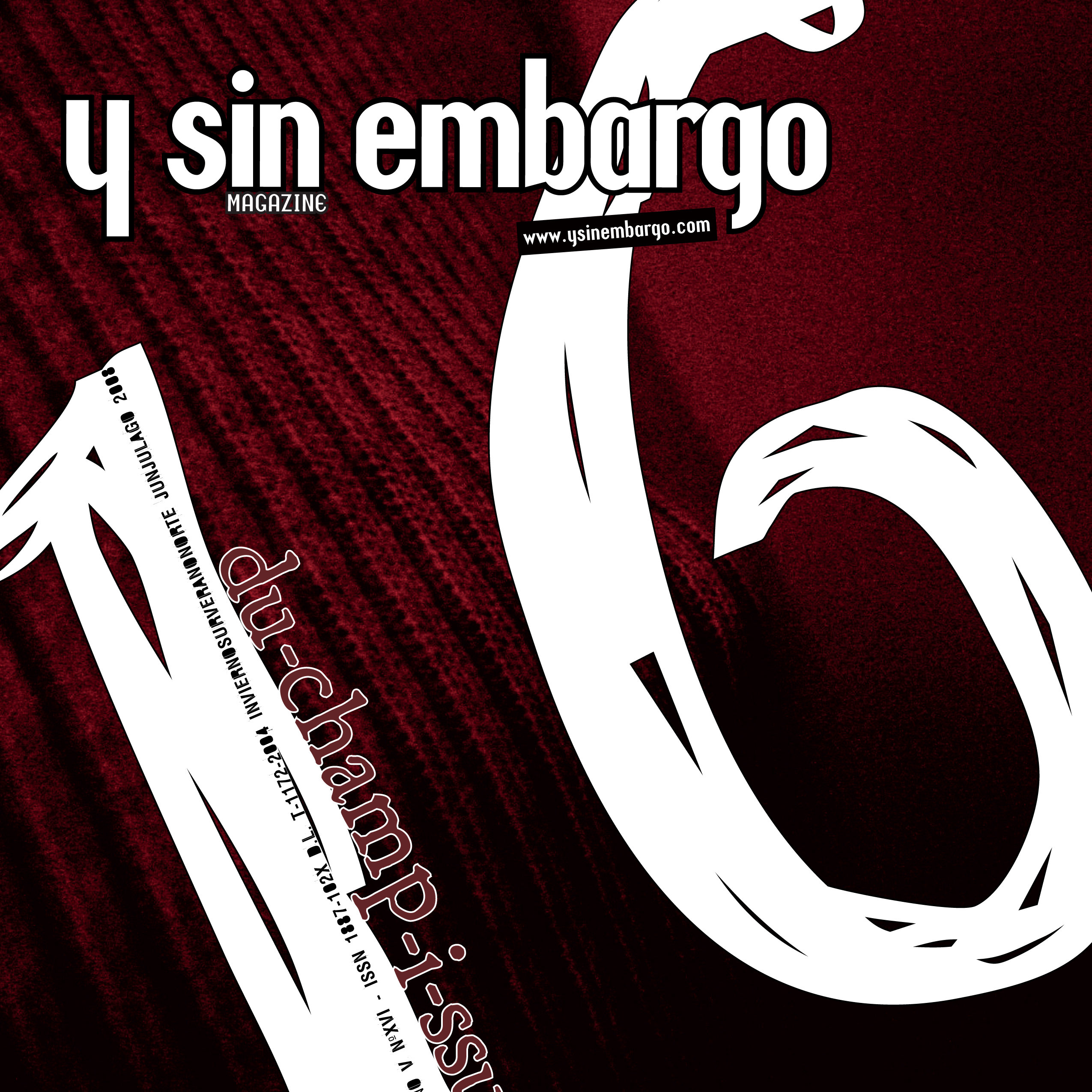
Image by fernandoprats [@ theGlif+]
"du-champ-i-ssue"
jun.jul.ago.2008 | inviernosurveranonorte
ISBN: 978-1-4092-5339-6ON PAPER
PDF
NAVIGATE it
Hi-Res PDFUn número dedicado a explorar la visión y propuestas de Marcel Duchamp.
No su vida, no su obra; tan sólo algunos de sus conceptos.
Realizado con aportes de artistas, pensadores y diseñadores de todo el mundo
combinados con la explícita intención de producir a su vez un objeto duchampiano.
-el medio como instrumento intelectual que transpasa su especificidad y se burla de ella
-la obra independientemente de su carácter representativo e interpretativo
-”arte”, en términos de convenciones, lo más “amorfo” posible
-”obras” en las que la obra no es una finalidad en sí misma sino una excusa
-interpretaciones o, mejor dicho, lecturas que pueden convivir a pesar de ser aparentemente excluyentes
-objetos “anestesiados estéticamente”, anulados en su probable complacencia de la mirada, “rectificados”,”asistidos” para otorgarles una nueva -a menudo, insólita- significación. Como en la elección de los “ready-mades”: “basada en la indiferencia visual y en la ausencia total del buen o mal gusto”
-obras “definitivamente inacabadas”
-rrose sélavy, su alter(-)ego
-ajedrez, máquinas ópticas, matemáticas, geometría, “artefactos”
-la “pintura mental”, “pintura de precisión”, el rechazo de cualquier elemento en el que la mirada se pueda recrear con fruición-texto, – bloques, – fotografías, + mixed-media, + pintura, + ilustración.
-toda la revista está en castellano e inglés.(descárgala gratis y comienza felizmente el verano -o el invierno-)
# # #
This issue plays around the conceptual universe of Marcel Duchamp. Not his life, nor his works, just some of his concepts.
– the medium, as an intellectual tool which goes beyond its specificity mocking it.
– the work, regardless of its representative and interpretative character.
– “art”, in terms of conventions, as “amorphous” as possible.
– “construction”, in which the work is not it’s purpose, but an excuse.
– interpretations, or rather readings which can coexist despite being seemingly exclusive.
– objects “aesthetically anesthetized,” lapsed in their likely sight complacency; “rectified”, “assisted”, to give them a new –often unusual- significance. As with the choice of “ready-mades”: “based on visual indifference and a total absence of good or bad taste”
– works “definitively unfinished”.
– rrose sélavy, his alter (-) ego.
– chess, optic machines, mathematics, geometry, “artifacts”.
– “mental painting,” “precision painting”, the rejection of any element in which sight can be delighted.– aesthetics: – text, – blocks, – photographs, + mixed-media, + painting, + illustration.
– the whole magazine, in spanish and english.(download it. it’s free. and start enjoying summer -or winter-)
# # #
edit(ing), direct(ing) + complements
fernandoprats
art direct(ing) + design(ing)
estudi prats
insistAnçao, correct(ing) + additional stuff
r | v
listen(ing)
hernán dardes
musicaliz(ing)
albert jordà
translat(ing)
kiddo | emilia cavecedo
frontcover(ing) concept fot
une autre sensualité
backcover(ing) concept borrador
UU – dou _ ble _you et aa
open(ing) concept
nacho piédrola + salaboli & fp porta-structure:
accesories, lisa kehoe { kiddo | emilia cavecedo, lisa liibbe lara, josean prado, oriol espinal, mark valentine sullivan, hernán dardes, alfredo de la rosa, jonathan minila } => meta
{ pepo m.-the secret society, r | v, leah leone } => hilarious
{ pancho lorenz, natalia osiatynska } fernandoprats => rage=> meta kiddo | emilia cavecedo, nacho piédrola, salaboli, lisa kehoe { lisa liibbe lara, mark valentine sullivan + shari baker, oriol espinal, gabriel magri, naomi vona, mara carrión }
=> hilarious { d7, olivier gilet, jef safi, special spatial guests }
=> rage { brancollina, gabriel magri, natalia osiatynska, bill horne, UU, christy trotter } simon fröehlichysinembargo#16… sensualmente inacabada.
a b r e l a m u r a l l a
antwerp · barcelona · basauri · boulder · bruxelles · buenos aires · carlsbad · collioure · coyoacán · grenoble · holden beach · iowa city · lawrenceville · lansing · london · madrid · mendoza · mexicali b.c. · milano · san francisco · san rafael · sào paulo · tarragona · warsaw# # #
YSE #16’s Original Music | YSElected videos
# # #
Official WEBsite | MySpace | Flickr Group
Greenpoint Studio 1

Image by Madilworth
Banners from the Art & Law Exhibition:The project takes its name from the latitudinal circle that divides the globe into north and south, the same circle that was used to draw the U.S. Mason-Dixon Line.
This historically important demarcation remains critical to global trade today, as a home to global economic centers and as a mediator of labor markets and migration.The composition is constructed from visual references to global trade and labor. An initial interest in the African American Burial Ground in lower Manhattan lead to research on the quilt patterns used for communication in the Underground Railroad, a system of iconic visual communication that was integrated into trade routes.
Its pattern, inspired by quilt design, is populated by a hybrid iconography drawn from states’ flags and emblems as well as the logos of companies with a relationship to the 36 ° 30’ parallel, cumulatively weaving together a history of global trade.Machinery (Abstract #2) by Paul Kelpe
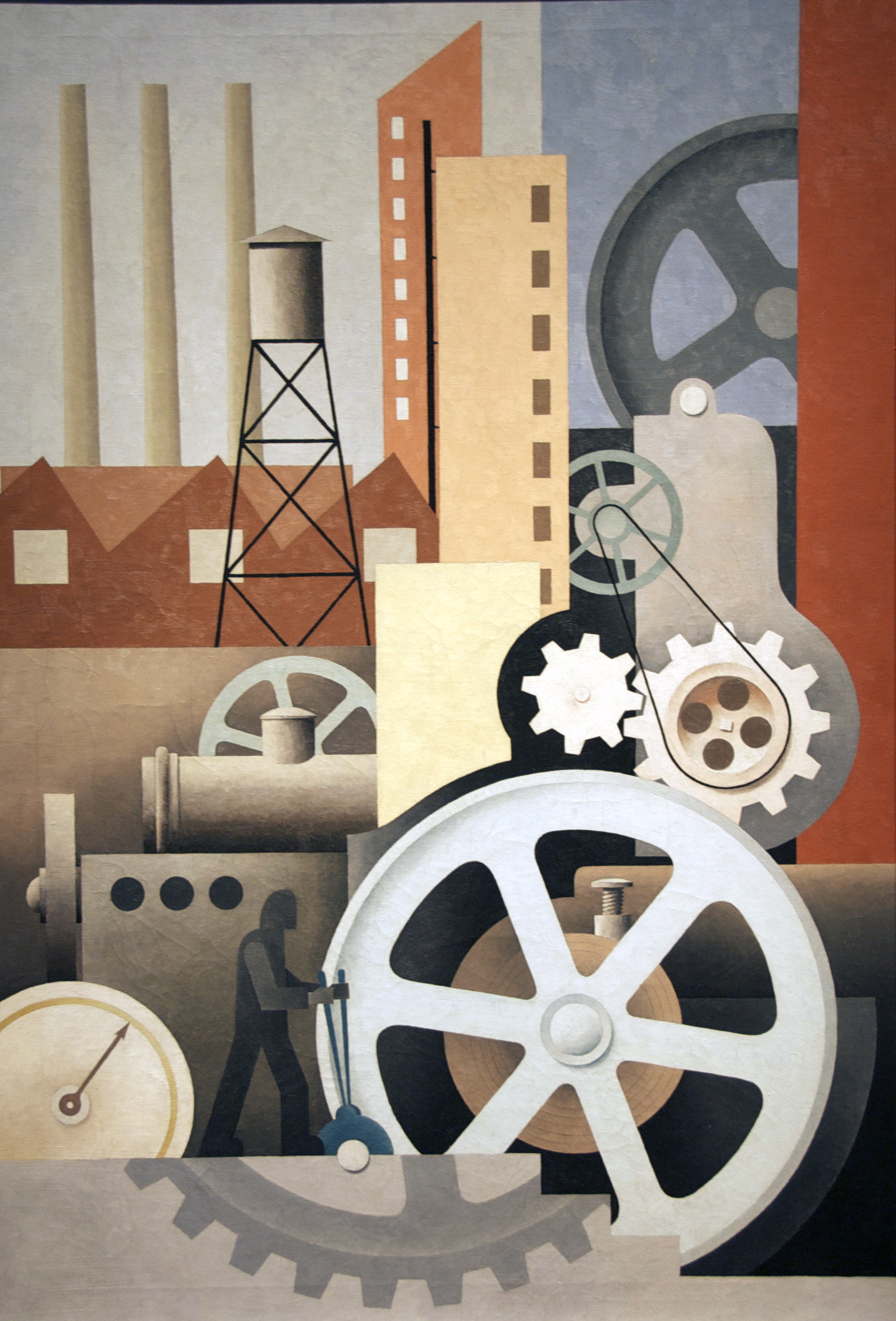
Image by ctankcycles
What kind of industry does the man holding the levers control in Paul Kelpe’s painting Machinery. There are no hints; the smokestacks emit no smoke and no product piles up on the factory floor. In fact, Kelpe’s mechanism manufactures nothing. He was actually an abstract painter whose concerns were aesthetic. In his paintings for the Public Works of Art Project, he knew that he needed to somehow address "the American Scene." "As they refused to accept ‘nonrepresentational’ art," he said, "I made a number of pictures with geometric machinery." But Kelpe, unlike the many PWAP artists who factually depicted industrial scenes, studied no real-life factories. He created his own independent visual world, reflecting the kind of technological progress of which Americans were proud. The artist thoughtfully balanced large and small shapes, warm and cool colors, to create a harmonious mechanistic vision. A pattern of diagonal brushstrokes on the painting’s surface catches the light to suggest action. The wheels seem to turn with the soft hum of a well-tuned machine.1934: A New Deal for Artists exhibition label
The shadowed worker in this painting appears to be controlling the structure, suggesting man’s essential role in industry and his ability to create massive, powerful machines. During the Depression, many artists celebrated human achievements in this way, to emphasize the importance of the working class and to boost morale. In 1934, Paul Kelpe worked for the Public Works of Art Project. The program did not accept abstract art, so he incorporated realistic elements such as figures, wheels, and buildings into his compositions. These images were still not "representational enough," however, and he soon gave up trying to please his bosses (Manthorne, Paul Kelpe, Abstractions and Constructions, 1925-1940, 1990).