RSS
 

Posts Tagged ‘Failures’

My Biggest Photography Failures and What I Learned

12 Dec

Success 1

“Success is a poor teacher. We learn the most about ourselves when we fail, so don’t be afraid of failing. Failing is part of the process of success. You cannot have success without failure.” – Rich Dad, Robert Kiyosaki

I was at a high-pressure shoot recently, and one of my clients was watching me make adjustments to my camera and lighting. They commented, “How do you remember all that stuff? You make it all look so effortless.”. The truth is that after thousands of photo shoots it has become second nature, but this wasn’t always the case.

Success 2 1

I broke a wedding.

Why am I always checking and rechecking exposure? Because I broke someone’s wedding. Yep, broke it.

The wedding was ten years BD (before digital) and very early in my career. I was so inexperienced that I didn’t realize the flash tube on my external flash was only emitting about 1/4 of its power and, as a result, I underexposed all the images by three to four stops. They could not be salvaged. I only managed to get one useable frame.

At the time, I just wanted to crawl into a hole and stay there, but this nightmare scenario defined the style of fill flash lighting I still use today.

I also developed a pre-shoot protocol that ensured I would never have this kind of disaster again. I always test all my equipment before a shoot and check and recheck exposure as I’m shooting.

“Fears are nothing more than a state of mind. Most great people have attained their greatest success just one step beyond their greatest failure.” – Napoleon Hill

If I had not experienced this crushing blow early in my career, I might have become more slap dash as a photographer and prone to more failures, steering my career to go in another direction.

Trevor Dennis

By Trevor Dennis

Why do I always use a light meter? Because I ruined the shot of my life by looking at my camera screen for the exposure and my hair light ended up being three stops over exposed. That shot should have stopped traffic. Instead, I lost a client.

Why do I back up twice while I’m shooting? Because an assistant (accidentally) dumped an entire shoot into the trash. I’m still in need of therapy over that one.

I’m proud to admit that I have failed spectacularly on countless occasions.

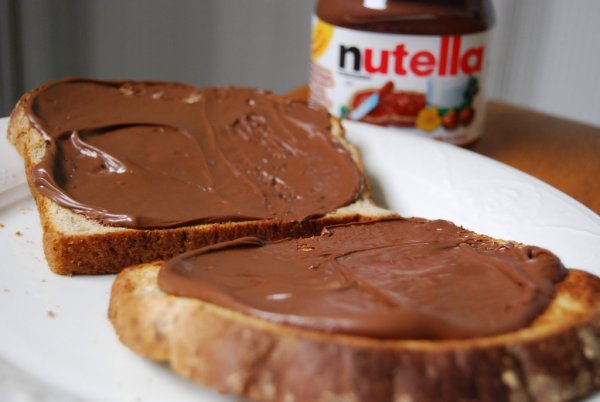
The aftermath was always the same. I’d have a complete meltdown and become a bit tired and emotional. I’d then spend a week at home curled up in the fetal position watching entire seasons of One Tree Hill and consuming my body weight in Nutella.
Janine

By Janine

As painful as each failure is, I learned something new each time, and I never made those mistakes again. They became burned into my brain.

“Failing is one of the greatest arts in the world. One fails toward success.” – Charles Kettering

You need to go out and fail, time and time again. Get up, cry for a bit, learn, grow, and move on.

At the time, these failures were devastating but I now know that my spectacular failures and toughest moments have been my greatest teachers and have molded me into the photographer that I am today.

I’m also proud to be part of a massive club of spectacular failures who have all gone on to achieve remarkable success.

Here are a few of my favorites:

  • Comedian Jerry Seinfeld completely froze during his first stand up gig and was booed off stage. He went back the next night was a huge success and went on to become one of the most successful American comedians in history.
  • Elvis Presley got fired from one of his first gigs and was told, “You ain’t goin’ nowhere, son. You ought to go back to drivin’ a truck.” Elvis Presley is one of the greatest recording artists of all time.
  • Oprah Winfrey (my hero) was fired from her television reporting job because TV executives thought she wasn’t fit to be on screen.
    She went on to create and star in “The Oprah Winfrey Show” the most watched talk show in the world, turning Oprah into a billionaire.
  • Winston Churchill failed grade six and lost every government position he ran for. He went on to become British prime minister at the age of 62.

Success 3 1

And one of my all time stories of how failure led to success is Apple founder, Steve Jobs. He was devastated after being removed from the company he started. Years later in a commencement speech at Stanford University he reflected:

“I didn’t see it then, but it turned out that getting fired from Apple was the best thing that could have ever happened to me. The heaviness of being successful was replaced by the lightness of being a beginner again, less sure about everything. It freed me to enter one of the most creative periods of my life.”

When he returned to Apple, he created some of the most iconic products in the world, including the iPhone, iPad, iPod, and he went on to become one of the richest men in the world.

“Never, never, never give up.” – Winston Churchill

Have you experienced any spectacular failures, and what have you learned from them? What are your strategies for coping with failure? I’d love to hear from you.


Gina is the author of four dPS eBooks including:

  • Portraits: Making the Shot
  • Portraits: Striking the Pose
  • Portraits: Lighting the Shot
  • Portraits: After the Shot

You can buy one for $ 19.99 or grab the whole bundle for only $ 49.99 (save 38%) from any of the links above.

googletag.cmd.push(function() {
tablet_slots.push( googletag.defineSlot( “/1005424/_dPSv4_tab-all-article-bottom_(300×250)”, [300, 250], “pb-ad-78623” ).addService( googletag.pubads() ) );
} );

googletag.cmd.push(function() {
mobile_slots.push( googletag.defineSlot( “/1005424/_dPSv4_mob-all-article-bottom_(300×250)”, [300, 250], “pb-ad-78158” ).addService( googletag.pubads() ) );
} );

The post My Biggest Photography Failures and What I Learned by Gina Milicia appeared first on Digital Photography School.


Digital Photography School

 
Comments Off on My Biggest Photography Failures and What I Learned

Posted in Photography


Fallen Starchitects: 7 Failures of Famous Architects

24 Feb

[ By Steph in Architecture & Offices & Commercial. ]

Architectural Failures 1

Even the world’s most famous and celebrated architects have their failures, whether due to unforeseen consequences of an extraordinarily complex design or just plain shoddy construction. From the mold and cracks in Frank Lloyd Wright’s masterpiece Fallingwater to downright dangerous flying roof panels at Calatrava’s opera house in Valencia, these structural defects have led to injuries, lawsuits and in some cases, potential razing of a project before it’s even opened to the public. You can’t quite call these buildings outright failures just because they’ve got structural issues, especially since some of them are already iconic. But is this what happens when architects neglect practical considerations in favor of bold aesthetics?

Mold and Structural Failures: Frank Lloyd Wright’s Fallingwater

Architectural Failures Fallingwater 1

The masterpiece of perhaps the only architect who’s a household name in America, Fallingwater by Frank Lloyd Wright was a fantasy home, a grand experiment that sought to push the boundaries of existing technology and building methods of the time. Cantilevered over a waterfall on Bear Run in rural Pennsylvania, the residence is undeniably stunning. Who wouldn’t want to live in a house perched right over the water, constantly filled with aquatic sounds and reflections? Anyone who’s ever dealt with mold. Fungal growth and excess humidity got so bad so quickly, owner Edgar Kaufmann nicknamed the house ‘Rising Mildew.’ And that’s just one of the major problems that began to plague the house almost immediately after it was built.

There were conflicts all along between Wright, Kaufmann and the contractors building the house and various elements were rebuilt several times. The cantilevers developed for the structure weren’t quite up to the task of holding it up, and the building started to deform before it was even complete in 1937. Two large cracks formed on the terrace’s parapet as soon as the formwork was removed. Wright insisted that the design didn’t require any kind of propping system, but by 1995, a deflection of 7″ was measured at the edge of the largest cantilever, along with a number of serious cracks. The Western Pennsylvania Conservancy, which owned it by that point as a museum, had to do an extensive restoration and add steel trusses to support the cantilevers. Of course, these problems hardly put a dent in the importance of this house’s impact on 20th century architecture, or in Wright’s legacy.

Roof Falling Off: Calatrava’s Palau de les Arts Reina Sofia Opera House, Valencia, Spain

Architectural Failures Calatrava Opera House

Architectural Failures Calatrava Winery

Santiago Calatrava is best known for sweeping, bird-like designs that seem like they could lift up off the ground and fly away. His Palau de les Arts Reina Sofia Opera House in his hometown of Valencia, Spain is a perfect example of his signature style, with 14 above-ground stories and three below-ground, all covered in a curved roof reminiscent of a helmet. The tallest opera house in the world at 246 feet, it contains four auditoriums. Right after it opened to the public in 2005, a series of problems began to plague the structure: the main stage platform in the largest hall collapsed, forcing the cancellation of performances. Then, the complex was inundated with 7 feet of floodwaters, destroying electronic equipment in the lower levels.

But in early 2014, the city of Valencia filed suit against Calatrava for a more serious issue: sections of the mosaic roof began to come off in high winds, forcing authorities to cancel performances and close the building to the public. And this is just one among many lawsuits and accidents relating to Calatrava’s structures. A conference center he designed in Oviedo suffered structural collapse, his footbridge to the Guggenheim museum in Bilbao has required the city to pay out medical costs for dozens of pedestrians who slipped on the glass surface, and another footbridge over the Grand Canal in Venice has required ‘excessive repairs.’ Calatrava was also ordered to pay for the leaking roof of the Ysios Winery (pictured above.)

Leaking, Cracks and Falling Ice: Gehry’s Strata Center

Architectural Failures Gehry Strata Center 1

Architectural Failures Gehry Strata Center 2

This massive 720,000-square-foot academic complex for the Massachusetts Institute of Technology is known as the Ray and Maria Stata Center after its two primary donors, and houses the Computer Science and Artificial Intelligence Laboratory in addition to other academic departments and offices for thinkers like Noam Chomsky. It would be hard for anyone who knows the slightest thing about architecture to miss the fact that it’s a Frank Gehry design, with its sharp angles and melange of metallic finishes. Like most of Gehry’s work, the structure is both praised and reviled – you either love it or you hate it. Gehry himself says it “looks like a party of drunken robots got together to celebrate.”

But MIT administrators have a less than glowing opinion of it for a different reason. The structure leaks, masonry has cracked, mold has developed, drainage has backed up and falling ice and debris repeatedly blocks emergency exits. MIT sued the architect in 2007, accusing him of negligence and breach of contract in the design of the center. Gehry’s response is that MIT is simply after his insurance money, stating “A building goes together with seven billion pieces of connective tissue. The chances of it getting done ever without something colliding or some misstep are small. I think the issues are fairly minor.”

Falling Apart: Zaha Hadid’s Guangzhou Opera Center

Architectural Failures Guangzhou Hadid 1

Architectural Failures Guangzhou Hadid 2

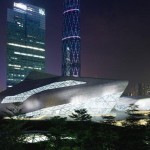
Zaha Hadid’s Guangzhou Opera Center has been praised as the world’s most beautiful performing arts venue with a futuristic ‘twin boulder’ design on the edge of the Pearl River. Sharp angles, geometric patterns and stark white surfaces belie Hadid’s organic inspiration, taken from the geology and topography of the setting. Dotted with starry lighting, the main auditorium has a womb-like feel in gleaming gold. Unfortunately, just a single year after it opened to the public, the building was marred by falling glass and large cracks in the walls and ceilings, leading to serious leaks.

Like many of these ‘failures,’ the problem here isn’t so much Hadid’s design as it is the shoddy materials and construction techniques of the contractors that built it. Many of the 75,000 granite slabs that make up the exterior have begun to fall off, with some blaming poor quality craftsmanship and others blaming Guangzhou’s extraordinarily humid climate. But in China, deadlines to complete even the most complex buildings are often rushed, and a lot of architecture is built with the expectation that it will only stand for about 25 years. The construction group that built the opera center say that it was just extremely difficult to fulfill Hadid’s vision.

Next Page – Click Below to Read More:
Fallen Starchitects 7 Failures Of Famous Architects

Share on Facebook


[ By Steph in Architecture & Offices & Commercial. ]

[ WebUrbanist | Archives | Galleries | Privacy | TOS ]


WebUrbanist

 
Comments Off on Fallen Starchitects: 7 Failures of Famous Architects

Posted in Creativity