Dragonflies and damselflies are fascinating insects which can be particularly photogenic due to their bright colours and striking patterns. As with any type of wildlife, dragonflies can be challenging to photograph because they can scare easily and never seem to keep still. However, it may be easier than you think to get some great shots of these amazing insects. Here are 10 tips to get you started.

1. Choose the right equipment
As they are slightly larger than other insects, dragonflies can be photographed with anything from a point-and-shoot to a DSLR. The accompanying images have been taken with a DSLR. However, many of the principles remain the same whatever equipment you use.
A good zoom lens (100-400mm) can produce decent results, but a dedicated macro lens has the advantage of providing closer focus for high magnification. If you are using a zoom lens, fitting an extension tube to the lens will allow it to focus closer and should produce good results. This is a cheaper option than buying a dedicated macro lens. However, if you plan to photograph insects on a regular basis, a macro lens may be a worthwhile investment as you will be able to take frame-filling shots from a comfortable working distance so as not to scare away the dragonflies. The macro lens used to take the majority of the shots here was the Sigma 150mm f/2.8.
2. Find a good location
During the summer months, dragonflies can be seen anywhere there is water. Certain species may be found in your garden pond, while others could be found near rivers or streams. Damselflies, for instance, are often weaker fliers and tend to stay close to the water surface, whereas dragonflies can be seen flying further away from the water, sometimes perching at eye level.
Taking the time to research your native species of dragonfly, and their preferred habitats, before you go out will make you much more successful in photographing them. Be prepared to get a bit muddy as you may need to get low to the ground near the water’s edge. Wear appropriate clothing and respect the environment that you are working in.
3. Study their behaviour
Once you have spotted a dragonfly, take some time to watch its behaviour. You will quickly learn where it flies and where it likes to perch; some dragonflies prefer the ground, but others prefer to perch on grass or rocks.

Photographing dragonflies in flight can be pretty tricky. So, for starters, I would recommend trying to get some shots of dragonflies at rest. Rather than chasing a dragonfly around with your camera, I have found it better to watch out for a spot where they land, set up the camera nearby, and then wait. If you see a dragonfly perched on a stick approach slowly and carefully and avoid sudden movements. You should be able to get quite close. However, if the dragonfly does fly off, remain still and wait for a few minutes. It may well return to land on the same spot. Patience is key.
If you are lucky enough to find a dragonfly that is eating, you may be able to get closer as they seem to focus more on their meal rather than you.
Something that I have tried with some success is to take your own perch – a stick or reed – and place it near the water, close enough for you to take some shots should the dragonflies decide to land on it. Adding a couple of water drops could encourage them to land.
4. Get up early
Dragonflies are more active during the hottest part of the day as they require the heat from the sun to warm them enough to fly. If possible, I would recommend going out earlier in the morning, when it is slightly cooler and the sunlight is not as harsh as it would be around midday. You may not find as many dragonflies as you would later in the day, but those you do spot will likely stay still for longer, allowing you to get closer. You may even be lucky enough to get a shot of them covered in early morning dew, if you go out first thing.
5. Control the aperture for sharp images
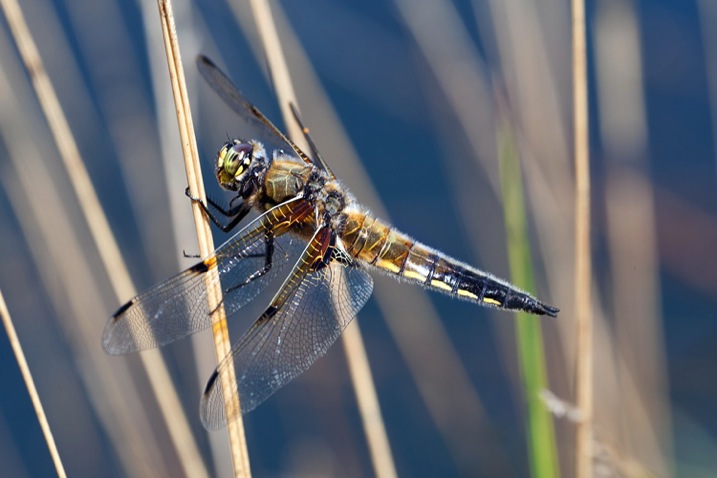
Sharpness is vital in macro photography, and to ensure you get sharp images you will have to use the aperture to control the depth of field. You will need to have as much of the dragonfly in focus as possible and one way that you can maximize this is to photograph the dragonfly sideways on. Making sure that the camera’s sensor is parallel to the body of the dragonfly will enable you to use a wider aperture to blur out any distracting background while keeping the whole of the dragonfly in focus.
Getting such a clear, side-on shot of a dragonfly will not always be possible. In such instances, you can increase the depth of field by reducing the aperture. I have found it useful to start off with an aperture of f/5.6, then take a series of shots working down to around f/11 or smaller, changing the shutter speeds and ISO accordingly. However, always ensure that the eyes are in focus and as sharp as possible. Your images will be poorer without this.
6. Get the correct exposure
Getting the correct exposure can be tricky, particularly if you are shooting in bright sunlight. You will get softer, diffused light by shooting earlier in the day or in slightly cloudier conditions.
Even when perched, dragonflies can make a lot of fast movements such as flicking their wings or twitching their heads. Therefore, you will need to work with relatively fast shutter speeds. I would recommend shooting in bursts of three or four frames, as when you are reviewing your shots, you may find one is particularly sharper than the others. You could increase the ISO setting slightly to allow faster shutter speed and smaller apertures, but probably no more than 400 to maximize the quality of your images. A tripod may come in useful if you do have to use slightly slower shutter speeds, however the locations where dragonflies are found are not always too tripod-friendly. If you decide to shoot while hand-holding the camera, make sure you keep a steady hand, maintain a good footing, and ensure image stabilization is switched on (if available).
7. Switch off autofocus
You will often get sharper shots of dragonflies by switching off the autofocus and focusing manually.
One useful (and inexpensive) piece of kit when shooting down low to the ground, is a right angle viewfinder, which attaches to your camera and allows you to look down into the viewfinder rather than having to lie flat on the ground. You could also try using your camera’s live view and zoom in on the detail to make sure the focus is as accurate as possible.

8. Pay attention to the background
When lining up your shot, pay attention to the background. Ideally, an uncluttered background of a contrasting colour to the dragonfly will produce shots full of impact. However, some damselflies will land in vegetation closer to the water surface making a clean background almost impossible. Larger apertures will help blur out any distracting backgrounds; this works well if you can take them sideway-on, as previously mentioned. A wider aperture will also help to produce bokeh in the background (circles of light from out-of-focus highlights) depending on your personal tastes.
If possible, when selecting a spot to set up, try to place the subject as far away from any potentially distracting vegetation in the background. Moving a perch, or taking your own with you, may help with getting a cleaner background.
9. Think about composition
With such fascinating subjects, you have a range of options when thinking about composition. Try shooting the dragonfly from a range of angles (sometimes this helps to identify the species when you get home). It is not always necessary for the whole dragonfly to be included in the frame. If you can get close enough, you could attempt an extreme close-up on the eyes or part of the wing detail.
Alternatively, you could capture the dragonfly within its surrounding environment. For example, iridescent demoiselles can look great when perched low down on a riverbank. This works particularly well with slightly larger dragonflies, and as the insect does not have to dominate the image, a dedicated macro lens may not be required.

10. Try to capture some behaviour
Dragonflies look great at rest, but if you can, try to capture some of their behaviour for some unique shots. For example, damselflies mating can make shapes that look a bit like a heart (see above under #3), which can make for a pleasing image. Or, if you are up for a challenge, try to shoot a dragonfly in flight. For this, I would recommend using a telephoto lens of 300-400mm with an extension tube. Spend a few minutes watching how the dragonfly moves as they often follow the same path repeatedly. Once you have observed them flying, focus on a spot on their flight path and wait for the dragonfly to enter the frame. There is an element of luck with this type of shot. I have tried on many different occasions and sometimes the dragonfly will vary its flight patterns seemingly at random. Don’t give up though – patience is key with all wildlife photography and just enjoy the process of observing and photographing these amazing insects.

I’ve included several dragonfly shots taken in the UK. Please feel free to add your own as a comment below.
googletag.cmd.push(function() {
tablet_slots.push( googletag.defineSlot( “/1005424/_dPSv4_tab-all-article-bottom_(300×250)”, [300, 250], “pb-ad-78623” ).addService( googletag.pubads() ) ); } );
googletag.cmd.push(function() {
mobile_slots.push( googletag.defineSlot( “/1005424/_dPSv4_mob-all-article-bottom_(300×250)”, [300, 250], “pb-ad-78158” ).addService( googletag.pubads() ) ); } );
The post 10 Tips for Photographing Dragonflies by Richard Beech appeared first on Digital Photography School.


