Tag: California

  • The Old Guard – Bristlecone Pine Forest, California

    The Old Guard  – Bristlecone Pine Forest, California

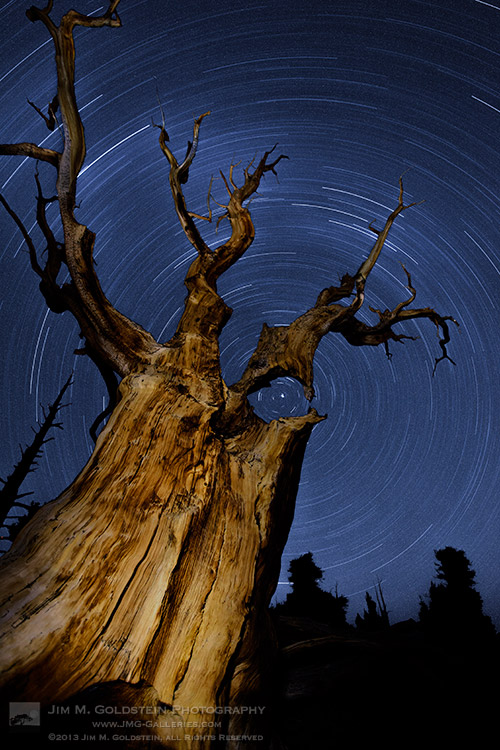
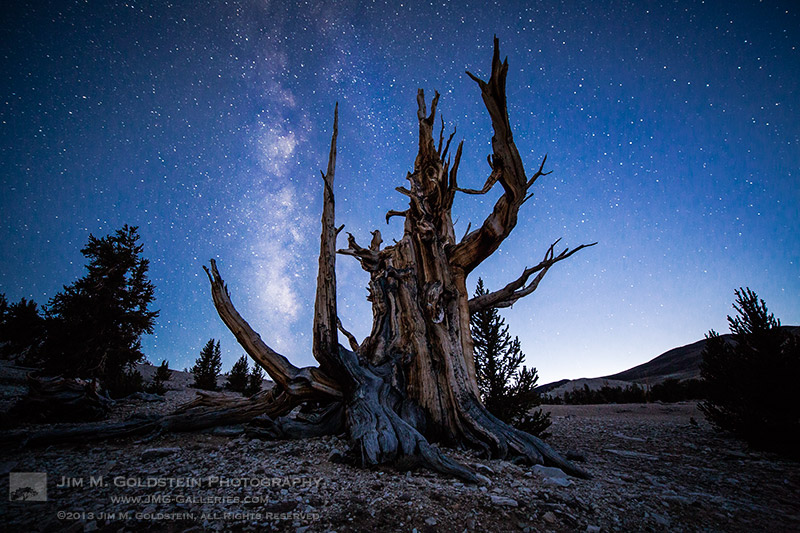
    This is a still from a motion control time-lapse sequence taken during the Fall of this year. While ancient Bristlecone Pine trees are old they look young compared to the stars up above. I was particularly fond of the juxtaposition of the two subjects and I’m eager to see how my lengthy time-lapse sequence comes out.

    If the stars should appear but one night every thousand years how man would marvel and stare.

    – Ralph Waldo Emerson

    Copyright Jim M. Goldstein, All Rights Reserved

    The Old Guard – Bristlecone Pine Forest, California

    The post The Old Guard – Bristlecone Pine Forest, California appeared first on JMG-Galleries – Landscape, Nature & Travel Photography.


    Related Stories

    • The Old Guard – Bristlecone Pine Forest, California – Enclosure
    • The Ancients – Bristlecone Pine Forest, California
    • Sky Rock Under the Stars
    Feed Ads by FeedBlitz
    powered by ad choices


    JMG-Galleries

  • The Ancients – Bristlecone Pine Forest, California

    Atop the White Mountains, along the eastern border of California, lies the Ancient Bristlecone Pine Forest. This area is known as the home of the worlds oldest trees including the oldest tree, Methuselah, whose age is 4,750 years.  The last time I took the time to visit this remote area I was a dedicated film shooter. On a recent visit I took advantage of the latest DSLR technology to photograph astro-landscapes while still using old film techniques, namely conducting single long exposures (not multiple image stacking). Cold weather on the order of 10-20 degrees Fahrenheit aided in keeping my camera sensor cold enough to avoid any amplifier glow or amp glow, noise caused by the circuitry heating up under extended exposures). Interestingly I found out that for similar long exposures the Canon 5D Mark II did better than the Canon 5D Mark III. The Canon 5D Mark III suffered notable amp glow while the 5D Mark II had none. Results I found quite surprising.

    Photo Details

    Canon 5D Mark II, Canon 16-35mm f/2.8 at 16mm, f/22, ISO 800, 91 minutes

    Foreground painted with my headlamp

    Copyright Jim M. Goldstein, All Rights Reserved

    The Ancients – Bristlecone Pine Forest, California

    The post The Ancients – Bristlecone Pine Forest, California appeared first on JMG-Galleries – Landscape, Nature & Travel Photography.


    Related Stories

    • The Ancients – Bristlecone Pine Forest, California – Enclosure
    • Sky Rock Under the Stars
    • Sky Rock Under the Stars – Enclosure
    Feed Ads by FeedBlitz
    powered by ad choices


    JMG-Galleries

  • Rolling Hills Near Morro Bay, California

    Rolling Hills Near Morro Bay, California

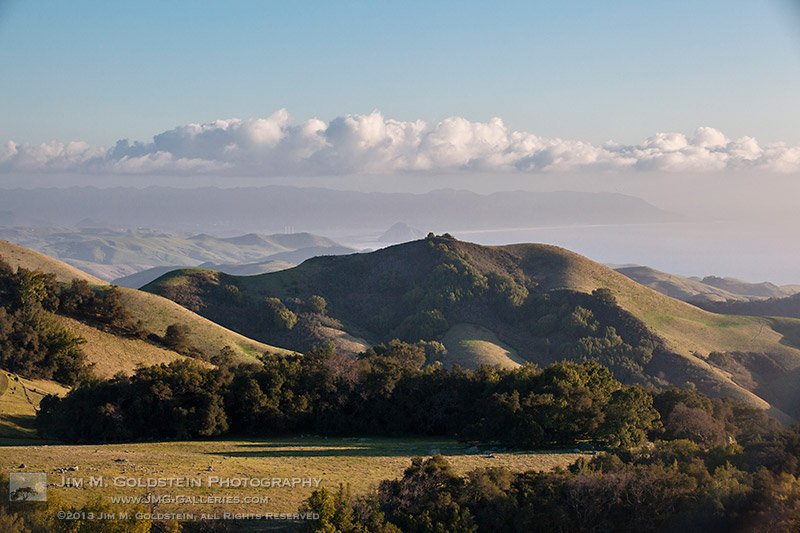
    Golden light falls on rolling hills near Morro Bay, California

    Having just returned from central California where the grass has turned golden brown, I thought it might be nice to take a moment to go back in time a few months and revisit the views while it was green. Pictured in late afternoon light are the rolling hills near Morro Bay, California.   If you look carefully you can make out the view of the monstrous Morrow Rock, a 581-foot volcanic plug, in the distance. As always I’m awed and inspired by California’s diverse geology.

    Copyright Jim M. Goldstein, All Rights Reserved

    Rolling Hills Near Morro Bay, California

    The post Rolling Hills Near Morro Bay, California appeared first on JMG-Galleries – Landscape, Nature & Travel Photography.


    Related Stories

    • Rolling Hills Near Morro Bay, California – Enclosure
    • Primitive Coast IV
    • Primitive Coast IV – Enclosure


    JMG-Galleries

  • Rolling Hills Near Morro Bay, California

    Rolling Hills Near Morro Bay, California

    Golden light falls on rolling hills near Morro Bay, California

    Having just returned from central California where the grass has turned golden brown, I thought it might be nice to take a moment to go back in time a few months and revisit the views while it was green. Pictured in late afternoon light are the rolling hills near Morro Bay, California.   If you look carefully you can make out the view of the monstrous Morrow Rock, a 581-foot volcanic plug, in the distance. As always I’m awed and inspired by California’s diverse geology.

    Copyright Jim M. Goldstein, All Rights Reserved

    Rolling Hills Near Morro Bay, California

    The post Rolling Hills Near Morro Bay, California appeared first on JMG-Galleries – Landscape, Nature & Travel Photography.


    JMG-Galleries – Landscape, Nature & Travel Photography

  • Jerez Video Blog for California Superbike School

    I quick video blog from an event we covered at Jerez. It shows some of the pictures that we take, as well as the context in which they were taken, and shows the access that we have for photographic training.
    Video Rating: 0 / 5

    Like/Fav this –Visit studio35photo.ca for more info. The Avenue Magazine Photoshoot Blooper (Gag) Reel. Adam Kuzik is Hilarious during our shoot with International Models Thanks For Watching!
    Video Rating: 5 / 5

  • Exploring the beauty of San Pedro, California 2011

    Nikon COOLPIX S9100 12.1 MP CMOS Digital Camera with 18x NIKKOR ED Wide-Angle Optical Zoom Lens and Full HD 1080p Video Korean Bell of Friendship and Bell Pavilion This massive and intricately-decorated bell and pavilion was donated in 1976 to the people of Los Angeles by the people of the Republic of Korea to celebrate the bicentennial of the US independence, honor veterans of the Korean War, and to consolidate traditional friendship between the two countries. The bell is patterned after the Bronze Bell of King Songdok, which was cast in 771 AD and is still on view in South Korea today. The bell was cast in Korea and shipped to the United States. Weighing 17 tons, with a height of twelve feet and a diameter of 7-1/2 feet, the bell is made of copper and tin, with gold, nickel, lead and phosphorous added for tone quality. When it was built, it cost the Korean people 0000. Four pairs of figures, each pair consisting of the Goddess of Liberty holding a torch, and a Korean spirit , are engraved in relief on the body of the bell. Each of the Korean spirits holds up a different symbol: a symbolic design of the Korean flag; a branch of the rose of Sharon, Korea’s national flower; a branch of laurel, symbol of victory; and a dove of peace. The bell has no clapper but is struck from the outside with a wooden log. The bell is set in a pagoda-like stone structure which was constructed on the site by thirty craftsmen flown in from Korea. It took them ten months and costs 9680

  • Cloud City – San Francisco, California

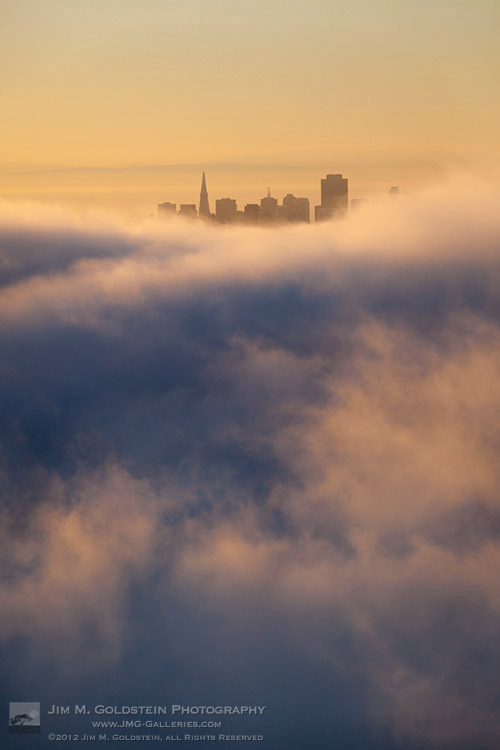
    One aspect of San Francisco that has forever fascinated and inspired me is the fog. I suppose having lived most of my life in areas that lacked such dense fog adds to my appreciation of it. While many associate rain as being a cleansing phenomenon, I can’t help but think of fog in the same way. It shrouds what many may consider commonplace views and magically re-reveals them in dramatic fashion. If you’re lucky enough to be in the right place at the right time you can see the fog wash over some of San Francisco’s most impressive and well engineered structures making them look like toys. Fog illuminated by magic hour light at sunrise or sunset is an easy sight to have engrained in ones mind via an iconic photo, but for me the one aspect of the fog locked into my memory that can never be shared in a photo is its smell. The clean marine smell that comes with it is rejuvenating tactilely and visually. When I return home to the coast from the mountains and desert it is the fog that greets me stimulating every sense and lets me know I am home.

    Cloud City – San Francisco, California

    Photo Details:
    Canon 5D Mark II, Canon 70-200mm f/2.8 II, ISO 400, 1/1250 sec, f/7.1

    Copyright Jim M. Goldstein, All Rights Reserved

    Cloud City – San Francisco, California

    flattr this!


    JMG-Galleries – Jim M. Goldstein Photography

  • TRON Legacy elecTRONica Dancer in 3D at Disney California Adventure -yt3d Fuji W3

    Same elecTRONica dancer at California Adventure, different platform, different night. This was shot with my Fuji W3 and edited in Sony Vegas Pro 10. The new version of Sony Vegas has native support of 3D videos. I no longer have to split the 3D-AVI file before opening the 3D video in Vegas. Auto correct is awesome! No more masking alignment corrections. Video is cropped to full frame. Workflow is streamlined. I will upgrade to the new version before my 30 day trial expires.
    Video Rating: 5 / 5

  • Dusky Fog – San Francisco, California

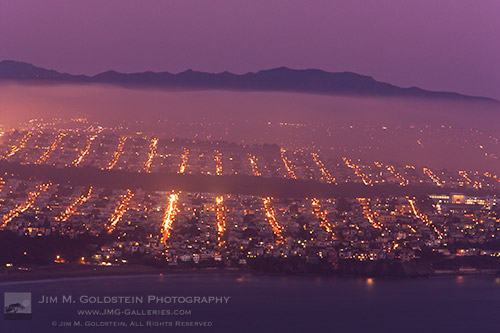
    Seeing that we’re about to end another week I thought a sunset / dusk photo might be in order. Pictured below is the north western section of San Francisco (Sea Cliff, Outer Richmond, the Golden Gate Park and Outer Sunset) as seen from the Marin Headlands on a mildly foggy evening at dusk. Note the solid horizontal band dividing the city lights is Golden Gate Park.

    I should also note as we transition into the weekend that if you’re looking for some interesting reading or listening I was recently interviewed on the B&H Insights blog and on the Nik Radio podcast (click the 2/2/12 episode) [UPDATE: Info & Audio Link]. Speaking of Nik coincidently the image below was fine tuned with Nik’s Vivezia software.

    Dusky Fog - San Francisco, California

    Dusky Fog – San Francisco, California

    Copyright Jim M. Goldstein, All Rights Reserved

    Dusky Fog – San Francisco, California

    flattr this!


    JMG-Galleries – Jim M. Goldstein Photography

  • California: Stanford University – Iris & B. Gerald Cantor Center for Visual Arts at Stanford University – Burghers of Calais
    Check out these visual art images:

    California: Stanford University – Iris & B. Gerald Cantor Center for Visual Arts at Stanford University – Burghers of Calais
    visual art
    Image by wallyg
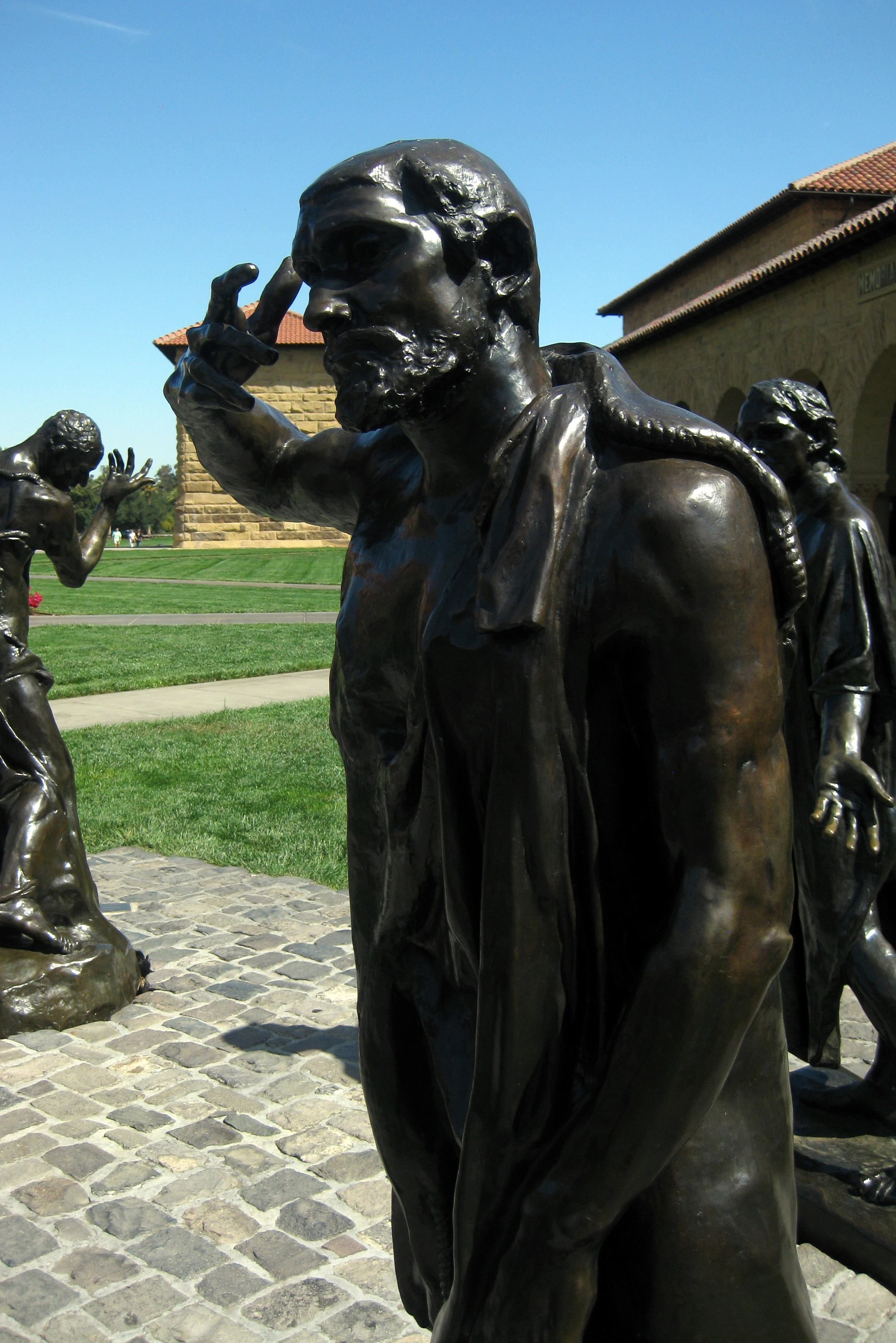
    Les Bourgeois de Calais (The Burghers of Calais) is one of the most famous sculptures by Auguste Rodin. It serves as a monument to the heroism of six burghers in Calais during a siege by the England in the Hundred Years’ War in 1347.

    After a victory in the Battle of Crécy, England’s King Edward III besieged Calais, an important French port on the English channel, and Philip VI of France ordered the city to hold out at all costs. Which it did for a over a year. Philip failed to lift the siege and starvation eventually forced the city to parlay for surrender. Edward offered to spare the people of the Calais if any six of its top leaders would surrender themselves. Edward demanded that they walk out almost naked, wearing nooses around their necks and carrying the keys to the city and castle. One of the wealthiest of the town leaders, Eustache de Saint Pierre, volunteered first and five other burghers–Jean d’Aire, Jacques and Pierre de Wissant, Jean de Fiennes, Andrieu d’Andres–soon followed suit. Though the burghers expected to be executed, their lives were spared by the intervention of England’s Queen, Philippa of Hainault, who persuaded her husband by saying it would be a bad omen for her unborn child. Rodin depicts a larger than life Saint Pierre leading the envoy of emaciated volunteers to the city gates, prepared to meet their imminent mortality.

    The monument was initially proposed by Omer Dewavrin, mayor of Calais, for the town’s square in 1884. Unusual in that monuments were usually reserved for victories, the town of Calais had long desired to recognize the sacrifices made by these altruistic men. Rodin’s controversial design echoed this intent–the burghers are not presented in a heroic manner, but sullen and worn. His innovative design initially presented the burghers at the same level as the viewers, rather than on a traditional pedestal, although until 1924 the city, against Rodin’s wishes, displayed it on an elevated base.

    The original statue still stands in Calais. Other casts stand around the world–the Victoria Tower Gardens, in the shadow of the Houses of Parliament in London; the Israel Museum in Jerusalem, the Rodin Museum in Philadelphia, the Metropolitan Museum of Art in New York City, the Brooklyn Museum in New York City, Musée Rodin in Paris, the National Museum of Western Art in Tokyo, the Rodin Gallery in Seoul, and Glyptoteket in Copenhagen, to name a few. Some installations have the figures tightly grouped with contiguous bases, while others have the figures separated. Some installations are elevated on pedestals, others are placed at ground level. This bronze cast, at Stanford University’s Iris & B. Gerald Cantor Center for Visual Arts, consists of six separate pieces which are slightly sunken, concealing the bottom few inches of the bases, and spaced such that viewers can walk between the figures. The museum claims this is how Rodin wished them to be displayed.
    California: Stanford University – Iris & B. Gerald Cantor Center for Visual Arts at Stanford University – Burghers of Calais
    visual art
    Image by wallyg
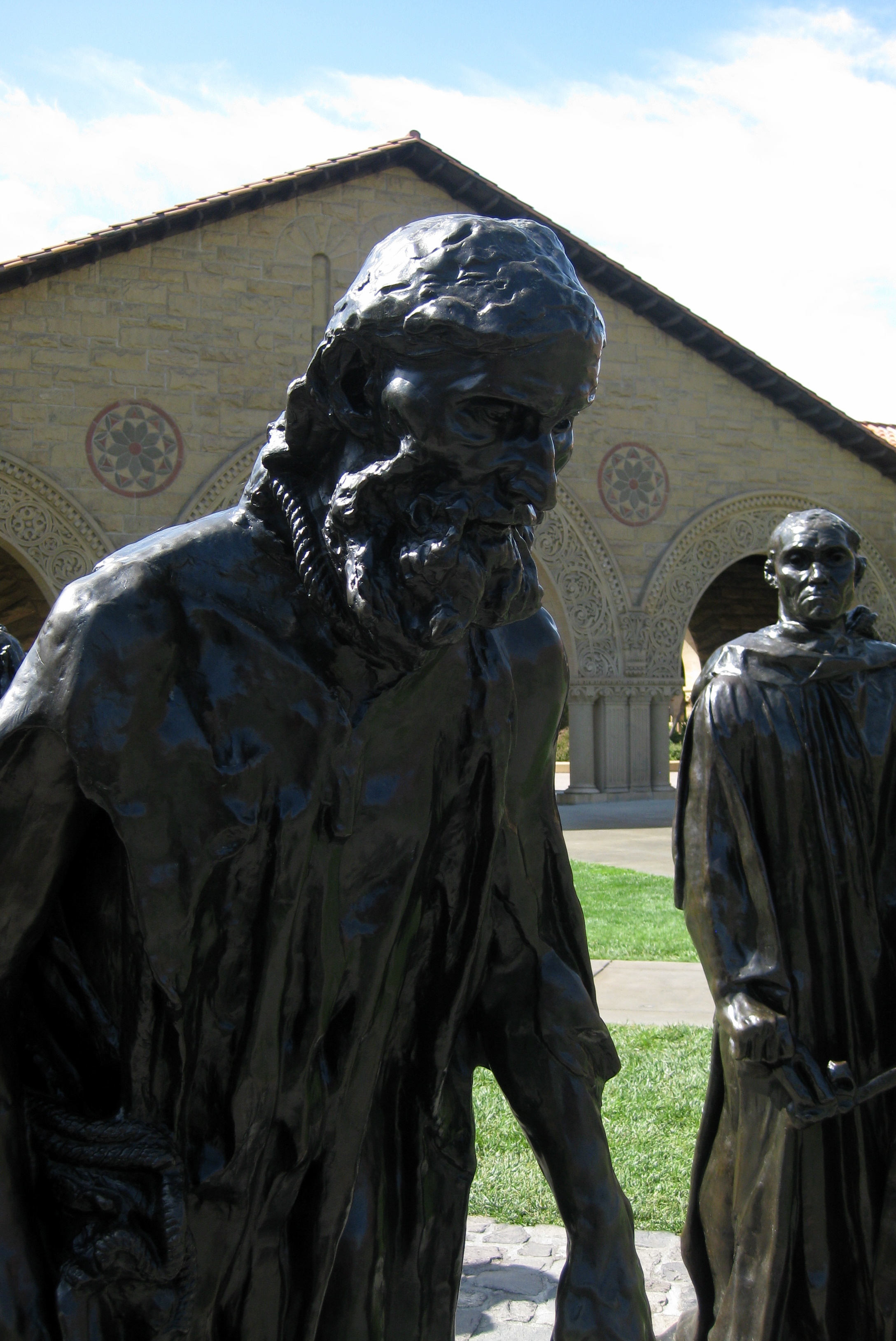
    Les Bourgeois de Calais (The Burghers of Calais) is one of the most famous sculptures by Auguste Rodin. It serves as a monument to the heroism of six burghers in Calais during a siege by the England in the Hundred Years’ War in 1347.

    After a victory in the Battle of Crécy, England’s King Edward III besieged Calais, an important French port on the English channel, and Philip VI of France ordered the city to hold out at all costs. Which it did for a over a year. Philip failed to lift the siege and starvation eventually forced the city to parlay for surrender. Edward offered to spare the people of the Calais if any six of its top leaders would surrender themselves. Edward demanded that they walk out almost naked, wearing nooses around their necks and carrying the keys to the city and castle. One of the wealthiest of the town leaders, Eustache de Saint Pierre, volunteered first and five other burghers–Jean d’Aire, Jacques and Pierre de Wissant, Jean de Fiennes, Andrieu d’Andres–soon followed suit. Though the burghers expected to be executed, their lives were spared by the intervention of England’s Queen, Philippa of Hainault, who persuaded her husband by saying it would be a bad omen for her unborn child. Rodin depicts a larger than life Saint Pierre leading the envoy of emaciated volunteers to the city gates, prepared to meet their imminent mortality.

    The monument was initially proposed by Omer Dewavrin, mayor of Calais, for the town’s square in 1884. Unusual in that monuments were usually reserved for victories, the town of Calais had long desired to recognize the sacrifices made by these altruistic men. Rodin’s controversial design echoed this intent–the burghers are not presented in a heroic manner, but sullen and worn. His innovative design initially presented the burghers at the same level as the viewers, rather than on a traditional pedestal, although until 1924 the city, against Rodin’s wishes, displayed it on an elevated base.

    The original statue still stands in Calais. Other casts stand around the world–the Victoria Tower Gardens, in the shadow of the Houses of Parliament in London; the Israel Museum in Jerusalem, the Rodin Museum in Philadelphia, the Metropolitan Museum of Art in New York City, the Brooklyn Museum in New York City, Musée Rodin in Paris, the National Museum of Western Art in Tokyo, the Rodin Gallery in Seoul, and Glyptoteket in Copenhagen, to name a few. Some installations have the figures tightly grouped with contiguous bases, while others have the figures separated. Some installations are elevated on pedestals, others are placed at ground level. This bronze cast, at Stanford University’s Iris & B. Gerald Cantor Center for Visual Arts, consists of six separate pieces which are slightly sunken, concealing the bottom few inches of the bases, and spaced such that viewers can walk between the figures. The museum claims this is how Rodin wished them to be displayed.