Month: November 2012

  • my digital camera bag

    here comes a look on my digital camera gear setup. This video does also gives you a look on my latest buy – the tripod. Please forgive my little mistakes 🙂 . The correct designation for the tripod would be: Bilora Perfect Pro A324 and my prime is a 35mm lens… not a 50mm (ok, it is if you multiply it with the crop factor of 1.5 … ) xD If you would like to have additional info – please feel free to ask me for that!!
    Video Rating: 5 / 5

  • The Night Sky In Landscape Photography

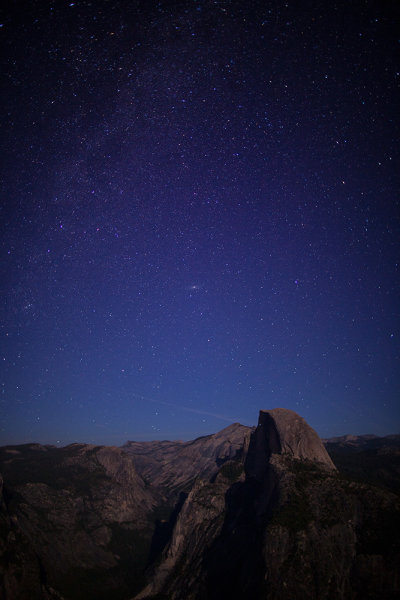
    This shot was taken with an EOS 5D Mark II and EF 24mm f/1.4L II lens. Exposure was 15 seconds, ISO 800, at f/1.4. The exposure for star fields should not be much longer than 15 seconds. Beyond 15 seconds, movement begins to creep in and slight star trails get recorded. In order to get the star fields to be as prominent as they are, I had to wait until the moon set behind me. Light pollution of any kind, be it the moon, street lights, or buildings, will diminish the intensity of the light of the stars. Moonless nights are best for photographing the night sky.

    As a landscape photographer, I typically liked to work at sunrise and sunset.  But the night sky holds its own magic, with countless stars, the moon, and the Milky Way all out there waiting to be photographed.

    Obviously, all night landscape photography happens on a tripod.  What type of shots you go for will depend greatly on your patience.  Night sky exposures can range from 15 seconds to several hours, depending on your goals.  Star fields can be captured with exposures of about 15 seconds, with aperture and ISO varying depending on the lens in use.

    One important thing to be aware of is the available light around you. Any ambient light will diminish the intensity of the stars.  This includes the moon, streetlights, a town or city with buildings that have outside lights on, or even just car lights.  All of these will have negative effects on the exposure of the night sky.  The best thing to do is to find a rural area where there aren’t any street lights, traffic, buildings etc.  The stars will be most intense and easily photographed.

    Because the night sky is best photographed, well, at night, it will be important to have a flashlight or other illumination to light the way while you hike to your location or assemble your gear.  Headlamps work exceptionally well for this.  These lights also come in handy for “painting” the foreground with light, to add some extra depth to your images.

    In addition to the camera and lens, a remote release, or even better, a time controller is a necessity.  The remote release will allow you to trigger your camera without touching it. A timer remote control (such as the Canon TC-80N3) does that and more.  When shooting star trails, the timer can be programmed to take as long an exposure as needed. It can also be programmed to take several exposures in sequence if needed. This is helpful for stacking images, a common technique when shooting star trails.

    I previously mentioned having a flashlight handy for painting the foreground.  Depending on the type of flashlight used, color correction gels can be useful as well.  Newer, LED flashlights have a much cooler light source than traditional flashlights, so a warming gel will help make it more natural looking. For lights using traditional bulbs, a cooling gel may be desired. Experimentation is essential here.  Too much light will ruin the exposure, too little won’t help the foreground the way that was intended. Generally, a quick kiss of light is all that may be needed.  A neutral density gel over the flashlight will help regulate it so just the right amount of light is applied.
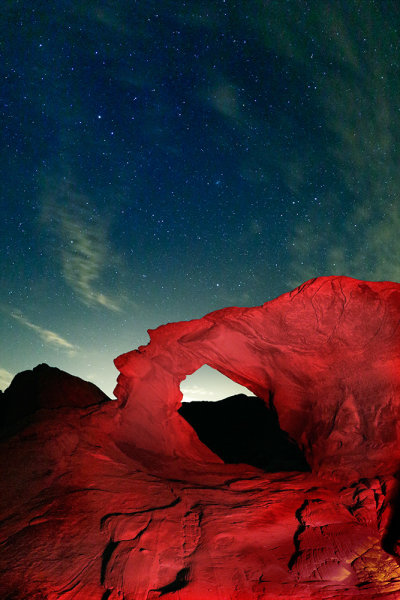
    For this image at Valley of Fire in Nevada, the arch made for the perfect foreground. But it was silhouetted against the night sky. Using an LED headlamp and a warming filter, I was able to illuminate the red rocks and balance that illumination with the ambient exposure for the night sky. This image was taken with the EOS 5D Mark III with EF 8-15mm Fisheye Zoom. Exposure was 15 seconds, ISO 6400 at f/4.

    One problem with night time photography is the long exposures.  Digital imaging sensors generate heat when they capture an image, and that heat manifests itself as noise in a long exposure.   Today’s digital SLRs all have settings for long exposure noise reduction.  This is generally done through a method known as “Dark Frame Subtraction”.  First, the camera takes the image at the intended exposure.  For this case, let’s say it’s a 30 second exposure.  When long exposure noise reduction is enabled, the camera then takes a second exposure, this one with the shutter closed. The imaging sensor is charged, for the same amount of time as the original exposure. This second, dark frame, is then compared to the first frame taken.  Since both frames were “exposed” for the same length of time, the heat generated on the sensor should be the same, and thus the noise generated should be the same. The camera then compares the two frames, and removes the noise that is consistent in both frames. While the camera does this, it is not possible to take another exposure, so this can become a very long process for star trail images that could be as long as an hour or more. Batteries are of paramount importance for this procedure, as the image won’t be recorded if the battery dies before long exposure noise reduction is complete.  If your camera has an AC adapter, and a generator or other power source is available, it will make the stress of wondering if the camera has enough battery power go away.  If you plan on stacking multiple images for star trails, this feature should be turned off, since continuous images are needed to keep the star trails continuous.
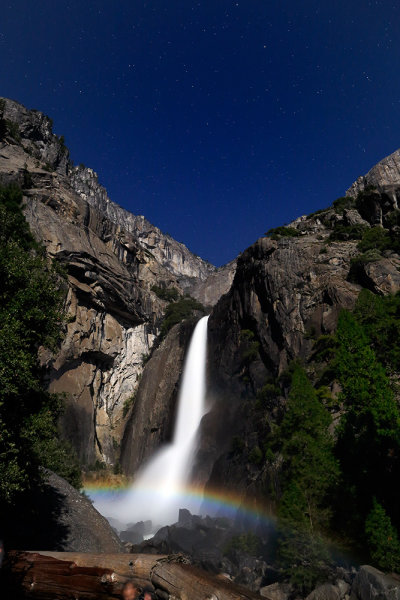
    Every year in the spring, during the full moon, a moonbow is created by the mist at Yosemite Falls. Taken with an EOS 5D Mark III, EF24mm f/1.4L II lens. Exposure was 10 seconds, ISO 1250, at f/4. It is readily apparent that the presence of the moon in the sky reduces the intensity of the stars, as compared to the shot of Half Dome above.
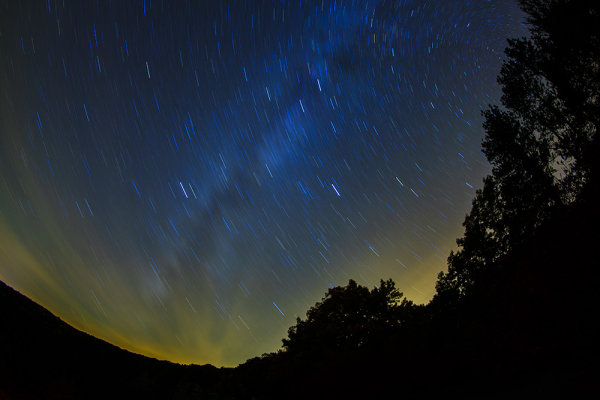


    This image of the skies over upstate New York was made with the EOS-1D X with EF 8-15mm f/4L Fisheye Zoom. Exposure was 15 minutes, ISO 400 at f/4. One 15 minute exposure took 30 minutes due to the long exposure noise reduction setting. If longer star trails are desired, you can use a longer exposure and keep the long exposure noise reduction on, or you can take shorter exposures of about 5 minutes, in succession. Turn off long exposure noise reduction, and combine the images later on in Photoshop or other image editing software.

    Post originally from: Digital Photography Tips.

    Check out our more Photography Tips at Photography Tips for Beginners, Portrait Photography Tips and Wedding Photography Tips.

    The Night Sky In Landscape Photography


    Digital Photography School

  • Cyber Monday: Strobist DVD sets on Sale for $49.99 each

    You snooze, you lose: All Strobist DVDs are on sale today for $ 49.99. (Depending on the version you choose, that's from 50% to 68% off!)

    Deets inside. Read more »


    Strobist

  • Why is This Pepper Smoking?

    Because it's about to blow up.

    Today, a glance into the explosive still life photography of Adam Voorhes. Read more »


    Strobist

  • Nikkor 17-55mm f/2.8 DX Hands-on Review

    In this video we take a look at Nikon’s crop sensor (DX) zoom lens – the 17-55mm f/2.8 – for a spin by going to an old slaughterhouse that has been converted to an art village. Price Reference: www.digitalrev.com

    Four VERY BRIGHT WiseLED flashlights, a Nikon D5000 on a tripod, a dark basement and… VOILÀ! Light Painting!

  • Fleadh Cavan 2011 Dancing girl with broom (now in 3D also)

    to view in 3D click on 3D and then red/cyan if thats the 3D glasses that you have. Rhen Switch and optimized for the best effect, I think.

  • A Fresh Change On The JMG-Galleries.com Blog

    Yosemite Sunbeams, Yosemite National Park

    Yosemite Sunbeams, Yosemite National Park

    Today the JMG-Galleries.com Blog jumps into its 3rd major incarnation with a new design. Over the past 18 months my old blog has become increasingly difficult to work with for a variety of reasons and it’s been a driving factor in my blogging less and less as of late. It’s tough to stay in a groove when you’re constantly fighting technical gremlins.

    While I consider myself a perfectionist, I can say with certainty that what you see today is not the final design change. I have a lot of fine tuning to do, but in the meantime you should at least see some of the following benefits:

    • Larger images moving forward
    • Scaleable design layout no matter the device you’re viewing my blog
    • Faster load time

    If you notice some bugs don’t be shy in letting me know. I want everyone’s experience with my blog to be a good one so bug fixing will be a top priority this week. Thanks for reading, subscribing and taking an interest in my work.

    Copyright Jim M. Goldstein, All Rights Reserved

    A Fresh Change On The JMG-Galleries.com Blog

    The post A Fresh Change On The JMG-Galleries.com Blog appeared first on JMG-Galleries – Jim M. Goldstein Photography.


    JMG-Galleries – Jim M. Goldstein Photography

  • SchoolBoy Q feat. AB-Soul – Druggys Wit Hoes

    Director: Ramses Perryman Director of Photography: Jon Williams RPerrymanfilms@Gmail.com
    Video Rating: 4 / 5

  • Gary Clark Jr. – “Third Stone From The Sun / If You Love Me Like You Say” captured in The Live Room

    Gary Clark Jr. performs a cover of “Third Stone From The Sun” by Jimi Hendrix and “If You Love Me Like You Say” by Little Johnny Taylor in an exclusive recording session live at Pedernales Recording Studio in Austin, TX for The Live Room on The Warner Sound. Watch more of Gary Clark Jr. in The Live Room: goo.gl Download Gary’s new album, Blak and Blu: On iTunes: goo.gl Or on: GaryClarkJr.com Executive Producer Phil Botti Director Michael Thelin Director of Photography Mikko Timonen Mixed by Brett Eliason Editor Steven Pierce Recording Engineer Jacob Sciba Tracking Engineer Bharath Ramanath Captured live at Pedernales Recording Studio Austin, TX The Live Room with Gary Clark Jr. was captured exclusively with Nikon D4 HD-SLRs camera and NIKKOR lenses. The Live Room is an exclusive Warner Sound original series that captures today’s most innovative artists performing live recording sessions in the most iconic recording studios across America. Subscribe to The Warner Sound goo.gl The Warner Sound on the Web: youtube.com thewarnersound.com http twitter.com

    Questions? Go here: www.youtube.com Hands-on review on Nikon 50mm ƒ/1.2 AIS. Manual focus only on all cameras.
    Video Rating: 0 / 5

  • The Great WebShop BrainSwap, Part 2

    We’ve been asking our favorite shops on the web to let us know what they fancy most in our shop.

    These folks know just what make the very best gifts. So, we picked their brains and are happy to present: what the crews from Modcloth and Polyvore like most.

    Psssst… If it’s 11/26 it’s Cyber Monday! Some very friendly, very cute robots have hidden special deals all over the Photojojo Shop. Make your giftlist, then run on over to our shop and grab those dealz.


    Ashley McGregor Dey, Modcloth

    Meet ModCloth’s Social Media Specialist and Present Picker Extraordinaire:

    Ashley McGregor Dey

    Fun facts about Ashley – She has a Batman tattoo and a pretty intense My Little Pony collection.


    A keychain tripod! What’s not to love about it?
    Tiltpod Mobile
    $ 15 at the Photojojo Store

    Helps get that perfect outfit photo!
    iPhone Shutter Remote
    $ 40 at the Photojojo Store

    Cameras and Cookies. Two of my favorite things.
    The Camera Cookie Cutter Set
    $ 18 at the Photojojo Store

    Adorable accessories!
    Lens Bracelets
    $ 15-25 at the Photojojo Store

    Always need some extra juice.
    Bamboo Solar Charger
    $ 35 at the Photojojo Store

    About ModCloth

    ModCloth.com is an e-retailer that sells retro, indie, and vintage clothing styles. We’ve attracted a large, devoted following through our unique selection of indie clothing and engaging promotions and content on the ModCloth Blog and social networks.

    www.modcloth.com


    Emily Craig, Polyvore

    Meet Polyvore’s Graphic Designer and Arbiter of Good Taste:

    Emily Craig

    Fun facts about Emily – Emily was born and raised in San Francisco’s Mission District. She has all of her fingers and toes.


    I just love how this can be used as a stand/tripod AND charges your phone. It’s the perfect conversational gadget piece that’ll have people asking, “what is that?”
    Une Bobine
    $ 30 at the Photojojo Store

    As a kid, I played with Sunprints and still find myself making them as an adult (I even have a few of my faves up at my desk). I love this kit because it makes photography accessible to all ages and levels of experience!
    DIY Pinhole Camera and Sunprint Kit
    $ 25 at the Photojojo Store

    I was first introduced to Souldier through their hand-made guitar straps and have become a huge fan of their recycled camera straps. They come in a range of delicious vintage colors and have a real sturdy feel (they are recycled from seat belts, after all).
    Seat Belt Camera Straps
    $ 20 at the Photojojo Store

    Cameras! Letterpress! Oh my! I just adore this super-sweet vintage camera print from Sycamore Street Press. It’s a simple black and silver print that just tickles the design-nerd camera-lover in me.
    Click Click Camera Print
    $ 35 at the Photojojo Store

    You’ve got photos of your friends but who doesn’t enjoy adding a little silliness to the situation… or everyday objects.
    Disguise Magnet Set
    $ 12 at the Photojojo Store

    About Polyvore

    Polyvore is a shoppable magazine where millions of members shop, create fashion collages and then share them with the world.

    www.polyvore.com

    No related posts.


    © laurel for Photojojo, 2012. |
    Permalink |
    No comment |
    Add to
    del.icio.us

    Post tags:


    Photojojo